



Ohio Notary Acknowledgment Overview
These Ohio paper-certificate examples use the wording permitted by R.C. 147.542(C)(3), together with the venue, act date, signature, printed name, seal and commission information required by division (F). They describe an individual or representative acknowledgment, or a jurat, and do not reproduce the separate statutory short forms in R.C. 147.55. Choose the certificate for the act actually performed.
Use the actual date and location of the notarial act. The notary completes and signs the certificate during the act. Whether a deed, power of attorney, trust or other instrument also needs witnesses or additional formalities depends on its governing law.
$5*
Ordinary notarial act
5 years*
Commission term
Authorized
Remote acts with conditions
Online acts
Journal required
*See the requirements and fees below for exceptions and applicable categories.
Ohio Acknowledgment and Jurat Wording
Ohio Revised Code 147.011, 147.04 and 147.542 — official source governs these paper-certificate examples under R.C. 147.542(C)(3) and (F). They do not reproduce R.C. 147.55. Electronic and remote acts require additional wording and procedures.
Individual Acknowledgment
State of Ohio
County of ____________________
This record was acknowledged before me on ____________________ [date] by ____________________ [name(s) of individual(s)].
Signature of notarial officer: ____________________
Printed name: ____________________
Notary Public
Commission expires: ____________________
For a qualifying attorney commission, state that it has no stated expiration under R.C. 147.03.
[Official Ohio notarial seal]
Representative Acknowledgment
State of Ohio
County of ____________________
This record was acknowledged before me on ____________________ [date] by ____________________ [name(s) of individual(s)] as ____________________ [type of authority] of ____________________ [party represented].
Signature of notarial officer: ____________________
Printed name: ____________________
Notary Public
Commission expires: ____________________
For a qualifying attorney commission, state that it has no stated expiration under R.C. 147.03.
[Official Ohio notarial seal]
Attorney-in-Fact Acknowledgment
State of Ohio
County of ____________________
This record was acknowledged before me on ____________________ [date] by ____________________ [attorney-in-fact] as attorney-in-fact of ____________________ [principal].
Signature of notarial officer: ____________________
Printed name: ____________________
Notary Public
Commission expires: ____________________
For a qualifying attorney commission, state that it has no stated expiration under R.C. 147.03.
[Official Ohio notarial seal]
Verification on Oath or Affirmation (Jurat)
State of Ohio
County of ____________________
Sworn to (or affirmed) and subscribed before me on ____________________ [date] by ____________________ [name(s) of individual(s) making statement].
Signature of notarial officer: ____________________
Printed name: ____________________
Notary Public
Commission expires: ____________________
For a qualifying attorney commission, state that it has no stated expiration under R.C. 147.03.
[Official Ohio notarial seal]
Identify each person who actually appears. A jurat requires signing and an oath or affirmation; an acknowledgment serves a different purpose. Confirm the required act with the document recipient or a legal adviser.
Ohio Notary Requirements
Commission: Under R.C. 147.03, an ordinary non-attorney commission lasts five years unless revoked. A qualifying Ohio attorney holds the commission while the statutory Ohio residence or practice conditions, good standing and unrevoked status continue; that commission has no stated expiration date. Online-notary authorization has a separate expiration, including a five-year maximum for an attorney under R.C. 147.63. The notary must be physically in Ohio when acting.
Education: Ordinary non-attorney applicants complete a three-hour approved course and pass the test under R.C. 147.01, 147.021 and O.A.C. 111:6-1-03. Attorney applicants after September 20, 2019 take the course without the test; previously commissioned attorneys have the statutory exception. A criminal-records report from the preceding six months is generally required, with the attorney and peace-officer exceptions in R.C. 147.01. Non-attorney renewal requires one hour of education. Online authorization requires an additional two-hour course and examination, with one hour of continuing education for renewal.
Bond: Chapter 147 does not impose a surety-bond requirement for an ordinary Ohio notary commission. Complete the oath required by R.C. 147.01(G) before acting. O.A.C. 111:6-1-03 sets separate education and application fees: ordinarily $130 for new non-attorney education/testing and $15 to the state, $75 for attorney education and $15 to the state, or $45 for non-attorney renewal education and $15 to the state. Background-check costs are separate.
Journal: The Secretary of State recommends a journal for traditional acts, but Ohio does not generally require one for those acts. R.C. 147.65 requires a secure, tamper-evident electronic journal for every online notarization, with the principal’s electronic signature, identifying and location details, act, record, fee, system and identity evidence. Do not record a Social Security number. Keep secure backups of the journal and required audiovisual recording. Retain records during the online authorization; on its expiration, transmit the journal to the Secretary or an approved repository for ten-year retention and start a new journal for a renewed authorization. Follow R.C. 147.65–147.66 for termination, access and custody rather than deleting records automatically after ten years from the act.
R.C. 147.04 requires an Ohio notarial seal, either inked or embossed, containing the prescribed state coat of arms and wording. The certificate must show the actual state and county, act and date, the notary’s commissioned signature, printed name below the signature or inked stamp, seal and commission expiration. For a qualifying attorney commission, indicate its non-expiring status under R.C. 147.03. A notary may explain acknowledgment and jurat but, unless an attorney, may not advise which act is best for the signer.
Remote Notarization in Ohio
An Ohio resident notary must obtain written online authorization before remote acts. R.C. 147.63 and O.A.C. 111:6-1-03 govern additional training, examination, application and renewal; the initial course/test fee is $250 and the state authorization fee is $20. A regular commission alone is insufficient. Keep the online authorization current, remain physically in Ohio, and check the United States connection and foreign-law conditions for a signer abroad. Online depositions are prohibited by R.C. 147.64.
Use a system that meets O.A.C. 111:6-1-05. Identity may be established by personal knowledge, the rule’s credible-witness procedure, or an unexpired government credential with both photograph and signature plus credential analysis and identity proofing. The ordinary rule permitting recently expired ID does not replace the remote requirements. Restart identity verification and unfinished acts if the connection or workflow is interrupted or compromised.
Use the electronic signature and seal, keep the required journal and audiovisual recording with secure backups, and include the correct certificate statement for an electronic act in physical presence or a remote act using audio-video communication under R.C. 147.542(F)(7) and O.A.C. 111:6-1-04. Choose the remote electronic option in the builder for an online acknowledgment or jurat. It records the actual identity route and checks the deposition and foreign-location restrictions. Preparing the certificate does not perform the notarization.
The June 10, 2025 rule permits one credible witness who personally knows the signer and gives an oath or affirmation. Identify that witness through personal knowledge or the full credential/proofing procedure. Identity proofing uses dynamic knowledge-based authentication or another process approved by the Secretary of State; a generic biometric tool is not automatically approved.
Prepare an Ohio remote acknowledgment · Ohio online authority and foreign-signer conditions · Current online identity and system requirements
Ohio Notary Fees
R.C. 147.08, effective April 3, 2025, sets the ordinary and online fees. Fees may not be calculated per signature. The online technology charge is capped at $10 per session even if identification fails or the act is not completed. R.C. 147.542(B) requires correction without charge when the certificate incorrectly identifies the type of notarization performed.
| Service or requirement | Fee rule |
|---|---|
| Ordinary notarial act | Up to $5 per act, not per signature |
| Online notarization | Up to $30; do not add the ordinary $5 fee |
| Online technology charge | Up to $10 per session, including an incomplete session |
| Travel | A reasonable fee agreed with the principal before the act |
Ohio Identification and Recordkeeping
For ordinary acts, R.C. 147.50 permits personal knowledge from sufficient dealings or satisfactory evidence. The listed government credentials may be current or expired no more than three years and include a signature or photograph. A credible witness must appear, take an oath or affirmation, be personally known or identified under the statute, and have no disqualifying conflict of interest. The notary may request additional identifying information. The signer personally appears for a paper act; acknowledgment does not require signing in the notary’s presence, but a jurat requires both the oath or affirmation and signing before the notary.
The Secretary of State recommends a journal for traditional acts, but Ohio does not generally require one for those acts. R.C. 147.65 requires a secure, tamper-evident electronic journal for every online notarization, with the principal’s electronic signature, identifying and location details, act, record, fee, system and identity evidence. Do not record a Social Security number. Keep secure backups of the journal and required audiovisual recording. Retain records during the online authorization; on its expiration, transmit the journal to the Secretary or an approved repository for ten-year retention and start a new journal for a renewed authorization. Follow R.C. 147.65–147.66 for termination, access and custody rather than deleting records automatically after ten years from the act.
Current Ohio notary statutes · Ohio remote-notarization rules
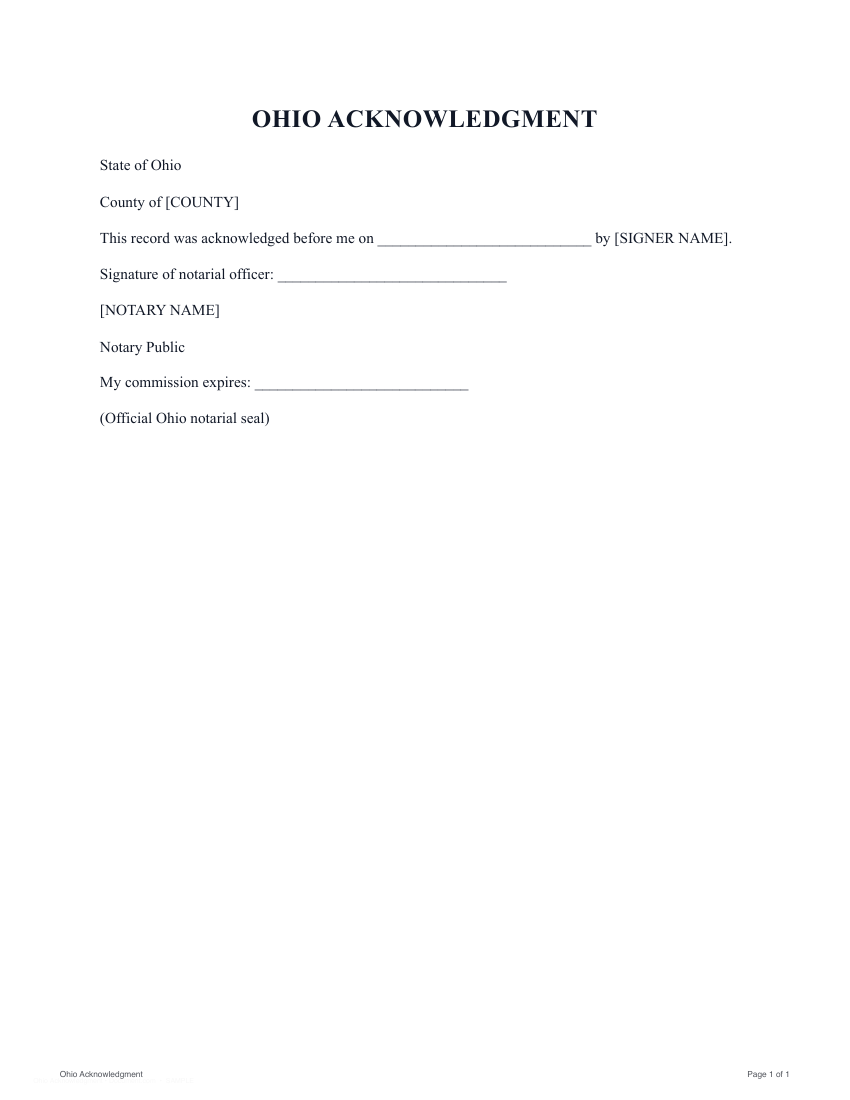
Sample Ohio Acknowledgment Certificate
The in-person individual example below includes the acknowledgment recital. Leave the notary’s certification, signature and seal for the notary to complete during the act.
State of Ohio
County of ____________________
This record was acknowledged before me on ____________________ [date] by ____________________ [name(s) of individual(s)].
Signature of notarial officer: ____________________
Printed name: ____________________
Notary Public
Commission expires: ____________________
For a qualifying attorney commission, state that it has no stated expiration under R.C. 147.03.
[Official Ohio notarial seal]
Ohio Notary Acknowledgment FAQ
Answers to common questions about notary acknowledgments in Ohio, including wording requirements, fees, and notarization procedures.
Official Ohio Resources
Use these official resources to verify Ohio notary requirements, find a notary, and access state notary forms and information.
Related Ohio Documents
Documents commonly used alongside notary acknowledgments in Ohio, or that require OH notarization.
Create your Ohio Notary Acknowledgment in under 5 minutes.
Prepare a certificate for the notary to review and complete when performing the act.