


South Carolina Notary Acknowledgment Overview
These paper examples describe the in-person acts required by South Carolina law. Acknowledgments follow S.C. Code 26-3-40 through 26-3-60 and include the physical signing required by 26-1-5. The general representative example records the actual capacity and represented party; it does not label every entity a corporation or reproduce the separate corporate short form in 26-3-70. Jurat wording records the oath or affirmation and signing required by 26-1-120(F).
Use the actual date and location of the notarial act. The notary completes and signs the certificate during the act. Whether a deed, power of attorney, trust or other instrument also needs witnesses or additional formalities depends on its governing law.
Up to $5/signature*
Paper acknowledgment
10 years
Commission term
Not available
Remote online notarization
10 years
Electronic journal retention
*See the requirements and fees below for exceptions and applicable categories.
South Carolina Acknowledgment and Jurat Wording
S.C. Code 26-3-40 through 26-3-70 — official source governs these in-person examples. Use the appropriate certificate for the actual capacity, verify authority, and arrange the required physical appearance. These examples describe the act; they do not reproduce every form in 26-3-70.
Individual Acknowledgment
State of South Carolina
County of ____________________
The foregoing instrument was acknowledged before me on ____________________ [date] by ____________________ [signer]. The signer was personally known to me or identified through satisfactory evidence and signed the instrument in my physical presence while I personally observed the signing.
Signature of notarial officer: ____________________
Printed name: ____________________
Notary Public
My commission expires: ____________________
[Official South Carolina notarial seal]
Representative Acknowledgment
State of South Carolina
County of ____________________
The foregoing instrument was acknowledged before me on ____________________ [date] by ____________________ [signer] as ____________________ [capacity] on behalf of ____________________ [represented party]. The signer was personally known to me or identified through satisfactory evidence and signed in my physical presence while I personally observed the signing, with proper authority in the stated capacity for the purposes stated in the instrument.
Signature of notarial officer: ____________________
Printed name: ____________________
Notary Public
My commission expires: ____________________
[Official South Carolina notarial seal]
Attorney-in-Fact Acknowledgment
State of South Carolina
County of ____________________
The foregoing instrument was acknowledged before me on ____________________ [date] by ____________________ [signer] as attorney-in-fact on behalf of ____________________ [principal]. The signer was personally known to me or identified through satisfactory evidence and signed in my physical presence while I personally observed the signing, with proper authority in the stated capacity for the purposes stated in the instrument.
Signature of notarial officer: ____________________
Printed name: ____________________
Notary Public
My commission expires: ____________________
[Official South Carolina notarial seal]
Verification on Oath or Affirmation (Jurat)
State of South Carolina
County of ____________________
Signed and sworn to (or affirmed) before me on ____________________ [date] by ____________________ [signer], who appeared in my physical presence, signed the record, and certified under oath or affirmation the truth of the matters stated in the record. The signer was personally known to me or identified through satisfactory evidence.
Signature of notarial officer: ____________________
Printed name: ____________________
Notary Public
My commission expires: ____________________
[Official South Carolina notarial seal]
Identify each person who actually appears. A jurat requires signing and an oath or affirmation; an acknowledgment serves a different purpose. Confirm the required act with the document recipient or a legal adviser.
South Carolina Notary Requirements
Commission: A South Carolina notary commission lasts ten years. Applicants must be registered South Carolina voters, be able to read and write English, and submit the required application and oath through their county legislative delegation. The state application or renewal fee is $25. Enroll the commission with the clerk of court in the county of residence within 15 days after commissioning. Complete renewal before continuing after expiration; the old commission provides no authority once expired.
Education: An ordinary paper commission does not require the separate electronic-notary course or test; applicants should study the Secretary of State’s reference manual. Electronic notaries must already hold a current ordinary commission, complete the electronic course and test, register and pay the $50 electronic registration fee, and select a state-approved technology provider. The electronic registration ends with the underlying commission.
Bond: South Carolina does not require a $1,000 notary surety bond. The ordinary application requires the prescribed application, oath, legislative-delegation endorsement and $25 fee. Optional insurance does not replace a valid commission or compliance with the notary’s duties.
Journal: For ordinary paper acts, the Secretary of State recommends a journal; a general paper journal is not mandatory. Electronic notarizations require an electronic journal under 26-2-90, with the act, document, principal, identity method, venue, system and fee details. Do not record Social Security numbers. Regulation 113-480 requires secure, tamper-evident storage for at least ten years after the last act recorded in that journal. The journal belongs to the notary, not the employer or vendor. Follow the retention and custody provisions upon termination, death or incapacity.
S.C. Code 26-1-5, 26-1-60 and 26-1-90 require the paper seal to identify the commissioned notary, Notary Public and State of South Carolina. An ink stamp or embosser may be used. Sign in ink with the commissioned name after performing the act, print or type the name legibly where required, and place the commission expiration below the signature. Complete the actual date, state and county. Do not notarize a blank or incomplete record or affix a signature or seal before the act.
Remote Notarization in South Carolina
South Carolina requires physical presence. Its electronic-notary program is in-person electronic notarization (IPEN), not remote online notarization. The signer and notary are physically together while using electronic documents and signatures. A South Carolina notary cannot replace this appearance with a video call.
Registered electronic notaries must use an approved provider, a compliant electronic signature and seal, and a tamper-evident electronic record and journal. The electronic seal includes the commissioned name, Notary Public, State of South Carolina, electronic registration number and commission expiration. See Title 26, Chapter 2 and Regulations 113-400 through 113-510. These paper certificates do not implement an electronic notarization system.
An out-of-state notarial act must comply with the law where performed and the destination’s requirements. Do not change the selected state merely to bypass South Carolina’s physical-presence rule; use the actual venue and confirm the recipient’s requirements.
South Carolina Notary Fees
S.C. Code 26-1-100 sets different fee units for different paper acts; do not treat every service as $5 per act. Display the applicable fees. Electronic fees follow 26-2-70 and must be displayed in at least ten-point type. There is no South Carolina remote-online-notarization fee schedule authorizing a remote act.
| Service or requirement | Fee rule |
|---|---|
| Paper acknowledgment, jurat or signature witnessing | Up to $5 per signature |
| Oath or affirmation without a signature | Up to $5 per person |
| Verification of fact | Up to $5 per certificate |
| Authorized electronic acts | Up to $10 per signature under 26-2-70 |
| Travel fee | Agree in advance and explain that it is separate from the notarial fee and not required by law |
South Carolina Identification and Recordkeeping
Under 26-1-5 and 26-1-120, the notary needs personal knowledge or satisfactory evidence. Qualifying identification is a current federal- or state-government document with the person’s photograph, signature and physical description; a current passport is accepted without the physical description. Alternatively, use the oath or affirmation of a credible witness personally known to the notary, or two witnesses with qualifying identification. An acknowledgment requires signing in the notary’s physical presence while the notary personally observes the signing. A jurat also requires an oath or affirmation as to the truth of the record. Do not pre-sign and assume a video call will satisfy these requirements.
For ordinary paper acts, the Secretary of State recommends a journal; a general paper journal is not mandatory. Electronic notarizations require an electronic journal under 26-2-90, with the act, document, principal, identity method, venue, system and fee details. Do not record Social Security numbers. Regulation 113-480 requires secure, tamper-evident storage for at least ten years after the last act recorded in that journal. The journal belongs to the notary, not the employer or vendor. Follow the retention and custody provisions upon termination, death or incapacity.
South Carolina notary duties · Secretary of State guidance · Electronic-notary regulations
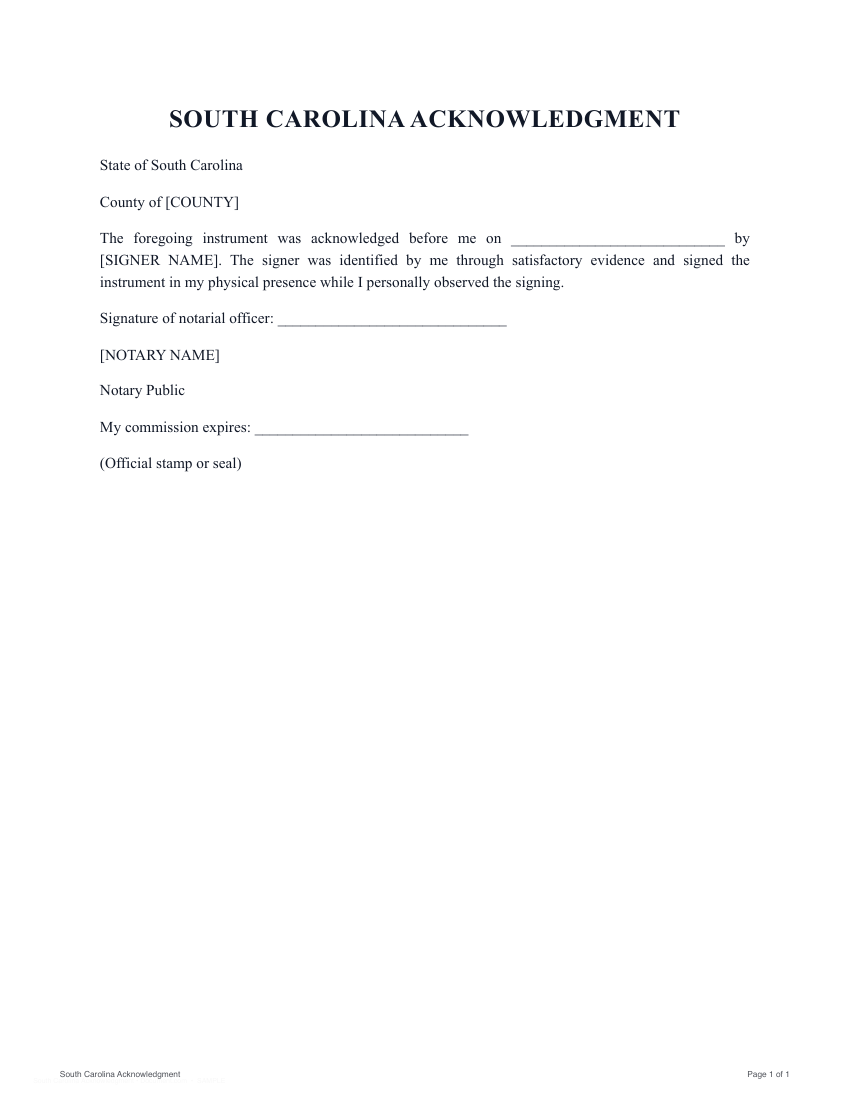
Sample South Carolina Acknowledgment Certificate
The in-person individual example below includes the acknowledgment recital. Leave the notary’s certification, signature and seal for the notary to complete during the act.
State of South Carolina
County of ____________________
The foregoing instrument was acknowledged before me on ____________________ [date] by ____________________ [signer]. The signer was personally known to me or identified through satisfactory evidence and signed the instrument in my physical presence while I personally observed the signing.
Signature of notarial officer: ____________________
Printed name: ____________________
Notary Public
My commission expires: ____________________
[Official South Carolina notarial seal]
South Carolina Notary Acknowledgment FAQ
Answers to common questions about notary acknowledgments in South Carolina, including wording requirements, fees, and notarization procedures.
Official South Carolina Resources
Use these official resources to verify South Carolina notary requirements, find a notary, and access state notary forms and information.
Related South Carolina Documents
Documents commonly used alongside notary acknowledgments in South Carolina, or that require SC notarization.
South Carolina Jurat / Verification
Notarial certificate for sworn statements and affidavits
South Carolina Affidavit
Sworn statement requiring notarized jurat
South Carolina Power of Attorney
Execution requirements depend on the type of power of attorney
South Carolina Quitclaim Deed
Property transfer deed requiring notarized acknowledgment
Create your South Carolina Notary Acknowledgment in under 5 minutes.
Prepare a certificate for the notary to review and complete when performing the act.