



Connecticut Notary Acknowledgment Overview
Connecticut recognizes the statutory short forms in section 1-62 and descriptive certificates meeting sections 1-59 through 1-61. These examples cover an individual, an actual representative capacity, and an attorney-in-fact acting for a named principal. The general representative example does not assume every organization is a corporation. A jurat records signing and an oath or affirmation; an acknowledgment records the signer’s acknowledgment of execution and voluntary act.
Use the actual date and location of the notarial act. The notary completes and signs the certificate during the act. Whether a deed, power of attorney, trust or other instrument also needs witnesses or additional formalities depends on its governing law.
$10
Maximum act fee
5 years
Commission term
Paper originals
Remote process
Optional
Ordinary seal
*See the requirements and fees below for exceptions and applicable categories.
Connecticut Acknowledgment and Jurat Wording
Conn. Gen. Stat. 1-59 through 1-62, 3-94a and 3-94k; official manual Rev. 2026-1 — official source governs these in-person examples. Use the appropriate certificate for the actual capacity, record the actual capacity and represented party, and confirm the document’s execution requirements. The descriptive representative example relies on sections 1-60 and 1-61. It does not invent a corporation or LLC type, place of organization or management structure that has not been supplied.
Individual Acknowledgment
State of Connecticut
County of ____________________
The foregoing instrument was acknowledged before me on ____________________ [date] by ____________________ [signer].
Signature of notarial officer: ____________________
Printed name: ____________________
Notary Public
My commission expires: ____________________
[Connecticut notary seal or stamp, if used]
Representative Acknowledgment
State of Connecticut
County of ____________________
The foregoing instrument was acknowledged before me on ____________________ [date] by ____________________ [signer] as ____________________ [actual capacity] on behalf of ____________________ [represented party].
Signature of notarial officer: ____________________
Printed name: ____________________
Notary Public
My commission expires: ____________________
[Connecticut notary seal or stamp, if used]
Attorney-in-Fact Acknowledgment
State of Connecticut
County of ____________________
The foregoing instrument was acknowledged before me on ____________________ [date] by ____________________ [agent] as attorney-in-fact on behalf of ____________________ [principal].
Signature of notarial officer: ____________________
Printed name: ____________________
Notary Public
My commission expires: ____________________
[Connecticut notary seal or stamp, if used]
Verification on Oath or Affirmation (Jurat)
State of Connecticut
County of ____________________
Subscribed and sworn to (or affirmed) before me on ____________________ [date] by ____________________ [signer].
Signature of notarial officer: ____________________
Printed name: ____________________
Notary Public
My commission expires: ____________________
[Connecticut notary seal or stamp, if used]
Identify each person who actually appears. A jurat requires signing and an oath or affirmation; an acknowledgment serves a different purpose. Confirm the required act with the document recipient or a legal adviser.
Connecticut Notary Requirements
Commission: A Connecticut notary commission lasts five years. An applicant must be at least 18 and reside in Connecticut or maintain a principal place of business there. After receiving the appointment, take the oath before performing any act and record the appointment and oath with the appropriate town clerk within 30 days of receipt. Record each renewed appointment as well. Renew during the 90-day window before expiration; a post-expiration renewal grace period does not authorize notarial acts while the commission is lapsed.
Education: The new-application examination is incorporated in the online application. Every question must be answered correctly before appointment. New applicants and reinstatements must also submit the completed jurat and handwriting sample and the required certificate of character. Study the current Secretary of the State manual; a course is not a substitute for completing the application examination.
Bond: Connecticut does not require a surety bond for an ordinary notary appointment. A notary may voluntarily obtain a bond or errors-and-omissions insurance. Optional financial protection does not replace proper identification, appearance, certificate and record procedures.
Journal: An ordinary notary journal is recommended, rather than required by Connecticut law. The Secretary of the State also recommends a journal for remote acts, noting the signer’s location, communication method and whether a recording was kept. Recording is not legally required, but the official manual strongly recommends recording each remote notarization and retaining it for at least 10 years. Protect identifying information and the recording against unauthorized access.
For ordinary in-person acts, a Connecticut seal or stamp is optional. If used, it must contain the commissioned name and the words Notary Public and Connecticut. Include the original notary signature and the commission expiration date; print or type the name legibly near the signature if no identifying seal or stamp is used. A signature stamp does not replace the notary’s original signature. Keep any seal clear of the signature and text.
Remote Paper Notarization in Connecticut
Connecticut’s section 3-95b process uses paper documents and wet-ink signatures. It is not full electronic remote online notarization. The notary must be physically in Connecticut and communicate with the signer simultaneously by sight and sound, with a legally appropriate disability accommodation where needed. The signer signs the original paper during that session and delivers it to the notary; the notary then completes and signs the certificate by hand and returns it. Date the act at the time the notary witnessed the signing, not the later delivery date. The certificate must indicate appearance by communication technology; the manual recommends identifying the platform used.
Remote identity may be established through personal knowledge, one current government ID containing name, photograph and signature, a qualifying third-party identity-proofing process, or an oath or affirmation by a credible witness meeting section 3-95b. The witness must be physically with the signer or notary, or connected to both by the communication technology, and must be identified by an authorized method. These remote rules differ from ordinary in-person identification.
Section 3-95b(i) excludes remote acknowledgments for wills, codicils, trusts and trust instruments; health-care instructions and living wills; standby-guardian and section 1-56r decision-maker designations; powers of attorney under 1-350a; the specified health-care or living-will self-proving affidavits; mutual estate distribution and estate-division agreements; statutory disclaimers; and real estate closings as defined in 51-88a. The downloaded in-person examples do not bypass these exclusions. The manual separately discusses out-of-state property transactions; obtain the appropriate legal direction rather than assuming all conveyances qualify.
For a signer outside Connecticut, check section 3-95b(c): the record must be intended for a matter before an entity subject to Connecticut jurisdiction, involve Connecticut property or a substantially connected transaction, or otherwise meet the statute’s condition concerning notarization outside the state. The manual instructs the notary to establish the Connecticut connection. These samples are in-person certificates and do not perform remote notarization or certify completion of its paper-delivery and identity procedures.
Official manual: remote acts, exclusions and sample certificate
Connecticut Notary Fees
Public Act 26-81 changed section 3-95 effective July 1, 2026. The maximum notarial-act fee is now $10; authorized travel mileage may not exceed the IRS business standard mileage rate. Agree charges before the appointment. The former $5 act fee and 35-cent mileage figure are outdated. Qualifying active state employees applying for official duties can receive the state application-fee exemption described by the Secretary of the State.
| Service or requirement | Fee rule |
|---|---|
| Notarial act | Up to $10 per act, effective July 1, 2026 |
| Travel | Per-mile rate no higher than the IRS business standard mileage rate |
| New commission or reinstatement | State application fee: $120 |
| Commission renewal | State renewal fee: $60 |
| Record commission and oath | Town-clerk recording fee: $20 |
Secretary of the State: July 2026 fee update and application fees
Connecticut Identification and Recordkeeping
For an in-person act, use personal knowledge, or at least two identification documents containing the signer’s signature, with at least one also containing a photograph or physical description. Alternatively, a credible witness personally known to the notary and personally acquainted with the signer may establish identity by oath or affirmation. A Social Security card or birth certificate is not an acceptable identification substitute. An acknowledgment may concern a signature made earlier, but the signer must appear and acknowledge it; a jurat requires signing in the notary’s presence and an oath or affirmation.
An ordinary notary journal is recommended, rather than required by Connecticut law. The Secretary of the State also recommends a journal for remote acts, noting the signer’s location, communication method and whether a recording was kept. Recording is not legally required, but the official manual strongly recommends recording each remote notarization and retaining it for at least 10 years. Protect identifying information and the recording against unauthorized access.
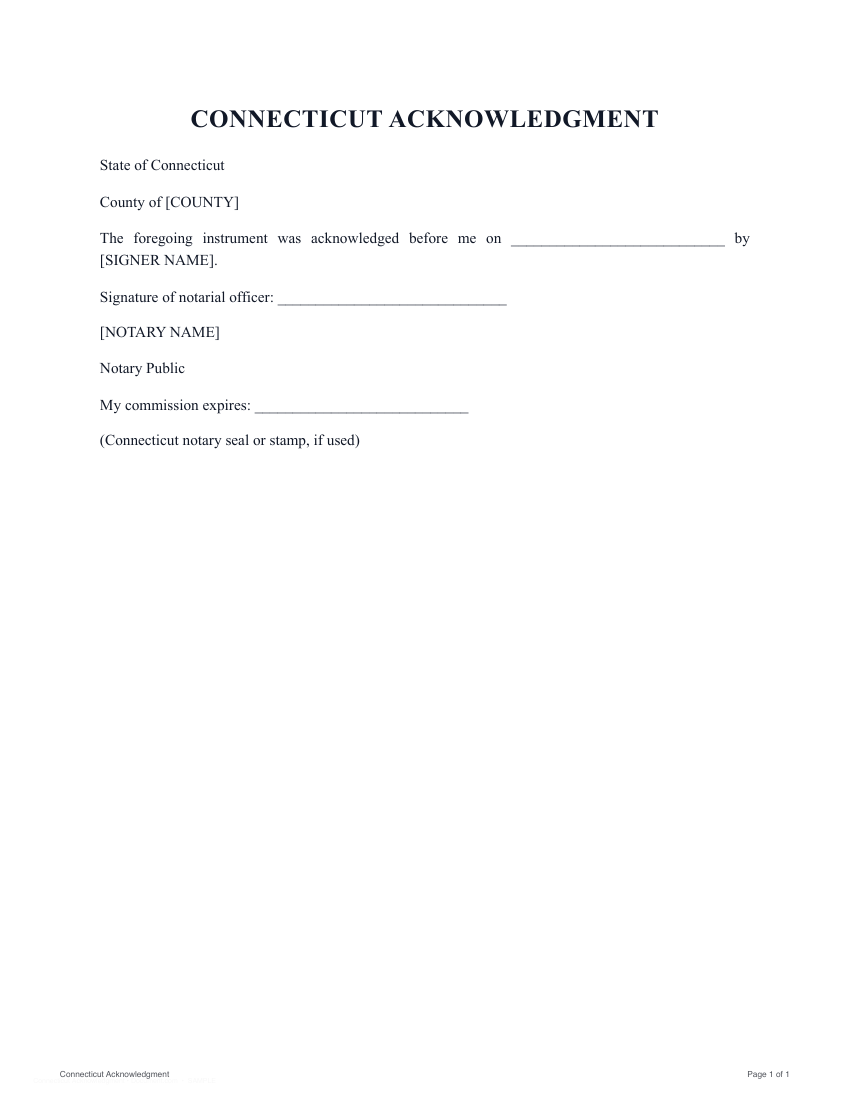
Sample Connecticut Acknowledgment Certificate
The in-person individual example below includes the acknowledgment recital. Leave the notary’s certification, signature and seal for the notary to complete during the act.
State of Connecticut
County of ____________________
The foregoing instrument was acknowledged before me on ____________________ [date] by ____________________ [signer].
Signature of notarial officer: ____________________
Printed name: ____________________
Notary Public
My commission expires: ____________________
[Connecticut notary seal or stamp, if used]
Connecticut Notary Acknowledgment FAQ
Answers to common questions about notary acknowledgments in Connecticut, including wording requirements, fees, and notarization procedures.
Official Connecticut Resources
Use these official resources to verify Connecticut notary requirements, find a notary, and access state notary forms and information.
Related Connecticut Documents
Documents commonly used alongside notary acknowledgments in Connecticut, or that require CT notarization.
Connecticut Jurat / Verification
Notarial certificate for sworn statements and affidavits
Connecticut Affidavit
Sworn statement requiring notarized jurat
Connecticut Power of Attorney
Execution requirements depend on the type of power of attorney
Connecticut Quitclaim Deed
Property transfer deed requiring notarized acknowledgment
Create your Connecticut Notary Acknowledgment in under 5 minutes.
Prepare a certificate for the notary to review and complete when performing the act.