



Indiana Notary Acknowledgment Overview
Indiana requires a contemporaneous certificate describing the actual notarial act, signed and dated by the notarial officer. IC 33-42-9-12 permits certificates in an authorized form or setting out the officer’s actions. Acknowledgments and verifications on oath or affirmation are different acts. The certificate must also include the notary’s commission expiration and the required Indiana county of commission or primary employment.
Use the actual date and location of the notarial act. The notary completes and signs the certificate during the act. Whether a deed, power of attorney, trust or other instrument also needs witnesses or additional formalities depends on its governing law.
$10 / signature*
Ordinary maximum
8 years
Commission term
Registration required
Remote process
Remote required
Journal
*See the requirements and fees below for exceptions and applicable categories.
Indiana Acknowledgment and Jurat Wording
Indiana Code 33-42-9, current 2026 edition provides the source rules for these in-person examples. Use the appropriate certificate for the actual capacity, record the actual capacity and represented party, and confirm the document’s execution requirements. The examples describe ordinary in-person acts under IC 33-42-9-12. Show the actual venue separately from the notary’s Indiana county of commission, or the Indiana county of primary employment for a nonresident notary. Do not claim that one generic recital is mandatory for every Indiana document.
Individual Acknowledgment
State of Indiana
County of ____________________
This record was acknowledged before me on ____________________ [date] by ____________________ [signer]. I determined the signer’s identity from personal knowledge or satisfactory evidence.
Signature of notarial officer: ____________________
Printed name: ____________________
Notary Public
Indiana county of commission or primary employment: ____________________
My commission expires: ____________________
[Official Indiana seal; also complete the separate commission-county field]
Representative Acknowledgment
State of Indiana
County of ____________________
This record was acknowledged before me on ____________________ [date] by ____________________ [signer] as ____________________ [actual capacity] on behalf of ____________________ [represented party]. I determined the signer’s identity from personal knowledge or satisfactory evidence.
Signature of notarial officer: ____________________
Printed name: ____________________
Notary Public
Indiana county of commission or primary employment: ____________________
My commission expires: ____________________
[Official Indiana seal; also complete the separate commission-county field]
Attorney-in-Fact Acknowledgment
State of Indiana
County of ____________________
This record was acknowledged before me on ____________________ [date] by ____________________ [agent] as attorney-in-fact on behalf of ____________________ [principal]. I determined the signer’s identity from personal knowledge or satisfactory evidence.
Signature of notarial officer: ____________________
Printed name: ____________________
Notary Public
Indiana county of commission or primary employment: ____________________
My commission expires: ____________________
[Official Indiana seal; also complete the separate commission-county field]
Verification on Oath or Affirmation (Jurat)
State of Indiana
County of ____________________
Signed and sworn to (or affirmed) before me on ____________________ [date] by ____________________ [signer]. I determined the signer’s identity from personal knowledge or satisfactory evidence.
Signature of notarial officer: ____________________
Printed name: ____________________
Notary Public
Indiana county of commission or primary employment: ____________________
My commission expires: ____________________
[Official Indiana seal; also complete the separate commission-county field]
Identify each person who actually appears. A jurat requires signing and an oath or affirmation; an acknowledgment serves a different purpose. Confirm the required act with the document recipient or a legal adviser.
Indiana Notary Requirements
Commission: An Indiana notary commission lasts eight years. The applicant must be at least 18, a U.S. citizen or permanent legal resident, and resident or primarily employed in Indiana, and must meet the remaining eligibility requirements. Complete the electronic application, oath, signature sample, assurance and current Secretary of State application instructions before acting.
Education: New and renewing applicants must complete a course of education and an examination. IC 33-42-12-2 also requires continuing education, not exceeding two hours every two years. Follow the current Secretary of State portal deadlines and completion requirements; missing a required course can affect the commission.
Bond: An assurance of $25,000 is required. Submit the electronic assurance as directed within 30 days of its effective date. A notary may act only during a period covered by a valid assurance on file with the Secretary of State. The coverage amount is not the premium paid to the surety.
Journal: The Secretary of State recommends recording ordinary notarial acts in a journal. Remote acts require an electronic journal under IC 33-42-17-8. The remote notary personally controls and protects it; an employer cannot take over that responsibility. Do not delete, overwrite or render it inaccessible without the authority specified by the statute. After resignation or expiration, retain it for at least ten years after the last remote act, and follow the separate recording and custodian rules.
The seal must be reproducible and include the commissioned name, “Notary Public,” “State of Indiana,” “Commission number” with the number and “My commission expires” with the expiration. The word “seal” is no longer mandatory after the 2024 amendment. Print or type the name below the signature unless the statutory exception for an otherwise printed, photocopiable name applies. The certificate separately identifies the county of commission or qualifying employment.
Remote Notarization in Indiana
An Indiana notary must separately register for remote acts, pass the remote examination, select approved technology and notify the Secretary of State. The remote notary must be physically in Indiana. For a signer abroad, the act must have the required U.S. connection and must not be prohibited where the signer is located.
The remote certificate under IC 33-42-17-7 identifies both the notary’s Indiana city and county and the signer’s city, county, state or province and country, and states the manner of appearance. The act must be recorded, with prior notice to the parties, even when it is not completed. Personal knowledge, the permitted credible-witness method or the required credential/analysis/proofing process must establish identity. These in-person examples do not replace the separate remote certificate.
Source 1 · Source 2 · Source 3 · Source 4 · Source 5 · Source 6
Indiana Notary Fees
Display fees in advance when charged. IC 33-42-14-1 includes employment, recordkeeping and public-official exceptions; do not treat the ordinary maximum as universal. Check current application and education charges directly with the Secretary of State.
| Service or requirement | Fee rule |
|---|---|
| Listed ordinary notarial acts | $10 maximum per signature, subject to statutory exceptions |
| Remote notarial act | $25 maximum per act |
| Travel | Reasonable charge not exceeding the applicable federal GSA travel fees |
Indiana Identification and Recordkeeping
IC 33-42-9-4 permits personal knowledge, including sufficient prior business dealings; inspection of a passport, driver’s license, government ID or qualifying government photo credential that is current or expired no more than three years; or verification under oath or affirmation by a credible witness identified under the statute. Additional identification can be requested. The signer must personally appear for an ordinary act. Remote KBA alone is not an ordinary in-person method.
The Secretary of State recommends recording ordinary notarial acts in a journal. Remote acts require an electronic journal under IC 33-42-17-8. The remote notary personally controls and protects it; an employer cannot take over that responsibility. Do not delete, overwrite or render it inaccessible without the authority specified by the statute. After resignation or expiration, retain it for at least ten years after the last remote act, and follow the separate recording and custodian rules.
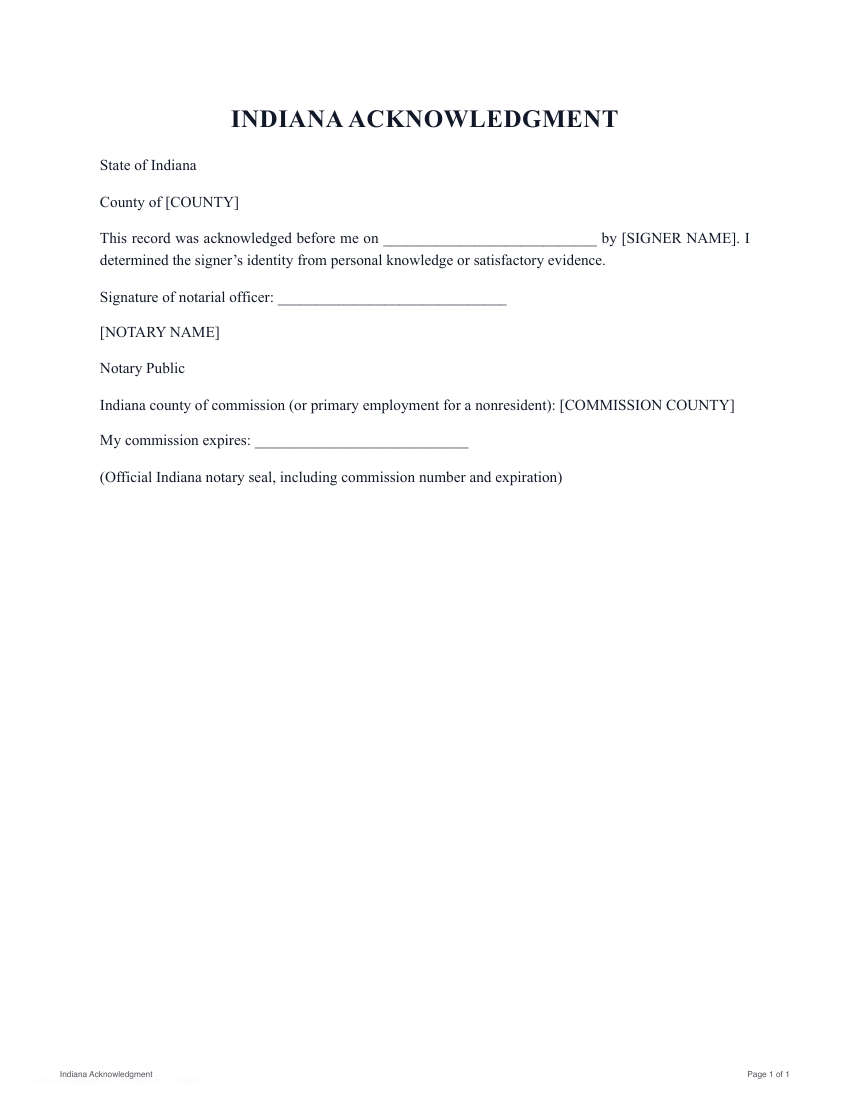
Sample Indiana Acknowledgment Certificate
The in-person individual example below includes the acknowledgment recital. Leave the notary’s certification, signature and seal for the notary to complete during the act.
State of Indiana
County of ____________________
This record was acknowledged before me on ____________________ [date] by ____________________ [signer]. I determined the signer’s identity from personal knowledge or satisfactory evidence.
Signature of notarial officer: ____________________
Printed name: ____________________
Notary Public
Indiana county of commission or primary employment: ____________________
My commission expires: ____________________
[Official Indiana seal; also complete the separate commission-county field]
Indiana Notary Acknowledgment FAQ
Answers to common questions about notary acknowledgments in Indiana, including wording requirements, fees, and notarization procedures.
Official Indiana Resources
Use these official resources to verify Indiana notary requirements, find a notary, and access state notary forms and information.
Related Indiana Documents
Documents commonly used alongside notary acknowledgments in Indiana, or that require IN notarization.
Indiana Jurat / Verification
Notarial certificate for sworn statements and affidavits
Indiana Affidavit
Sworn statement requiring notarized jurat
Indiana Power of Attorney
Execution requirements depend on the type of power of attorney
Indiana Quitclaim Deed
Property transfer deed requiring notarized acknowledgment
Create your Indiana Notary Acknowledgment in under 5 minutes.
Prepare a certificate for the notary to review and complete when performing the act.