


South Dakota Notary Acknowledgment Overview
These in-person examples follow South Dakota acknowledgment and jurat requirements. Individual, attorney-in-fact and partnership recitals are adapted from SDCL 18-5-8, 18-5-10 and 18-5-12. The general representative example describes the signer’s actual authority and represented party; it is not a verbatim copy of the corporation or public-officer forms. The notary must confirm the correct certificate for the act and instrument.
Use the actual date and location of the notarial act. The notary completes and signs the certificate during the act. Whether a deed, power of attorney, trust or other instrument also needs witnesses or additional formalities depends on its governing law.
No statutory cap*
Instrument fee
6 years
Commission term
Authorized
Remote acts with conditions
10 years
Electronic recording retention
*See the requirements and fees below for exceptions and applicable categories.
South Dakota Acknowledgment and Jurat Wording
SDCL 18-1, 18-3 and 18-5 — official source governs these in-person examples. Use the appropriate certificate for the actual capacity, verify authority, and follow the required remote form for a remote act.
Individual Acknowledgment
State of South Dakota
County of ____________________
On ____________________ [date], before me, ____________________ [notary], the undersigned officer, personally appeared ____________________ [signer], known to me or satisfactorily proven to be the person whose name is subscribed to the within instrument and acknowledged executing it for the purposes therein contained. In witness whereof I hereunto set my hand and official seal.
Signature of notarial officer: ____________________
Printed name: ____________________
Notary Public
[Official South Dakota notarial seal]
My commission expires: ____________________
Representative Acknowledgment
State of South Dakota
County of ____________________
On ____________________ [date], before me, ____________________ [notary], personally appeared ____________________ [signer], known to me or satisfactorily proven to be the person described in the instrument, who acknowledged executing it with proper authority as ____________________ [capacity] on behalf of ____________________ [party represented] for the purposes therein contained. In witness whereof I hereunto set my hand and official seal.
Signature of notarial officer: ____________________
Printed name: ____________________
Notary Public
[Official South Dakota notarial seal]
My commission expires: ____________________
Attorney-in-Fact Acknowledgment
State of South Dakota
County of ____________________
On ____________________ [date], before me, ____________________ [notary], the undersigned officer, personally appeared ____________________ [signer], known to me or satisfactorily proven to be the person whose name is subscribed as attorney-in-fact for ____________________ [principal], and acknowledged executing it as the act of the principal for the purposes therein contained. In witness whereof I hereunto set my hand and official seal.
Signature of notarial officer: ____________________
Printed name: ____________________
Notary Public
[Official South Dakota notarial seal]
My commission expires: ____________________
Verification on Oath or Affirmation (Jurat)
State of South Dakota
County of ____________________
Subscribed and sworn to (or affirmed) before me on ____________________ [date] by ____________________ [signer].
Signature of notarial officer: ____________________
Printed name: ____________________
Notary Public
[Official South Dakota notarial seal]
My commission expires: ____________________
Identify each person who actually appears. A jurat requires signing and an oath or affirmation; an acknowledgment serves a different purpose. Confirm the required act with the document recipient or a legal adviser.
South Dakota Notary Requirements
Commission: SDCL 18-1-1 provides a six-year commission unless removed earlier. Applicants must reside in South Dakota, or reside in a county bordering South Dakota and have a place of work or business within the state. A felony conviction disqualifies an applicant. Wait for the issued commission before acting, remain physically in South Dakota, and use the actual venue and current commission expiration. Renewal uses the application and oath process; the Secretary accepts renewal applications no more than 60 days before expiration.
Education: The current ordinary commission application process does not impose a state course or examination. Read the Secretary of State’s July 2025 handbook and current statutes before acting. Electronic services require a compliant system and notice to the Secretary; an ordinary paper commission alone does not complete those steps.
Bond: The 2025 amendments removed the notary surety-bond requirement. Current SDCL 18-1-2 and 18-1-3 require the oath and filing of the official seal impression. Submit the prescribed application and oath with the $30 application fee. The former $5,000 bond requirement is no longer current.
Journal: South Dakota does not generally mandate a paper notarial journal; keeping a careful record is prudent. This does not remove the separate electronic recording duty: SDCL 18-1-11.3 requires an audiovisual copy of each act using a tamper-evident notarization system to be retained for ten years from the act. A designated repository may hold it. Suspension, revocation, death or incapacity does not remove the retention duty; follow the statute’s custody provisions.
SDCL 18-1-3.1 requires an approved official seal with the notary’s name, South Dakota, notary public and a surrounding border. Rubber and electronic seals also include the word seal within that border. Place the commission expiration below and outside the seal. The certificate includes the actual venue and act date, notary signature, printed name, official title, seal and expiration. Do not apply the seal or signature before the act.
Remote Notarization in South Dakota
South Dakota has two different remote procedures. For a tangible paper record under SDCL 18-1-11.1, the notary must personally know the signer through sufficient dealings, observe through live video, sign the same original tangible document, and include the signer’s remote location and video-appearance statement. Use the substantially prescribed certificate in SDCL 18-4-29. This is not the electronic-record procedure.
For electronic records under SDCL 18-1-11.2, identify the signer through two different methods of identity proofing, use a selected tamper-evident system, apply the electronic signature and official seal, include the remote location and electronic-appearance statements, and create the audiovisual recording. SDCL 18-4-30 prescribes the remote electronic acknowledgment. Retain the recording for ten years under 18-1-11.3.
Before offering electronic services, notify the Secretary of the selected systems and file the electronic seal image under SDCL 18-1-11.4 and A.R.S.D. 5:04:03. The Secretary issues an e-notary certificate after recording the information. South Dakota does not maintain an approved-vendor list; the notary must check the provider’s compliance. The notary remains physically in South Dakota. These in-person paper examples do not carry out a remote act.
South Dakota Notary Fees
The 2025 amendment to SDCL 18-1-9 removed the former $10 limit. Do not treat that old limit or a generic $25 online price as current law. The exemption for notarizing an absentee-ballot request remains. Any other applicable fee restriction still controls; for example, SDCL 18-3-6 bars a fee for an oath or affirmation administered by a public officer in the discharge of official duties.
| Service or requirement | Fee rule |
|---|---|
| Notarizing an instrument | A fee may be charged; current SDCL 18-1-9 sets no dollar ceiling |
| Absentee-ballot request | No notarization fee may be charged |
| Commission application | Submit the $30 state application fee |
| Other charges | Ask about all service, travel and technology charges before booking |
South Dakota Identification and Recordkeeping
Under SDCL 18-5-5, the officer must know or have satisfactory evidence that the acknowledger is the person described in and who executed the instrument. The July 2025 handbook describes personal knowledge, government-issued picture identification and an unbiased credible witness personally known to the notary and signer who appears for the act. It also directs signers to sign in the notary’s physical presence for an in-person acknowledgment: do not pre-sign for this procedure. A jurat additionally requires an oath or affirmation. For a representative, verify the authority and identify the represented party.
South Dakota does not generally mandate a paper notarial journal; keeping a careful record is prudent. This does not remove the separate electronic recording duty: SDCL 18-1-11.3 requires an audiovisual copy of each act using a tamper-evident notarization system to be retained for ten years from the act. A designated repository may hold it. Suspension, revocation, death or incapacity does not remove the retention duty; follow the statute’s custody provisions.
Current South Dakota notary statutes · South Dakota July 2025 handbook
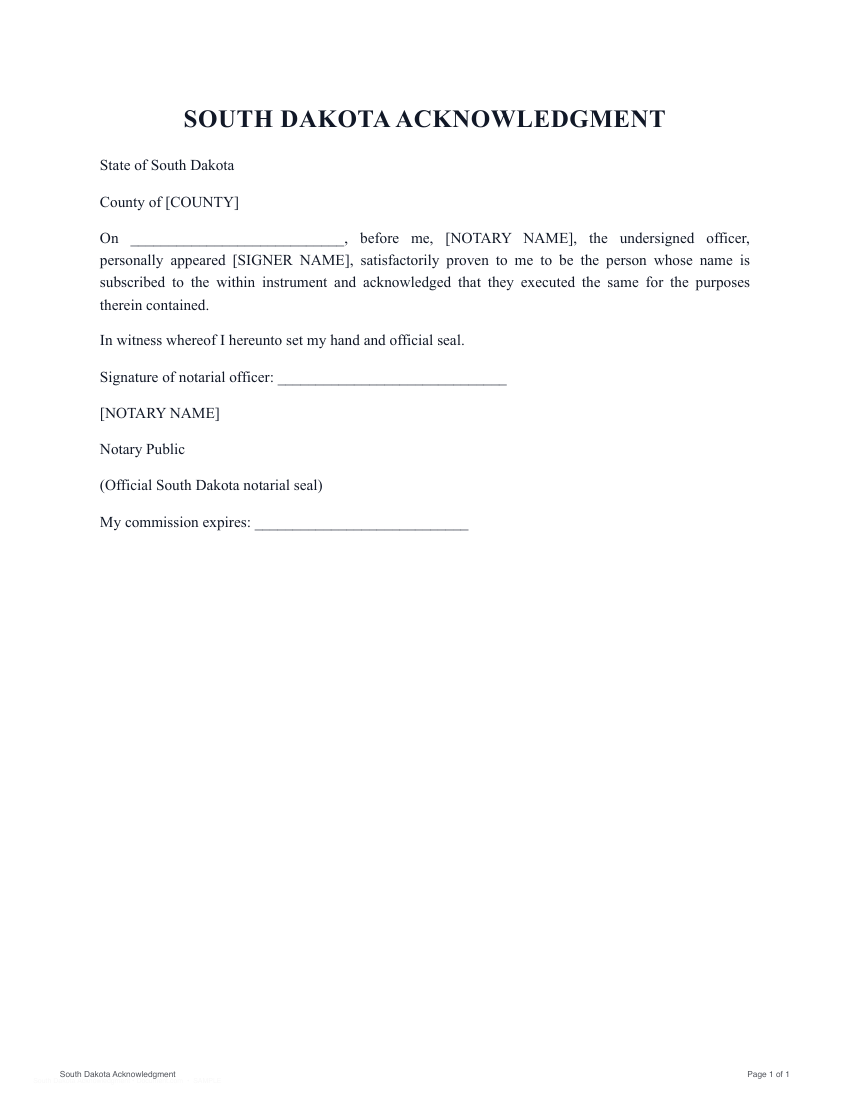
Sample South Dakota Acknowledgment Certificate
The in-person individual example below includes the acknowledgment recital. Leave the notary’s certification, signature and seal for the notary to complete during the act.
State of South Dakota
County of ____________________
On ____________________ [date], before me, ____________________ [notary], the undersigned officer, personally appeared ____________________ [signer], known to me or satisfactorily proven to be the person whose name is subscribed to the within instrument and acknowledged executing it for the purposes therein contained. In witness whereof I hereunto set my hand and official seal.
Signature of notarial officer: ____________________
Printed name: ____________________
Notary Public
[Official South Dakota notarial seal]
My commission expires: ____________________
South Dakota Notary Acknowledgment FAQ
Answers to common questions about notary acknowledgments in South Dakota, including wording requirements, fees, and notarization procedures.
Official South Dakota Resources
Use these official resources to verify South Dakota notary requirements, find a notary, and access state notary forms and information.
Related South Dakota Documents
Documents commonly used alongside notary acknowledgments in South Dakota, or that require SD notarization.
South Dakota Jurat / Verification
Notarial certificate for sworn statements and affidavits
South Dakota Affidavit
Sworn statement requiring notarized jurat
South Dakota Power of Attorney
Execution requirements depend on the type of power of attorney
South Dakota Quitclaim Deed
Property transfer deed requiring notarized acknowledgment
Create your South Dakota Notary Acknowledgment in under 5 minutes.
Prepare a certificate for the notary to review and complete when performing the act.