
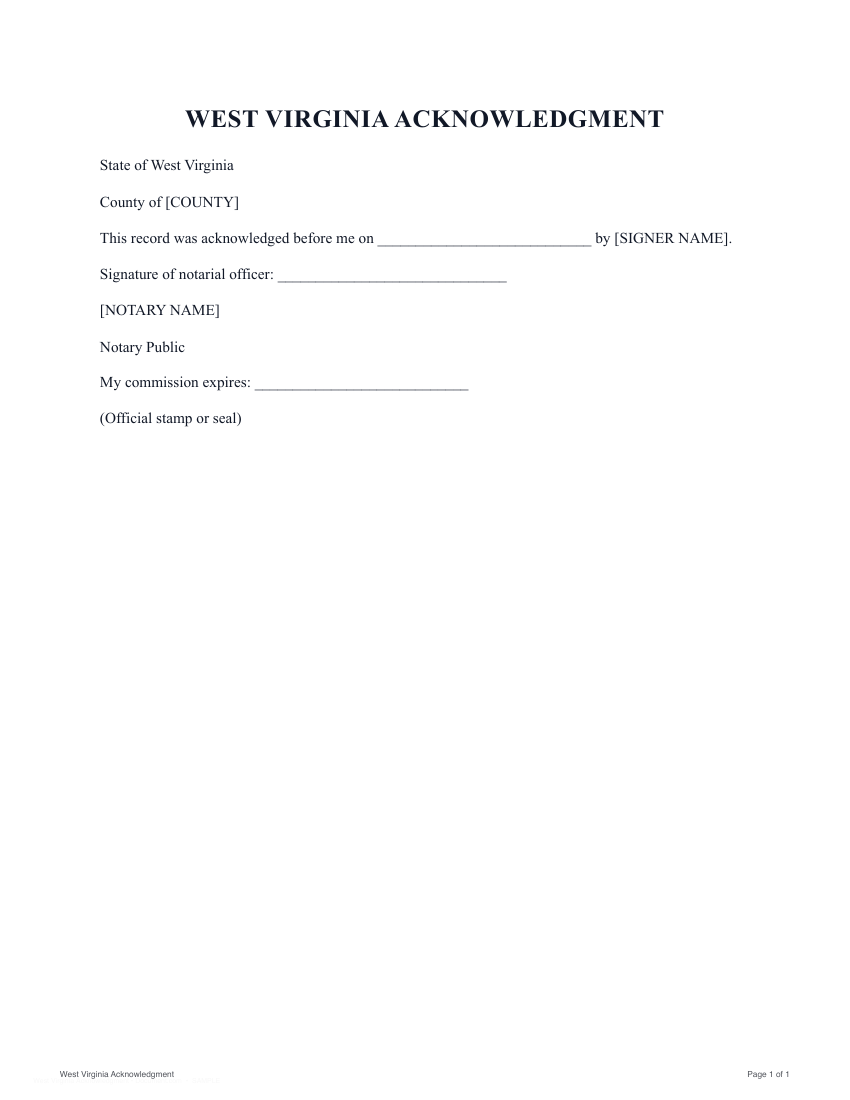



West Virginia acknowledgments
Use an individual acknowledgment when the named signer acknowledges signing the record. For a representative, identify the signer, their actual authority and the party on whose behalf they signed. A jurat requires an oath or affirmation. Ask the document preparer or receiving office which act the underlying record requires.
Completing the certificate
Enter the actual jurisdiction, date, signer and capacity. The officer signs and dates the certificate and states their title. A West Virginia notary signs as on file with the Secretary of State and gives their commission expiration. Attach the completed certificate to the record.
Section 39-4-16 provides short forms for an individual and a representative acknowledgment and for verification on oath or affirmation. Section 39-4-15 also recognizes other sufficient certificates.
Commission and stamp
West Virginia issues a five-year commission. The Secretary of State eliminated the surety-bond requirement in 2018. A paper certificate completed by a notary needs the official rubber stamp. The stamp includes the notary’s commissioned name, address, office, state and expiration date.
Commission qualifications and term
Remote electronic and remote ink acts
For a remote electronic act under §39-4-37, the notary is in West Virginia. Identify the signer by personal knowledge, a qualifying credible witness on oath or affirmation, or at least two distinct types of identity proofing. Confirm the record is the one signed, record the act and indicate the use of communication technology on the certificate. Notify the Secretary of State of the intended technology before the first such act. The state’s vendor list is informational.
If the electronic signer is outside the United States, the notary also needs an Out-of-State Commissioner commission and the statutory connection to a West Virginia matter, property or transaction. Retain the recording at least five years unless the governing rule requires a different period.
For a remote ink act under §39-4-38, use live sight and sound and the section’s permitted personal knowledge, unexpired photo ID with name and signature, two-method proofing or credible-witness procedure. Record the signing and notarization. The signer delivers the signed original for certification and the official stamp or seal. Use the date and time of witnessed signing. Retain the recording for five years unless another law provides otherwise. Here the additional commissioner and record requirements apply when the signer is outside West Virginia.
Notary fees and records
The maximum is $10 per notarized signature with proper journal recording. For a certified facsimile retained and recorded as specified, the limit is $10 per retained 8½-by-11-inch page. The maximum for any other notarial act is $10. A remote session has a separate audiovisual recording requirement.
Identifying a signer in person
Personal knowledge requires prior dealings sufficient to identify the signer with reasonable certainty. A passport, driver’s license or government-issued nondriver ID may be current or expired no more than three years. Another government ID within that period must carry a signature or photo and satisfy the officer.
A credible witness may identify the signer on oath or affirmation. The witness appears before the officer and must be known to the officer or identified using a qualifying passport, driver’s license or government-issued nondriver ID. The officer may require more evidence.
Download a West Virginia sample
These examples are for an in-person act. Select the certificate that matches the act, review it with the notary and complete it only when the act takes place.
Individual acknowledgment · PDF
Individual acknowledgment · DOCX
Representative acknowledgment · PDF
Representative acknowledgment · DOCX
West Virginia Notary Acknowledgment FAQ
Answers to common questions about notary acknowledgments in West Virginia, including wording requirements, fees, and notarization procedures.
Official West Virginia Resources
Use these official resources to verify West Virginia notary requirements, find a notary, and access state notary forms and information.
Related West Virginia Documents
Documents commonly used alongside notary acknowledgments in West Virginia, or that require WV notarization.
West Virginia Jurat / Verification
Notarial certificate for sworn statements and affidavits
West Virginia Affidavit
Sworn statement requiring notarized jurat
West Virginia Power of Attorney
Legal authorization requiring notarized acknowledgment
West Virginia Quitclaim Deed
Property transfer deed requiring notarized acknowledgment
Create your West Virginia Notary Acknowledgment in under 5 minutes.
Answer a few questions and download a West Virginia-compliant document, for a notary to complete. Check the receiving office’s requirements before filing.