



Virginia Notary Acknowledgment Overview
A notary acknowledgment in Virginia is a certificate completed by a VA-commissioned notary public confirming that a signer personally appeared before the notary, was positively identified, and acknowledged signing a document voluntarily. Virginia law prescribes specific statutory wording that must be used for acknowledgment certificates to be valid and accepted by recording offices throughout the state. Using incorrect or out-of-state wording can result in document rejection.
Virginia notary acknowledgments are required for real estate deeds, powers of attorney, trust documents, mortgages, and many other legal instruments filed or recorded in the state. The notary does not verify the content or legality of the document — only the identity of the signer and that the signature was made willingly. Virginia notaries must hold an active commission, maintain proper bonding, and follow all VA notarial procedures when performing acknowledgments.
$5
Max fee per act
4 years
Commission term
Yes
RON allowed
Recommended
Journal
Virginia Acknowledgment Wording
Virginia law prescribes specific statutory wording for notary acknowledgment certificates. Using the correct wording is essential for documents that will be recorded with Virginia county recorders or filed with state agencies. Below are the required acknowledgment forms for different signer types.
Virginia Specific Note
The acknowledgment wording below reflects Virginia's statutory requirements. While substantially similar certificates may be accepted, using the exact statutory language ensures your document will not be rejected for recording. Always verify current requirements with your county recorder's office before filing.
Individual Acknowledgment
County/City of _______________
The foregoing instrument was acknowledged before me this _____ day of _______________, 20_____, by _______________.
___________________________
Notary Public
My Commission Expires: _______________
Registration No.: _______________
Corporate / Representative Acknowledgment
County/City of _______________
The foregoing instrument was acknowledged before me this _____ day of _______________, 20_____, by _______________ as _______________ [title] of _______________ [entity], on behalf of said entity.
___________________________
Notary Public
My Commission Expires: _______________
Registration No.: _______________
Multiple Signers Acknowledgment
County/City of _______________
The foregoing instrument was acknowledged before me this _____ day of _______________, 20_____, by _______________ and _______________.
___________________________
Notary Public
My Commission Expires: _______________
Registration No.: _______________
Virginia Notary Requirements
Virginia has specific requirements for notaries public who perform acknowledgments. Understanding these requirements helps ensure your notarization is valid and your documents will be accepted.
- Commission Term: Virginia notary commissions are valid for 4 years from the date of issuance
- Bond: A $10,000 surety bond is required for Virginia notaries
- Exam: No exam is required to become a notary in Virginia
- Journal: Maintaining a notary journal is recommended but not legally required in Virginia
- Seal/Stamp: Virginia notaries must use an official seal or stamp on all notarial certificates
- Max Fee: $5 per notarial act for in-person notarizations
Remote Online Notarization in Virginia
Virginia does allow remote online notarization (RON), which permits signers to appear before a notary via secure audio-video technology rather than in person. RON sessions require multi-factor identity verification including knowledge-based authentication questions, credential analysis of a government-issued ID, and live video confirmation.
RON notaries in Virginia must use approved technology platforms that meet state requirements for security, recording, and record retention. All RON sessions are recorded and the recordings must be stored for the period specified by VA law. RON fees may differ from in-person notarization fees.
Virginia Notary Fees
Virginia regulates the maximum fees notaries may charge for notarial acts. Below is a breakdown of typical notarization costs in Virginia.
| Service | Fee |
|---|---|
| Acknowledgment (per signature) | Up to $5 |
| Jurat (per signature) | Up to $5 |
| Oath / Affirmation | Up to $5 |
| Mobile Notary Travel Fee | Varies (not regulated in most cases) |
| Remote Online Notarization | $25 (typical, may vary by platform) |
Virginia Identification Requirements
Virginia notaries must verify the identity of each signer before performing an acknowledgment. The following forms of identification are generally accepted in Virginia.
Sample Virginia Acknowledgment Certificate
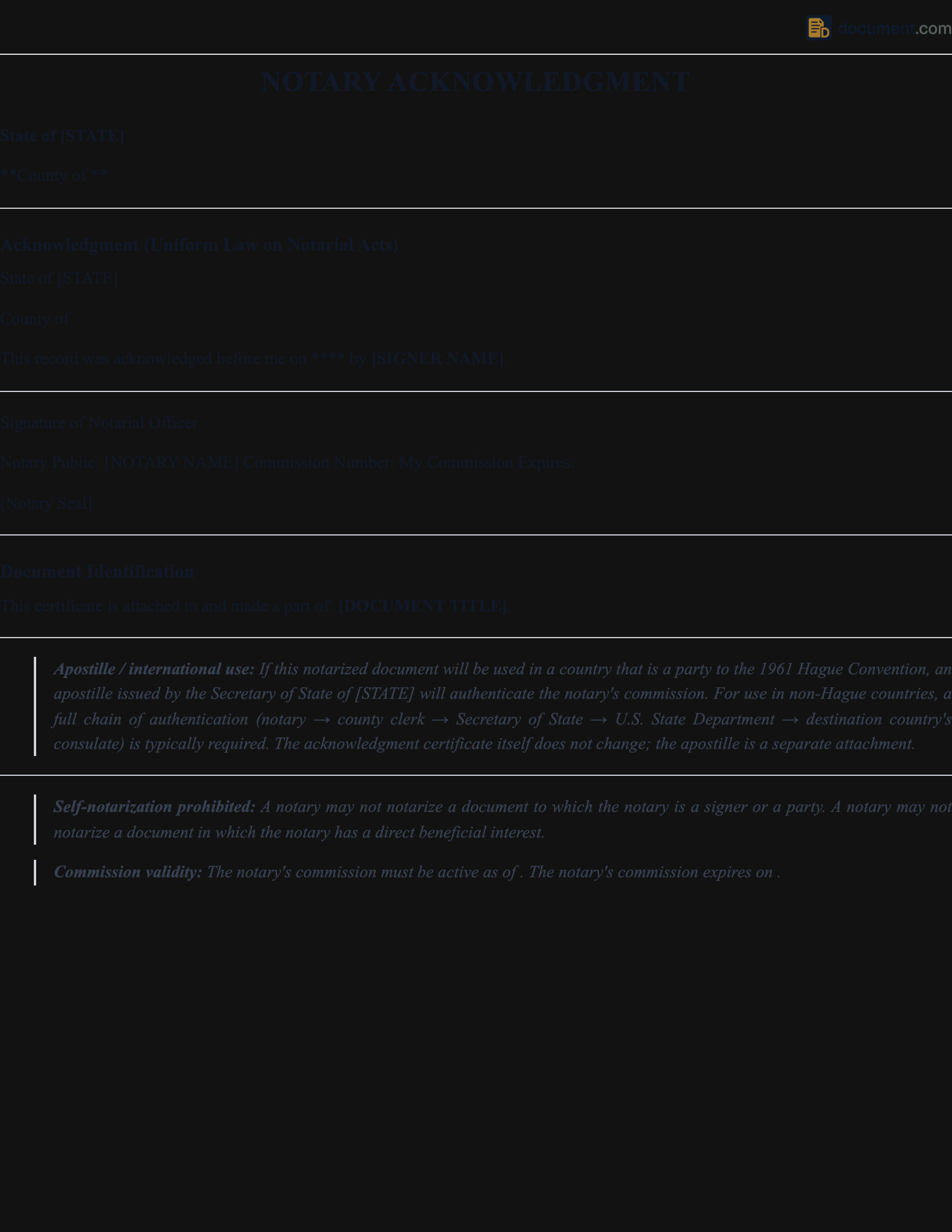
Below is a preview of our Virginia-specific notary acknowledgment certificate. Your customized document will include the exact VA statutory wording and all required notarial elements.
CERTIFICATE OF ACKNOWLEDGMENT
STATE OF VIRGINIA
Individual Acknowledgment
VENUE:
State of Virginia
County of [County]
SIGNER INFORMATION:
Name: [Full Legal Name]
ID Type: [ID Presented]
Date: [Date of Notarization]
NOTARY CERTIFICATION:
Notary Name: [Printed Name]
Commission #: [Number]
Commission Expires: [Date]
Signature:
[NOTARY SEAL / STAMP]
Virginia Notary Acknowledgment FAQ
Answers to common questions about notary acknowledgments in Virginia, including wording requirements, fees, and notarization procedures.
Official Virginia Resources
Use these official resources to verify Virginia notary requirements, find a notary, and access state notary forms and information.
Related Virginia Documents
Documents commonly used alongside notary acknowledgments in Virginia, or that require VA notarization.
Virginia Jurat / Verification
Notarial certificate for sworn statements and affidavits
Virginia Affidavit
Sworn statement requiring notarized jurat
Virginia Power of Attorney
Legal authorization requiring notarized acknowledgment
Virginia Quitclaim Deed
Property transfer deed requiring notarized acknowledgment
Create your Virginia Notary Acknowledgment in under 5 minutes.
Answer a few questions and download a Virginia-compliant document, ready for the state agency.