



New Jersey Notary Acknowledgment Overview
New Jersey’s official September 2026 manual sets out acknowledgment and verification forms under N.J.A.C. 17:50-1.10. An acknowledgment records the identified person’s acknowledgment of a signature; representative wording identifies the authority and the party represented. A jurat requires an oath or affirmation.
Use the actual date and location of the notarial act. The notary completes and signs the certificate during the act. Whether a deed, power of attorney, trust or other instrument also needs witnesses or additional formalities depends on its governing law.
$2.50*
Ordinary service
5 years
Commission term
Authorized
Remote acts with conditions
Required*
Journal / records
*See the requirements and fees below for exceptions and applicable categories.
New Jersey Acknowledgment and Jurat Wording
N.J.A.C. 17:50-1.10 — official source provides these short forms. These examples cover in-person acts. Remote acts need additional certificate wording and procedures.
Individual Acknowledgment
State of New Jersey
County of ____________________
This record was acknowledged before me on ____________________ [date] by ____________________ [name(s) of individual(s)].
Signature of notarial officer: ____________________
Printed name: ____________________
Notary Public, State of New Jersey
My commission expires: ____________________
[Official seal / stamp]
Representative Acknowledgment
State of New Jersey
County of ____________________
This record was acknowledged before me on ____________________ [date] by ____________________ [name(s) of individual(s)] on ____________________ [date] as ____________________ [type of authority] of ____________________ [party represented].
Signature of notarial officer: ____________________
Printed name: ____________________
Notary Public, State of New Jersey
My commission expires: ____________________
[Official seal / stamp]
Verification on Oath or Affirmation (Jurat)
State of New Jersey
County of ____________________
Signed and sworn to (or affirmed) before me on ____________________ [date] by ____________________ [name(s) of individual(s) making statement].
Signature of notarial officer: ____________________
Printed name: ____________________
Notary Public, State of New Jersey
My commission expires: ____________________
[Official seal / stamp]
Identify each person who actually appears. A jurat requires signing and an oath or affirmation; an acknowledgment serves a different purpose. Confirm the required act with the document recipient or a legal adviser.
New Jersey Notary Requirements
Commission: New Jersey notaries are commissioned for five years under N.J.S.A. 52:7-11. Check both the commission’s expiration and completion of the required county-clerk oath.
Education: Non-attorney applicants for an initial commission must complete the required course and pass the Treasurer’s examination. Qualifying renewal applicants must complete continuing education. After receiving an initial or renewed commission, take and file the oath with the appropriate county clerk within three months.
Bond: New Jersey’s commissioning process does not require a surety bond. Applicants must still satisfy the application, education, examination and oath requirements that apply to them.
Journal: A journal is required, with ten-year retention after the last recorded act. A statutory alternative permits New Jersey attorneys, their employees, and employees or agents of licensed title insurers to record acts in regularly maintained practice or business files instead. This is not a general exemption from keeping records.
The notary must have current authority, avoid disqualifying interests, identify the signer, perform the required act, and complete the certificate and official seal or stamp.
Remote Notarization in New Jersey
A notary located in New Jersey may use qualifying communication technology. Before the first act, notify the State Treasurer and identify the intended technology. Follow Chapter 8 of the official manual for identity verification, record matching, secure real-time communication and an audio-video recording.
The certificate must indicate that communication technology was used. Retain the recording for at least ten years. A tangible record already held by the notary must be displayed to and identified by the signer. A tangible record held by the signer requires the additional witnessed-signing, declaration and delivery procedure, including sending the record and declaration within three days. Electronic-record notarization also has separate tamper-evident technology requirements.
New Jersey Notary Fees
Chapter 11 of the official manual distinguishes ordinary services from the two real-estate transaction categories. The $25 financing-transaction amount is not a general remote-notarization price. Confirm the applicable category before the act.
| Service or requirement | Fee rule |
|---|---|
| Ordinary oath, affidavit, proof of deed or acknowledgment | Up to $2.50 per service |
| Grantor in a real-estate transfer | Up to $15 per transaction, regardless of service count |
| Mortgagor in a real-estate financing transaction | Up to $25 per transaction, regardless of service count |
New Jersey Identification and Recordkeeping
The official manual permits personal knowledge, or a passport, driver’s license or government-issued nondriver ID that is current or expired no more than three years. Other government ID must meet the same age limit, contain a signature or photograph, and satisfy the notary. A qualifying credible witness can give an oath or affirmation and must be personally known or identified by a qualifying passport, license or nondriver ID. Additional identifying information may be requested.
A journal is required, with ten-year retention after the last recorded act. A statutory alternative permits New Jersey attorneys, their employees, and employees or agents of licensed title insurers to record acts in regularly maintained practice or business files instead. This is not a general exemption from keeping records.
Sample New Jersey Acknowledgment Certificate
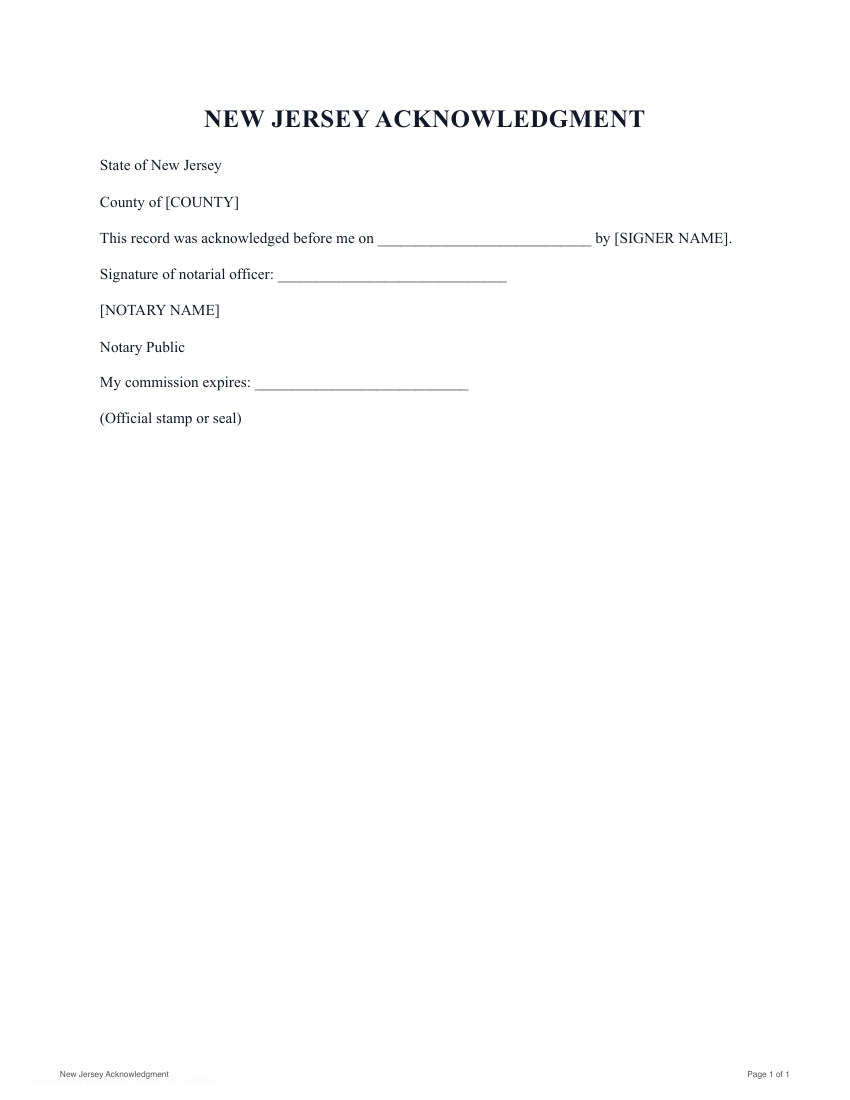
The in-person individual example below includes the acknowledgment recital. Leave the notary’s certification, signature and seal for the notary to complete during the act.
State of New Jersey
County of ____________________
This record was acknowledged before me on ____________________ [date] by ____________________ [name(s) of individual(s)].
Signature of notarial officer: ____________________
Printed name: ____________________
Notary Public, State of New Jersey
My commission expires: ____________________
[Official seal / stamp]
New Jersey Notary Acknowledgment FAQ
Answers to common questions about notary acknowledgments in New Jersey, including wording requirements, fees, and notarization procedures.
Official New Jersey Resources
Use these official resources to verify New Jersey notary requirements, find a notary, and access state notary forms and information.
Related New Jersey Documents
Documents commonly used alongside notary acknowledgments in New Jersey, or that require NJ notarization.
New Jersey Jurat / Verification
Notarial certificate for sworn statements and affidavits
New Jersey Affidavit
Sworn statement requiring notarized jurat
New Jersey Power of Attorney
Execution requirements depend on the type of power of attorney
New Jersey Quitclaim Deed
Property transfer deed requiring notarized acknowledgment
Create your New Jersey Notary Acknowledgment in under 5 minutes.
Prepare a certificate for the notary to review and complete when performing the act.