
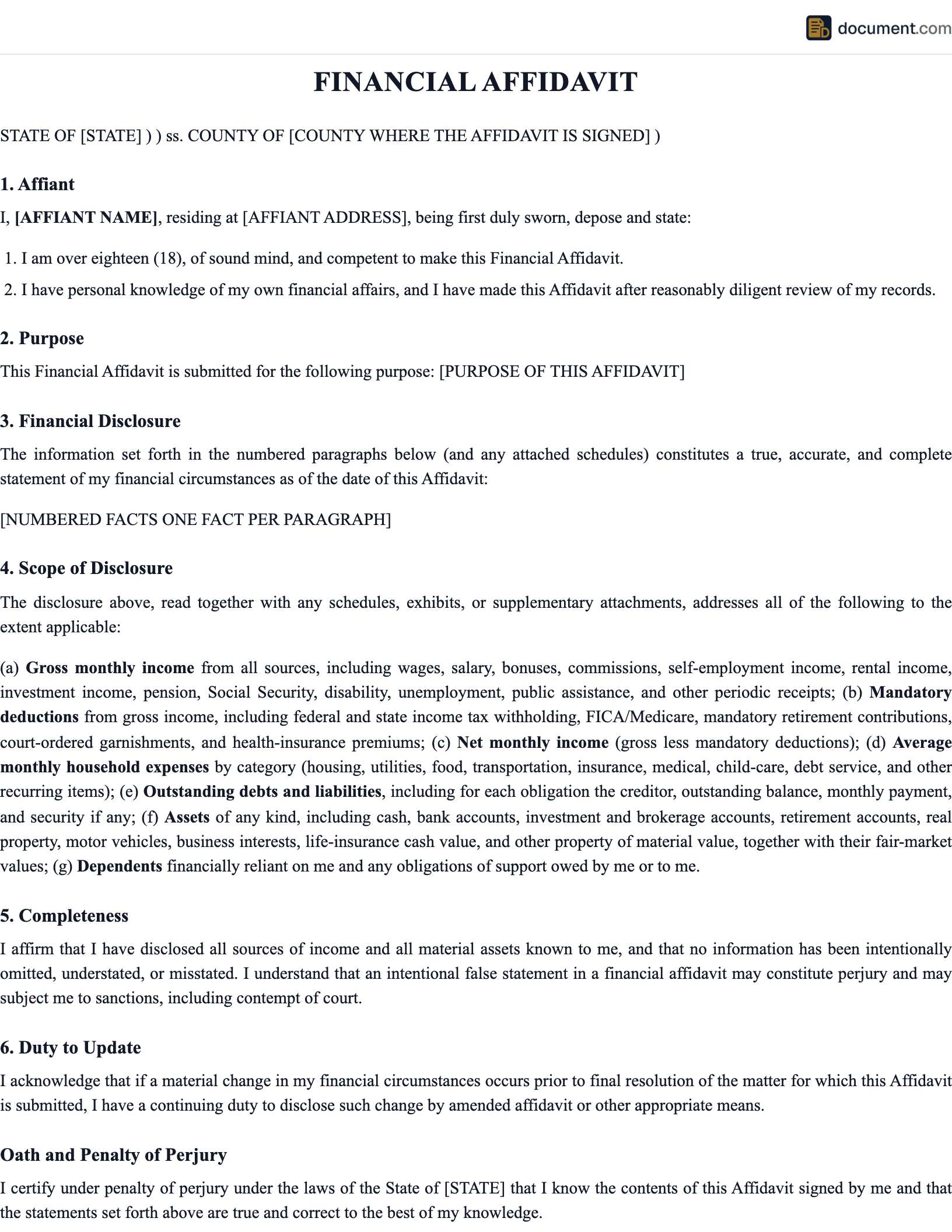



What Is a Financial Affidavit
A financial affidavit is the sworn financial-disclosure document required in divorce, legal separation, child support, alimony, and federal bankruptcy proceedings. It enumerates every source of income, every category of monthly expense, every asset, and every debt under penalty of perjury. The document is the evidentiary foundation for support calculations under state child-support guidelines (incorporating IV-D federal requirements at 42 U.S.C. § 666), property division under community-property or equitable-distribution rules, and bankruptcy schedules under 11 U.S.C. § 521. Family courts in every U.S. jurisdiction require at least one party to file a current affidavit; most require both parties to exchange and file simultaneously.
The form is intentionally exhaustive. California Form FL-150 (Income and Expense Declaration) and Form FL-142 (Schedule of Assets and Debts) require itemized disclosure of every paycheck, recurring expense, account, and debt. Florida Family Law Form 12.902(b) and 12.902(c) impose similar detail. New York's Statement of Net Worth under DRL § 236(B)(4) is comparably exhaustive. The purpose is informational parity: neither spouse can hide income or treat an asset as nonexistent while support and property division are negotiated.
Mandatory disclosure under Florida and California family law
Florida Family Law Rule 12.285 imposes mandatory disclosure within 45 days of service of the petition, including the financial affidavit on Form 12.902(b) for incomes under $50,000 or 12.902(c) for incomes over $50,000, supporting tax returns, pay stubs, account statements, and debt documentation across 16 enumerated categories. California Family Code §§ 2103-2104 require Preliminary Declaration of Disclosure within 60 days of petition including FL-142 (Schedule of Assets and Debts), FL-150 (Income and Expense Declaration), and 2 years of tax returns; Final Declaration of Disclosure under § 2105 follows before judgment. Failure to comply triggers FC § 2107 sanctions including mandatory attorney-fee award and adverse inference on contested issues.
Bankruptcy schedules under 11 U.S.C. § 521 and perjury exposure
Bankruptcy debtors file equivalent financial schedules under 11 U.S.C. § 521 within 45 days of filing: Schedule A/B (real and personal property), Schedule C (exemptions), Schedule D (secured creditors), Schedule E/F (unsecured creditors), Schedule G (executory contracts), Schedule H (codebtors), Schedule I (income), Schedule J (expenses), and the Statement of Financial Affairs. Non-disclosure exposes the debtor to denial of discharge under 11 U.S.C. § 727(a)(4)(A) (false oath), revocation of discharge under § 727(d)(1) for fraudulently obtained discharge, and criminal prosecution under 18 U.S.C. §§ 152 (concealment), 157 (bankruptcy fraud), and 1623 (false declarations) carrying up to 5 years imprisonment per count. The perjury exposure applies equally to family-court financial affidavits under state false-swearing statutes.
When the Court Requires It
Every U.S. family-court divorce, legal separation, and annulment triggers automatic financial-disclosure obligations under the local rules. Child support, spousal support, and alimony actions require current affidavits even when no divorce is pending because support amounts are tied to current income under state guidelines (Cal. Family Code § 4055 et seq.; Fla. Stat. § 61.30; NY DRL § 240(1-b)). Modification proceedings under 42 U.S.C. § 666 require updated affidavits showing material change in circumstances. Bankruptcy filings under 11 U.S.C. § 521 require equivalent disclosure within 45 days of petition.
The duty of disclosure is continuing. California Family Code § 2102 imposes a fiduciary duty of full disclosure that continues until distribution of the marital estate; Florida Rule 12.285(e) requires supplementing prior disclosure when it becomes incomplete. Failure to update is treated as continuing fraud and supports set-aside under California Family Code § 1101(h) (potentially 100% of the hidden asset), Florida Stat. § 61.181, or New York CPLR § 5015(a)(3). The continuing-duty rule is the single most overlooked exposure for divorce litigants whose financial situation changes during pendency.
Long Form vs Short Form
| Feature | Short Form | Long Form |
|---|---|---|
| Income Threshold | Below state limit (often $50K) | Above state limit |
| Detail Level | Basic income and expenses | Itemized assets, debts, and budgets |
| Supporting Documents | Pay stubs and recent tax return | Three years of returns plus account statements |
| Typical Use | Simple child support cases | Divorce with property and alimony |
| Length | Two to four pages | Eight to fifteen pages |
How to Complete the Affidavit
Gather Income Documentation
Collect three months of pay stubs, the last two years of tax returns, and any 1099 or self-employment records.
Pull Account Statements
Download the most recent statements for every checking, savings, brokerage, retirement, and credit card account.
List Real Property and Vehicles
Include addresses, purchase price, current estimated value, and outstanding loan balances.
Build a Realistic Monthly Budget
Track actual spending for at least one month rather than guessing, so the expense schedule reflects real life.
Disclose All Debts
List every creditor, balance, monthly payment, and whether the debt is in your name, your spouse's name, or joint.
Sign Under Oath and File
Sign in front of a notary if required, file with the court, and serve a copy on the opposing party.
Key Components
Personal Information
Name, age, occupation, employer, length of marriage, and number of dependents.
Gross and Net Income
All sources of income before and after taxes, deductions, and mandatory withholdings.
Mandatory Deductions
Federal and state tax withholding, Social Security, Medicare, mandatory retirement, and union dues.
Monthly Expenses Schedule
Itemized household, transportation, child care, medical, debt service, and personal expenses.
Assets Schedule
Real estate, vehicles, bank accounts, investments, retirement, business interests, and personal property of significant value.
Liabilities Schedule
Mortgages, auto loans, credit cards, student loans, personal loans, and tax debts with balances and monthly payments.
Sworn Verification
Signature under penalty of perjury, often acknowledged before a notary public.
Sample Disclosure
FINANCIAL AFFIDAVIT
Petitioner: _____________ Case No: _____________
I. INCOME (monthly)
Gross wages: $______ Bonuses: $______ Self-employment: $______
Investment income: $______ Other: $______
II. EXPENSES (monthly)
Housing: $______ Utilities: $______ Food: $______ Transport: $______
Insurance: $______ Child care: $______ Debt service: $______
III. ASSETS Real estate, vehicles, accounts, retirement, business interests
IV. LIABILITIES Mortgages, auto loans, credit cards, student loans
I declare under penalty of perjury that the foregoing is true. ____________ Date: _______
Frequently Asked Questions
Common questions about financial affidavits, mandatory disclosure rules, sanctions for hiding assets, and bankruptcy schedules.
Official Resources
Office of Child Support Services
Federal program supporting state child-support enforcement
U.S. Courts: Forms Library
Official federal court forms including bankruptcy schedules
LawHelp.org: Free Family Law Help
Free legal aid resources for low-income family-law litigants
IRS: Order Tax Transcripts
Federal tax transcripts to support income disclosures
Create your Financial Affidavit in under 10 minutes.
Answer a few questions and download a compliant, attorney-drafted document ready for your divorce or support case.