
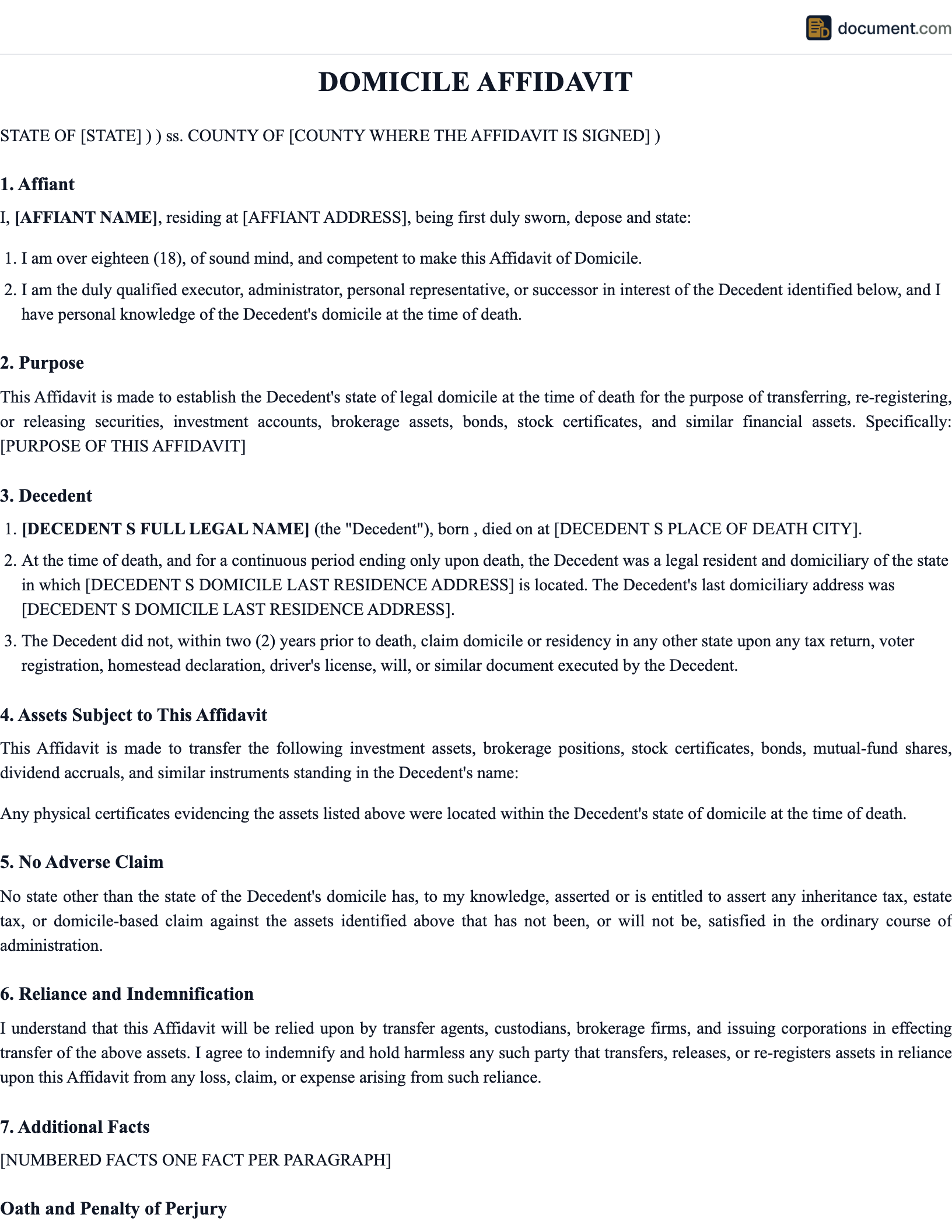



What Is an Affidavit of Domicile
An affidavit of domicile is a short notarized declaration that identifies the state and county where a deceased person legally lived at the time of their death. The document is presented to a transfer agent or stock issuer when securities held in the decedent's name need to be retitled, sold, or moved to an heir or surviving joint owner.
Transfer agents are the financial institutions responsible for tracking ownership of corporate stocks, bonds, and registered mutual funds. Before they will modify a deceased shareholder's account, they need a formal record of where that shareholder was domiciled, because state inheritance tax rules and probate jurisdiction follow domicile, not the location of the broker or the issuing corporation.
The affiant, usually an executor, administrator, or surviving joint tenant, signs the affidavit under oath in front of a notary. In most cases the transfer agent also demands a medallion signature guarantee, which is a separate stamp issued by participating banks and brokers that insures the agent against forged endorsements on the accompanying stock power.
Although the form looks brief, getting it wrong can stall a securities transfer for weeks. Submitting incorrect domicile, missing a required state inheritance tax waiver, or forgetting the medallion stamp are the three most common reasons a transfer package is rejected. A clean affidavit of domicile clears the way for the rest of the package to be processed.
Why Transfer Agents Require It
Securities are governed by a patchwork of state laws when their owner dies. A handful of states still impose an inheritance tax that must be paid or waived before assets can be released, and the only way a transfer agent can know which state's rules apply is to obtain a sworn statement from someone with personal knowledge.
By collecting an affidavit of domicile, the agent shifts liability to the affiant. If the declaration turns out to be wrong and a state later assesses unpaid tax, the agent can point to the sworn document as evidence that it acted in good faith. This is why agents are unwilling to accept a copy of the death certificate or a casual letter in place of the formal affidavit.
Domicile vs Residency
| Concept | Domicile | Residency |
|---|---|---|
| Number Allowed | Only one at any moment | Multiple possible |
| Intent Required | Yes, intent to make permanent home | No, mere physical presence |
| Tax Significance | Determines estate and income tax state | Generally non-tax |
| Used by Transfer Agents | Yes, this is the controlling concept | No |
| Changes Easily | Hard to change, requires affirmative steps | Can change with each move |
How to Complete the Affidavit
Confirm the Decedent's Legal Domicile
Gather voter registration, driver's license, last income tax return, and homestead records to identify a single state of permanent residence.
Obtain Authority Documents
Secure letters testamentary or letters of administration if you are acting as executor; surviving joint tenants need only the death certificate.
List All Affected Securities
Inventory every stock, bond, and mutual fund position held by the decedent that needs to be retitled or sold.
Complete and Sign the Affidavit
Fill in decedent details, domicile, capacity, and securities, then sign in front of a notary public.
Obtain a Medallion Signature Guarantee
Visit a bank or broker that participates in a medallion program and request the stamp on the affidavit and stock power.
Submit the Package to the Transfer Agent
Mail the affidavit, certified death certificate, stock power, and any required tax waiver to the transfer agent for processing.
Key Components
Decedent Identification
Full legal name, date of death, and Social Security number of the deceased securities holder.
Domicile Declaration
The single state and county the decedent considered their permanent home at the moment of death.
Affiant Capacity
Whether the signer is executor, administrator, surviving joint tenant, or successor trustee.
Securities Description
List of stocks, bonds, or mutual fund shares being transferred, including CUSIP numbers and share counts.
Transfer Agent Reference
Name of the transfer agent or issuer to which the affidavit is being delivered.
Notary Acknowledgment
Jurat or acknowledgment block completed by a commissioned notary public.
Medallion Guarantee Block
Space for the STAMP, SEMP, or MSP medallion stamp from a participating institution.
Sample Affidavit
AFFIDAVIT OF DOMICILE
STATE OF __________ )
COUNTY OF _________ ) ss.
The undersigned, being duly sworn, deposes and says:
1. That [Decedent Name], who died on [Date of Death], was at the time of death a resident of and domiciled in the County of ______, State of ______.
2. That deponent is the duly qualified [Executor/Administrator/Surviving Joint Tenant] of the estate of said decedent.
3. That this affidavit is made for the purpose of inducing [Transfer Agent] to transfer the following securities held in the name of decedent: ____________.
Sworn to before me this ___ day of ______, 20__.
__________________________ Notary Public
Frequently Asked Questions
Common questions about affidavits of domicile, transfer agents, medallion guarantees, and securities inheritance.
Official Resources
Securities Exchange Act of 1934 (SEC)
Federal framework governing transfer agents
SEC Division of Trading and Markets: Transfer Agents
Regulatory overview of transfer agent operations
Investor.gov: Transfer Agent Overview
Plain-language SEC investor education on transfer agents
IRS: Deceased Taxpayers Information
Federal tax guidance for estates and personal representatives
Create your Affidavit of Domicile in under 10 minutes.
Answer a few questions and download a compliant, attorney-drafted document ready for your transfer agent.