
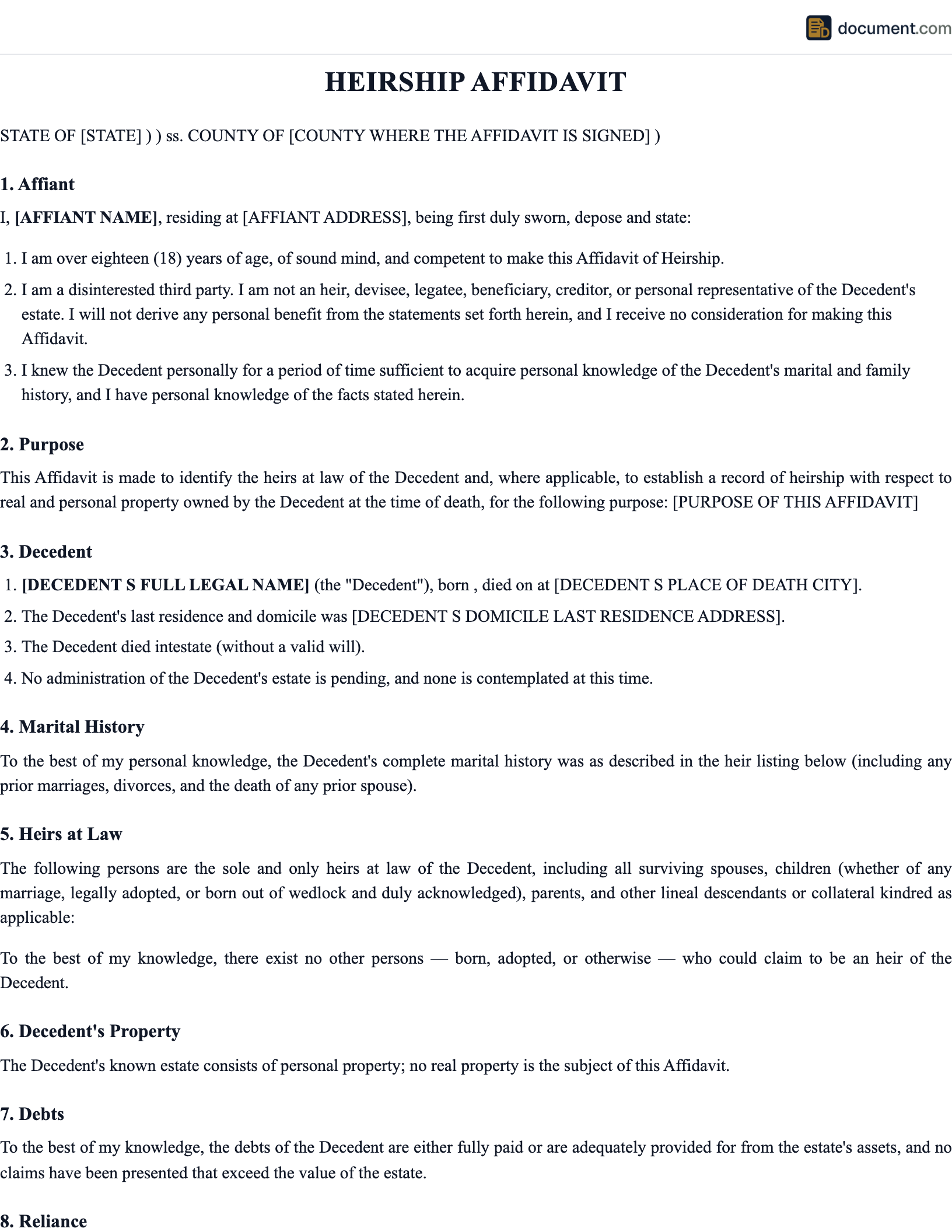



What Is an Affidavit of Heirship?
An affidavit of heirship is a sworn written statement that identifies the heirs of a person who died without a will and explains how those heirs inherit under the state's intestate succession statute. It is filed in the deed records of the county where the decedent owned real property — typically a family home, agricultural land, or mineral interest — and serves as the chain-of-title document that title insurers use to confirm ownership without requiring formal probate. The affidavit is most commonly used in Texas, Oklahoma, Arkansas, Mississippi, Georgia, and Louisiana, where statutes and long-standing practice give the document evidentiary weight.
The decedent is the person who died without a valid will. The heirsare the people who inherit under the state's intestacy statute, which generally favors surviving spouses and children, then parents and siblings, then more distant relatives. The affiantis a person who has firsthand knowledge of the decedent's family history — typically a surviving spouse, adult child, or sibling. The witnessesare two disinterested individuals who knew the decedent and the family well, who can swear to the family history, and who stand to inherit nothing from the estate. Their disinterest is the document's primary safeguard against fraud.
The legal effect of the affidavit varies by state. In Texas, an affidavit of heirship that has been on file in the deed records for five years becomes prima facie evidence of the facts stated in it under Estates Code Section 203.001. In Arkansas, the affidavit must be on file for five years before it carries the statutory presumption. In states without an explicit statutory framework, the affidavit is still recognized as a customary tool, and title insurers may accept it on a case-by-case basis depending on the property, the family situation, and the underwriting standards of the particular insurer.
The affidavit does not transfer title the way a deed does. Instead, title is considered to pass by operation of law from the decedent to the heirs at the moment of death, and the affidavit simply memorializes who those heirs are. Once the affidavit is on record, the heirs collectively hold title and can convey the property by signing a warranty deed or special warranty deed. Title companies will typically want all heirs to join in the conveyance, or at least to confirm that the affidavit accurately identifies every person with an inheritance interest.
Whether you are a Texas family clearing title to grandfather's farmland, an Oklahoma family confirming mineral interests after several generations of intestate deaths, or a Georgia family preparing to sell an inherited home, our affidavit of heirship templates are built around the family-history recitals, intestacy disclosures, and two-witness format that title insurers and county clerks expect.
Family Tree
Document marriages, children, and descendants for the intestacy chain
Avoid Probate
Clear real estate and mineral title without expensive court proceedings
Two Witnesses
Sworn by two disinterested individuals who knew the decedent and family
Affidavit of Heirship Form Preview
Below is a preview of the structure of a complete affidavit of heirship. Your final document will include every marriage, child, and descendant required by your state's intestacy statute.
Affidavit of Heirship
For Recording in the Deed Records
Section 1: Decedent
Section 2: Marital History
Marriage 1
Section 3: Children
1. Earl D. McCready — son, born 1952, living, address: Beaumont, TX
2. Ruth McCready Stiles — daughter, born 1955, living, address: Lufkin, TX
3. Vernon McCready — son, born 1958, deceased 2010, survived by 2 children: Mara McCready and Toby McCready
Section 4: Property Description
Section 5: Disinterested Witnesses
Witness 1
Witness 2
Section 6: Notarization
Witness 1 Signature
Witness 2 Signature
Notary Public
When to Use an Affidavit of Heirship
The affidavit of heirship is a specialized tool. It works well in some situations and is the wrong choice in others. Use the scenarios below to confirm fit.
An intestate decedent owned real estate
The decedent died without a valid will and owned real property — most often a family home, farm, or mineral interest. The heirs need to clear title before they can sell, lease, or refinance the property.
Mineral or royalty interests passed across generations
Oil, gas, and royalty interests in producing states (Texas, Oklahoma, Louisiana, North Dakota, New Mexico) frequently descend through several generations of intestate deaths. Each generation requires an affidavit of heirship to identify the current fractional owners.
Probate is too expensive relative to the asset value
When the only meaningful asset is a modest piece of real estate, the cost of probate (often $3,000 to $10,000+ in attorney fees and court costs) may exceed the practical benefit. The affidavit gives families a low-cost alternative for modest real property holdings.
All known heirs agree
The affidavit assumes that the heirs agree on the family history and on who inherits. If there is any dispute among potential heirs, full probate or a court-ordered determination of heirship is the safer path.
Wrong tool when: the decedent had a valid will (use probate), the estate has significant debts (creditors can attack the affidavit later), or the family history is genuinely disputed.
Heirship vs Other Documents
The affidavit of heirship is often confused with probate, with affidavits of death, and with small estate affidavits. Each addresses a different problem.
Affidavit of Heirship vs Probate
Affidavit of Heirship
- - Out-of-court, private document
- - Recorded in deed records, not court records
- - Only addresses real property and mineral interests
- - Costs hundreds of dollars
- - Carries less legal certainty than a probate decree
Probate
- - Court-supervised proceeding
- - Personal representative appointed by court
- - Addresses all assets and all creditors
- - Costs thousands of dollars
- - Produces a binding court decree of heirship
Affidavit of Heirship vs Affidavit of Death
Affidavit of Heirship
- - Identifies who inherits under intestacy law
- - Used when there is no will and no survivorship
- - Signed by two disinterested witnesses
- - Includes complete family history
Affidavit of Death
- - Documents the fact of death for an automatic transfer
- - Used with joint tenancy, TOD deed, or trust
- - Signed by surviving owner or beneficiary
- - Does not analyze heirship
Affidavit of Heirship vs Small Estate Affidavit
Affidavit of Heirship
- - Focused on real property and mineral interests
- - No estate value cap
- - Recorded in deed records of the county
- - Establishes ownership, not collection rights
Small Estate Affidavit
- - Focused on personal property of small estates
- - Subject to state value thresholds
- - Filed with court or held by claimant
- - Used to collect bank accounts and personal property
How to Create an Affidavit of Heirship
Preparing a proper affidavit of heirship takes more research than most affidavits because you must compile the decedent's complete family history. Follow these eight steps.
Confirm Intestacy
Verify that the decedent died without a valid will. Search the decedent's papers, safe deposit box, and attorney files. Check the probate court in the county of residence for any will that may have been deposited for safekeeping. If a will exists, the affidavit of heirship is generally not the right tool — you need probate.
Build the Family Tree
Research the decedent's complete marital and parental history. Document every marriage (start date, end date, manner of termination), every child (biological and adopted, in marriage and out of marriage), and the descendants of any predeceased child. Use birth certificates, marriage licenses, divorce decrees, death certificates, and old family photographs to confirm dates.
Apply the Intestacy Statute
Look up the intestate succession statute for the state where the property is located (the law of the situs governs real property). Determine which heirs inherit and in what fractional shares. The affidavit must list every heir with their share — for example, 'surviving spouse one-half, two children one-quarter each.'
Gather the Property Description
Pull the most recent deed for the property and copy the legal description verbatim. Include the assessor's parcel number, the recording reference (book/page or instrument number), the common street address, and any survey or subdivision references.
Identify Two Disinterested Witnesses
Find two people who knew the decedent and the family for many years and who stand to inherit nothing from the estate. Long-time neighbors, family friends, members of the church or community, business associates, and distant relatives outside the heirship line are all acceptable. Avoid current spouses, children, and named beneficiaries.
Draft the Recitals
Compile all of the above into a sworn affidavit with sections for: decedent identification, marital history, children and descendants, intestacy analysis, property description, disinterested-witness statements, and the legal conclusion identifying every heir and their share.
Sign Before a Notary
Both witnesses sign the affidavit in front of a notary public. Each witness must swear under oath that they have personal knowledge of the family history and that the facts are true. The notary completes the acknowledgment or jurat, applies the seal, and notes the commission expiration.
Record in the Deed Records
Take the original signed and notarized affidavit to the county clerk or recorder of the county where the real property is located. Pay the recording fee. The clerk will index the affidavit, scan it into the deed records, and return the original. In Texas, the affidavit must be on file for five years before it carries the statutory presumption.
Key Components of an Affidavit of Heirship
Every complete affidavit of heirship contains the same essential elements, regardless of state.
Decedent Identification
Full legal name, aliases, date of birth, date of death, and county of residence at death.
Marital History
Every marriage with start date, end date, name of spouse, and manner of termination.
Children and Descendants
Every child (biological and adopted, in or out of marriage) and the descendants of any predeceased child.
Intestacy Analysis
Application of state intestacy law to determine each heir's fractional share.
Property Description
Complete legal description, APN, common address, and recording reference of the prior deed.
Two-Witness Statements
Sworn statements from two disinterested individuals who knew the decedent and family for years.
Affiant Signature
Signature of a family member or witness who has personal knowledge of the facts.
Notary Acknowledgment
Notarial certificate, signature, seal, and commission expiration.
Legal Requirements
Affidavits of heirship are governed by state probate codes and real property statutes. Requirements vary significantly across states.
Texas Estates Code Section 203.001
Texas is the leading example of a state with a clear statutory framework. Under Texas Estates Code Section 203.001, an affidavit of heirship that has been on file in the deed records of a county for five years becomes prima facie evidence of the facts stated in the affidavit, including the identity of the decedent's heirs and the proportionate share of each heir in the decedent's estate. Title insurers and courts give the seasoned affidavit substantial weight as a result.
Witness Requirements
Most states require two disinterested witnesses who knew the decedent and the family for a substantial period (often described as "many years"). The witnesses must swear that they have personal knowledge of the family history and that they stand to inherit nothing from the estate. Witnesses who are heirs, named beneficiaries, or creditors are not disinterested and cannot serve. Some states accept the witnesses signing in lieu of a separate affiant; others require a separate family-member affiant in addition to the two witnesses.
Recording in the Deed Records
The affidavit must be recorded in the deed records (sometimes called the official records or land records) of the county where the property is located. Recording is what places the affidavit in the chain of title where future title examiners will find it. Recording fees typically range from $25 to $75 depending on the county and the page count.
Title Insurance Underwriting
Title insurance underwriters set their own standards for accepting an affidavit of heirship. Some will insure off a fresh affidavit; others require it to season for several years; others require additional documentation such as obituaries, family Bibles, or census records. Always confirm the underwriting requirements of the specific title insurer that will issue the policy on the next sale.
State-Specific Variations
- Texas: Estates Code Chapter 203 provides the strongest statutory framework. Five-year seasoning creates a presumption of correctness.
- Arkansas: Recognizes the affidavit by long-standing practice with a five-year seasoning rule before the title presumption applies.
- Mississippi: Recognizes affidavits of heirship with a ten-year seasoning rule; commonly used for rural and timber land.
- Oklahoma: Recognized for both surface and mineral interests under Title 16 Section 67; landmen rely heavily on recorded affidavits.
- California, New York, Florida: Affidavit of heirship is not the standard tool — these states generally require formal probate or a court-ordered determination of heirship for real property.
Sample Affidavit of Heirship
Below is a condensed preview of our affidavit of heirship template, written in the Texas tradition. Your final document will be customized to the family history of the decedent, the property at issue, and the intestacy law of your state.
AFFIDAVIT OF HEIRSHIP
STATE OF [State] COUNTY OF [County]
BEFORE ME, the undersigned authority, on this day personally appeared [Witness 1] and [Witness 2], each known to me to be a credible person, who being by me first duly sworn upon oath, stated as follows:
1. KNOWLEDGE OF DECEDENT
Each affiant has known [Decedent Full Name] ("Decedent") for at least [years]years and is well acquainted with the family history of the Decedent. Neither affiant is an heir of the Decedent and neither stands to inherit any portion of the Decedent's estate.
2. DEATH AND DOMICILE
Decedent died on [Date of Death] in [City, County, State], a resident of [County] County. Decedent died intestate, leaving no valid will.
3. MARITAL HISTORY
Decedent was married [#] times. The marriages and their disposition are as follows:
- [Spouse 1 name; dates of marriage; how terminated]
- [Spouse 2 name; dates of marriage; how terminated]
4. CHILDREN
Decedent had [#] children. Each child is identified as follows:
- [Name; date of birth; living/deceased; if deceased, surviving descendants]
5. HEIRS AT LAW
Under the laws of intestate succession of the State of [State], the heirs of the Decedent and their respective fractional interests in the Decedent's real property are:
- [Heir name — fractional share]
6. PROPERTY
[Insert complete legal description of the real property]
FURTHER AFFIANTS SAYETH NAUGHT.
Subscribed and sworn to before me by both affiants on [Date].
Frequently Asked Questions
Common questions about affidavits of heirship, intestate succession, mineral rights, and the two-witness requirement.
Official Resources
Authoritative sources for intestate succession, heirship determinations, and rural land title.
Texas Estates Code Chapter 203
Statutory framework for the Texas affidavit of heirship and the five-year presumption
ULC - Uniform Probate Code
Uniform Law Commission text and adoption status of the UPC
USDA Agricultural Law Resource Center
Resources on heirs property, partition, and rural land succession
American Farmland Trust - Heirs Property Guide
Comprehensive guide to heirs property issues for agricultural landowners
ABA Real Property, Trust and Estate Section
American Bar Association resources on intestacy and probate alternatives
NAELA - Elder Law Attorneys
National Academy of Elder Law Attorneys for finding probate counsel
American Land Title Association
Industry organization for title insurers; underwriting bulletins on heirship
Nolo - Avoid Probate Resources
Plain-English overview of probate alternatives including heirship affidavits
Create your Heirship Affidavit in under 10 minutes.
Answer a few questions and download a compliant, attorney-drafted document ready for your state.