



What Is a Small Estate Affidavit?
A small estate affidavit is a sworn written statement that allows the surviving family members of a deceased person to collect bank accounts, vehicles, personal property, and other limited assets without opening a formal probate proceeding. The affidavit is authorized by statute in every state, although the qualifying value cap, waiting period, asset definition, and procedural rules vary widely. For families with modest estates, the small estate affidavit is the single most important alternative to probate — saving thousands of dollars in attorney fees and many months of court delay.
The decedent is the deceased person whose assets are being collected. The affiant(sometimes called the "successor in interest") is the person legally entitled to the assets under the decedent's will or under the state's intestate succession statute. Typical affiants are surviving spouses, adult children, parents, or named beneficiaries. The holder of the asset — the bank, brokerage, employer, motor vehicle department, or other institution holding the property — releases the asset to the affiant upon presentation of the affidavit and a certified death certificate.
The qualifying value cap is the most important variable. California allows estates up to $184,500 (CCP 13100, adjusted periodically); Texas caps the procedure at $75,000 of personal property excluding homestead and exempt property; New York at $50,000; Illinois at $100,000; Florida summary administration at $75,000; Pennsylvania at $50,000; Ohio at $35,000 (or $100,000 with surviving spouse). Some states define value in gross terms; others net of debts. Some include real property; most exclude it. The affidavit cannot be used if the qualifying assets exceed the cap.
Most states impose a waiting period between the date of death and the date the affidavit may be presented — commonly 30 days, 40 days, or 45 days. The waiting period protects creditors and the personal representative by giving them an opportunity to come forward. After the waiting period has run, the affiant signs the affidavit under penalty of perjury, has it notarized, attaches a certified death certificate, and presents it to the institution holding the asset. The institution releases the asset to the affiant, and the family avoids probate entirely.
Whether you are collecting a final paycheck, claiming a deceased parent's checking account, transferring title to a vehicle, or recovering a security deposit, our state-specific small estate affidavit templates include the statutory recitals, waiting-period acknowledgments, asset inventories, and successor declarations that every bank, brokerage, employer, and DMV in the country expects to see.
Skip Probate
Save thousands in attorney fees and court costs for qualifying small estates
Faster Access
Collect assets in weeks rather than the 6-24 months probate typically takes
No Court Filing
In most states, the affidavit is presented directly to the asset holder
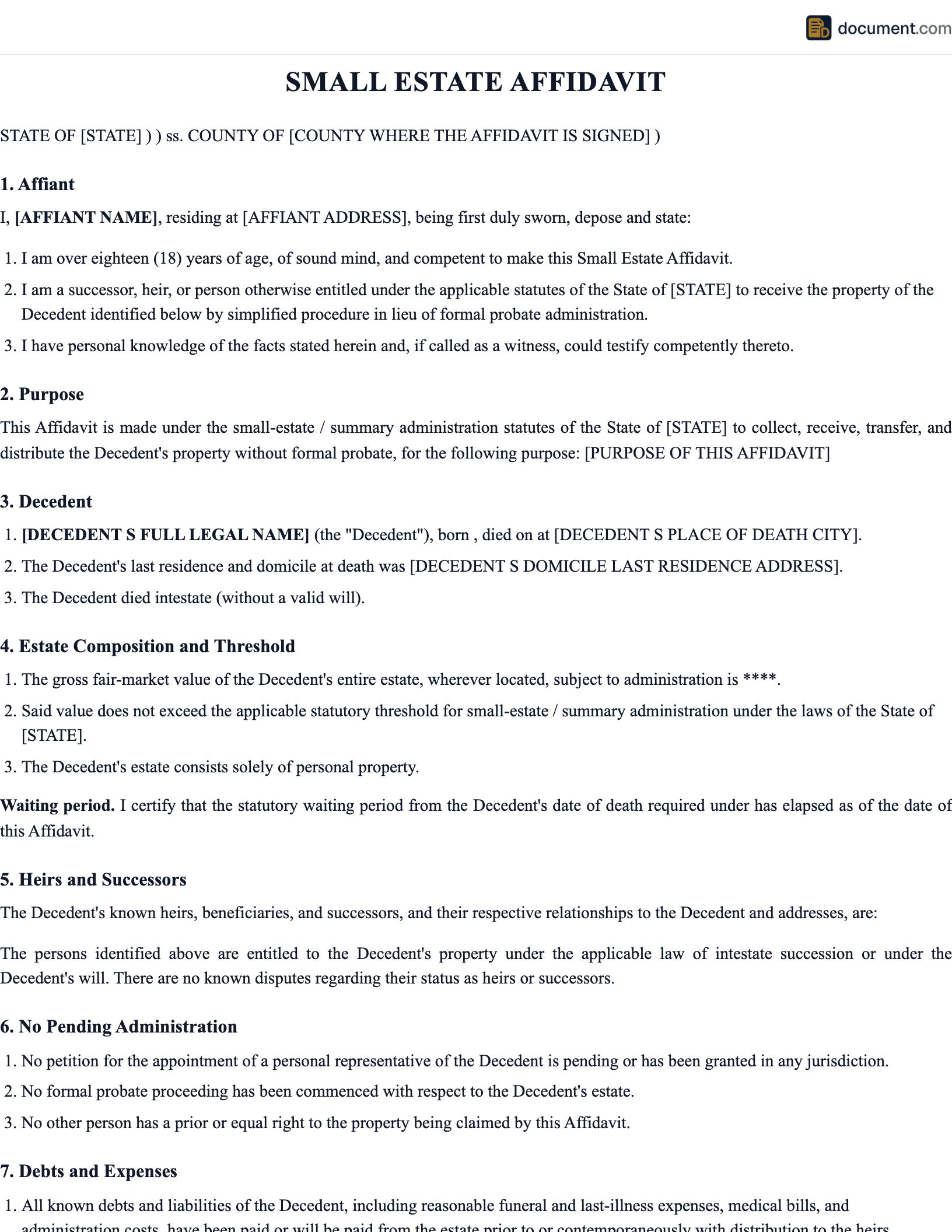
Small Estate Affidavit Form Preview
Below is a preview of a complete small estate affidavit. Your final document will be customized to your state's value threshold, waiting period, and asset disclosure requirements.
Small Estate Affidavit
For Collection of Personal Property of Decedent
Section 1: Decedent
Section 2: Affiant (Successor)
Section 3: Asset Inventory
Section 4: Sworn Declarations
1. At least 45 days have elapsed since the date of death.
2. No probate proceeding has been commenced and none is pending.
3. The total value of the qualifying estate does not exceed Tennessee's threshold of $50,000.
4. All known funeral expenses and debts of the decedent have been paid or provided for.
5. The affiant is entitled to the assets as the sole surviving heir under T.C.A. Section 30-4-103.
Section 5: Notarization
Affiant Signature
Notary Public
State Value Thresholds at a Glance
The threshold is the most important number to confirm before relying on the small estate affidavit procedure. The figures below reflect the most recent statutory caps and should always be verified against the current state statute.
| State | Cap | Wait | Notes |
|---|---|---|---|
| California | $184,500 | 40 days | CCP 13100; separate procedure for real property |
| Texas | $75,000 | 30 days | Estates Code Ch. 205; excludes homestead/exempt |
| New York | $50,000 | 30 days | SCPA Article 13; voluntary administration |
| Florida | $75,000 | Varies | Summary administration under Ch. 735 |
| Illinois | $100,000 | 30 days | 755 ILCS 5/25-1; no real estate |
| Pennsylvania | $50,000 | Varies | 20 Pa.C.S. Section 3102 |
| Ohio | $35,000 | Varies | $100,000 if surviving spouse inherits all |
| Tennessee | $50,000 | 45 days | T.C.A. 30-4-101 |
| Arizona | $75,000 | 30 days | ARS 14-3971; $100,000 for real property |
| Colorado | $80,000 | 10 days | C.R.S. 15-12-1201 |
Small Estate vs Other Documents
The small estate affidavit overlaps with several other estate-related documents. Understanding the differences is critical to choosing the right tool.
Small Estate Affidavit vs Formal Probate
Small Estate Affidavit
- - Out-of-court (in most states)
- - Subject to value cap
- - Limited to personal property
- - Waiting period 30-45 days
- - Affiant assumes creditor liability
- - Cost under $100
Formal Probate
- - Court-supervised
- - No value cap
- - Covers all assets including real estate
- - Takes 6-24 months
- - Formal creditor notice and bar date
- - Cost: thousands of dollars
Small Estate Affidavit vs Affidavit of Heirship
Small Estate Affidavit
- - Collects personal property
- - Subject to value cap
- - Signed by successor
- - Authorizes asset release
Affidavit of Heirship
- - Identifies heirs of intestate decedent
- - No value cap
- - Signed by 2 disinterested witnesses
- - Clears real property and mineral title
Small Estate Affidavit vs Letters Testamentary
Small Estate Affidavit
- - Self-help document
- - No court appointment
- - Authority limited to listed assets
- - Available only for qualifying estates
Letters Testamentary
- - Court-issued credential
- - Personal representative formally appointed
- - Broad authority over the estate
- - Required for larger estates
How to Create a Small Estate Affidavit
Preparing a valid small estate affidavit takes careful inventory work and a clear understanding of your state's threshold and waiting period. Follow these eight steps.
Confirm the Estate Qualifies
Inventory all of the decedent's assets that would otherwise pass through probate. Exclude assets that pass outside probate by their own terms — joint accounts, payable-on-death accounts, life insurance with named beneficiaries, retirement accounts with beneficiaries, and assets in a living trust. Add up the remaining qualifying assets and confirm the total is within your state's threshold.
Wait for the Statutory Period
Note the date of death and confirm that the state's waiting period (commonly 30, 40, or 45 days) has elapsed before signing the affidavit. Presenting the affidavit before the waiting period has run is a frequent reason for rejection by banks and DMVs.
Locate the Will (If Any)
Search the decedent's papers for a will. If a will exists, the affiant must distribute the assets to the beneficiaries named in the will rather than to the intestate heirs. In some states, the will must be filed with the probate court even if no estate is opened.
Identify the Successor
Determine who is legally entitled to the assets. If there is a will, the named beneficiaries are the successors. If there is no will, the heirs at law under the state's intestacy statute are the successors. Some states require all successors to join in the affidavit; others allow one to act on behalf of all.
Inventory the Assets in Detail
List every qualifying asset on the affidavit with the holder, account number, vehicle VIN, or other identifier, and the fair market value as of the date of death. Banks and DMVs will compare the affidavit to their own records and will reject affidavits that don't match.
Confirm Debts Are Handled
Review the decedent's debts and funeral expenses. Pay or provide for known creditors. The affidavit will require you to swear that debts have been handled, and the affiant assumes personal liability up to the value of assets received if creditors later appear.
Sign Before a Notary
Sign the affidavit in front of a notary public. The notary will verify your identity, watch you sign, and complete a notarial certificate. Some states (like California) accept signature under penalty of perjury without notarization, but notarization is universally accepted and is required by most banks.
Present to the Asset Holder
Deliver the original signed and notarized affidavit, along with a certified death certificate, your government-issued ID, and a copy of the will (if applicable), to each institution holding a qualifying asset. The institution will verify the documents and release the asset to the affiant.
Key Components of a Small Estate Affidavit
Every state-compliant small estate affidavit contains the same essential elements.
Decedent Identification
Full legal name, date of death, last residence address, and last four of SSN.
Affiant Identification
Full legal name, address, relationship to decedent, and basis of entitlement.
Waiting Period Recital
Sworn statement that the state's waiting period has elapsed since the date of death.
Asset Inventory
Itemized list of every qualifying asset with the holder, identifier, and value.
Threshold Compliance
Sworn statement that the total qualifying estate does not exceed the state's cap.
Debt Acknowledgment
Statement that known debts and funeral expenses have been paid or provided for.
Will Reference
Reference to the will if one exists, or statement that no will is known to exist.
Notarization
Notarial certificate, signature, seal, and commission expiration date.
Legal Requirements
Small estate affidavits are creatures of state statute, and the requirements vary significantly across jurisdictions. The following rules are common across most states.
Uniform Probate Code Article 3
Several states have adopted the Uniform Probate Code (UPC), which authorizes a collection-by-affidavit procedure under Section 3-1201. The UPC sets a default threshold of $25,000 (which adopting states typically increase) and requires a 30-day waiting period after death. The UPC also provides for summary administration of small estates under Section 3-1203. UPC states include Alaska, Arizona, Colorado, Hawaii, Idaho, Maine, Michigan, Minnesota, Montana, Nebraska, New Mexico, North Dakota, South Carolina, South Dakota, and Utah.
Notarization vs Penalty of Perjury
Most states require the affidavit to be notarized. A few (notably California) allow the affidavit to be signed under penalty of perjury without notarization. Even where notarization is not required by statute, most banks and DMVs require it as a matter of internal policy, so notarization is the safer choice in every state.
Affiant Liability for Creditors
By signing the small estate affidavit and collecting assets, the affiant accepts personal responsibility to creditors of the estate up to the value of the assets collected. If creditors later present valid claims, the affiant must pay them out of the assets received or face personal liability. For estates with significant debts, full probate may actually be safer because the publication-and-bar-date procedure cuts off late creditor claims.
State-Specific Variations
- California (CCP 13100-13116): Threshold $184,500. 40-day waiting period. No notarization required (signed under penalty of perjury). Separate $61,500 cap for real property under CCP 13200.
- Texas (Estates Code Ch. 205): Threshold $75,000 of personal property excluding homestead and exempt property. 30-day waiting period. Must be filed with probate court, not just presented to holder.
- New York (SCPA Article 13): Threshold $50,000. 30-day waiting period. Voluntary administration filed with Surrogate's Court.
- Florida (Ch. 735): Summary administration available for estates with non-exempt assets up to $75,000 or where decedent has been dead more than two years. Court petition required.
- Illinois (755 ILCS 5/25-1): Threshold $100,000. 30-day waiting period. Real estate excluded. Affidavit need not be filed with court.
Sample Small Estate Affidavit
Below is a condensed preview of our small estate affidavit template. The final document will be tailored to your state's threshold, waiting period, and required recitals.
SMALL ESTATE AFFIDAVIT
For Collection of Personal Property of Decedent
STATE OF [State] COUNTY OF [County]
I, [Affiant Name], being first duly sworn upon oath under penalty of perjury, depose and state:
1. DECEDENT
That [Decedent Name] died on [Date of Death] while a resident of [County, State]. A certified copy of the death certificate is attached.
2. WAITING PERIOD
That at least [#] days have elapsed since the date of death as required by [Statute Cite].
3. NO PROBATE PENDING
That no application or petition for the appointment of a personal representative is pending or has been granted in any jurisdiction.
4. ESTATE VALUE
That the total fair market value of the decedent's qualifying personal property does not exceed the statutory threshold of [$Cap].
ASSET INVENTORY:
[Itemized list of qualifying assets with holder, identifier, and value]
5. SUCCESSOR ENTITLEMENT
That the affiant is a successor of the decedent under [Will / Intestacy] and is entitled to the assets described above.
6. DEBTS
That all known funeral expenses and debts of the decedent have been paid or provided for, and the affiant assumes personal liability to creditors up to the value of the assets received.
The affiant requests that the holder of the assets described above deliver them to the affiant in accordance with state law.
Subscribed and sworn to before me on [Date].
Frequently Asked Questions
Common questions about thresholds, waiting periods, asset eligibility, and creditor liability.
Official Resources
Authoritative sources for probate alternatives, intestate succession, and small estate procedures.
ULC - Uniform Probate Code
Uniform Law Commission text and adoption status of the UPC, including Article 3
ABA Real Property, Trust and Estate Section
American Bar Association resources on probate alternatives and small estate procedures
NAELA - Elder Law Attorneys
National Academy of Elder Law Attorneys for finding probate counsel
CFPB - Consumer Financial Protection Bureau
Information on closing accounts of deceased family members
SSA - Social Security Forms
Survivor benefits and lump-sum death payment forms for deceased workers
IRS - Deceased Taxpayers
Federal tax obligations and final returns for a deceased person
AARP - Financial and Legal Caregiving
Plain-English guides to handling a loved one's finances after death
Nolo - Avoid Probate Resources
Comprehensive guide to small estate procedures by state
Create your Small Estate Affidavit in under 10 minutes.
Answer a few questions and download a compliant, attorney-drafted document ready for your state.