



What Is a Certificate of Trust?
A certificate of trust — also called a certification of trust, trust certificate, or abbreviated trust — is a short, sworn document that proves a trustee's authority to act on behalf of a trust without revealing the trust's full terms. The document summarizes only the information that third parties legitimately need: confirmation that the trust exists, the identity of the settlor and the currently acting trustees, the powers granted to those trustees, the revocability of the trust, and the trust's taxpayer identification number. Sensitive details — beneficiary names, distribution shares, contingent interests, and asset schedules — remain private.
The certificate of trust was created to solve a recurring privacy problem in trust administration. Trust agreements are typically 30 to 80 pages long and contain highly personal information about family relationships, intended distributions, tax planning, and creditor protection strategies. Before the Uniform Trust Code was adopted, banks and title companies routinely demanded the entire trust instrument as a condition of opening accounts or insuring real estate transactions, exposing private family arrangements to clerks and underwriters who had no need for the information.
Section 1013 of the Uniform Trust Code, adopted in some form by more than 35 states, codified the certificate of trust as the preferred method of proving trustee authority. The statute specifies what information the certificate must contain, requires third parties to accept properly executed certificates, and imposes liability on those who unreasonably refuse. Most states have enacted parallel provisions in their probate codes (for example, California Probate Code §18100.5, Florida Statutes §736.1017, and Texas Property Code §114.086).
Privacy Protection
Keeps beneficiary names, distribution shares, and asset details confidential
Bank Accepted
Required to be accepted under UTC §1013 and parallel state statutes
Quick Execution
Two to three pages; signed by trustee, notarized, ready to use
Certificate of Trust Form Preview
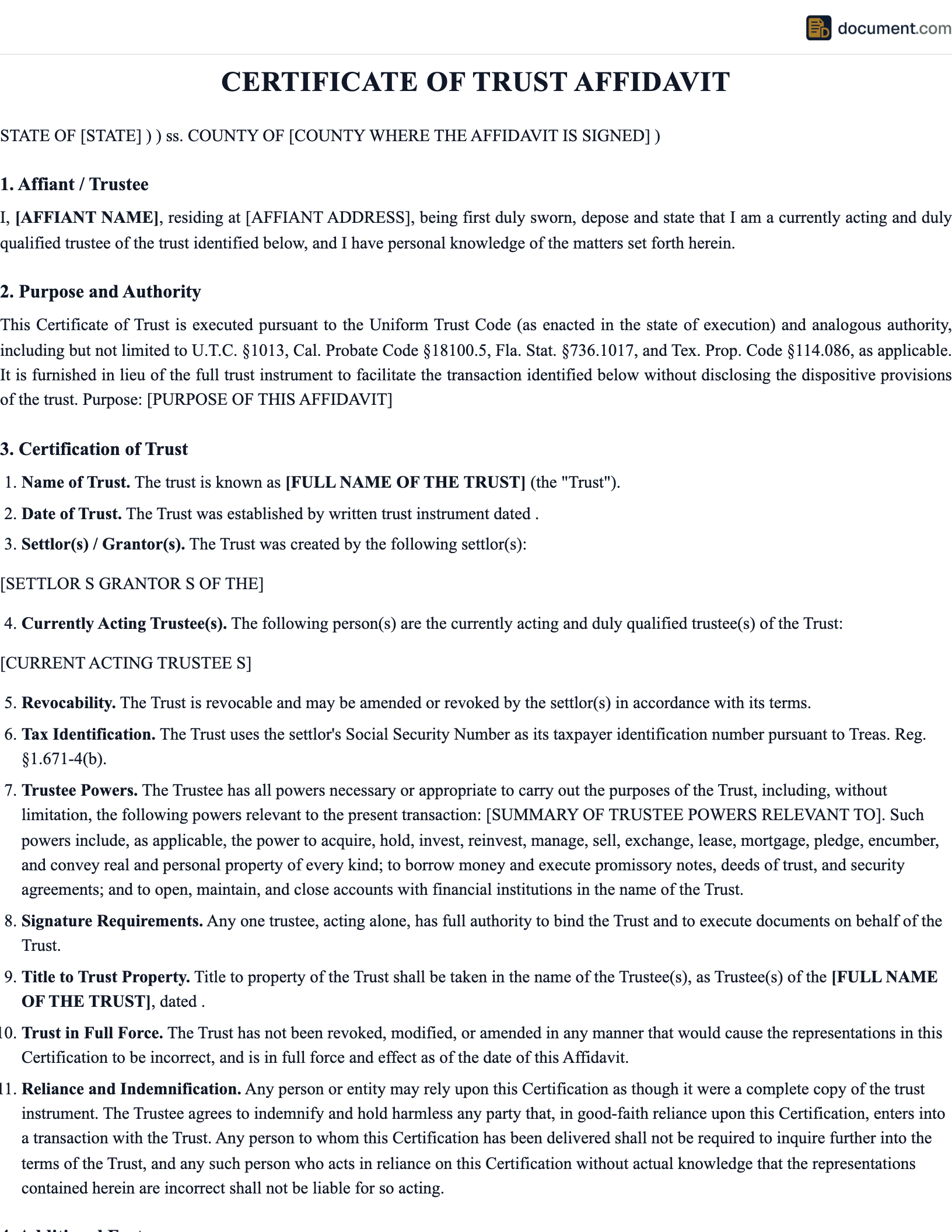
A certificate of trust is intentionally short. Below is a preview of the standard sections and sample data fields included in our attorney-reviewed template.
Certification of Trust
Pursuant to UTC §1013 / State Probate Code
Section 1: Trust Identification
Section 2: Currently Acting Trustees
Section 3: Revocability
Section 4: Trustee Powers
Section 5: Title to Trust Property
Section 6: Trustee Certification & Notary
Key Components of a Certificate of Trust
Trust Name and Date
The exact legal name of the trust as written in the trust instrument and the date the instrument was originally executed. Amendments and restatements should also be referenced.
Settlor Identification
Full legal name of the person or persons who created the trust. For joint trusts, both settlors must be named.
Currently Acting Trustees
The full legal name and mailing address of each trustee currently authorized to act. Successor trustees who have not yet taken office should not be listed.
Trustee Powers
A list of the powers relevant to the transaction at hand — for real estate transactions, the power to buy, sell, mortgage, and convey real property; for banking, the power to open accounts, write checks, and borrow money.
Revocability and Power to Revoke
A statement of whether the trust is revocable or irrevocable, and if revocable, the identity of the person holding the power to revoke.
Co-Trustee Signing Authority
If there are multiple trustees, whether they must act jointly or may act independently (severally).
Tax Identification Number
The trust's EIN, or for a grantor trust, the settlor's Social Security number.
Manner of Taking Title
The exact form in which title to trust property should be taken, typically 'Trustee Name, as Trustee of the Trust Name dated Date.'
Trustee Certification Under Penalty of Perjury
A sworn statement that the certificate is accurate and that the trust has not been revoked or amended in any way that would make the certificate inaccurate.
Notary Acknowledgment
Notarization confirming the trustee's identity and voluntary execution.
UTC Section 1013: The Legal Foundation
Section 1013 of the Uniform Trust Code, drafted by the Uniform Law Commission and adopted in some form by more than 35 states, is the statutory authority for certificates of trust. The section accomplishes three things: it specifies what a valid certificate must contain, it protects third parties who rely on a certificate in good faith, and it imposes liability on third parties who unreasonably refuse to accept one.
Subsection (b) lists the required contents. Subsection (c) requires the trustee to certify under penalty of perjury. Subsection (d) prohibits third parties from demanding the trust instrument when a valid certificate has been provided. Subsection (f) protects third parties acting in good faith reliance from liability. Subsection (g) imposes damages — including attorney's fees — on third parties who refuse a valid certificate without reasonable cause.
A handful of non-UTC states have enacted similar but distinct statutes. California uses Probate Code §18100.5. Florida uses §736.1017. Texas uses Property Code §114.086. New York lacks a comprehensive certificate-of-trust statute, but trustees in New York routinely use abbreviated trust documents that follow UTC §1013 substance. Always confirm the governing statute for your state when preparing a certificate.
How to Create a Certificate of Trust
- 1
Locate your original trust instrument and any amendments or restatements. You will need the exact trust name, execution date, settlor names, and current trustee information.
- 2
Confirm which trustees are currently acting. If a co-trustee has resigned or died, do not list them. If you are a successor trustee, gather the documents that establish your succession (death certificate, written resignation, or physician's incapacity letter).
- 3
Identify the powers relevant to the transaction. For a real estate sale, list the powers to sell, convey, and execute deeds. For a bank account, list the powers to open accounts, write checks, and borrow money.
- 4
Determine whether the trust is revocable or irrevocable, and identify any person holding the power to revoke. After the settlor of a revocable trust dies, the trust typically becomes irrevocable.
- 5
Complete the certificate using our attorney-reviewed template, ensuring all required UTC §1013 elements are included.
- 6
Sign the certificate before a notary public. The notary will verify your identity and witness your signature.
- 7
Provide the certificate to the third party (bank, brokerage, title company). For real estate transactions, the certificate is typically recorded with the county recorder.
- 8
Update the certificate whenever the trustee changes, the trust is amended, or the trust's revocability changes (for example, when the settlor dies and the trust becomes irrevocable).
When You Need a Certificate of Trust
Opening Trust Bank Accounts
Banks require proof of trustee authority before opening checking, savings, or money market accounts in the name of a trust.
Brokerage and Retirement Transfers
Investment firms require certificates before retitling brokerage accounts or accepting trustee instructions on existing accounts.
Real Estate Sales
Title insurers and county recorders require a recorded certificate of trust to insure and record deeds executed by a trustee.
Real Estate Purchases
When a trust buys property, the certificate establishes the trustee's authority to take title and sign loan documents.
Refinancing Trust-Owned Property
Mortgage lenders require certificates before issuing loans to trust-titled real estate.
Insurance Claims and Policy Changes
Life and property insurers require certificates before making changes to policies owned by a trust.
Vehicle and Boat Title Transfers
DMVs in many states require certificates before retitling vehicles into a trust.
Successor Trustee Administration
When a successor trustee takes over, a new certificate proves their authority to all third parties holding trust assets.
Certificate of Trust vs. Full Trust Instrument
| Feature | Certificate of Trust | Full Trust Instrument |
|---|---|---|
| Length | 2-3 pages | 30-80+ pages |
| Discloses beneficiaries | No | Yes |
| Discloses asset schedule | No | Often yes |
| Discloses trustee powers | Selected powers only | All powers |
| Required to be accepted by banks | Yes (UTC §1013) | Not required by statute |
| Notary required | Yes | Yes (at original execution) |
Sample Certificate of Trust
CERTIFICATION OF TRUST
Pursuant to [State Probate Code / UTC §1013], the undersigned trustee certifies the following:
1. Existence of Trust. The Margaret A. Richardson Living Trust (the "Trust") is a valid trust executed on May 14, 2018, by Margaret A. Richardson as Settlor.
2. Currently Acting Trustee. The currently acting trustee is David R. Richardson, whose address is 1500 Oak Park Drive, Chicago, IL 60614.
3. Revocability. The Trust is revocable. The power to revoke is held by the Settlor, Margaret A. Richardson.
4. Trustee Powers. The trustee is authorized to buy, sell, lease, mortgage, and convey real and personal property; open and close financial accounts; borrow money and pledge trust assets; invest and reinvest trust assets; and execute all instruments necessary to administer the Trust.
5. Tax Identification. The Trust's tax identification number is XXX-XX-4521.
6. Title to Trust Property. Title shall be taken as: "David R. Richardson, Trustee of the Margaret A. Richardson Living Trust dated May 14, 2018."
7. Certification. The undersigned trustee certifies under penalty of perjury that the foregoing statements are true and correct, that the Trust has not been revoked, and that no amendment has been made that would cause these statements to be inaccurate.
_________________________
David R. Richardson, Trustee
[Notary Acknowledgment]
Frequently Asked Questions
Official Resources
Ready to Create Your Certificate of Trust?
Attorney-reviewed, UTC §1013 compliant, ready in minutes.
Create Document