
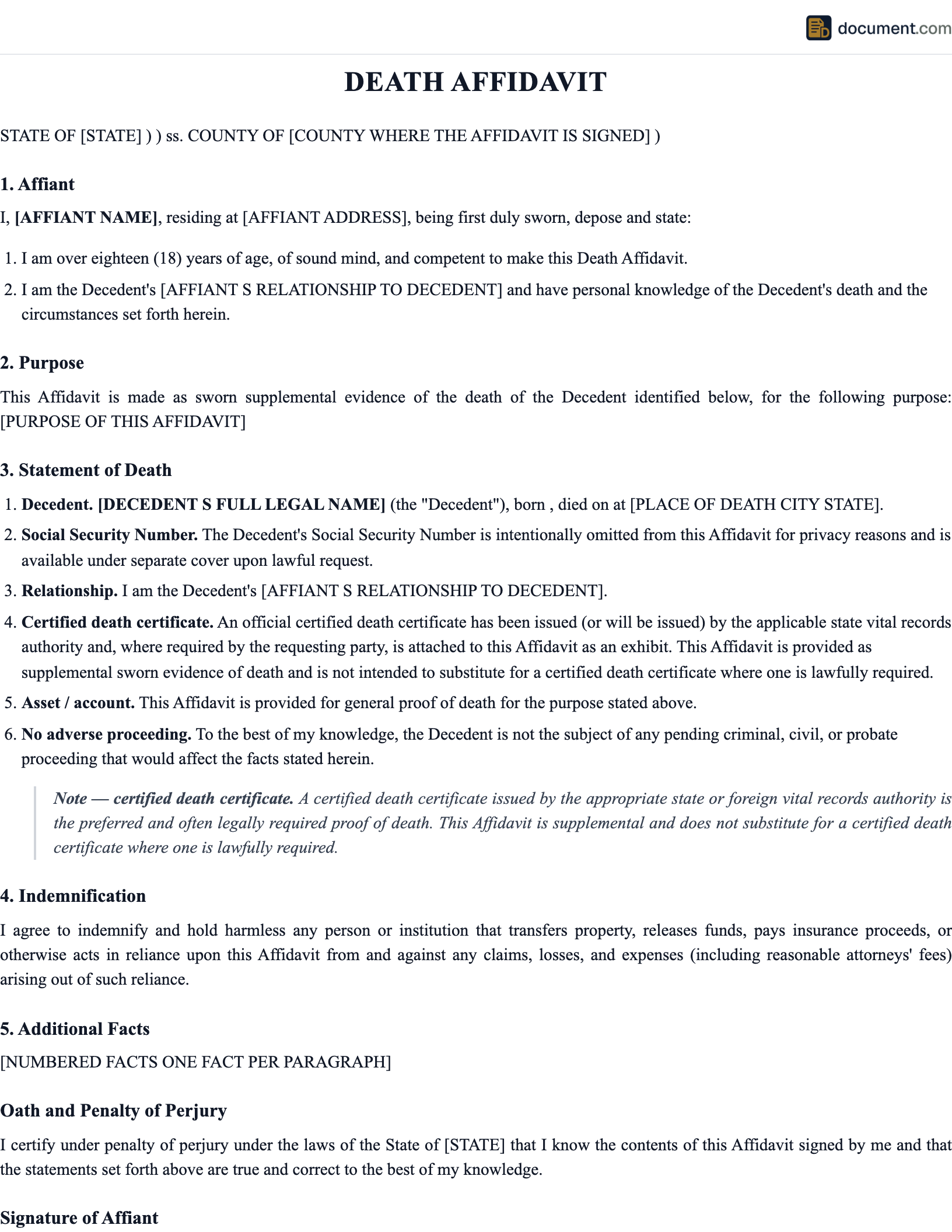



What Is an Affidavit of Death?
An affidavit of death is a sworn written statement, signed before a notary public, in which a person with personal knowledge of a death formally identifies the decedent and explains the legal consequence of that death for a specific asset or relationship. It is most commonly used in real estate to clear a deceased joint tenant from title, to perfect a transfer under a transfer-on-death (TOD) deed, to remove a deceased life tenant, or to document the death of a trustee so the successor trustee can convey trust property. The affidavit does not by itself prove the death — it must be accompanied by a certified copy of the death certificate issued by the state vital records office.
The affiant is the living person who signs the affidavit. Depending on the situation, this is typically a surviving joint tenant, a named TOD beneficiary, a successor trustee, a surviving spouse, or a court-appointed personal representative. The decedent is the person whose death is being documented. The affiant must have personal knowledge of the death — meaning they either witnessed it, attended the funeral, received the death certificate as next of kin, or was named in the legal instrument (such as the deed or trust) that depends on the death taking effect. Distant relatives, neighbors, and acquaintances generally do not qualify.
The legal effect of the affidavit is to put the public record on notice of the death and to allow a county recorder, title insurer, bank, brokerage, or other third party to act without independently investigating the survivorship event. For real property, recording the affidavit in the county where the land sits creates a continuous chain of title that a future title examiner can rely on. For accounts and policies, the affidavit gives the institution the sworn statement it needs to release funds to the named beneficiary or surviving owner.
Because the affidavit is given under oath, every statement carries perjury liability. The affiant must review the recitals carefully, attach the death certificate as an exhibit, and sign in front of a notary public. Once recorded or submitted, the affidavit becomes part of the permanent record. Errors must be corrected through a corrective affidavit or, in serious cases, a court order. For these reasons, the affidavit of death should be prepared with the same care as a deed.
Whether you are a surviving spouse clearing your home from a deceased husband or wife, the named beneficiary on a TOD deed, or a successor trustee winding up a family trust, our state-specific affidavit of death templates include the recitals, exhibit format, and notarization language that recorders and financial institutions across all 50 states accept. Each form is built around the certified death certificate as the central proof and is formatted to satisfy county recording requirements out of the box.
Clear Title
Remove a deceased joint tenant from real property and update the public record
Perfect TOD Deeds
Vest title in a transfer-on-death beneficiary without probate
Release Accounts
Support release of bank, brokerage, and insurance assets to surviving beneficiaries
Affidavit of Death Form Preview
Below is a visual preview of the sections included in a recordable affidavit of death of joint tenant. Your completed document will be fully formatted, professionally styled, and customized for the specific death scenario, the property involved, and your county recorder's formatting rules.
Affidavit of Death of Joint Tenant
For Recording in the Official Records
Section 1: Decedent Information
Section 2: Affiant (Surviving Joint Tenant)
Section 3: Property Description
Section 4: Sworn Statements
1. The decedent named above died on the date of death listed in Section 1.
2. A certified copy of the death certificate is attached hereto as Exhibit A.
3. At the time of death, the decedent and the affiant held title to the property as joint tenants with right of survivorship under the prior deed referenced in Section 3.
4. The affiant is the surviving joint tenant and is now the sole owner of the property by operation of law.
5. The affiant has personal knowledge of the facts stated above.
Section 5: Notarization
Affiant Signature
Notary Public
When to Use an Affidavit of Death
An affidavit of death is the right tool whenever a third party needs sworn confirmation that a death has occurred and that a specific legal consequence — survivorship, beneficiary vesting, trustee succession, or account release — should follow. Use the scenarios below to confirm the affidavit fits your situation.
Clearing a deceased joint tenant from real property
The most common scenario. Real property held in joint tenancy with right of survivorship passes automatically to the surviving tenant, but the public record still shows both names. The survivor records an affidavit of death of joint tenant to memorialize the event and clear title for any future sale or refinance.
Perfecting a transfer-on-death (TOD) deed
Roughly 30 states authorize TOD or beneficiary deeds. When the grantor dies, the named beneficiary records an affidavit of death of grantor (with the death certificate and, in many states, a change-of-ownership report) to vest title in the beneficiary's name without probate.
Documenting the death of a trustee
When a trustee of a revocable or irrevocable trust dies, the successor trustee must establish their authority before conveying or managing trust property. An affidavit of death of trustee, recorded with a copy of the trust's certification, provides the chain-of-trustees record that title companies require.
Terminating a life estate
When a life tenant under a life-estate deed dies, the remainder interest vests automatically in the remainderman. An affidavit of death of life tenant clears the life estate from title so the remainderman holds full fee simple ownership.
Releasing bank, brokerage, or insurance assets
Many financial institutions accept an affidavit of death (alongside a certified death certificate and a beneficiary claim form) to release small accounts or insurance proceeds without requiring letters testamentary from the probate court.
Not the right tool when:the property was owned solely in the decedent's name with no survivorship feature, no TOD beneficiary, and no living trust. In that case, you generally need probate, a small estate affidavit (if the estate qualifies), or letters testamentary.
Affidavit of Death vs Other Documents
An affidavit of death is often confused with the death certificate itself, with affidavits of heirship, and with small estate affidavits. Each document plays a distinct role.
Affidavit of Death vs Death Certificate
Affidavit of Death
- - Sworn statement by a private individual
- - Identifies the legal action being taken
- - Names affiant, decedent, and the asset
- - Recorded with the county recorder
- - Carries perjury liability
Death Certificate
- - Official government record of death
- - Issued by state vital records office
- - Signed by physician, coroner, or examiner
- - Primary legal proof that the death occurred
- - Attached as an exhibit to the affidavit
They work together: the death certificate proves the death; the affidavit explains what should happen because of it.
Affidavit of Death vs Affidavit of Heirship
Affidavit of Death
- - Documents the fact of death
- - Used when survivorship is automatic
- - Signed by surviving owner or beneficiary
- - Does not identify heirs
Affidavit of Heirship
- - Identifies the heirs of an intestate decedent
- - Used when there is no will and no survivorship
- - Signed by two disinterested witnesses
- - Establishes who inherits under intestacy law
Key takeaway: If the property automatically passes by survivorship, use an affidavit of death. If the decedent died intestate and the property is in their name alone, use an affidavit of heirship.
Affidavit of Death vs Small Estate Affidavit
Affidavit of Death
- - Used to clear title or release a single asset
- - Tied to a specific survivorship instrument
- - No estate value threshold
- - Recorded immediately after death
Small Estate Affidavit
- - Used to collect personal property of a small estate
- - Subject to state value thresholds
- - Requires statutory waiting period
- - Replaces formal probate for qualifying estates
Both documents avoid full probate, but they address different problems: the affidavit of death clears one specific asset, while the small estate affidavit collects the entire qualifying estate.
How to Create an Affidavit of Death: Step by Step
Creating a recordable affidavit of death involves gathering supporting documents, drafting precise recitals, signing before a notary, and recording with the right county office. Follow these eight steps.
Order the Certified Death Certificate
Request a certified copy of the death certificate from the state vital records office or local registrar where the death occurred. You generally need an original certified copy with the raised seal — photocopies are not accepted by recorders or financial institutions. Order at least three certified copies; you will use them for the affidavit, the insurance carrier, and the bank.
Identify the Survivorship Instrument
Locate the deed, trust, beneficiary designation, or account agreement that creates the survivorship right. For a joint tenant affidavit, this is the prior recorded deed that vested title in joint tenancy. For a TOD beneficiary, this is the recorded TOD or beneficiary deed. Pull the recording reference (book, page, or instrument number) — you will cite it in the affidavit.
Confirm the Legal Description
Copy the legal description from the prior deed exactly — including lot, block, subdivision name, and map reference. Do not paraphrase, do not abbreviate, and do not rely on the street address alone. A flawed legal description is the most common reason recorders reject an affidavit of death.
Draft the Recitals
The affidavit must clearly state: the decedent's full legal name, date of birth, date of death, and place of death; that the death certificate is attached as Exhibit A; the affiant's relationship to the decedent and capacity (surviving joint tenant, TOD beneficiary, successor trustee); the legal description and APN of the property; and a sworn statement that the affiant has personal knowledge of the facts.
Sign Before a Notary Public
All affidavits of death must be acknowledged before a notary public. The notary will verify your identity using a government-issued ID, watch you sign, and complete a notarial certificate. Many states now permit remote online notarization (RON) via video conference — useful for affiants who cannot travel.
Attach the Death Certificate as an Exhibit
Staple or clip the certified death certificate to the back of the affidavit and label it 'Exhibit A.' The exhibit will be recorded along with the affidavit and will become a permanent part of the public record. Some counties charge per page, so confirm the page count before delivering for recording.
Record with the County Recorder
Take or mail the original signed affidavit (with the death certificate exhibit) to the county recorder's office in the county where the property is located. Pay the recording fee (typically $15 to $50 plus per-page charges). The recorder will stamp the document, scan it, and return the original to the affiant or designated address.
Notify Lenders, Insurers, and Title Companies
After recording, send a copy of the recorded affidavit (with the recorder's stamp) and a certified death certificate to the mortgage servicer, homeowners insurance carrier, county assessor, and any title company that may handle a future sale. This ensures statements, policies, and tax bills are issued in the survivor's name only.
Key Components of an Affidavit of Death
Every recordable affidavit of death contains the same essential elements. Missing or inaccurate components are the leading cause of recorder rejection.
Decedent Identification
Full legal name, aliases, date of birth, date of death, place of death, and death certificate number.
Affiant Identification
Full legal name, mailing address, capacity (surviving joint tenant, TOD beneficiary, successor trustee), and relationship to decedent.
Property Description
Common address, assessor's parcel number, complete legal description, and recording reference of the prior deed.
Survivorship Recital
Clear statement of the form of co-ownership and the legal consequence of the death (vesting in survivor, beneficiary, or successor trustee).
Sworn Personal Knowledge
Statement that the affiant has personal knowledge of the facts and is competent to testify.
Notary Acknowledgment
Notarial certificate, signature, seal, and commission expiration date — the affidavit is invalid without it.
Death Certificate Exhibit
Certified copy of the death certificate attached and incorporated by reference as Exhibit A.
Recording Cover Information
Title at top of first page, return-to address, preparer information, and any state-specific cover-page items.
Legal Requirements
Affidavits of death are governed by state real property and probate codes, and the requirements vary from state to state. The following rules are common across most jurisdictions.
Notarization Is Always Required
Unlike some affidavits that may be signed under penalty of perjury without notarization, an affidavit of death must be acknowledged before a notary public to be accepted by county recorders and title insurers in every U.S. state. The notary verifies the affiant's identity, witnesses the signature, and completes a notarial certificate either as an acknowledgment or jurat depending on state practice.
Recording Format Rules
County recorders impose strict formatting requirements: a minimum top margin (often 3 inches on the first page for the recorder's stamp), minimum side and bottom margins, paper size (8.5 x 11 in most states, legal size in some), font size (typically at least 10 point), document title clearly visible at the top, and a return-to address on the first page. Documents that fail to meet these requirements are rejected at the counter or recorded with a non-conformity surcharge.
Death Certificate Attachment
A certified copy of the death certificate must be attached as an exhibit. Photocopies, uncertified printouts, and obituaries are not acceptable substitutes. Some counties will accept the certified copy and return it to the affiant after recording; others retain it permanently. Confirm the policy with your local recorder before submitting.
Community Property States
In community property states (Arizona, California, Idaho, Louisiana, Nevada, New Mexico, Texas, Washington, and Wisconsin), property held as "community property with right of survivorship" passes to the surviving spouse automatically and is cleared with an affidavit of death of spouse. The affidavit must specifically recite that the property was held as community property with right of survivorship under the relevant state statute.
State-Specific Variations
- California: Probate Code Section 210 governs affidavits of death of joint tenant. A Preliminary Change of Ownership Report (PCOR) must accompany the recording, and the county assessor will determine whether a reassessment exclusion applies.
- Texas: Estates Code Chapter 203 authorizes the affidavit of heirship; affidavits of death are typically recorded with a transfer-on-death deed under Estates Code Chapter 114.
- Florida: Statute 731.103 governs proof of death; the affidavit must reference the certified death certificate and is typically recorded with a continuous marriage affidavit when the surviving spouse is the affiant.
- New York: RPL Section 240-a governs joint tenancy; an affidavit of death is recorded with the county clerk and supported by a certified death certificate from the New York State Department of Health.
Sample Affidavit of Death
Below is a condensed preview of our affidavit of death of joint tenant template. Your completed document will be fully customized for the specific decedent, property, and recording county.
AFFIDAVIT OF DEATH OF JOINT TENANT
STATE OF [State] COUNTY OF [County]
I, [Affiant Name], being first duly sworn upon oath, depose and state:
1. DECEDENT
That [Decedent Full Legal Name], who was born on [DOB], died on [Date of Death] in[City, State], as evidenced by the certified death certificate attached hereto as Exhibit A and incorporated by reference.
2. JOINT TENANCY
That at the time of death, the Decedent and Affiant were the joint tenants with right of survivorship of the following described real property, pursuant to that certain Deed recorded[Recording Date] as Instrument No. [Inst. No.] in the Official Records of [County]:
LEGAL DESCRIPTION:
[Insert complete legal description as it appears on the prior deed]
Commonly known as: [Property Address]
APN: [Parcel Number]
3. SURVIVORSHIP
That by reason of the death of the Decedent, all right, title, and interest of the Decedent in the above-described property has vested in the Affiant as the surviving joint tenant by operation of law.
4. PERSONAL KNOWLEDGE
That the Affiant has personal knowledge of the facts stated herein and is competent to testify to the same.
FURTHER AFFIANT SAYETH NAUGHT.
Dated: [Date]
Subscribed and sworn to before me on [Date] by [Affiant Name], proved to me on the basis of satisfactory evidence to be the person who appeared before me.
Frequently Asked Questions
Common questions about affidavits of death, joint tenancy, transfer-on-death deeds, and recording requirements.
Official Resources
Authoritative sources for death certificates, vital records, and joint tenancy law.
CDC NCHS - Where to Write for Vital Records
National directory of state vital records offices for ordering certified death certificates
SSA Form SSA-721 - Statement of Death
Social Security Administration form used by funeral directors to report a death
ULC - Uniform Real Property Transfer on Death Act
Uniform Law Commission text and adoption status of the URPTODA
CFPB - Surviving Spouse Mortgage Rights
Consumer Financial Protection Bureau guidance on Garn-St. Germain protections
American Land Title Association
Industry organization for title insurers; standard forms and underwriting bulletins
ABA Real Property, Trust and Estate Law Section
American Bar Association resources on probate, title, and survivorship
IRS - Deceased Taxpayers
Federal tax obligations and final returns for a deceased person
Nolo - Joint Tenancy FAQ
Plain-English overview of joint tenancy and survivorship rules
Create your Death Affidavit in under 10 minutes.
Answer a few questions and download a compliant, attorney-drafted document ready for your state.