
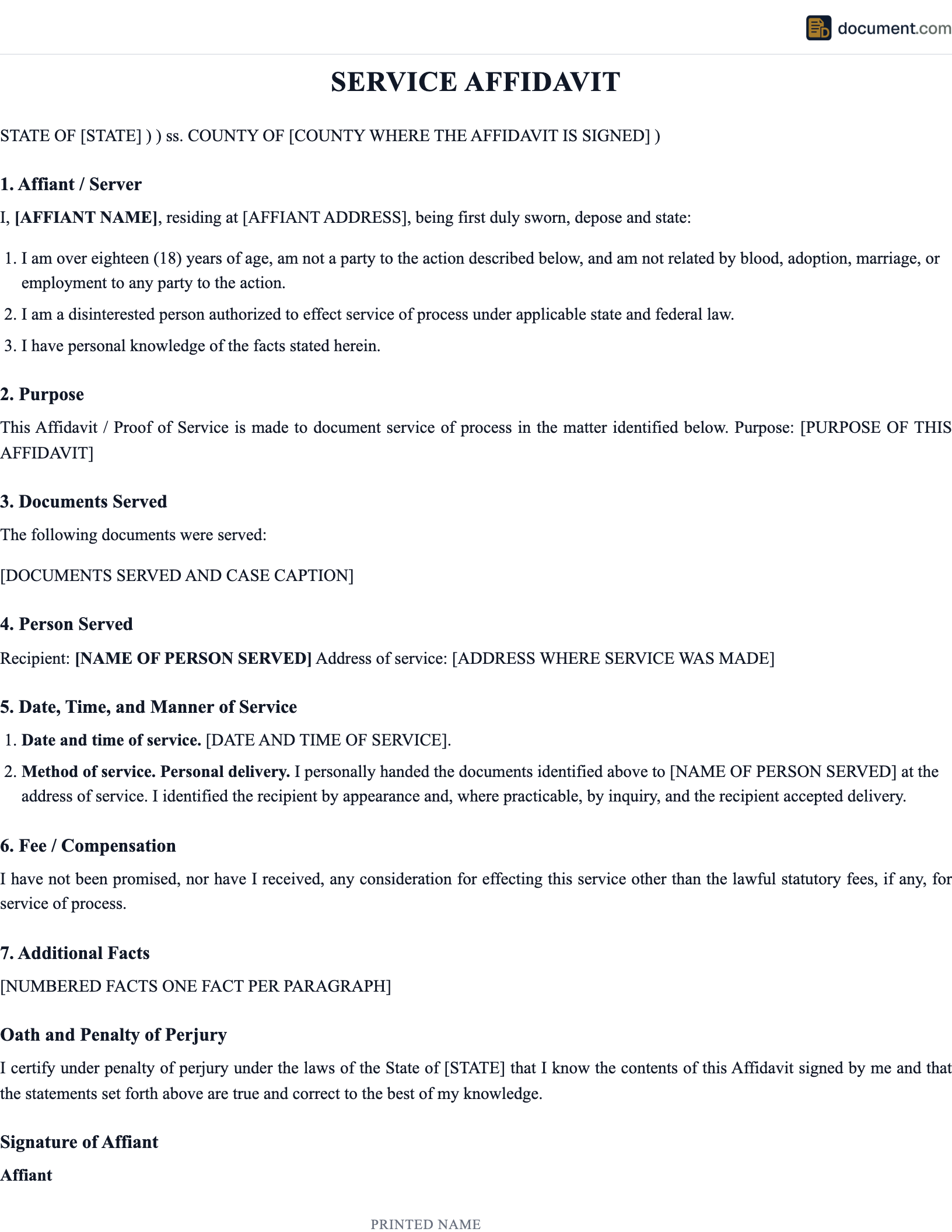



What Is an Affidavit of Service
An affidavit of service is the sworn statement establishing that a summons, complaint, subpoena, or motion was delivered in the manner required by court rule. Service of process is the constitutional predicate for personal jurisdiction under the Fourteenth Amendment Due Process Clause as set forth in Mullane v. Central Hanover Bank & Trust Co., 339 U.S. 306 (1950), and Pennoyer v. Neff, 95 U.S. 714 (1877). Without a properly filed proof, the court lacks personal jurisdiction; any judgment entered is voidable on motion to vacate under FRCP 60(b)(4) or its state-court analog. The proof is filed with the court, not the parties.
Federal courts apply FRCP 4 and call the filing a return of service. California uses CCP § 417.10 and calls it a proof of service of summons. New York uses CPLR § 308 and calls it an affidavit of service. Texas uses TRCP 107 and calls it a return. The terminology varies; the legal function is identical: a sworn first-hand account that the recipient received the legal papers in compliance with applicable service rules. The affidavit is signed by the server, not by counsel; counsel signature is improper and supports a motion to strike.
FRCP Rule 4 service requirements
FRCP 4(c)(2) authorizes service by any person who is at least 18 years old and not a party. FRCP 4(e)(2) permits personal delivery, leaving copies at the defendant's dwelling with a person of suitable age and discretion residing there, or delivery to an authorized agent. FRCP 4(h) governs corporate service through an officer, managing agent, or registered agent. FRCP 4(m) imposes a 90-day service deadline measured from filing; failure requires dismissal without prejudice absent good cause. FRCP 4(l) requires prompt filing of the return; the return is prima facie evidence of service. FRCP 4(d) waiver-of-service procedure offers cost-shifting incentives for cooperative defendants and is the default first-step in most federal civil litigation.
State-court analog rules and licensing
State rules diverge in important particulars. California CCP § 415.10 governs personal service; § 415.20 governs substituted service after diligent attempts; § 415.30 governs notice and acknowledgment. New York CPLR § 308 enumerates five methods including leave-and-mail under § 308(2) and nail-and-mail under § 308(4) requiring affixing to the door of actual dwelling and mailing. Texas TRCP 103, 106, and 107 govern personnel, methods, and returns. Five states require process-server licensing or registration: California (Bus. & Prof. Code § 22350), Texas (TRCP 103), Arizona (ARS § 11-445), Illinois (705 ILCS 405), and Nevada (NRS Ch. 648). Confirm both the substantive rule and the personnel rule before retention.
Who Can Serve Process
FRCP 4(c)(2) requires service by any person who is at least 18 and not a party. State analogs vary. The party-disqualification rule is universal across all U.S. jurisdictions: the named plaintiff, the defendant, and any party to the action are barred from serving the papers. Counsel may also be disqualified under some state rules where counsel's signature appears on the underlying papers. Most jurisdictions accept service by sheriff, U.S. Marshal under 28 U.S.C. § 566, professional process servers (licensed in California, Texas, Arizona, Illinois, Nevada), or any disinterested adult.
Professional process servers reduce defect risk through familiarity with local rules, errors-and-omissions insurance coverage, skip-trace and asset-search capabilities for evasive defendants, and contemporaneous GPS-tracked attempt logs. Pricing typically runs $40 to $150 per address with surcharges for rush service ($100 to $300), evening or weekend service, and skip-trace ($50 to $200). For high-stakes matters where service defects could reset the case (constitutional jurisdiction, statute of limitations, default judgment exposure), professional service is functionally a no-substitutes line item.
Sham-affidavit doctrine and contradictory testimony
The sham-affidavit doctrine, articulated in Cleveland v. Policy Management Systems, 526 U.S. 795 (1999) and applied to service contexts in numerous federal circuits, bars a server from submitting later testimony contradicting the sworn affidavit without sufficient explanation. A server who attests to personal hand-delivery cannot later concede in deposition that the documents were left at the door without the recipient present, absent compelling explanation. The doctrine reinforces the importance of accurate contemporaneous documentation; speculative or padded affidavits expose the server to perjury exposure under 18 U.S.C. § 1621 and state-law analogs and the underlying case to vacatur on Rule 60(b) motion.
Personal vs Substituted Service
| Method | When Used | Reliability |
|---|---|---|
| Personal Service | First choice in nearly every case | Highest, hardest to challenge |
| Substituted Service | After multiple personal attempts fail | High, requires diligent attempts log |
| Certified Mail | Permitted for some motions and post-judgment notices | Moderate, depends on signature receipt |
| Publication | When defendant cannot be located | Lowest, requires court order |
| Acceptance by Counsel | When defense lawyer agrees to accept | High, voluntary waiver |
How to Complete the Affidavit
Verify Court Service Rules
Check the local rules and state statute to confirm acceptable methods, timing, and any process server licensing requirement.
Hire or Designate a Server
Engage a registered process server, the sheriff, or another disinterested adult to perform service.
Deliver the Documents
Hand the documents to the named party, leave them with a qualified substitute, or use certified mail as authorized.
Record the Details Immediately
Note the date, time, location, recipient description, and any unusual circumstances while the events are fresh.
Complete and Sign the Affidavit
Transfer the recorded details onto the affidavit form and sign in front of a notary public if required.
File With the Court
Submit the original affidavit through the court's e-filing portal or in person at the clerk's window before any deadline.
Key Components
Court Caption
Court name, case number, and parties involved, matching the underlying complaint or motion.
Server Identification
Full name, address, age, and statement that the server is not a party to the action.
Documents Served
Exact titles of every document delivered, such as summons, complaint, and exhibits.
Method of Service
Personal, substituted, certified mail, publication, or other method permitted by court rule.
Date, Time, and Place
Specific timestamp and street address where the documents were handed over or left.
Recipient Description
Physical description of the person served including approximate age, height, weight, and distinguishing features.
Signature and Notary
Server's sworn signature acknowledged before a notary public, where state rules require.
Sample Proof of Service
AFFIDAVIT OF SERVICE
Case No. ________ Court: ________
Plaintiff: _____________ vs Defendant: _____________
I, [Server Name], being over 18 and not a party to this action, state under oath that on [Date] at approximately [Time], I personally served [Recipient] at [Address] with the following documents: [List].
Recipient described as: approx. age __, height __, weight __, hair __, race __.
I declare under penalty of perjury that the foregoing is true.
__________________________ Server / Date
Frequently Asked Questions
Common questions about FRCP Rule 4, who may serve process, substituted service, and curing service defects.
Official Resources
Federal Rule of Civil Procedure 4: Summons and Service
Authoritative text and notes for federal service of process
U.S. Courts: Summons in a Civil Action
Official AO 440 summons form for federal civil actions
U.S. Marshals Service: Civil Process
Federal Marshal-served process for indigent and government parties
Federal Court Forms Library
Catalog of federal court forms including service-related filings
File proof of service in under 10 minutes.
Answer a few questions and download a court-ready affidavit of service formatted for federal or state filing.