



What Is a Small Claims Demand Letter?
A small claims demand letter is a pre-suit demand sent by a plaintiff to a defendant before filing a small claims action. It identifies the claim, itemizes damages, sets a cure deadline, and warns the defendant of the plaintiff's specific intent to file in small claims court — naming the court, the claim amount within the jurisdictional limit, and the expected filing date if the dispute is not resolved.
What distinguishes a small claims demand letter from a generic demand letter is specificity and credibility. A generic demand threatens unspecified "legal action." A small claims demand letter names the exact court (e.g., "the [County] Small Claims Division of the Superior Court"), quotes the jurisdictional limit statute, identifies the filing date, and attaches or references a draft complaint. Defendants who receive this letter know the plaintiff has done the homework and is ready to file — which dramatically increases the settlement rate.
Small claims court is intentionally designed to be fast, cheap, and accessible to people without attorneys. Filing fees are modest ($15 to $400), attorneys are often prohibited entirely, rules of evidence are relaxed, and hearings are typically scheduled within 30 to 90 days of filing. This makes the threat of a small claims action uniquely credible — unlike the threat of a lawsuit in district or superior court, which defendants know could take years and tens of thousands in fees, the small claims threat is something the plaintiff can actually deliver on next week.
Credible Threat
Small claims is fast, cheap, and DIY-friendly — defendants know you can actually file
Jurisdictional Fit
Calibrated to your state's small claims cap, from $2,500 to $25,000
Pre-Suit Documentation
Creates a paper trail judges view favorably at the hearing
Small Claims Jurisdictional Limits
Each state sets its own small claims jurisdictional limit. Your demand letter must reference the correct limit for your state — claiming too much makes the claim ineligible for small claims, and claiming too little leaves money on the table.
| State | Small Claims Limit | Notes |
|---|---|---|
| California | $12,500 / $6,250 | Individuals / entities; attorneys prohibited |
| Texas | $20,000 | Justice Court; attorneys permitted |
| New York | $10,000 / $5,000 | NYC Civil Court / town and village courts |
| Florida | $8,000 | County Court Small Claims Division |
| Illinois | $10,000 | Circuit Court Small Claims |
| Massachusetts | $7,000 | District Court Small Claims Session |
| Delaware | $25,000 | Justice of the Peace Court |
| Tennessee | $25,000 | General Sessions Court |
| Georgia | $15,000 | Magistrate Court |
| Washington | $10,000 | District Court Small Claims |
| Kentucky | $2,500 | District Court Small Claims |
| Arkansas | $5,000 | District Court |
Types of Small Claims
Contract Dispute
Breach of written or oral contract claim under the jurisdictional limit
Unpaid Debt
Money owed on an invoice, personal loan, or account receivable
Property Damage
Damage to personal property, vehicle, or rental unit
Services Not Rendered
Paid for services that were not performed or were defective
Landlord-Tenant
Security deposit, rent overpayment, or habitability claim
Consumer Claim
Defective product, deceptive advertising, or warranty breach
Pre-Suit Demand Requirements
Some states require a pre-suit demand as a condition of filing in small claims. California, for example, requires the plaintiff to demand payment before filing and to state under oath that the demand was made (Code of Civil Procedure § 116.320(b)(3)). Other states incorporate the demand requirement informally through court rules or local practice. Even where no demand is legally required, sending one is universally recommended.
California Small Claims Demand Rule
Under California Code of Civil Procedure § 116.320(b)(3), the small claims complaint form requires the plaintiff to state: "You have asked the defendant to pay this money, but it has not been paid." In practice this means the plaintiff must have demanded payment before filing. A documented demand letter with a certified mail return receipt is the gold-standard evidence that this requirement was met.
Why Send a Demand Letter Even Where Not Required
- Settlement leverage: 50-70% of small claims disputes resolve at the demand letter stage without a filing fee or court appearance.
- Good faith evidence: Judges universally view plaintiffs who attempted reasonable resolution before suing as more credible.
- Defendant on notice: The certified mail return receipt is airtight evidence the defendant had actual notice, which defeats later claims of surprise or lack of notice.
- Specificity creates credibility: A letter that names the specific court and statutory limit signals the plaintiff knows exactly what they are doing.
- Preserves relationships: For disputes between neighbors, family members, or ongoing business relationships, a demand letter gives the defendant a face-saving way to resolve the dispute privately.
How to Write and Send a Small Claims Demand Letter
Verify Your Claim Fits the Jurisdictional Limit
Look up your state's current small claims limit. If your damages exceed the limit, decide whether to waive the excess or file in a higher court. Most individual plaintiffs waive the excess to take advantage of the small claims advantages (fast, cheap, attorney-free).
Identify the Correct Court
Small claims courts use different names in different states: California Small Claims Division, Texas Justice Court, Delaware Justice of the Peace, Tennessee General Sessions, Florida County Court Small Claims Division, New York City Civil Court, Georgia Magistrate Court. Use the correct official name in your letter.
Gather Your Evidence
Collect every document, photo, text message, email, contract, invoice, receipt, and witness statement supporting your claim. Organize chronologically. These will become exhibits at the hearing if the case is not settled.
Draft the Letter
State the facts concisely, itemize the damages, cite the specific statute or contract provision being enforced, name the exact court where you will file, reference the jurisdictional limit, and set a deadline of 10 to 30 days for payment.
Calculate Damages Precisely
Small claims judges hate math errors. Show your work: principal, interest, fees, penalties, and costs, with a clear total. Round down rather than up — a $12,487.32 claim that includes every possible penny is less credible than a $12,450 claim that is clearly conservative.
Identify the Defendant's Legal Name and Address
For individuals, use the full legal name. For businesses, look up the legal entity (LLC, corporation, partnership) on the Secretary of State business search portal and identify the registered agent for service of process. A judgment against the wrong entity is worthless.
Send by Certified Mail with Return Receipt
USPS Certified Mail with Return Receipt Requested is standard. The green card return receipt becomes Exhibit 1 at the hearing. Send a courtesy copy by first-class mail and email so the defendant cannot avoid notice by refusing certified mail.
Calendar the Deadline and File If Ignored
On the deadline date, check whether payment arrived. If not, go to the courthouse, pick up the small claims forms, complete the complaint, pay the filing fee, and schedule service of process. Your demand letter becomes Exhibit 1 at the hearing; the certified mail return receipt becomes Exhibit 2.
Key Components
Plaintiff and Defendant Information
Legal names, addresses, and contact information for both parties
Statement of the Claim
Concise factual narrative of what the defendant did and what is owed
Itemized Damages
Principal, interest, fees, penalties, and costs broken out and totaled
Specific Court Identification
Exact name and county of the small claims court where you will file
Jurisdictional Limit Reference
Citation to state statute or court rule establishing the claim limit
Cure Deadline
Specific date, typically 10 to 30 days, after which you will file
Filing Intent
Explicit statement of the date you will file if payment is not received
Signature and Exhibit List
Your signature, date, and a list of supporting documents enclosed
Filing the Small Claims Action
If the deadline passes without payment, follow through on exactly what you said you would do. Empty threats destroy your credibility; follow-through builds it.
Obtain the Forms
Most state courts publish small claims forms online. Look for the self-help center or small claims division on your state court website.
Complete the Complaint
State the parties, the facts, the amount claimed, and the court where you are filing. Keep it brief — small claims complaints are typically one page.
Pay the Filing Fee
File the complaint with the clerk and pay the filing fee ($15 to $400 depending on state and claim amount). Request a fee waiver if you qualify based on income.
Arrange Service of Process
Have the defendant personally served by a sheriff or process server, or use certified mail where permitted. Keep the proof of service.
Prepare for the Hearing
Organize your exhibits, prepare a two-minute opening, and anticipate the defendant's arguments. Arrive 30 minutes early.
Attend the Hearing
Dress conservatively. Address the judge as "Your Honor." Tell your story clearly. Let the judge ask questions. Submit your exhibits.
Collect the Judgment
If you win, the court will enter a judgment — but the court does not collect it. Use wage garnishment, bank levies, or property liens under your state's post-judgment procedures.
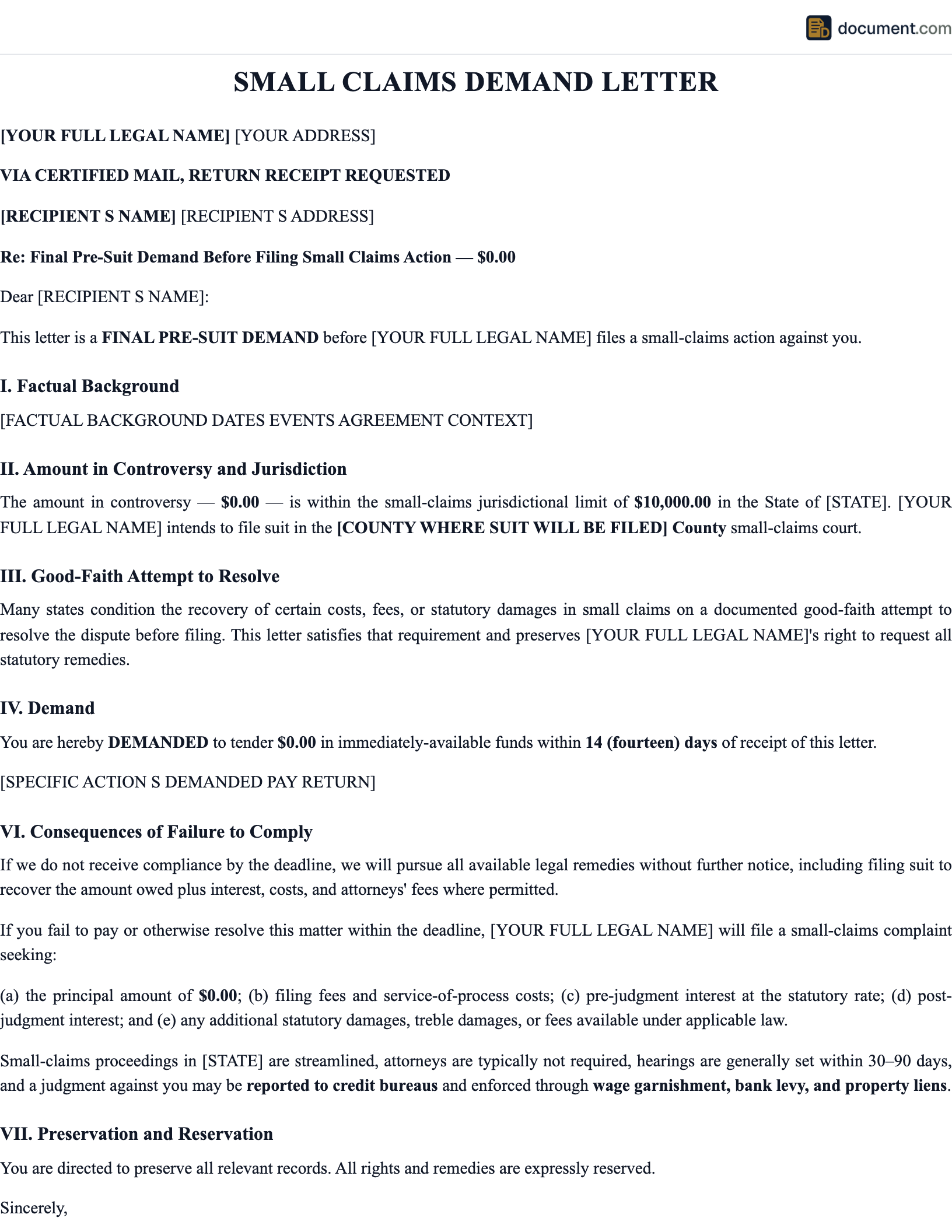
Sample Small Claims Demand Letter
[Plaintiff Name]
[Plaintiff Address]
[Date]
VIA CERTIFIED MAIL — RETURN RECEIPT REQUESTED
[Defendant Name / Registered Agent]
[Defendant Address]
Re: Notice of Intent to File Small Claims Action — Amount Claimed: $[____]
Dear [Defendant]:
This letter is a pre-suit demand and notice of intent to file a small claims action against you in the [Court Name] of [County], [State] seeking judgment in the amount of $[____], which is within the small claims jurisdictional limit of $[Limit] under [State Statute §___].
Facts: [Concise factual narrative of what happened — the contract, the breach, the damages. Keep it to one short paragraph.]
DAMAGES:
Principal: $[____]
Interest: $[____]
Costs: $[____]
TOTAL CLAIMED: $[____]
You have [14] days from the date of this letter — until [Deadline Date]— to remit payment in full. If I do not receive payment by that date, I will file a small claims action against you in the [Court Name] on or about [Filing Date], seeking the full amount above plus filing fees, service costs, and statutory costs of court.
A small claims judgment against you may be enforced by wage garnishment, bank levy, and property liens under [State] post-judgment collection procedures, and may be reported to credit bureaus. Resolving this matter now will avoid the time, expense, and judgment risk of litigation.
All rights and remedies are expressly reserved.
Sincerely,
[Signature]
[Printed Name]
Frequently Asked Questions
Official Resources
U.S. Courts - Court Structure
Overview of federal and state court systems
California Courts - Small Claims Self-Help
California self-help resources for small claims plaintiffs
NCSC - Small Claims Resources
National Center for State Courts small claims information
Nolo - Small Claims Encyclopedia
Free encyclopedia of small claims rules by state
LawHelp - Find Legal Help
Free legal aid directory for qualifying plaintiffs
ABA - Free Legal Answers
American Bar Association free legal advice program
Create your Small Claims Demand Letter in under 10 minutes.
Answer a few questions and download a compliant, attorney-drafted document ready for your state.