
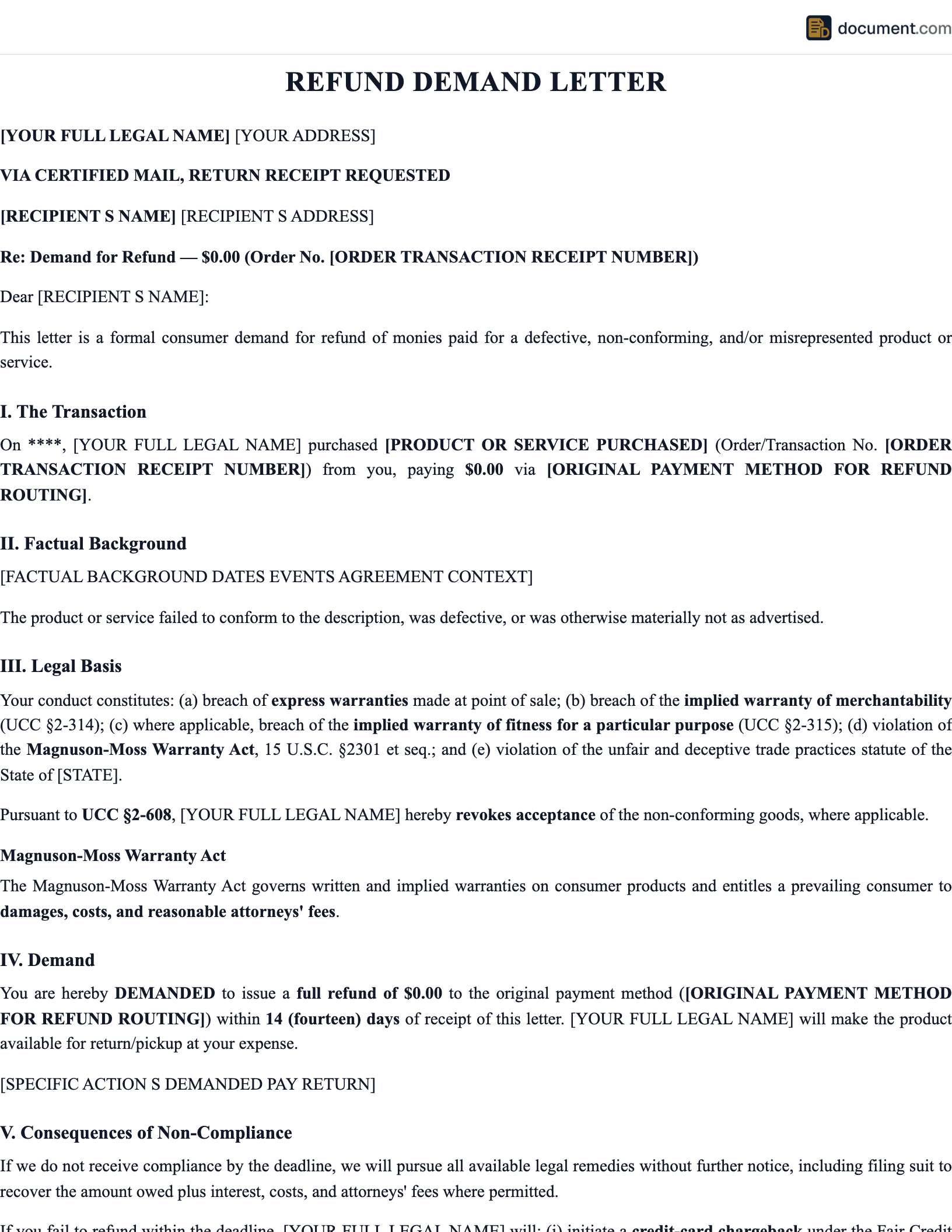



What Is a Refund Demand Letter?
A refund demand letter is a formal written notice from a consumer to a merchant demanding the return of money paid for a defective product, undelivered service, unauthorized charge, or purchase induced by deceptive advertising. It transforms a customer-service complaint into a legal claim by citing the specific consumer protection statutes the merchant has violated and warning of concrete consequences if a full refund is not issued within the stated cure period.
Unlike a payment demand (where a creditor is collecting money owed), a refund demand runs in the opposite direction — the consumer paid money, received nothing of value in return, and is demanding restoration of the status quo. The legal framework is also different. Payment demands rely on contract law and commercial collection statutes. Refund demands rely on consumer protection law: the federal FTC Act, the Magnuson-Moss Warranty Act, the Fair Credit Billing Act, state Unfair and Deceptive Acts and Practices (UDAP) statutes, state lemon laws, and the implied warranty of merchantability under UCC § 2-314.
A well-drafted refund demand letter is remarkably effective because most merchants know that consumer protection statutes carry treble damages and attorney's fees, that state attorneys general actively mediate consumer complaints, and that credit-card chargebacks bypass the merchant entirely. Faced with that exposure, the rational business decision is almost always to refund the $200 or $2,000 rather than fight.
Get Your Money Back
Recover the full purchase price plus consequential damages where allowed
Invoke Consumer Law
Cite the FTC Act, Magnuson-Moss, your state UDAP, and any lemon law
Enable Escalation
Set up FTC, state AG, BBB, chargeback, and small claims escalation
The Consumer Protection Framework
American consumers are protected by an overlapping web of federal and state laws. A strong refund demand letter cites every applicable layer to maximize the merchant's perceived exposure.
Federal Consumer Protection Statutes
- FTC Act § 5 (15 U.S.C. § 45): Prohibits unfair or deceptive acts or practices in commerce. Enforced by the Federal Trade Commission.
- Magnuson-Moss Warranty Act (15 U.S.C. § 2301): Governs written warranties on consumer products over $10. Allows consumers to sue for breach and recover attorney's fees.
- Fair Credit Billing Act (15 U.S.C. § 1666): Gives credit-card users the right to dispute billing errors, including undelivered goods and services, within 60 days of the statement date.
- FTC Cooling-Off Rule (16 C.F.R. § 429): Three-day right to cancel for door-to-door sales and certain off-premises sales of $25 or more.
- Mail, Internet, or Telephone Order Rule (16 C.F.R. § 435): Requires sellers to ship within 30 days or offer a refund.
State UDAP Statutes (All 50 States)
Every state has an Unfair and Deceptive Acts and Practices (UDAP) statute. Many include private rights of action, statutory damages, treble damages for willful violations, and mandatory attorney's fees for prevailing consumers. Notable examples:
- - Massachusetts Chapter 93A: Requires 30-day demand letter; up to treble damages plus fees
- - California CLRA (Civ. Code § 1750) and UCL (Bus. & Prof. § 17200): Broad remedies including restitution and injunction
- - New York GBL § 349: Minimum $50 damages, up to $1,000 statutory, plus fees
- - Florida FDUTPA (§ 501.201): Actual damages and attorney's fees
- - Texas DTPA (Bus. & Com. § 17.41): Economic damages, mental anguish, up to treble damages
Implied Warranty of Merchantability (UCC § 2-314)
Under the Uniform Commercial Code, adopted in some form by every state, every sale of goods by a merchant includes an implied warranty that the goods are fit for their ordinary purpose, of fair average quality, and conform to the description. A "no refunds" policy cannot override this implied warranty unless it is specifically and conspicuously disclaimed in writing at the time of sale — and even then, many states prohibit disclaimers in consumer transactions.
Types of Refund Demand Letters
Different refund scenarios call for different legal hooks. Choose the variant that matches your situation so the letter cites the correct statutes and remedies.
Defective Product
Demand refund for merchandise that does not work as advertised or arrived damaged
Undelivered Goods or Services
Recover money paid for goods or services that were never provided
Deceptive Advertising (UDAP)
Refund for purchases induced by false, deceptive, or misleading advertising
Unauthorized Charge
Demand reversal of a charge made without the consumer's authorization
Canceled Service
Refund for a subscription, event, or service canceled by the merchant
Lemon Law Claim
Refund or replacement under a state lemon law for a defective vehicle or major purchase
Refund Demand vs Other Consumer Remedies
Demand Letter vs Credit Card Chargeback
Refund Demand Letter
- - Works regardless of payment method
- - Can recover full damages, fees, treble
- - Creates paper trail for later litigation
- - Usually resolves in 14-30 days
Credit Card Chargeback
- - Only works if paid by credit card
- - Reverses the charge only, no damages
- - 60-day window for billing errors
- - Handled entirely by the card issuer
Best practice: Do both at the same time. They are not mutually exclusive.
Demand Letter vs BBB Complaint
Refund Demand Letter
- - Legally binding threat of suit
- - Cites specific statutes and remedies
- - Sent directly to the merchant
- - Triggers merchant's legal/risk review
BBB Complaint
- - Non-binding mediation
- - Affects merchant's BBB rating
- - Public visibility on BBB profile
- - No legal remedies
Demand Letter vs FTC/State AG Complaint
Refund Demand Letter
- - Individual remedy: your refund
- - Fast resolution (days to weeks)
- - Consumer-initiated, consumer-controlled
Regulatory Complaint
- - Agency-initiated action against merchant
- - May or may not result in your refund
- - Takes months to years
- - State AGs often mediate individual cases
How to Write and Send a Refund Demand Letter
Document the Problem
Gather receipts, order confirmations, photos of the defective product, screenshots of deceptive advertising, copies of written warranties, prior customer-service correspondence, and any other evidence. Your letter should reference specific documents by date and description.
Identify the Legal Theory
Determine which consumer protection laws apply: breach of express warranty, breach of implied warranty of merchantability, state UDAP statute, federal FTC Act, Magnuson-Moss Warranty Act, lemon law, or Cooling-Off Rule. Cite each applicable statute by name and section number.
Calculate Your Damages
Include the purchase price, sales tax, shipping costs, consequential damages (repair costs, alternative-product costs, lost-use damages), and any statutory minimums. Under many state UDAP statutes, willful violations allow treble damages — mention this in the letter.
Identify the Correct Recipient
Send the letter to the merchant's legal entity — not the store location. For national chains, the letter should go to the corporate headquarters or the registered agent for service of process. For small businesses, the LLC or corporation named on the receipt.
Draft the Letter
Open with the parties and the transaction. State the facts — what was purchased, when, for how much, and why it is defective or deceptive. Cite the specific statutes violated. Itemize your damages. Demand a full refund by a specific deadline. List the consequences: FTC complaint, state AG complaint, BBB dispute, chargeback, and small claims action.
Comply with Statutory Demand Requirements
If you are invoking Massachusetts Chapter 93A, the letter must (1) identify the claimant, (2) reasonably describe the unfair or deceptive act, and (3) describe the injury. You must wait 30 days before suing. Lemon law statutes often require written notice to the manufacturer first.
Send by Certified Mail with Return Receipt
Use USPS Certified Mail with Return Receipt Requested. Send a courtesy copy by email. Keep the original signed return receipt in your file.
Follow Through on the Deadline
On the deadline date, check whether the refund was issued. If not, file the FTC complaint, state AG complaint, BBB dispute, and/or small claims action you threatened. Merchants learn that you mean what you say.
Key Components of a Refund Demand Letter
Consumer and Merchant Information
Names, addresses, and contact information for the consumer and the merchant's legal entity
Transaction Details
Date of purchase, order number, product/service, amount paid, and payment method
Description of the Problem
Specific facts: what is defective, what was misrepresented, what was not delivered
Statutory Citations
Federal FTC Act, Magnuson-Moss, state UDAP statute, lemon law, UCC § 2-314
Itemized Damages
Purchase price, tax, shipping, consequential damages, and any statutory treble demand
Refund Deadline
A specific calendar date, typically 14 to 30 days; 30 days for Chapter 93A
Escalation Notice
FTC, state AG, BBB, chargeback, and small claims action if refund not issued
Signature and Evidence List
Consumer signature, date, and a list of enclosed exhibits (receipts, photos, etc.)
FTC, State AG, and BBB: The Escalation Path
The threat of regulatory escalation is what gives a refund demand letter its teeth. Merchants know that state AG complaints get mediated, FTC complaints feed enforcement investigations, and BBB complaints affect their public ratings. Naming each of these specifically in your letter signals that you know exactly where to go next.
Federal Trade Commission (FTC)
File at ReportFraud.ftc.gov. The FTC does not pursue individual refunds but aggregates complaints to identify patterns. Widespread complaints lead to enforcement actions, which merchants desperately want to avoid. Your complaint becomes part of the Consumer Sentinel Network used by federal, state, and local law enforcement.
State Attorney General
Every state AG has a consumer protection division. Most actively mediate individual consumer complaints — a state AG staff member will contact the merchant on your behalf. State AG contact is particularly effective because it puts the merchant on notice that the state's enforcement authority is watching. Many merchants refund immediately upon receiving an AG inquiry.
Better Business Bureau (BBB)
File at bbb.org. The BBB offers non-binding mediation and publishes the complaint on the merchant's BBB profile. This is particularly effective for merchants that actively maintain their BBB rating, including most service businesses, home improvement contractors, and auto dealers.
Credit Card Chargeback
If you paid by credit card, dispute the charge with your card issuer under the Fair Credit Billing Act. Billing errors (including undelivered goods and services) must be disputed within 60 days of the statement date. The issuer provisionally credits your account while investigating.
Small Claims Court
For refunds under your state's small claims limit (typically $5,000 to $25,000), small claims court is fast, inexpensive, and does not require an attorney. Under many state UDAP statutes, you may recover treble damages and attorney's fees even in small claims.
Sample Refund Demand Letter
[Consumer Name]
[Consumer Address]
[Date]
VIA CERTIFIED MAIL — RETURN RECEIPT REQUESTED
[Merchant Legal Entity Name]
Attn: Consumer Affairs / Legal Department
[Registered Agent Address]
Re: Demand for Refund — Order No. [____] — Amount $[____]
Dear [Merchant]:
This letter is a formal demand under [State] Unfair and Deceptive Acts and Practices statute, Section [___], the federal Magnuson-Moss Warranty Act, 15 U.S.C. § 2301, and the implied warranty of merchantability under UCC § 2-314, for a full refund of $[____] paid to you on [Date] for [product/service] under Order No. [____].
Facts: On [Date] I purchased [item description] from you for $[____]. The product [describe defect / describe how it was misrepresented / describe non-delivery]. I contacted your customer service on [Date] and [describe response]. The product fails to conform to [the express warranty / the implied warranty of merchantability / your advertising] and constitutes an unfair and deceptive act under [State UDAP statute].
DAMAGES CLAIMED:
Purchase price: $[____]
Sales tax: $[____]
Shipping: $[____]
Consequential damages: $[____]
TOTAL: $[____]
Plus treble damages and attorney's fees if this matter proceeds to litigation.
You have [30] days from the date of this letter — that is, by [Deadline]— to issue a full refund in the amount of $[____]. If you fail to do so, I will (1) file a complaint with the Federal Trade Commission, (2) file a complaint with the [State] Attorney General's Consumer Protection Division, (3) file a complaint with the Better Business Bureau, (4) initiate a credit card chargeback under the Fair Credit Billing Act, and (5) file suit in [County] Small Claims Court seeking the full refund, treble damages, and attorney's fees as authorized by [State UDAP statute].
All of my rights and remedies are expressly reserved.
Sincerely,
[Signature]
[Printed Name]
Frequently Asked Questions
Official Resources
FTC - Report Fraud
File a consumer complaint with the Federal Trade Commission
FTC - How to Get a Refund
Official FTC guide to refund rights and consumer remedies
CFPB - Consumer Financial Protection Bureau
Financial product complaints and consumer education
BBB - File a Complaint
Better Business Bureau complaint and mediation system
NAAG - Find Your State Attorney General
Directory of all 50 state AG consumer protection divisions
FTC - Mail Order Rule
30-day shipping rule for mail, internet, and telephone orders
Create your Refund Demand Letter in under 10 minutes.
Answer a few questions and download a compliant, attorney-drafted document ready for your state.