


What Is a Demand Letter?
A demand letter communicates a claim and asks for payment, property, performance or another specific response. It can help organize a dispute, but it does not determine liability, create a judgment or guarantee settlement. Its effect depends on the actual facts, governing law and applicable procedure.
Demand letters are used in a wide range of situations: recovering an unpaid loan, reclaiming a security deposit, collecting unpaid wages, resolving a breach of contract, pursuing compensation after an accident, returning defective goods, and many others. Because each type of dispute has its own facts, legal standards, and procedural requirements, our templates are organized by category so you can select the one that matches your situation and get content tailored to that claim.
State supported facts and distinguish disputed or unknown points. Explain the request and its basis, check independent deadlines, and describe only lawful next steps actually being considered. Do not assume that selecting a state completes a statutory notice or makes every remedy available.
Assert Your Rights
Formally notify the other party of your claim and legal position
Create a Record
Document your good-faith attempt to resolve the dispute before filing suit
Explore Resolution
Communicate a supported request and consider an appropriate resolution process
Demand Letter Form Preview
An illustrative outline. Replace every placeholder with checked facts; the completed letter depends on the selected dispute type.
Demand Letter
Payment Request — Draft Outline
Section 1: Parties
Section 2: Statement of Facts
Section 3: Demand
Section 4: Procedure and Next Steps
Section 5: Signature
Sender Signature
Date
Types of Demand Letters
Select the template that matches the type of dispute you are trying to resolve.
Insurance Claim Request
Review actual policy, claim and notice facts
Returned Check Request
Reconcile the returned check, payments and any specific notice procedure
Property Damage
Explain actual damage, ownership and supported loss
Payment Demand Letter
Demand payment of an overdue invoice, loan, or other monetary obligation
Personal Injury
Describe actual injuries, disputed responsibility and supported losses
Refund Demand Letter
Request a refund for defective goods or unsatisfactory services
Security Deposit
Review the deposit, deductions, records and applicable return procedure
Small Claims
Pre-filing demand letter required or recommended before small claims court
Unpaid Wages
Demand payment of wages, overtime, or final paychecks owed by an employer
Personal Property
Demand return of personal belongings held by another party
Child Support
Request a verified support balance or clarification of account records
Response to Demand
Respond to a demand letter you have received
Contract Breach
Demand a remedy for a breached contract including payment, performance, or cure of default
How to Write a Demand Letter
A clear, professional demand letter follows a predictable structure. Walk through these steps.
- 1
Gather the facts and documents
Collect contracts, invoices, photos, receipts, correspondence, and any other evidence that supports your claim.
- 2
Identify the legal basis
Determine which legal theory applies — breach of contract, negligence, violation of a statute, or unjust enrichment.
- 3
State the facts clearly
Present the facts in chronological order, sticking to what you can prove and avoiding emotional language.
- 4
Specify the amount or action
State exactly what you are demanding, whether it is a dollar amount, return of property, or performance of an obligation.
- 5
Check each deadline
Distinguish the requested response date from statutory periods, contractual cure rights and filing deadlines.
- 6
Describe actual next steps
Identify lawful options being considered without promising automatic litigation, penalties or enforcement.
- 7
Use the required delivery method
Check the actual method, recipient and timing rules; retain accurate dispatch and receipt records.
Key Components
Review these items and any additional requirements of the actual procedure.
State and Claim-Specific Requirements
A state selection alone does not establish the governing law, complete a statutory demand or preserve a filing deadline. Check the actual claimant, respondent, transaction, remedy and proceeding.
For example, Massachusetts chapter 93A section 9 generally requires a qualifying written demand at least 30 days before the covered action, with specified exceptions. The content, recipient and mailing or delivery matter; a generic 14-day request is not interchangeable with that process.
California small-claims guidance explains that asking for payment is a separate preliminary step, subject to exceptions, and can be done in person, by phone or in writing. A demand letter is not universally required to use certified mail. Other claim-specific statutes can impose different requirements.
Use the relevant court or agency instructions for forum limits, filing, service and representation rules. Do not treat a general demand as a court pleading, government claim form, debt-validation notice or insurance filing.
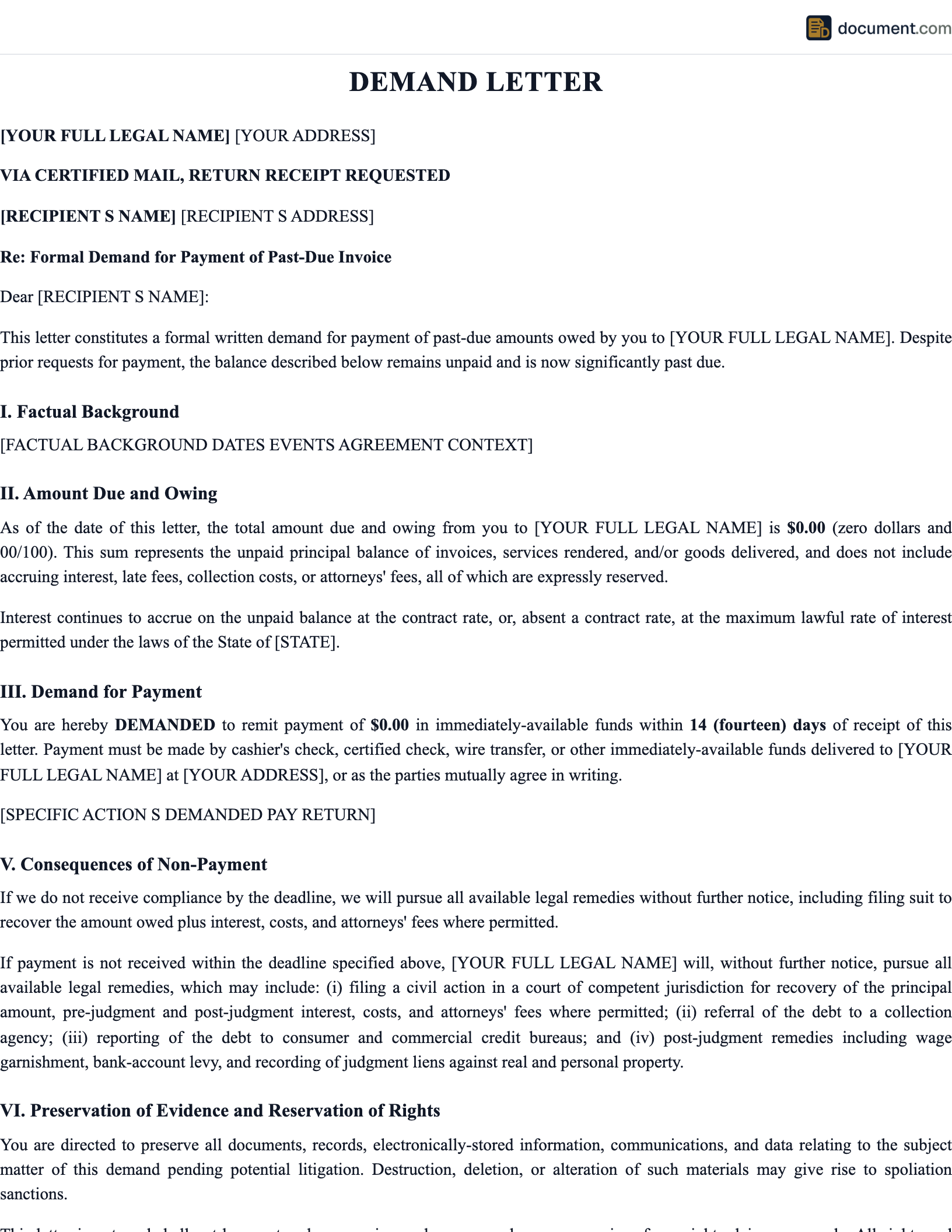
Sample Demand Letter
An unsigned outline showing the information to review. It is not a completed demand or statutory notice.
DEMAND LETTER
Payment Request — Draft Outline
[Sender Name]
[Sender Address]
Date: [Date]
[Actual intended lawful delivery method]
[Recipient Name]
[Recipient Address]
Re: Formal Demand for Payment — [Matter / Invoice #]
Dear [Recipient]:
1. STATEMENT OF FACTS
[Describe the actual agreement or incident, relevant dates, supported performance or loss, disputed facts and source records.]
2. DEMAND
[State the supported payment or other request. Itemize principal, lawful adjustments, amounts already received and the specific basis for any additional remedy. Choose the response date only after checking independent deadlines.]
3. PROCEDURE AND NEXT STEPS
[Identify the actual notice or cure procedure, intended delivery, required waiting period and lawful next steps being considered. Silence does not automatically establish liability or award additional remedies.]
4. FINAL REVIEW
[Review accuracy, authority, privacy, payment details and all separate deadlines before signing. A reservation of rights does not replace a required filing or extend time. Unresolved requests remain unsigned drafts.]
Sincerely,
[Printed Name]
Frequently Asked Questions
Common questions about demand letters, legal weight, and next steps.
Official Resources
Trusted resources on dispute resolution, small claims, and consumer rights.
Massachusetts chapter 93A section 9
Specific consumer-demand content, timing and exceptions
California small-claims guidance
San Mateo court guidance on asking for payment and separate filing steps
Federal Rule of Evidence 408
Conditional treatment of compromise offers and negotiation statements
Find the relevant court
USAGov directory of federal, state and local court resources
Find affordable legal help
USAGov legal-aid and lawyer resources
Create your Demand Letter in under 10 minutes.
Organize the actual facts and review the requirements before signing or sending.