
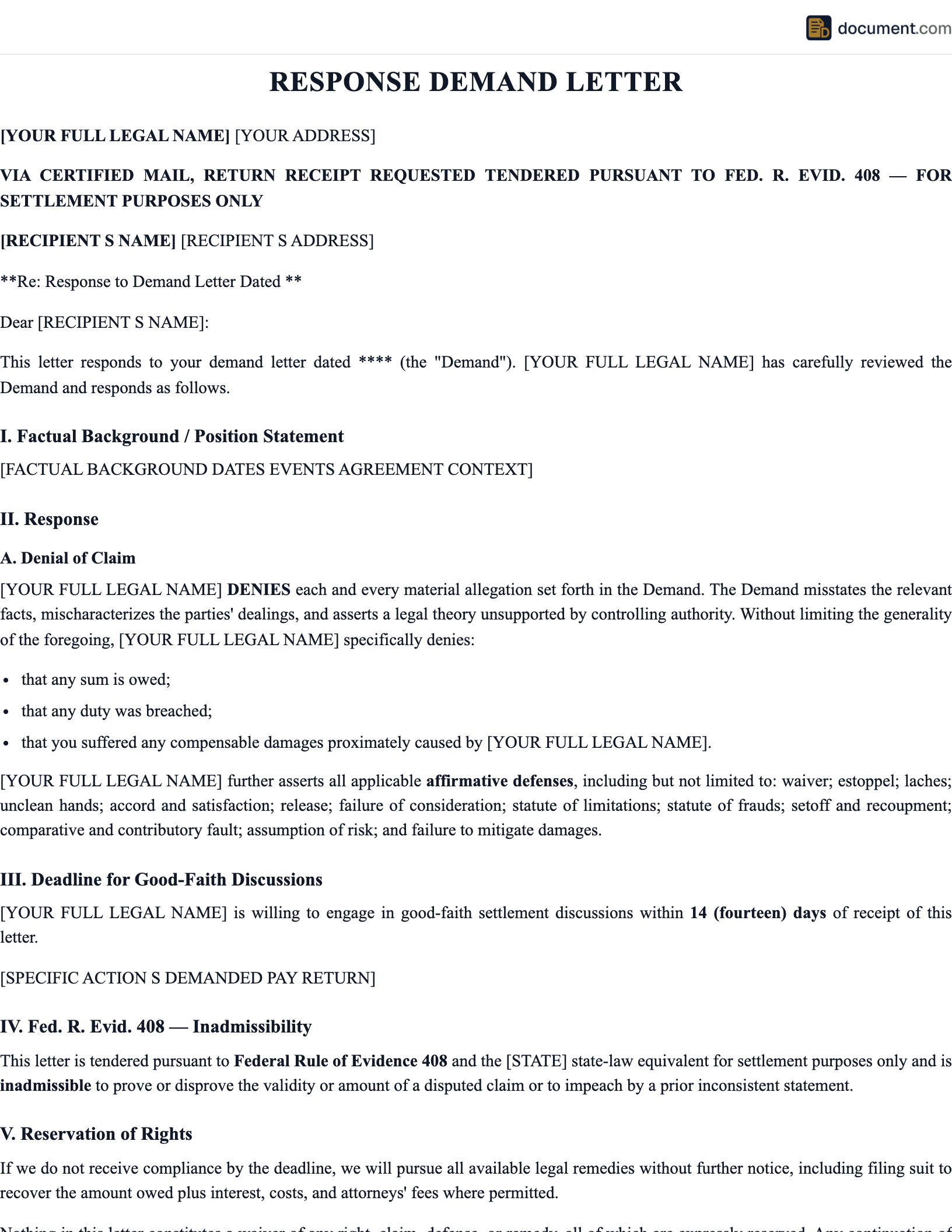



What Is a Response to a Demand Letter?
A response to a demand letter is your formal written reply to someone who has sent you a demand — whether they are demanding payment, return of property, contract performance, or that you stop a particular activity. Receiving a demand letter can be stressful, but your response is one of the most important documents in the dispute because it sets the tone for everything that follows: negotiations, mediation, or litigation. A well-drafted response can resolve the dispute entirely, narrow the issues to a manageable scope, or create a strong evidentiary record that protects you if the case goes to court.
The response serves multiple strategic functions simultaneously. It preserves your legal defenses by raising them in writing before a lawsuit is filed — some defenses, such as statute-of-limitations arguments, prior material breach, and failure to mitigate damages, are stronger when documented early. It corrects factual inaccuracies in the demand before the sender's version of events becomes the accepted narrative. It demonstrates good faith to a future judge, who will evaluate both parties' pre-litigation conduct when awarding costs and fees. And it opens the door to settlement negotiations, which resolve the vast majority of civil disputes without the expense and uncertainty of trial.
Perhaps most importantly, a written response prevents the inadvertent admissions that occur during phone calls and in-person confrontations. When you respond verbally to a demand, you may say things in the heat of the moment — apologies, partial acknowledgments, emotional statements — that can be used against you. A written response gives you time to think, consult an attorney if needed, gather evidence, and craft a measured reply that protects your interests while keeping the door open to resolution.
Preserve Defenses
Raise legal defenses early and avoid inadvertent admissions
Control the Narrative
Correct factual errors and present your side of the dispute
Open Settlement Talks
Propose resolution terms protected by settlement privilege
Response to Demand Letter Form Preview
Response to Demand Letter
Sent via Certified Mail, Return Receipt Requested
RE: Your Demand Letter Dated
Dear ,
I am writing in response to your demand letter dated , received on . Without admitting liability or the validity of any claim, I respond as follows:
FACTUAL CORRECTIONS
Your letter contains several factual inaccuracies that must be addressed:
SETTLEMENT PROPOSAL (RULE 408 PROTECTED)
Without admitting liability, and solely for the purpose of resolving this matter, I propose:
RESPONDENT
DATE
Key Components
A strong response to a demand letter addresses each element of the demand while protecting your legal position:
| Component | Purpose | Key Details |
|---|---|---|
| Acknowledgment of Receipt | Confirms you received and reviewed the demand | Date received, reference to sender's letter date, no admission language |
| Non-Admission Clause | Protects against inadvertent liability admissions | "Without admitting liability" language, reservation of all rights and defenses |
| Factual Corrections | Disputes inaccurate claims before they become accepted | Point-by-point rebuttal of specific false or misleading statements with supporting evidence |
| Legal Defenses | Raises defenses that may bar or reduce the claim | Statute of limitations, prior material breach, failure to mitigate, accord and satisfaction, waiver |
| Counterclaims | Puts the sender on notice of their own exposure | Claims you have against the sender, quantified damages, supporting documentation |
| Settlement Proposal | Opens negotiation under settlement privilege | Counteroffer amount, payment terms, mutual release language, Rule 408 protection statement |
| Document Preservation Notice | Creates a mutual obligation to preserve evidence | Request that the sender preserve all relevant documents, communications, and electronic records |
How to Write Your Response
Read the Demand Letter Carefully — Multiple Times
Before writing anything, read the demand letter at least twice. On the first read, understand the claims being made. On the second read, identify specific factual assertions, legal theories, dollar amounts, deadlines, and threats. Highlight or note each claim that you need to address. Do not respond in anger or haste — take 24 to 48 hours to let the emotional reaction subside before drafting your response.
Gather Your Evidence and Documentation
Collect every document relevant to the dispute: the underlying contract or agreement, invoices and payment records, correspondence (emails, texts, letters), photographs, receipts, and any witness information. Organize the evidence chronologically so you can construct an accurate factual timeline. Your response is only as strong as the evidence supporting it.
Open with Non-Admission Language
Begin your response by acknowledging receipt of the demand letter without admitting any of its claims. Use standard protective language: 'Without admitting liability, the validity of any claim, or the accuracy of any factual assertion in your letter, I respond as follows.' This boilerplate protects you from having your response used as an admission in court.
Address Each Claim Point by Point
Go through the demand letter systematically and respond to each factual assertion and legal claim. Correct inaccuracies with specific, documented counter-evidence. For claims you dispute, explain why they are wrong. For claims where the law is on your side, cite the relevant statute or legal principle. Do not ignore valid points — if a claim has merit, address it constructively rather than pretending it does not exist.
Raise Your Defenses and Counterclaims
If you have legal defenses (statute of limitations has expired, the sender breached the contract first, you already performed your obligations), state them clearly. If you have counterclaims against the sender, present them with the same specificity and documentation you would use in a demand letter. Counterclaims often shift the negotiation dynamics in your favor.
Propose a Resolution (If Appropriate)
If you want to settle, include a settlement proposal clearly labeled as a compromise under Federal Rule of Evidence 408 (or your state's equivalent). State your counteroffer, the payment terms, and the requirement for a mutual release of all claims. Even if you believe you owe nothing, offering a nominal 'nuisance value' settlement can be cheaper than litigation. If you do not want to settle, simply state that you reject the demand and are prepared to defend any legal action.
Types of Responses
Your response strategy depends on the merits of the demand and your goals for resolving the dispute. Choose the approach that best fits your situation:
Full Denial
Reject the demand entirely when the claims are baseless. Deny the factual allegations, raise your defenses, and state you are prepared to defend any lawsuit. Used when you owe nothing and the demand has no legal merit.
Partial Dispute with Counteroffer
Acknowledge part of the claim but dispute the amount or specific allegations. Offer to pay the undisputed portion and negotiate the remainder. The most common response type that leads to settlement.
Acceptance with Conditions
Agree to the demand in substance but propose modified terms: a payment plan instead of lump sum, a later deadline, or a mutual release of all claims. Used when the claim has merit and you want to resolve it on manageable terms.
Counterclaim Response
Deny the demand and assert your own claims against the sender. This shifts the dynamic from defense to offense and creates settlement leverage when the sender also faces legal exposure.
Frequently Asked Questions
Official Resources
Authoritative resources on civil dispute resolution, settlement negotiations, and legal rights when responding to demands.
ABA - Dispute Resolution Section
American Bar Association resources on mediation, arbitration, and negotiation as alternatives to litigation.
U.S. Courts - Types of Cases
Federal judiciary overview of civil case types, procedures, and how disputes progress through the court system.
Federal Rule of Evidence 408
The federal rule protecting settlement negotiations from being used as evidence of liability in court.
CFPB - Debt Validation Rights
Consumer Financial Protection Bureau guidance on your rights when a debt collector sends a demand or collection notice.
FTC - Fair Debt Collection Practices Act
Full text of the FDCPA, which regulates how third-party debt collectors can communicate and make demands.
ABA - Free Legal Help Directory
Find free or low-cost legal assistance in your area if you need help responding to a complex demand.
Create Your Response to a Demand Letter
Protect your rights with a professional response that disputes claims, preserves defenses, and opens the door to settlement.
Create DocumentNo account required. Free to create and preview.