
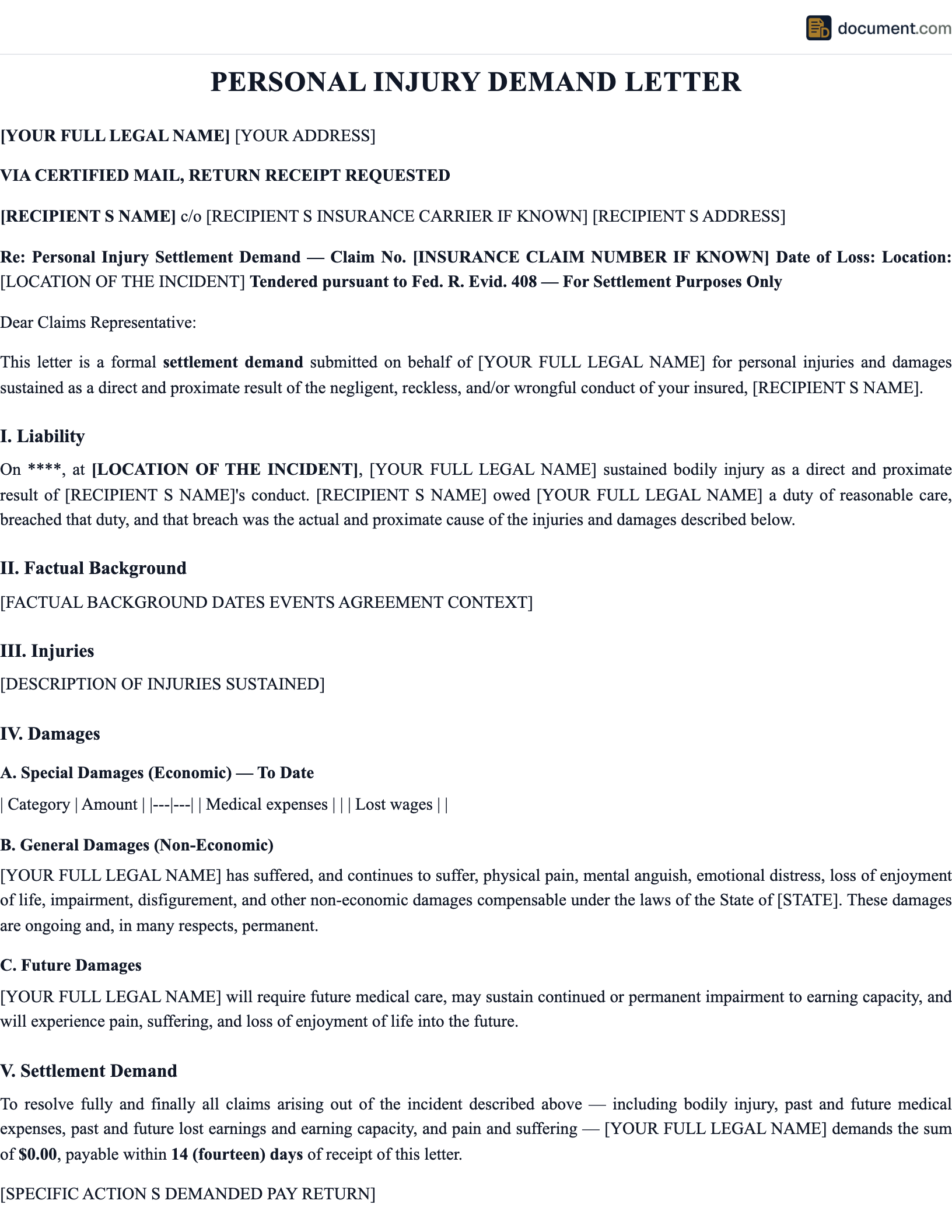



What Is a Personal Injury Demand Letter?
A personal injury demand letter is the formal document that opens settlement negotiations with an at-fault party's insurance company after you have been injured in an accident. It is not a lawsuit — it is a pre-litigation negotiation tool that presents your version of events, establishes the other party's liability, documents your injuries and medical treatment, itemizes your economic damages (medical bills, lost wages, out-of-pocket costs), calculates your non-economic damages (pain and suffering, emotional distress, loss of enjoyment of life), and states a specific dollar amount you are willing to accept to settle the claim.
The demand letter is the most important document in the settlement process because it frames the entire negotiation. Insurance adjusters handle hundreds of claims simultaneously and often spend less than 30 minutes reviewing a file before making an initial offer. A clear, well-organized demand letter with supporting documentation makes it easy for the adjuster to justify a fair settlement to their supervisor. A disorganized or vague letter, by contrast, signals an unsophisticated claimant and invites a lowball offer. The letter is your best opportunity to control the narrative of what happened and why the insurer should pay.
Most personal injury claims in the United States settle without ever going to trial — the Insurance Research Council estimates that roughly 95% of personal injury cases are resolved through negotiation. The demand letter is the vehicle that drives these settlements. Even if you ultimately hire an attorney, the demand letter stage is where the claim's value is established, and the quality of the supporting documentation you provide directly affects the outcome.
Document Injuries
Present medical records, treatment timelines, and prognosis reports
Calculate Damages
Itemize medical costs, lost income, and pain and suffering valuations
Negotiate Settlement
Anchor negotiations with a documented, justifiable demand amount
Personal Injury Demand Letter Form Preview
Demand for Settlement of Personal Injury Claim
Sent via Certified Mail, Return Receipt Requested
RE: Claim No. / Date of Loss:
Dear ,
I. FACTS OF THE ACCIDENT
On , at approximately , your insured caused an accident at .
II. INJURIES AND TREATMENT
As a direct result of this accident, I sustained the following injuries:
III. DAMAGES SUMMARY
Total medical expenses: $
Lost wages: $
Pain and suffering: $
CLAIMANT
DATE
Key Components
A persuasive personal injury demand letter follows a logical structure that builds the case from liability through damages to the settlement demand:
| Component | Purpose | Key Details |
|---|---|---|
| Factual Narrative | Establishes what happened and who is at fault | Date, time, location, weather, description of the incident, police report number, witness names |
| Liability Analysis | Explains why the other party is legally responsible | Duty of care, breach, causation, applicable traffic laws or safety codes, comparative fault rebuttal |
| Injury Description | Documents the physical and emotional harm | Diagnosis, treatment received, treating physicians, prognosis, permanent limitations or scarring |
| Medical Expenses | Itemizes every treatment cost | ER, ambulance, surgeon, imaging, PT, prescriptions, future medical estimates with supporting documentation |
| Lost Wages | Recovers income lost due to the injury | Days missed, hourly rate or salary, employer verification letter, tax returns for self-employed |
| Pain & Suffering | Values non-economic damages | Multiplier calculation, daily impact narrative, disrupted activities, emotional distress documentation |
| Settlement Demand | States the specific dollar amount requested | Total demand, response deadline (typically 30 days), reservation of right to file suit if not resolved |
How to Write a Personal Injury Demand Letter
Wait Until You Reach Maximum Medical Improvement
Do not send the demand letter until your doctor confirms you have reached MMI — the point where your condition has stabilized and the full extent of your injuries is known. Sending too early risks undervaluing your claim because future treatment costs and permanent impairments may not yet be apparent.
Gather All Evidence and Documentation
Collect the police report, photographs of the accident scene and your injuries, medical records from every provider, itemized medical bills, prescription records, employer wage verification letters, proof of out-of-pocket expenses (mileage to medical appointments, medical equipment purchases), and any witness statements or surveillance footage.
Write the Factual Narrative and Liability Analysis
Describe exactly what happened in chronological order: the date, time, location, weather conditions, what the at-fault party did or failed to do, and how their actions caused the accident. Cite specific traffic laws, building codes, or safety standards they violated. Address comparative fault preemptively if the adjuster might argue you were partially at fault.
Itemize All Economic Damages
Create a detailed table listing every medical expense by provider, date, service, and amount. Add lost wages with supporting documentation. Include out-of-pocket costs (prescriptions, medical devices, travel to appointments). If future medical treatment is expected, include an estimate supported by your doctor's prognosis letter.
Calculate Non-Economic Damages
Apply the multiplier method (1.5x to 5x economic damages based on severity) or the per diem method (daily rate from injury date through MMI). Write a personal narrative describing how the injuries affected your daily life, relationships, hobbies, sleep, and emotional well-being. This section is what separates a strong demand from a weak one.
State Your Demand Amount and Deadline
Add economic damages plus non-economic damages to arrive at your total demand. Add a negotiation buffer of 25% to 50% above your true target. State the total clearly and give the insurer 30 days to respond. Reserve your right to file a lawsuit if the claim is not resolved.
Calculating Damages in a Personal Injury Demand
The damages section is the heart of your demand letter. Insurance adjusters evaluate claims based on documented, verifiable numbers. Present your damages in three categories so the adjuster can follow your logic and justify the settlement to their supervisor.
Economic Damages (Special Damages)
Quantifiable out-of-pocket losses with receipts: medical bills, ambulance charges, prescriptions, physical therapy, lost wages, property damage, and future medical costs supported by a doctor's estimate.
Non-Economic Damages (General Damages)
Subjective losses that lack a receipt: pain and suffering, emotional distress, loss of enjoyment of life, loss of consortium, scarring and disfigurement, and post-traumatic stress.
Damage Caps
Some states cap non-economic damages in personal injury cases. For example, several states limit pain and suffering awards in medical malpractice cases to $250,000 to $750,000. Check your state's specific damage cap rules before calculating your demand, as exceeding a statutory cap signals to the adjuster that you are not familiar with the law.
Frequently Asked Questions
Official Resources
Authoritative resources on personal injury law, insurance claims, and accident reporting.
National Highway Traffic Safety Administration (NHTSA)
Federal accident data, vehicle safety ratings, and crash investigation reports for motor vehicle claims.
National Association of Insurance Commissioners (NAIC)
State insurance department directory and consumer complaint resources for insurance claim disputes.
U.S. Courts - Personal Injury Overview
Federal judiciary explanation of personal injury case types, filing procedures, and jurisdictional requirements.
OSHA - Occupational Safety and Health Administration
Workplace safety standards and violation records relevant to workplace injury claims.
Consumer Financial Protection Bureau (CFPB)
Guidance on medical debt, credit reporting of injury-related debts, and financial rights of injured consumers.
ABA - Personal Injury Law Resources
American Bar Association consumer guidance on personal injury claims, finding a lawyer, and understanding your rights.
Create Your Personal Injury Demand Letter
Document your injuries, calculate your damages, and negotiate a fair insurance settlement with a professional demand letter.
Create DocumentNo account required. Free to create and preview.