



What Is a Breach of Contract Demand Letter?
A breach of contract demand letter is a formal written notice from the non-breaching party to the breaching party that identifies a specific contractual obligation that has not been fulfilled and demands a remedy — performance, payment of damages, or both — within a stated timeframe. It differs from a general demand for payment in that it must reference the underlying contract, identify the breached provision by section or clause, explain how the breach occurred, and connect the breach to quantifiable harm.
The letter serves multiple strategic purposes beyond simple notification. It satisfies contractual notice-and-cure prerequisites that many agreements require before the non-breaching party can declare a formal default or file suit. It creates a contemporaneous written record of the claim that can later be introduced as evidence of both the breach and the claimant's good-faith effort to resolve the matter without litigation. And it puts the breaching party on formal notice that continued nonperformance will result in escalated legal action — which, in practice, motivates settlement in the majority of contract disputes.
Contract breaches arise in virtually every commercial and personal context: a vendor who fails to deliver goods by the agreed date, a contractor who abandons a project midway, a business partner who violates a non-compete clause, a buyer who refuses to close on a purchase, a tenant who defaults on lease obligations, or an employer who fails to pay commissions earned under an employment agreement. Each situation requires a letter tailored to the specific obligation, the available remedies, and the procedural posture of the relationship.
Satisfy Notice Requirements
Fulfill contractual notice-and-cure provisions before declaring default
Preserve Legal Rights
Document the breach and your damages to strengthen a future lawsuit
Force Resolution
Pressure the breaching party to cure, settle, or negotiate before court
When to Send a Breach of Contract Demand Letter
Timing is critical. Send the demand letter as soon as you can document that a contractual obligation has been missed and informal attempts to resolve the issue have failed. Waiting too long weakens your position in two ways: it can support a defense of waiver (the argument that your silence constituted acceptance of the nonperformance), and it allows the breaching party to argue laches — that your delay caused them prejudice. At the same time, sending the letter before the obligation is actually due, or before you have gathered the facts necessary to state your claim precisely, can undermine your credibility.
Certain situations call for immediate action. If the contract contains a time-is-of-the-essence clause and the deadline has passed, send the letter promptly — the clause itself may eliminate any grace period. If you discover that the other party has repudiated the contract (stated explicitly that they will not perform), you can send a demand letter immediately without waiting for the performance date to arrive; this is known as anticipatory repudiation. If the breach is ongoing — such as a continuing violation of a non-compete or confidentiality provision — the letter should demand immediate cessation as well as damages for the period of the violation.
Check your contract's notice clause first
Many commercial contracts require that breach notices be sent to a specific address, by a specific method (certified mail, overnight courier), and within a specific number of days after the non-breaching party knew or should have known of the breach. Failing to follow these requirements exactly can void your right to claim a default. Read the "Notices" section of your contract before drafting the letter.
Types of Contract Breach
Not all breaches are equal, and the type of breach determines the remedies available to you and the urgency of your demand. Understanding the distinction is essential to drafting an effective letter.
Material Breach
A material breach goes to the heart of the contract and substantially deprives the non-breaching party of the benefit they bargained for. It excuses the non-breaching party from further performance and entitles them to sue for total damages. Examples include a contractor who abandons a construction project, a supplier who delivers goods that are fundamentally different from what was ordered, or a buyer who refuses to pay for delivered merchandise. Your demand letter should characterize the breach as material and explain why you are treating the contract as terminated.
Minor (Partial) Breach
A minor breach is a failure to perform some aspect of the contract that does not destroy its overall value. The non-breaching party must continue to perform their own obligations but can recover damages for the specific deficiency. Examples include a vendor who delivers goods one week late, a painter who uses a slightly different shade than specified, or a service provider who completes 90% of the work as agreed. Your demand letter should demand cure of the specific deficiency and compensation for any resulting losses without claiming the entire contract has been destroyed.
Anticipatory Repudiation
Anticipatory repudiation occurs when one party unequivocally communicates — through words or conduct — that they will not perform their contractual obligations before the performance date arrives. The non-breaching party does not have to wait for the actual breach; they can immediately treat the contract as breached and demand damages. Your demand letter should quote or describe the repudiating statement, demand retraction and assurance of future performance under UCC Section 2-609 (for goods) or common law, and state a deadline for response.
Fundamental Breach (UCC)
Under the Uniform Commercial Code, which governs the sale of goods in all 50 states, a buyer who receives non-conforming goods can reject the entire shipment under the "perfect tender" rule (UCC Section 2-601). However, if the buyer has already accepted the goods, they must show the nonconformity substantially impairs the value of the lot or commercial unit before they can revoke acceptance (UCC Section 2-608). Your demand letter should cite the applicable UCC section and explain whether you are rejecting, revoking acceptance, or demanding a price reduction and cure.
How to Write a Breach of Contract Demand Letter
A breach of contract demand letter follows a specific logical structure. Each section builds on the previous one to construct a clear, persuasive case for why the recipient must act.
Identify the Contract
Open with a clear identification of the contract: the names of the parties, the date of execution, the subject matter, and any contract number or reference identifier. If you are working from a written contract, attach a copy. If the agreement was oral, describe the essential terms that were agreed upon and any evidence supporting the existence of the agreement (emails, text messages, witnesses, partial performance).
State Your Performance
Explain that you have fulfilled your obligations under the contract or that your performance was excused by the other party's breach. Be specific: if you delivered goods, state the date, quantity, and method of delivery. If you performed services, describe what was completed and when. This section preempts the "first-breach" defense and establishes your standing to demand performance from the other side.
Describe the Breach
Identify the specific contractual provision that was breached — by section number if the contract is written — and explain in plain language exactly what the other party failed to do or did wrong. State the date the obligation was due, the date the breach occurred or was discovered, and any correspondence or conduct surrounding the breach. Include a chronological narrative if the breach involved multiple acts or omissions over time.
Quantify Your Damages
Calculate and itemize your damages clearly. Include direct damages (the value of the performance you did not receive), consequential damages (foreseeable losses caused by the breach, such as lost profits or costs incurred to find a replacement), incidental damages (expenses incurred in dealing with the breach, such as inspection and cover costs), and any contractual penalties or liquidated damages. Show your math so the recipient — and a future judge — can verify every number.
State Your Demand and Deadline
Be explicit about what you want: payment of a specific dollar amount, completion of specific work, delivery of specific goods, or some combination. Set a firm deadline — typically 10 to 30 days from receipt — and state clearly what happens if the deadline passes. Common consequences include filing a lawsuit, terminating the contract, seeking specific performance, or pursuing arbitration if the contract contains an arbitration clause.
Send by Certified Mail
Send the letter by certified mail with return receipt requested. If the contract specifies a different delivery method (overnight courier, registered mail, personal service), use that method instead — or use both. Also send a courtesy copy by email and regular mail. Keep the certified mail receipt, tracking information, and a date-stamped copy of the complete letter package, including all attachments.
Key Components of a Breach of Contract Demand Letter
While every demand letter should be tailored to the specific dispute, the following elements are present in virtually every effective breach of contract demand.
| Component | Purpose | Common Mistake |
|---|---|---|
| Contract identification | Establishes which agreement is at issue | Referencing the wrong date or party name |
| Breached provision citation | Narrows the dispute to a specific obligation | Vague allegations without section references |
| Chronological fact narrative | Creates a clear record of events | Skipping dates or jumping between events |
| Proof of your performance | Preempts the first-breach defense | Assuming performance is obvious to the reader |
| Itemized damages calculation | Shows the financial stake and supports your claim | Round-number estimates without supporting math |
| Specific demand | Tells the recipient exactly what you want | Leaving the demand ambiguous or open-ended |
| Firm deadline | Creates urgency and starts the clock for escalation | Using "as soon as possible" instead of a date |
| Consequences of noncompliance | Motivates the recipient to take the demand seriously | Empty threats you cannot or will not follow through on |
| Attachments and evidence | Supports your factual assertions with documentation | Referencing documents without actually attaching them |
Calculating Breach of Contract Damages
The fundamental principle of contract damages is to put the non-breaching party in the position they would have been in had the contract been fully performed — known as the "benefit of the bargain" or expectation damages. Courts recognize several categories of damages in breach of contract cases, and your demand letter should identify which categories apply to your situation and calculate each one separately.
Direct (Expectation) Damages
The difference between what you were promised and what you received. If a contractor agreed to build a deck for $15,000 and abandoned the project after completing half the work, your direct damages include the cost to hire another contractor to finish the job minus what you would have paid the original contractor for the remaining work. For goods, this is typically the difference between the contract price and the market price (or cover price) at the time of breach under UCC Section 2-712 or 2-713.
Consequential Damages
Losses that flow indirectly from the breach and were foreseeable at the time the contract was formed. The classic test comes from Hadley v. Baxendale (1854): consequential damages must arise "naturally" from the breach or be within the "reasonable contemplation" of both parties when the contract was made. Examples include lost profits from a business that could not open because a contractor missed the construction deadline, or revenue lost when a supplier's failure to deliver materials forced a factory to shut down.
Incidental Damages
Reasonable expenses incurred as a direct result of the breach — the costs of inspecting defective goods, arranging return shipment, finding a replacement supplier, storing goods pending resolution, or hiring experts to assess the deficiency. These are typically smaller amounts but add up quickly and are recoverable in addition to direct and consequential damages.
Liquidated Damages
If the contract includes a liquidated damages clause — a pre-set amount or formula that the parties agreed to as the remedy for breach — you can demand that amount instead of proving actual damages. Courts enforce liquidated damages clauses as long as: (1) the amount was a reasonable estimate of anticipated harm at the time the contract was signed; and (2) actual damages would be difficult to calculate. If the clause is found to be a "penalty" (unreasonably large relative to likely harm), courts may refuse to enforce it.
Duty to mitigate
The non-breaching party has a duty to take reasonable steps to minimize damages. If a supplier fails to deliver materials, you must make reasonable efforts to find a replacement rather than simply shutting down and claiming maximum lost profits. Your demand letter should explain what mitigation steps you took — this strengthens your position and prevents the breaching party from arguing that your damages were avoidable.
Sample Breach of Contract Demand Letter
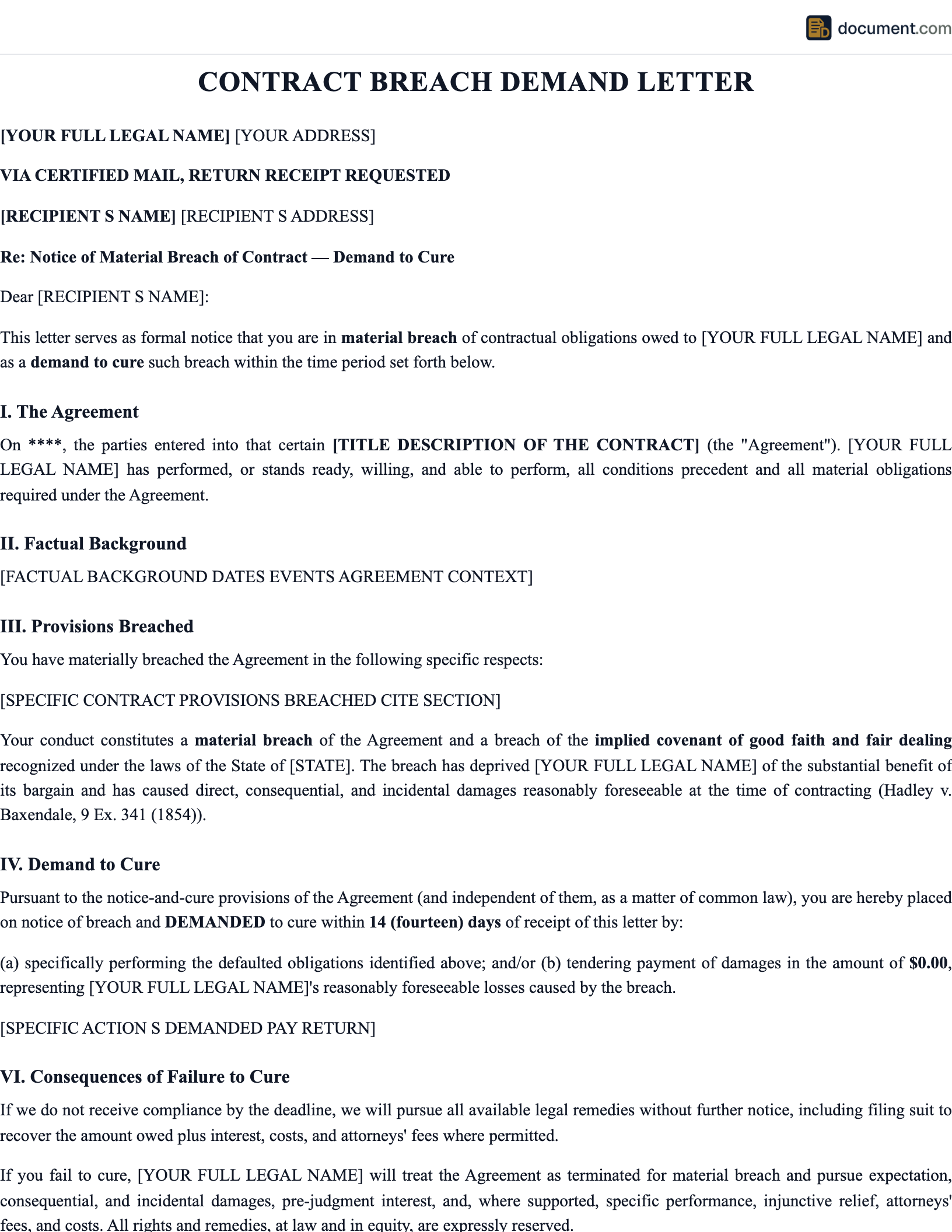
The following is an illustrative example of a breach of contract demand letter for a contractor who abandoned a residential renovation project before completion. Adapt the structure to your specific situation.
Demand Letter
Breach of Contract - Notice and Demand for Damages
[Recipient Full Name]
[Recipient Address]
Via Certified Mail, Return Receipt Requested
Re: Breach of Residential Renovation Contract dated [Date], Section [X]
Dear [Recipient Name],
I am writing regarding the Residential Renovation Agreement ("Agreement") entered into between [Your Name] ("Owner") and [Recipient/Company Name] ("Contractor") on [Contract Date] for the renovation of the property located at [Property Address]. A copy of the executed Agreement is attached as Exhibit A.
Under Section [X] of the Agreement, Contractor agreed to complete all renovation work specified in Exhibit B to the Agreement, including [briefly describe scope], by [Completion Date], for a total contract price of $[Amount]. Owner has paid $[Amount Paid] to date as required by the payment schedule in Section [Y].
On [Date], Contractor ceased all work on the project without notice or justification. As of this date, the work is approximately [X]% complete according to an independent inspection conducted on [Inspection Date] (report attached as Exhibit B). Contractor has not responded to my [emails / phone calls / written requests] dated [dates] requesting an explanation and timeline for completion. This abandonment constitutes a material breach of Sections [X], [Y], and [Z] of the Agreement.
As a result of Contractor's breach, I have incurred the following damages:
- Cost to complete remaining work (based on replacement contractor estimate): $[Amount]
- Cost to repair defective work performed by Contractor: $[Amount]
- Additional rental housing costs during delay period: $[Amount]
- Independent inspection fee: $[Amount]
- Total damages: $[Total Amount]
I demand that you pay the sum of $[Total Amount] within thirty (30) days of your receipt of this letter. If payment is not received by [Specific Date], I intend to pursue all available legal remedies, including filing a lawsuit for breach of contract, seeking attorney's fees and costs as provided by Section [Fee Clause] of the Agreement, and filing a complaint with the [State] Contractors State License Board.
This letter constitutes formal notice under Section [Notice Section] of the Agreement. All rights and remedies are expressly reserved.
Sincerely,
[Your Signature]
[Your Printed Name]
Enclosures: (1) Copy of Agreement; (2) Independent Inspection Report; (3) Replacement Contractor Estimate; (4) Correspondence Log
Frequently Asked Questions
Official Resources
Cornell LII - UCC Article 2
Full text of the Uniform Commercial Code Article 2 on the sale of goods, including breach and remedies
ABA - Business Law Today
American Bar Association resources on contract law and commercial disputes
USPS - Certified Mail
Instructions for sending certified mail with return receipt requested for proof of delivery
U.S. Courts - Federal Forms
Civil complaint forms and filing guidance for federal breach of contract claims
ULC - Uniform Commercial Code
Uniform Law Commission resources on the UCC and its adoption across all 50 states
CFPB - Consumer Tools
Consumer Financial Protection Bureau tools for resolving financial disputes
Create your Contract Breach Demand Letter in under 10 minutes.
Answer a few questions and download a compliant, attorney-drafted document ready for your state.