



What Is a Cease and Desist Letter?
A cease and desist letter is a formal written demand sent by one party to another requesting that the recipient stop a specific activity that allegedly violates the sender's legal rights. It is one of the most widely used pre-litigation tools in American law because it costs almost nothing to send, can be drafted in hours, and resolves a substantial percentage of disputes without ever requiring a courthouse. The letter is not a court order — it has no inherent power to compel anyone to do anything — but it carries significant practical weight because it establishes formal notice of the alleged wrongdoing, signals that the sender is prepared to escalate, and creates a documentary record that becomes important evidence in any later lawsuit.
Cease and desist letters are sent in five common categories of dispute. The most frequent is intellectual property infringement — trademark, copyright, patent, and trade secret claims, where the rights holder demands that the infringer stop using the protected work and, often, transfer ownership of infringing materials. The second is defamation, where the subject of false statements demands retraction and an end to the publication. The third is harassment and stalking, where an individual demands that another person stop unwanted contact. The fourth is debt collection abuse, where consumers exercise their statutory rights under the federal Fair Debt Collection Practices Act to stop calls and letters from collectors. The fifth is breach of contract, where a party demands the other side stop violating a non-compete, non-solicitation, NDA, or licensing agreement.
The legal weight of the letter comes from establishing notice. In intellectual property cases, proof that the infringer was aware of the rights holder's claims is often required for enhanced statutory damages and willful infringement findings. In tort cases, notice can affect whether punitive damages are available. In debt collection, the FDCPA explicitly requires the consumer's written cease and desist as the trigger for the collector's obligation to stop. And in nearly every context, the letter creates a contemporaneous record showing that the recipient was given a chance to comply before being sued, which judges and juries view favorably and which can affect attorneys' fees awards.
An effective cease and desist letter is firm but professional. It should clearly identify the sender and recipient, describe the offending conduct with specificity, cite the legal basis for the demand, set a clear compliance deadline, describe the consequences of non-compliance, and request a written response. It should avoid inflammatory language, baseless threats of criminal prosecution, exaggerated legal claims, and emotional rhetoric — all of which undermine credibility and can expose the sender to counterclaims for defamation, abuse of process, or tortious interference. The most effective letters are calm, factual, and grounded in specific legal authority.
Anyone can send a cease and desist letter. There is no legal requirement that an attorney draft or sign it. However, letters on attorney letterhead carry more weight because they signal that the sender has invested resources in the dispute and is prepared to litigate. For high-stakes matters — significant intellectual property, serious defamation, or contract claims worth more than a few thousand dollars — the cost of having an attorney prepare the letter is almost always worth it. For lower-stakes matters like personal harassment, simple debt collection demands, or minor disputes, a well-drafted self-prepared letter is often sufficient.
Establishes Notice
Creates a paper trail proving the recipient was aware of the wrongdoing
Signals Resolve
Shows the sender is prepared to escalate to litigation if needed
Resolves Without Court
Most disputes are settled at the cease and desist stage without litigation
Cease and Desist Letter Preview
Below is a structured preview showing the key sections of a professional cease and desist letter. Your final letter will be tailored to your specific dispute, the legal basis, and the desired remedies.
CEASE AND DESIST LETTER
VIA CERTIFIED MAIL — RETURN RECEIPT REQUESTED
SENDER (You)
Name: [Your Name / Company]
Address: [Street, City, State, ZIP]
Date: [Date]
RECIPIENT
Name: [Recipient Name / Company]
Address: [Street, City, State, ZIP]
DESCRIPTION OF OFFENDING CONDUCT
Describe specifically: [Detailed description of conduct]
Dates: [When the conduct occurred]
Evidence: [Screenshots, documents, witnesses]
LEGAL BASIS
Statute: [15 U.S.C. §1114, 17 U.S.C. §501, etc.]
Registration: [Trademark Reg. No., Copyright Reg.]
DEMANDS
1. Stop all [offending conduct]
2. Remove [infringing material]
3. Provide written confirmation by [deadline]
CONSEQUENCES OF NON-COMPLIANCE
Failure to comply will result in [litigation, injunctive relief, damages] without further notice.
SIGNATURE
Signed: [Your Signature]
Printed: [Your Name]
Types of Cease and Desist Letters
Cease and desist letters cover a wide range of disputes. Pick the type that matches your situation.
Deepfake & Unauthorized Likeness
Demand removal of an unauthorized AI-generated likeness, voice, or deepfake
Harassment
Demand that an individual stop unwanted contact, stalking, or harassing behavior
Defamation
Demand retraction and stoppage of false and damaging statements
Trademark Infringement
Notice to stop unauthorized use of a registered or common-law trademark
Copyright Infringement
Notice to stop unauthorized reproduction or distribution of copyrighted work
Debt Collection
Demand under the FDCPA that a debt collector stop contacting the consumer
Cease and Desist vs Lawsuit vs Demand Letter
These three pre-litigation tools serve different purposes. Use this table to choose the right one for your situation.
| Feature | Cease and Desist | Demand Letter | Lawsuit |
|---|---|---|---|
| Goal | Stop conduct | Recover money | Court relief |
| Cost | $0-$500 | $0-$500 | $5,000-$100,000+ |
| Time to draft | Hours | Hours | Weeks |
| Court filing required? | No | No | Yes |
| Public record? | No | No | Yes |
| Legal force | Demand only | Demand only | Court order |
How to Write the Letter
Follow these steps to write a cease and desist letter that will be taken seriously.
Identify yourself and the recipient
Use full legal names and current addresses. Verify the recipient's correct legal entity name if a business.
State the purpose clearly
Open with 'This letter is a formal demand that you cease and desist from [conduct].' Avoid burying the demand.
Describe the offending conduct specifically
List dates, locations, witnesses, screenshots, and any other evidence. Vague descriptions weaken the letter.
Cite the legal basis
Identify the specific statute, common law claim, or contract provision being violated. Include trademark or copyright registration numbers.
Make specific demands
Clearly state what action is required: stop the conduct, remove materials, pay damages, transfer assets, etc.
Set a compliance deadline
Provide a specific date (typically 7-30 days). Use a firm but reasonable timeframe.
Describe consequences
State that non-compliance will result in litigation, injunctive relief, statutory damages, and attorneys' fees.
Request written confirmation
Ask for written confirmation that the conduct has stopped, and provide your contact information.
Avoid emotional language
Stay professional and factual. Threats of criminal prosecution can backfire.
Send via certified mail
Send by certified mail with return receipt requested. Keep copies of everything.
Key Components
Every effective cease and desist letter includes these elements.
Header and date
Sender info, recipient info, and the date the letter was sent.
Description of conduct
Specific facts about what the recipient is doing wrong.
Legal basis
Statute, case law, contract clause, or registration relied on.
Demand
Clear statement of what action must be taken or stopped.
Deadline
Specific date by which the recipient must comply.
Consequences
What happens if the recipient does not comply.
Reservation of rights
Statement preserving all legal rights and remedies.
Signature line
Printed name, signature, and title if applicable.
Delivery and Proof of Service
Proof of delivery is essential for cease and desist letters because the entire legal significance of the letter depends on the recipient receiving it. Multiple delivery methods are commonly used in combination.
Certified mail with return receipt is the gold standard. The U.S. Postal Service requires the recipient to sign for the letter, and the green return receipt card serves as definitive proof of delivery. Email delivery is faster and creates a digital timestamp, but the recipient can claim they did not see it. FedEx and UPS provide signature confirmation and tracking that is often viewed as more reliable than USPS. Personal service or process server delivery is the most aggressive option and is sometimes used for high-stakes matters or when the recipient is evading mail.
Always retain originals and copies of: the letter itself, the certified mail receipt, the green return receipt card, any tracking confirmations, and any responses from the recipient. These documents become evidence in any later legal proceeding.
Responding to a Cease and Desist
If you receive a cease and desist letter, do not panic and do not ignore it. Take these steps to evaluate and respond appropriately.
Read it carefully
Identify what conduct the sender is alleging and what they want you to do.
Do not destroy evidence
Preserve all relevant documents, emails, and communications. Spoliation can lead to severe sanctions.
Consult an attorney
Even if you believe the demands are baseless, an attorney can evaluate the legal claims and advise on a proper response.
Evaluate the merits
Determine whether the sender's claims have merit. Some letters are baseless intimidation; others reflect serious legal exposure.
Respond in writing
If you choose to respond, do so in writing through counsel if possible. A firm, professional response can deflate weak claims.
Comply if appropriate
If the claims are valid, complying is often cheaper than litigation. A simple stop-and-confirm response can resolve most disputes.
Legal Requirements
Cease and desist letters do not require any particular legal formalities, but they should adhere to several best practices to be effective and avoid liability.
Truthful statements
All factual statements must be accurate. False statements expose the sender to defamation claims.
Well-founded legal claims
Cite real statutes and registrations. Baseless claims invite counterclaims.
No criminal threats
Threatening criminal prosecution to gain civil advantage is itself a crime in many states.
Proportionate demands
Demands should match the alleged wrongdoing. Excessive demands invite pushback.
Reasonable deadlines
7-30 days is standard. Unreasonable deadlines undermine the letter.
Proper delivery
Use certified mail or other delivery method with proof of service.
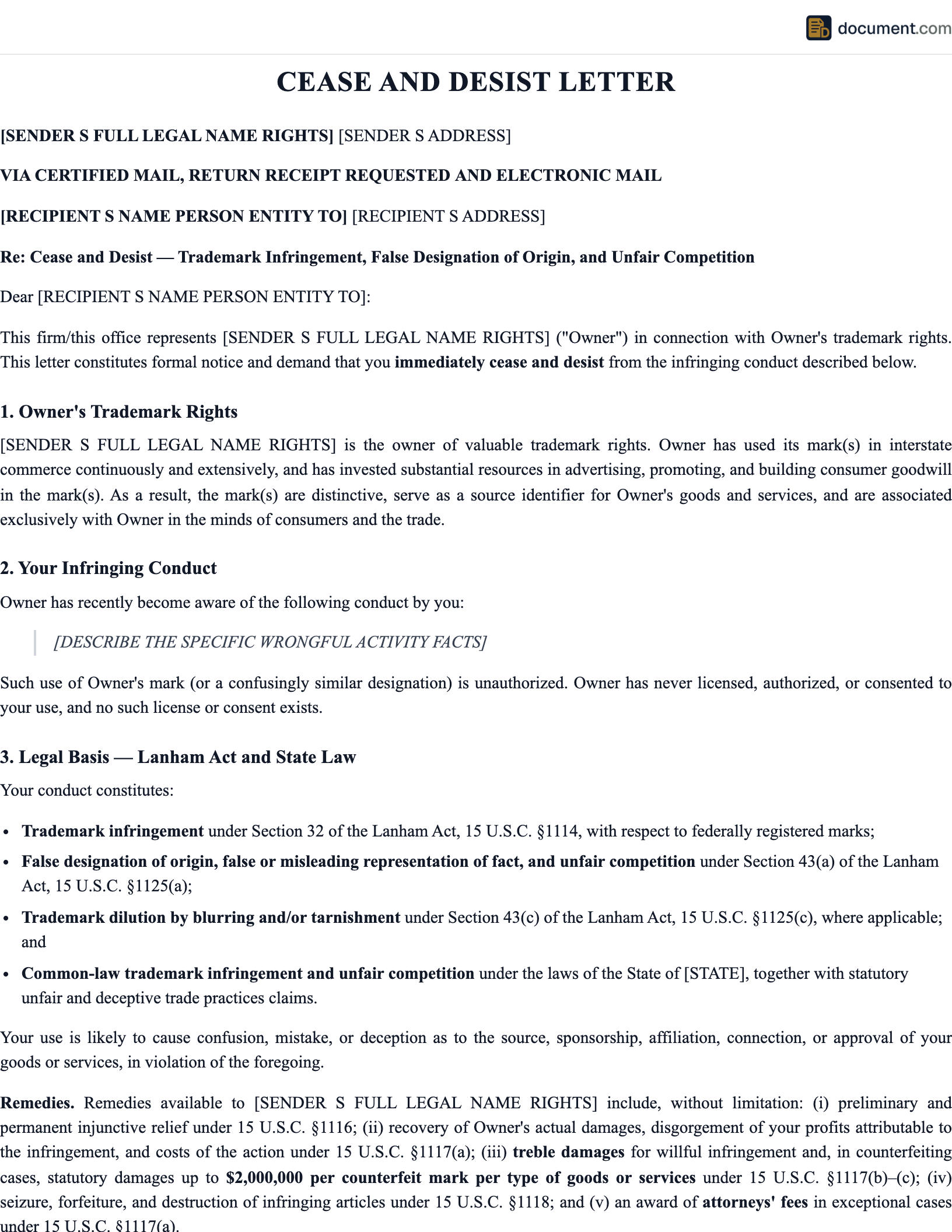
Sample Cease and Desist Letter
Below is the operative language of a representative trademark cease and desist letter. Your final letter will be tailored to your specific dispute, jurisdiction, and legal claims.
[YOUR NAME]
[YOUR ADDRESS]
[CITY, STATE, ZIP]
[DATE]
[RECIPIENT NAME]
[RECIPIENT ADDRESS]
VIA CERTIFIED MAIL — RETURN RECEIPT REQUESTED
RE: CEASE AND DESIST DEMAND — TRADEMARK INFRINGEMENT
Dear [RECIPIENT]:
This firm represents [CLIENT NAME], the owner of U.S. Trademark Registration No. [NUMBER] for the mark [MARK] in connection with [GOODS/SERVICES]. We write to demand that you immediately cease and desist from all unauthorized use of our client's mark or any confusingly similar variation.
It has come to our attention that you are using [INFRINGING MARK] in connection with [INFRINGING USE]. This use constitutes trademark infringement under the Lanham Act, 15 U.S.C. §1114, and trademark dilution under 15 U.S.C. §1125(c), and is likely to cause consumer confusion as to the source, sponsorship, or affiliation of your goods and services.
We hereby demand that you, within fourteen (14) days of receipt of this letter:
1. Immediately cease and desist all use of [INFRINGING MARK];
2. Remove all infringing materials from your website, social media, packaging, and marketing;
3. Transfer to our client any infringing domain names;
4. Provide written confirmation of compliance with these demands;
5. Account for all profits derived from the infringing use.
Failure to comply with these demands within the specified time will leave our client no choice but to pursue all available legal remedies, including but not limited to a federal lawsuit seeking injunctive relief, statutory damages of up to $2 million per counterfeit mark, treble damages, and recovery of attorneys' fees and costs.
This letter is sent without prejudice to any of our client's legal rights or remedies, all of which are expressly reserved.
Govern yourself accordingly.
Sincerely,
[YOUR NAME / SIGNATURE]
Frequently Asked Questions
Common questions about cease and desist letters, legal weight, delivery, and what to do if the letter is ignored.
Official Resources
Trusted resources for additional information on cease and desist letters and underlying legal claims.
U.S. Patent and Trademark Office
Federal trademark and patent registration and enforcement information
U.S. Copyright Office
Federal copyright registration, takedown notices, and DMCA resources
Federal Trade Commission
Federal consumer protection and unfair business practices guidance
Consumer Financial Protection Bureau
FDCPA debt collection rules and consumer rights
Create your Cease and Desist Letter in under 10 minutes.
Answer a few questions and download a compliant, attorney-drafted document ready for your state.