



What Is a Copyright Infringement Cease and Desist Letter?
A copyright infringement cease and desist letter is a formal pre-litigation demand sent by a copyright owner (or their attorney) to a party who is using a copyrighted work without authorization. The letter identifies the original work, establishes the sender's ownership, describes the specific infringing use, cites the relevant provisions of federal copyright law, demands that the infringement stop, and typically includes a settlement demand or a deadline before a federal lawsuit is filed.
Copyright is governed exclusively by federal law under Title 17 of the United States Code. The exclusive rights of a copyright owner — reproduction, distribution, public performance, public display, preparation of derivative works, and digital transmission — are set out in 17 U.S.C. § 106. Infringement of any of these rights without permission or a valid fair use defense is actionable under 17 U.S.C. § 501, and the remedies include injunctive relief (§ 502), impoundment and destruction of infringing articles (§ 503), actual damages and profits or statutory damages (§ 504), and attorney fees (§ 505).
For infringements occurring on online platforms, the Digital Millennium Copyright Act (DMCA) provides an additional takedown mechanism under 17 U.S.C. § 512. A copyright owner can send a DMCA notice directly to the hosting platform (YouTube, Instagram, a web host, a search engine) to request rapid removal of infringing content. The platform enjoys a safe harbor from liability if it promptly complies. Many copyright enforcement campaigns use both tools in parallel: a DMCA notice to get the content down quickly, and a cease and desist letter to pursue damages and permanent compliance from the actual infringer.
A cease and desist letter is often the most cost-effective first step in copyright enforcement. A well-drafted letter resolves the majority of infringement disputes without litigation because the infringer realizes the owner has documented the claim, is prepared to sue in federal court, and can recover statutory damages of up to $150,000 per willful infringement. The letter also establishes the infringer's knowledge of the claim, which is critical to proving willfulness if the infringement continues.
Asserts Ownership
Formally establishes your rights under 17 U.S.C. § 106 and puts the infringer on notice
Preserves Damages
Documents knowledge to prove willfulness and unlock enhanced statutory damages
Avoids Litigation
Most infringers comply or settle when presented with a credible pre-litigation demand
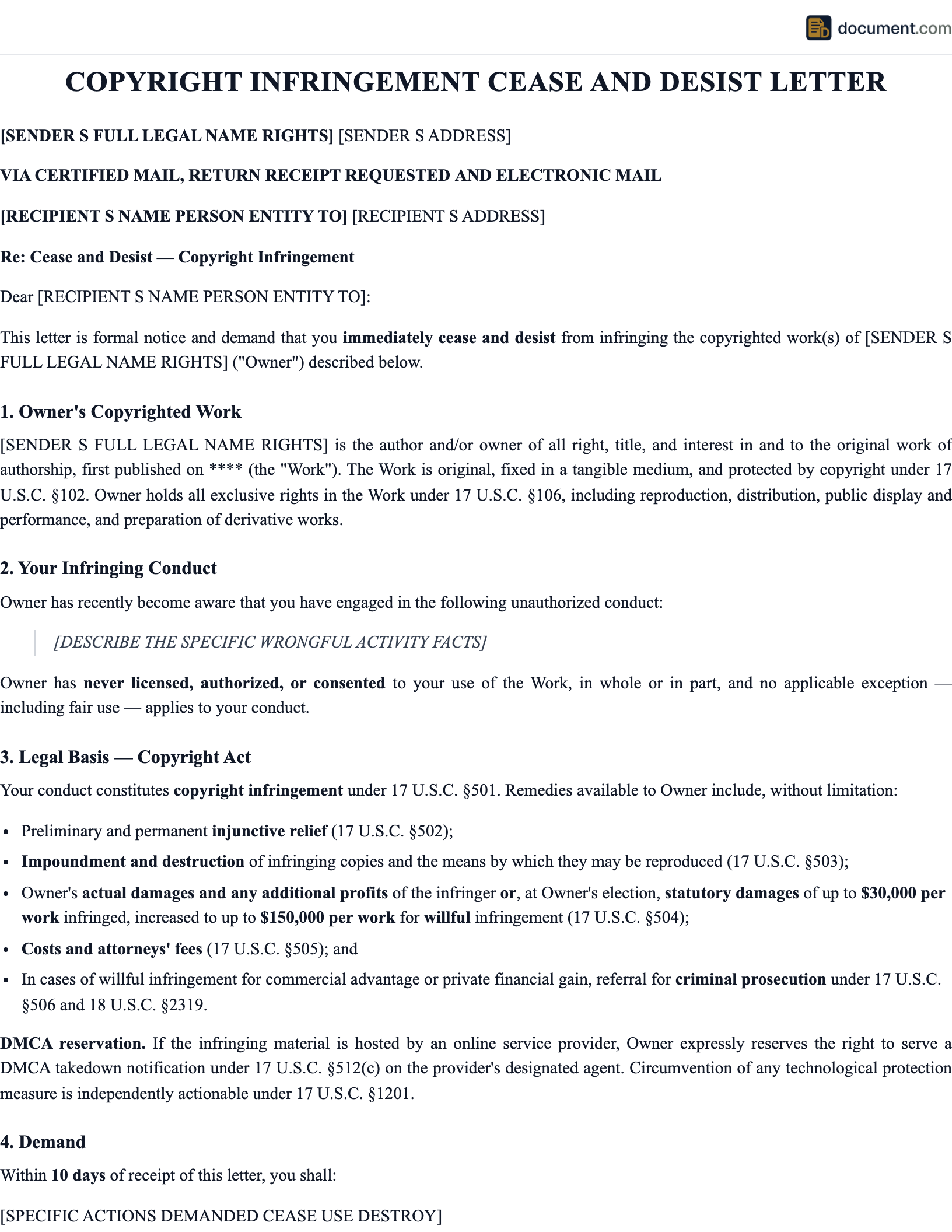
Form Preview
A visual preview of the sections our copyright infringement letter template includes.
Cease and Desist — Copyright Infringement
Pursuant to 17 U.S.C. § 501 and the DMCA
Section 1: Copyright Owner
Section 2: Original Work
Title: "Autumn Storm Over Mount Baker"
Medium: Digital photograph, 6000x4000 px
First published: September 14, 2023 on ravindersinghphoto.com
Registered: U.S. Copyright Office, December 3, 2023
Section 3: Infringing Use
The infringing copy appears at https://example.com/blog/pacific-northwest without license or attribution...
Section 4: Demand and Damages
You are demanded to (1) immediately remove the infringing material, (2) provide written confirmation of removal, (3) account for all profits, and (4) remit a settlement of $4,500...
Types of Copyright Infringement Letters
Select the medium that best describes the infringed work. Each template is tailored to the evidence, licensing norms, and damages typical of that creative category.
Photographs and Images
Unauthorized use of photographs, illustrations, or stock images on websites or social media
Written Content
Copied blog posts, articles, book chapters, or other literary works
Music and Audio
Unauthorized sampling, streaming, or distribution of sound recordings and compositions
Video and Film
Unauthorized reproduction or streaming of motion pictures, short films, or video content
Software and Code
Copied source code, unauthorized distribution of software, or license violations
Visual Art and Design
Unauthorized reproduction of paintings, graphic designs, or digital art
Website Content
Copying of entire websites, page layouts, or proprietary web content
Product Images
Unauthorized use of commercial product photography by resellers or competitors
When to Send a Copyright Cease and Desist
Send a letter when you have clear evidence of unauthorized use and reasonable confidence that no fair use or license defense applies.
Your photograph appears on a commercial website without license or attribution
A blog has copied your article verbatim or with only superficial edits
A competitor is distributing your software or SaaS product without authorization
A video using your music has been monetized without a sync license
Your product photography is being used by a reseller or dropshipper
An online store is selling merchandise that reproduces your original artwork
Your book chapter has been uploaded to a file-sharing site
Source code from your GitHub repository has been republished without license compliance
Cease and Desist Letter vs. DMCA Takedown Notice
These tools work together but serve different purposes.
| Feature | Cease & Desist | DMCA Takedown |
|---|---|---|
| Sent to | The infringer | The hosting platform |
| Legal authority | 17 U.S.C. § 501 | 17 U.S.C. § 512 |
| Required format | None | Statutory elements required |
| Damages demand | Yes | No |
| Speed of removal | Varies | Usually 24-72 hours |
| Counter-notice available | N/A | Yes (§ 512(g)) |
How to Draft the Letter
Step 1: Register or confirm registration
Register the work with the U.S. Copyright Office before sending the letter if possible. Registration is required for statutory damages and for filing suit.
Step 2: Gather evidence
Capture screenshots with URLs and timestamps, archive the infringing page using the Wayback Machine, and save native files showing the infringement.
Step 3: Document your original work
Locate the original file, metadata, publication date, and registration certificate.
Step 4: Identify the infringer
Use WHOIS, platform transparency reports, and business registration records to identify the human or entity responsible.
Step 5: Draft the letter
Cite 17 U.S.C. §§ 106 and 501, describe the original work, describe the infringing use, and state your demands.
Step 6: Set a deadline
Typically 10-14 days for removal; longer for negotiation of a settlement or license.
Step 7: Deliver and preserve proof
Certified mail, courier, or email with read receipt. Keep all delivery confirmation.
Key Components
Owner identification
Full legal name or entity of the copyright owner
Description of original work
Title, medium, creation date, publication date
Registration information
U.S. Copyright Office registration number if available
Description of infringing use
URLs, screenshots, dates, and scope of the infringement
Statutory citations
17 U.S.C. §§ 106, 501, 504, and DMCA § 512 where applicable
Demand for removal
Specific instruction to take down the infringing material
Damages demand
Actual damages, statutory damages, or a settlement amount
Compliance deadline
Typically 10-14 days from receipt
The DMCA Takedown Process
A DMCA takedown notice under 17 U.S.C. § 512(c)(3) must contain six statutory elements: a physical or electronic signature; identification of the copyrighted work; identification of the infringing material and its location; contact information; a good-faith statement that the use is unauthorized; and a statement under penalty of perjury that the information is accurate and that the sender is authorized to act. Most major platforms (Google, YouTube, Meta, Twitter/X, Cloudflare, web hosts) maintain dedicated DMCA agent addresses and online forms.
Warning: Misrepresentation liability
Under 17 U.S.C. § 512(f), knowingly materially misrepresenting that material is infringing can result in liability for damages, costs, and attorney fees. Only send a DMCA notice for material you genuinely believe infringes your rights.
Damages Under 17 U.S.C. § 504
A successful copyright plaintiff can recover either actual damages plus the infringer's profits, or statutory damages in the following ranges:
Standard statutory damages: $750 - $30,000 per work
Available for registered works regardless of willfulness.
Willful infringement: up to $150,000 per work
Courts increase damages when the infringer knew or recklessly disregarded that the conduct was infringing.
Innocent infringement: as low as $200 per work
Courts may reduce damages where the infringer had no reason to know the work was copyrighted.
Attorney fees under § 505
The prevailing party in a copyright suit may recover reasonable attorney fees, which dramatically changes the economics of litigation.
Fair Use Considerations
Before sending a cease and desist letter, evaluate whether the accused use could qualify as fair use under 17 U.S.C. § 107. The four fair use factors are:
1. Purpose and character
Commercial vs. educational. Transformative uses that add new expression, meaning, or message are strongly favored.
2. Nature of the work
Factual works receive less protection than creative works; published works less than unpublished.
3. Amount used
Small, non-central portions favor fair use; using the "heart" of the work weighs against it.
4. Market effect
If the use substitutes for the original or harms licensing markets, fair use is less likely.
Sample Letter
VIA EMAIL AND CERTIFIED MAIL
April 7, 2026
Atlas Outdoors Co.
Attn: Legal Department
350 Market Street, Suite 400
Portland, OR 97204
Re: Unauthorized Use of Copyrighted Photograph — U.S. Copyright Reg. No. VA 2-386-774
To Whom It May Concern,
This firm represents Ravinder K. Singh Photography LLC, the owner of the copyrighted photograph titled "Autumn Storm Over Mount Baker" (the "Work"), registered with the U.S. Copyright Office under Registration No. VA 2-386-774. Pursuant to 17 U.S.C. § 106, our client is the exclusive owner of the rights to reproduce, distribute, publicly display, and prepare derivative works based upon the Work.
It has come to our attention that Atlas Outdoors Co. is currently displaying the Work at https://atlasoutdoors.example.com/blog/pacific-northwest-gear without license, permission, or attribution. This constitutes copyright infringement under 17 U.S.C. § 501.
You are hereby demanded to, within ten (10) days of receipt of this letter: (1) immediately remove the Work from all websites, servers, and marketing materials under your control; (2) provide written confirmation of removal; (3) account for all revenues derived from the infringing use; and (4) remit settlement in the amount of $4,500, representing a reasonable license fee plus pre-litigation costs.
Should you fail to comply, our client is prepared to pursue all remedies available under federal copyright law, including injunctive relief under § 502, impoundment under § 503, statutory damages of up to $150,000 per work for willful infringement under § 504(c)(2), and attorney fees under § 505.
This letter is sent without waiver of any rights, all of which are expressly reserved.
Sincerely,
Counsel for Ravinder K. Singh Photography LLC
Frequently Asked Questions
Official Resources
U.S. Copyright Office
Registration, search, and official guidance on federal copyright law
Title 17 - Copyright Act
Full text of the Copyright Act including §§ 106, 501, 504, 505, and 512
U.S. Copyright Office - DMCA
Digital Millennium Copyright Act information and designated-agent directory
Copyright Office - Fair Use Index
Searchable index of federal fair use opinions
Copyright Public Records System
Search registered works and recorded documents
WIPO - Copyright
World Intellectual Property Organization copyright treaties and resources
Lumen Database
Database of DMCA takedown notices and other content removal requests
EFF - Intellectual Property
Electronic Frontier Foundation commentary on copyright, DMCA, and fair use
Create your Copyright Infringement Cease and Desist Letter in under 10 minutes.
Answer a few questions and download a compliant, attorney-drafted document ready for your state.