



What Is a Debt Collector Cease and Desist Letter?
A debt collector cease and desist letter is a written notification sent to a third-party debt collector that legally requires them, under federal law, to stop contacting you about a debt. Unlike most cease and desist letters, which have no direct legal force, this one does. Section 805(c) of the Fair Debt Collection Practices Act (FDCPA), codified at 15 U.S.C. § 1692c(c), requires a debt collector to cease all further communication with a consumer after receiving written notice that the consumer refuses to pay the debt or wants the collector to stop communicating.
The FDCPA was enacted in 1977 to eliminate abusive, deceptive, and unfair debt collection practices. It applies only to third-party debt collectors — collection agencies, debt buyers (who buy old debt portfolios for pennies on the dollar), and attorneys who regularly collect debts for others. It does not generally apply to original creditors collecting their own debts, though many states have parallel laws that do. The statute covers only consumer debts — debts incurred primarily for personal, family, or household purposes. Business debts fall outside the FDCPA.
Once the collector receives your written cease and desist letter, they are legally permitted only three kinds of follow-up contact: to acknowledge receipt of the letter; to tell you they are ceasing collection efforts; or to inform you of a specific remedy they intend to invoke, such as filing a lawsuit. Any other contact — phone calls, letters, texts, emails, or contact with third parties — is a violation that gives you a private right of action under 15 U.S.C. § 1692k for actual damages, statutory damages up to $1,000, and reasonable attorney fees and costs.
Important caveat: a cease and desist letter stops communication, but it does noteliminate the underlying debt. The creditor or collector retains the legal right to sue you. In some cases, sending a cease and desist letter actually pushes the collector to file suit sooner because informal collection is no longer an option. If you have any ability to pay or to negotiate a settlement, consider whether a debt validation letter under 15 U.S.C. § 1692g, or a negotiated settlement, might better serve your interests before you invoke the cease and desist right.
Stops Contact
Legally required under 15 U.S.C. § 1692c(c) once the collector receives the letter
$1,000 Statutory Damages
If they violate the FDCPA, you can recover statutory damages plus attorney fees
Workplace Protection
Ends calls to your workplace and contact with third parties
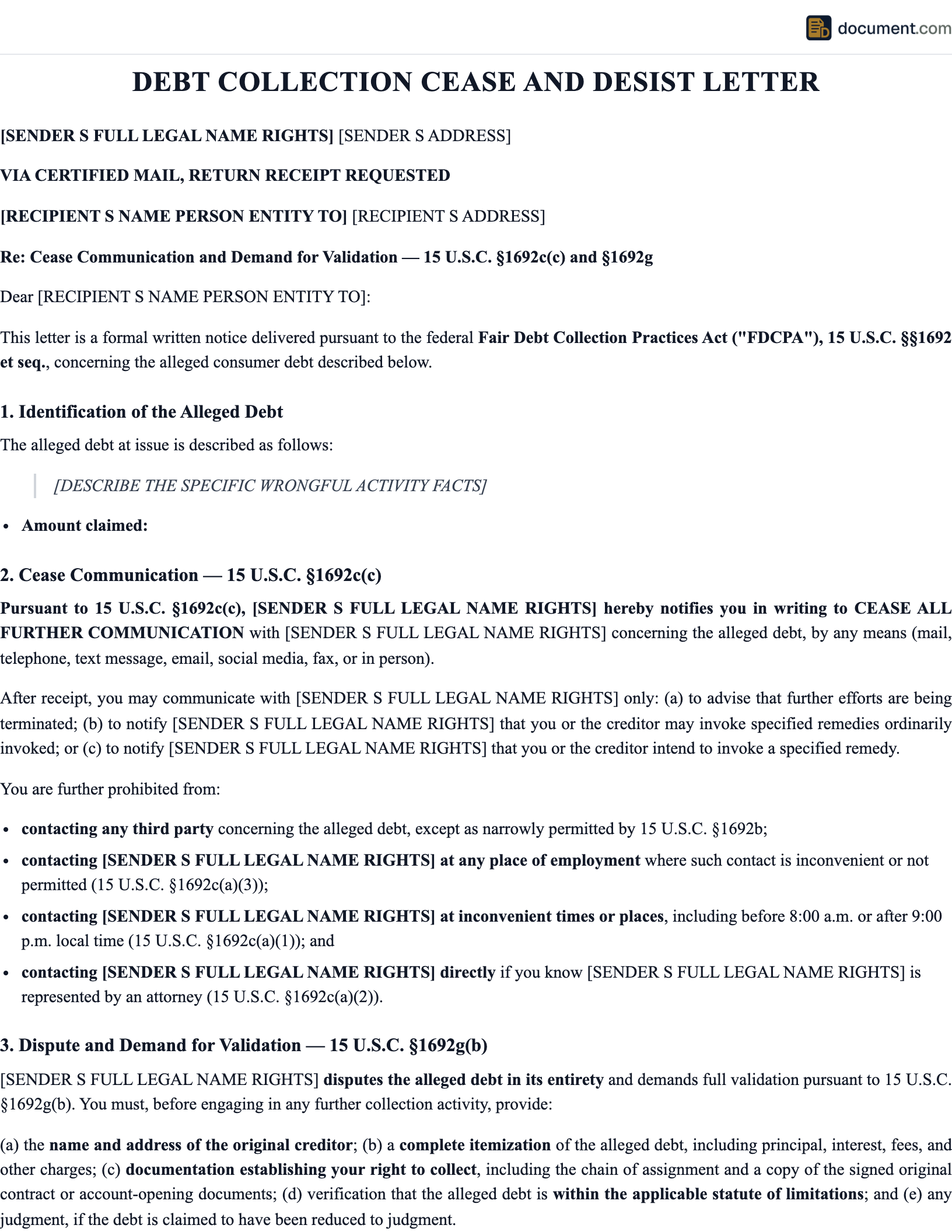
Form Preview
FDCPA Cease and Desist Notice
Pursuant to 15 U.S.C. § 1692c(c)
Section 1: Consumer Information
Section 2: Collector Information
Section 3: Cease and Desist Demand
Pursuant to 15 U.S.C. § 1692c(c), you are hereby notified to CEASE all further communication with me regarding the above-referenced account. This includes phone calls, letters, text messages, emails, and contact with any third parties...
Types of Debt Collection Letters
Credit Card Debt
Collection activity on credit card balances by original creditors or third-party collectors
Medical Debt
Collection on hospital bills, doctor invoices, or other medical expenses
Student Loan Debt
Private student loan collection; note FDCPA limits for federal loans
Zombie Debt
Old debts beyond the statute of limitations that collectors try to revive
Debt Not Owed
Letters disputing debts that are not yours or have already been paid
Time-Barred Debt
Debts past the statute of limitations where legal collection is barred
Harassing Calls
Letters demanding that phone harassment and repeated calls stop
Workplace Contact
Stopping collectors from contacting you at your job or workplace
Your Rights Under the FDCPA
The FDCPA gives consumers powerful protections against abusive collection practices. Even before sending a cease and desist letter, you have the right to:
No contact before 8 a.m. or after 9 p.m.
Under § 1692c(a)(1), collectors cannot call at inconvenient hours.
No calls to your workplace
Under § 1692c(a)(3), once a collector knows your employer prohibits personal calls.
No harassment or abuse
Section 1692d prohibits threats, obscene language, and repeated calls intended to annoy.
No false or misleading representations
Section 1692e prohibits false claims about the debt, the consequences, or the collector's identity.
No unfair practices
Section 1692f prohibits collecting amounts not authorized and other unfair conduct.
Right to validation
Section 1692g gives you 30 days to demand validation of the debt.
Right to stop communication
Section 1692c(c) gives you the right to send a cease and desist letter.
Right to sue
Section 1692k gives you a private right of action with statutory damages and attorney fees.
Effect of the Letter on Your Debt
| What Happens | Yes | No |
|---|---|---|
| Collector must stop calling | Yes | — |
| Debt is erased | — | No |
| Collector may still sue | Yes | — |
| Credit report changes | — | No |
| Statute of limitations changes | — | No |
| Third-party contact must stop | Yes | — |
How to Draft the Letter
Step 1: Confirm FDCPA coverage
Verify that the entity is a third-party debt collector and the debt is a consumer debt.
Step 2: Identify the account
Use the reference number the collector provides — never your full Social Security number.
Step 3: State the cease and desist demand
Explicitly invoke 15 U.S.C. § 1692c(c) and demand all communication stop.
Step 4: Reserve your rights
State that you dispute the debt and preserve all legal defenses.
Step 5: Sign and date
Keep a signed copy for your records.
Step 6: Send by certified mail, return receipt
The green card is your proof of receipt and starts the legal clock.
Key Components
Consumer name and mailing address
Your full legal name; no SSN required or recommended
Account reference
The collector's file or account number from their prior letter
Collector name and address
The name and mailing address on the most recent collection letter
Statutory citation
Explicit reference to 15 U.S.C. § 1692c(c)
Cease-communication demand
Clear instruction to stop all contact with you, your family, and your employer
Dispute of debt
Statement that you dispute the debt and reserve all defenses
Warning of FDCPA liability
Notice that continued contact will expose the collector to damages
Signature and date
Your signature and the date mailed
Debt Validation Letters
Before (or instead of) sending a cease and desist letter, consider sending a debt validation letter under 15 U.S.C. § 1692g. Within thirty days of the collector's first contact, you can demand written proof of the debt. Until the collector provides validation — typically an itemized accounting and a copy of the original agreement or account statement — they must suspend collection activity. Many debt buyers cannot produce adequate documentation, and the debt is written off. A validation letter preserves your ability to negotiate, dispute, or settle, while a cease and desist letter ends communication entirely.
FDCPA Damages Under 15 U.S.C. § 1692k
Actual damages
Out-of-pocket losses, emotional distress, lost wages, and related harms caused by the collector's violation.
Statutory damages up to $1,000
Awarded per lawsuit regardless of actual damages, at the court's discretion.
Class action damages
Up to $500,000 or 1% of the collector's net worth, whichever is less.
Attorney fees and costs
Reasonable attorney fees and costs are awarded to successful plaintiffs, which is why many consumer rights attorneys take FDCPA cases on contingency.
Risks and Warnings
Litigation risk increases
A collector who can no longer call or write may decide to sue instead.
The debt remains
Your credit report, statute of limitations, and underlying obligation do not change.
Do not acknowledge old debt
For time-barred debt, avoid statements that could be construed as acknowledging the debt or agreeing to pay, as this can restart the statute of limitations in many states.
FDCPA only covers third-party collectors
Original creditors are not generally covered. Check your state law for additional protections.
Sample Letter
VIA CERTIFIED MAIL — RETURN RECEIPT REQUESTED
April 7, 2026
Aegis Portfolio Recovery LLC
Attn: Compliance Department
1900 Corporate Blvd
Boca Raton, FL 33431
Re: File No. APR-881-22094 — Notice to Cease Communication Pursuant to 15 U.S.C. § 1692c(c)
To Whom It May Concern,
This letter serves as formal written notice pursuant to Section 805(c) of the Fair Debt Collection Practices Act, 15 U.S.C. § 1692c(c), that I hereby demand you CEASE ALL COMMUNICATION with me regarding the above-referenced account.
From the date you receive this letter, you are permitted only the limited communications expressly allowed by 15 U.S.C. § 1692c(c): to advise that further collection efforts are being terminated, or to notify me that you intend to invoke a specific remedy. You are prohibited from making any further contact with me by telephone, letter, text message, email, or any other means, and from contacting my employer, family, friends, or any other third party regarding this alleged debt.
I additionally dispute this debt in full. All of my legal rights and defenses are expressly reserved.
Be advised that any violation of the FDCPA will subject your agency to civil liability under 15 U.S.C. § 1692k, including actual damages, statutory damages up to $1,000, and reasonable attorney fees and costs. I will not hesitate to pursue those remedies.
Govern yourselves accordingly.
Sincerely,
Priscilla D. Fontaine
Frequently Asked Questions
Official Resources
CFPB - Debt Collection
Consumer Financial Protection Bureau guidance on your rights and how to complain
FTC - FDCPA Full Text
Federal Trade Commission copy of the Fair Debt Collection Practices Act
CFPB - Regulation F
Current regulation implementing the FDCPA, effective November 2021
CFPB Complaint Portal
File a complaint against a debt collector directly with the CFPB
FTC - Full FDCPA Text
Complete federal statute with amendments
NACA - Consumer Advocates
National Association of Consumer Advocates - find an FDCPA attorney
Nolo - Debt Collection Guide
Plain-English guide to your rights against debt collectors
USA.gov - Debt Collection
Federal government consumer guide to debt collection
Create your Debt Collection Cease and Desist Letter in under 10 minutes.
Answer a few questions and download a compliant, attorney-drafted document ready for your state.