



What Is a Licensing Agreement?
A licensing agreement is a contract under which the owner of intellectual property (the licensor) grants another party (the licensee) the right to use that intellectual property under specified terms and conditions, typically in exchange for royalties, fees, or other consideration. Licensing agreements are one of the most important commercial vehicles in the modern economy because they allow rights holders to monetize their IP without selling it outright. The licensor retains ownership and ongoing rights, while the licensee gains the ability to use the IP for specific purposes — manufacturing branded products, distributing software, publishing creative works, or making and selling patented inventions. The combined U.S. licensing economy is estimated at hundreds of billions of dollars annually across all forms of IP.
A license is fundamentally different from an assignment or sale of intellectual property. In an assignment, the seller transfers full ownership of the IP to the buyer permanently — the seller has no continuing rights or interest. In a license, ownership stays with the licensor and only specific use rights pass to the licensee for a defined term and within defined limits. This distinction matters for tax treatment, accounting, regulatory compliance, and dispute resolution. License revenue is typically treated as ordinary income subject to ongoing royalty payments, while assignment proceeds are typically treated as a capital gain. Licenses also offer the licensor ongoing leverage to enforce quality standards, terminate for breach, and recover the rights when the license ends.
Licensing agreements come in many flavors depending on the type of IP being licensed. Trademark licenses grant the right to use a brand name, logo, or trade dress on products or services. Patent licenses grant the right to make, use, sell, or import a patented invention. Copyright licensesgrant the right to reproduce, distribute, perform, or display a creative work. Software licenses govern installation, use, modification, and distribution of computer programs. Brand licenses bundle multiple forms of IP — trademarks, copyrights, trade dress, goodwill — into a single license for product manufacturing or service delivery. Each type has unique legal requirements and industry conventions that affect how the agreement should be structured.
Licenses are categorized by exclusivity. An exclusive license grants the licensee the sole right to use the IP within the licensed scope, meaning the licensor cannot grant additional licenses and (usually) cannot use the IP themselves. A non-exclusive license permits the licensor to grant similar rights to multiple licensees. A sole licenseis exclusive against third parties but allows the licensor to continue using the IP. The choice affects pricing, market dynamics, and risk allocation. Exclusive licenses command much higher fees and royalties because they provide market protection, but they also concentrate the licensor's revenue in a single licensee. Non-exclusive licenses spread risk across multiple revenue streams but generate lower per-licensee fees.
Quality control is one of the most important and frequently misunderstood requirements of trademark licensing. Under U.S. trademark law, a licensor must maintain meaningful control over the quality of goods or services bearing the licensed mark. If the licensor fails to exercise quality control, courts can declare the license a "naked license"and rule that the trademark has been abandoned, destroying the licensor's rights altogether. To avoid this catastrophic outcome, trademark licenses must include specific quality control provisions, sample approval procedures, periodic inspections, and audit rights — and the licensor must actually exercise these controls, not just include them in the contract. Patent and copyright licenses do not require quality control in the same way, but they typically include various performance, reporting, and audit obligations to ensure proper compliance with the license terms.
Monetize Your IP
Generate ongoing royalty revenue without selling the underlying intellectual property
Retain Ownership
Keep full title to your IP and recover the rights when the license ends
Expand Your Reach
Enter new markets, geographies, and product categories through licensee partners
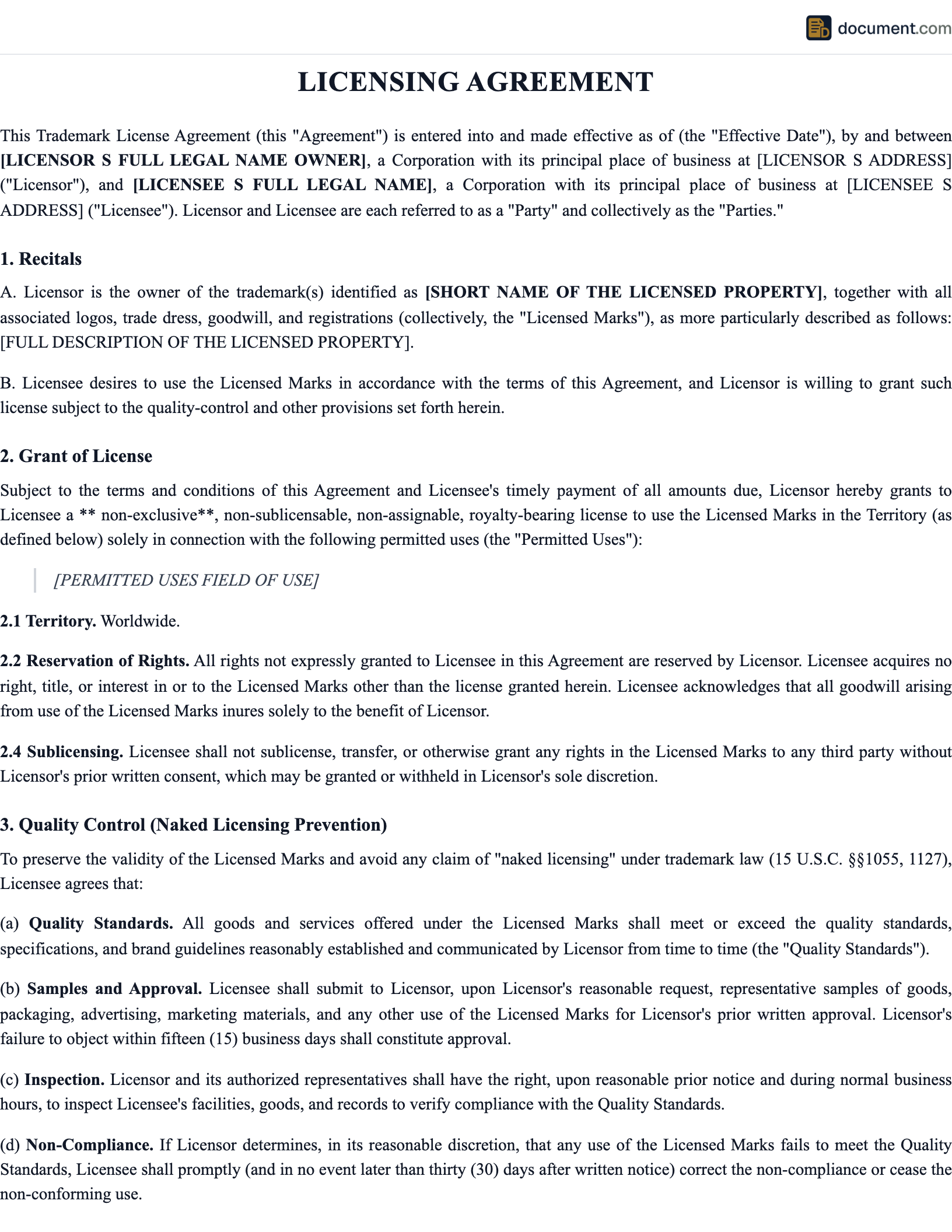
Licensing Agreement Form Preview
Below is a structured preview of the key sections in a licensing agreement. Your final document will be tailored to the type of IP, licensing structure, and commercial terms of your specific transaction.
LICENSING AGREEMENT
Trademark / Patent / Copyright / Software / Brand
LICENSOR
Name: [Legal Entity]
Address: [Street, City, State, ZIP]
LICENSEE
Name: [Legal Entity]
Address: [Street, City, State, ZIP]
LICENSED IP
IP Type: [Trademark / Patent / Copyright / Software]
Description: [Identification of IP]
Registration: [Reg. No., Application No.]
SCOPE OF LICENSE
Exclusivity: [Exclusive / Non-exclusive / Sole]
Permitted Uses: [Make / Use / Sell / Distribute / Display]
Field of Use: [Specific market or product category]
Sublicensing: [Allowed / Prohibited / With consent]
TERRITORY AND TERM
Territory: [Worldwide / Specific countries / Regions]
Term: [Years or perpetual]
Renewal: [Automatic / Optional / None]
ROYALTIES AND FEES
Upfront Fee: $[Amount]
Royalty Rate: [%] of net sales
Minimum Annual Royalty: $[Amount]
Reporting: [Quarterly / Annually]
QUALITY CONTROL
Standards: [Specifications, sample approval]
Inspections: [Frequency, scope]
SIGNATURES
Licensor: [Signature]
Licensee: [Signature]
Date: [Date]
Types of Licensing Agreements
Different types of intellectual property require different licensing structures. Pick the one that matches the IP you want to license.
License vs Assignment vs Sale
Choose the right vehicle for transferring or sharing IP rights.
| Feature | License | Assignment | Sale |
|---|---|---|---|
| Ownership | Stays with licensor | Transfers fully | Transfers fully |
| Duration | Defined term | Permanent | Permanent |
| Compensation | Royalties / fees | Lump sum | Purchase price |
| Reversion | Yes at end | No | No |
| Quality control | Required (TM) | N/A | N/A |
| Tax treatment | Ordinary income | Capital gain | Capital gain |
How to Create a Licensing Agreement
Follow these steps to create an enforceable, commercially sound licensing agreement.
Identify the IP precisely
Specify the trademark registration number, patent number, copyright registration, or software version. Vague identification creates disputes.
Define the parties
Use full legal entity names. Verify that the licensor actually owns the IP and has authority to grant the license.
Choose exclusivity
Decide whether the license is exclusive, non-exclusive, or sole. Exclusivity dramatically affects pricing and risk.
Define the scope of permitted use
Specify whether the licensee can make, use, sell, distribute, modify, sublicense, or display the IP. Restrict to specific fields of use if needed.
Set the territory
Define the geographic area: worldwide, specific countries, regions, or local markets. Consider antitrust implications of territorial restrictions.
Specify the term
Set a clear duration with renewal provisions. Most licenses run 3-10 years with renewal options.
Structure royalties
Choose upfront fee, running royalties, milestone payments, minimum guarantees, or a combination. Include reporting and audit rights.
Add quality control
For trademark licenses, include sample approval, quality standards, and inspection rights. Failure creates a naked license.
Address warranties and indemnification
Licensor warrants ownership and right to license; mutual indemnification for IP infringement claims.
Include termination provisions
Define termination triggers, cure periods, sell-off rights, and post-termination obligations.
Key Components
Every comprehensive licensing agreement contains these provisions.
Grant clause
The operative language granting the license and defining its scope.
IP identification
Specific identification of trademarks, patents, or copyrighted works.
Exclusivity
Exclusive, non-exclusive, or sole license designation.
Territory
Geographic area where the license rights apply.
Term
Duration of the license and renewal provisions.
Royalties
Payment structure, reporting, and audit rights.
Quality control
Standards, samples, and inspection rights (essential for trademark).
Termination
Triggers, cure periods, and post-termination obligations.
Royalty Structures
Royalty structures determine how the licensor is compensated. Most sophisticated licenses combine multiple structures to balance upfront cash, ongoing revenue, and performance incentives.
Upfront license fee
One-time payment at signing in exchange for the grant of rights. Typical range: $5,000 to $5,000,000+ depending on the IP.
Running royalties
Percentage of net sales of licensed products. Industry-typical ranges: consumer products 5-12%, pharma 3-8%, software 15-25%, brands 3-15%.
Per-unit royalties
Fixed dollar amount per licensed unit sold. Common in patent licenses for components or fixed-price products.
Minimum guaranteed royalties
Floor payment regardless of sales performance. Ensures the licensor receives a baseline return and incentivizes the licensee to perform.
Milestone payments
Lump-sum payments tied to specific events: regulatory approval, product launch, sales thresholds, market entry.
Lump-sum buyout
Single payment in exchange for paid-up perpetual rights. Often used to convert running royalties at the end of a relationship.
Quality Control and Naked Licenses
Quality control is the most critical and most frequently overlooked requirement of trademark licensing. Under U.S. trademark law, a trademark functions as a source identifier — consumers rely on the mark to indicate consistent quality from a specific source. When a licensor permits another party to use the mark, the licensor must maintain meaningful control over the quality of goods or services bearing the mark to preserve the trademark's function and legal protection.
A naked license is a trademark license in which the licensor fails to exercise quality control. Courts treat naked licensing as abandonment of the trademark, which can result in cancellation of the federal registration and forfeiture of all common-law rights. Famous cases like Barcamerica International USA Trust v. Tyfield Importers have invalidated trademark rights based on naked licensing, even where the licensor was a sophisticated business that intended to protect its mark. The risk is real and the consequences are catastrophic.
To avoid creating a naked license, trademark licensors should: include detailed quality control provisions in the license agreement; require sample submission and approval before any new licensed products are released; conduct periodic inspections of licensee facilities and products; reserve the right to audit licensee compliance; maintain documented quality control records; and be prepared to terminate licensees who fail to meet quality standards. Token language is not enough — courts look at whether the licensor actually exercised meaningful control, not just whether the contract said they could. Document everything.
Legal Requirements
Licensing agreements must satisfy basic contract requirements plus several IP-specific standards.
Licensor ownership
Licensor must actually own the IP and have authority to grant the license.
Specific identification
IP must be identified with specificity (registration numbers, descriptions).
Quality control (trademark)
Trademark licenses require meaningful quality control to avoid naked license.
Antitrust compliance
Territorial restrictions and tying arrangements must comply with antitrust laws.
Recording (optional)
Patent and copyright licenses can be recorded with USPTO/Copyright Office for priority.
Authority to sign
Signatory must have actual or apparent authority to bind each party.
Sample Licensing Agreement
Below is the operative language of a representative trademark licensing agreement. Your final document will include the specific commercial terms and IP-type-specific provisions for your transaction.
TRADEMARK LICENSE AGREEMENT
This Trademark License Agreement ("Agreement") is entered into as of [DATE], by and between [LICENSOR NAME]("Licensor") and [LICENSEE NAME]("Licensee").
1. GRANT OF LICENSE. Licensor hereby grants to Licensee a [non-exclusive / exclusive] license to use the trademark [MARK] (U.S. Reg. No. [NUMBER]) (the "Licensed Mark") in connection with the manufacture, distribution, and sale of [LICENSED PRODUCTS] in the Territory during the Term.
2. TERRITORY. The Territory shall be [GEOGRAPHIC AREA].
3. TERM. The Term of this Agreement shall be [NUMBER OF YEARS] from the Effective Date, with renewal options as set forth herein.
4. ROYALTIES. Licensee shall pay Licensor (a) an upfront license fee of $[AMOUNT] due upon execution; (b) running royalties of [%] of Net Sales of Licensed Products, payable quarterly within 30 days of the end of each calendar quarter; and (c) minimum guaranteed annual royalties of $[AMOUNT].
5. QUALITY CONTROL.Licensee shall maintain the quality of all Licensed Products at a level no lower than the quality standards established by Licensor. Licensee shall submit samples of all Licensed Products to Licensor for approval before commercial release. Licensor shall have the right, upon reasonable notice, to inspect Licensee's facilities and Licensed Products to verify quality compliance.
6. OWNERSHIP.Licensee acknowledges that Licensor is the sole owner of the Licensed Mark and that all use of the Licensed Mark by Licensee inures to the benefit of Licensor. Licensee shall not challenge Licensor's ownership of the Licensed Mark during or after the Term.
7. AUDIT.Licensor shall have the right, no more than once per calendar year, to audit Licensee's books and records relating to royalty calculations.
8. TERMINATION.Either party may terminate this Agreement upon 30 days written notice for material breach not cured within the notice period, or immediately upon the other party's bankruptcy or insolvency.
9. GOVERNING LAW. This Agreement shall be governed by the laws of the State of [STATE].
Licensor Signature
Name: _______________
Title: _______________
Licensee Signature
Name: _______________
Title: _______________
Frequently Asked Questions
Common questions about licensing agreements, royalties, exclusivity, sublicensing, and quality control.
Official Resources
Trusted government resources for IP licensing, registration, and recording.
U.S. Patent and Trademark Office
Federal trademark and patent registration, search, and assignment recording
U.S. Copyright Office
Federal copyright registration, recording of transfers, and licensing guidance
World Intellectual Property Organization
International IP licensing, treaties, and global registration systems
ABA Section of IP Law
American Bar Association resources on IP licensing and transactions
Create your Licensing Agreement in under 10 minutes.
Answer a few questions and download a compliant, attorney-drafted document ready for your state.