
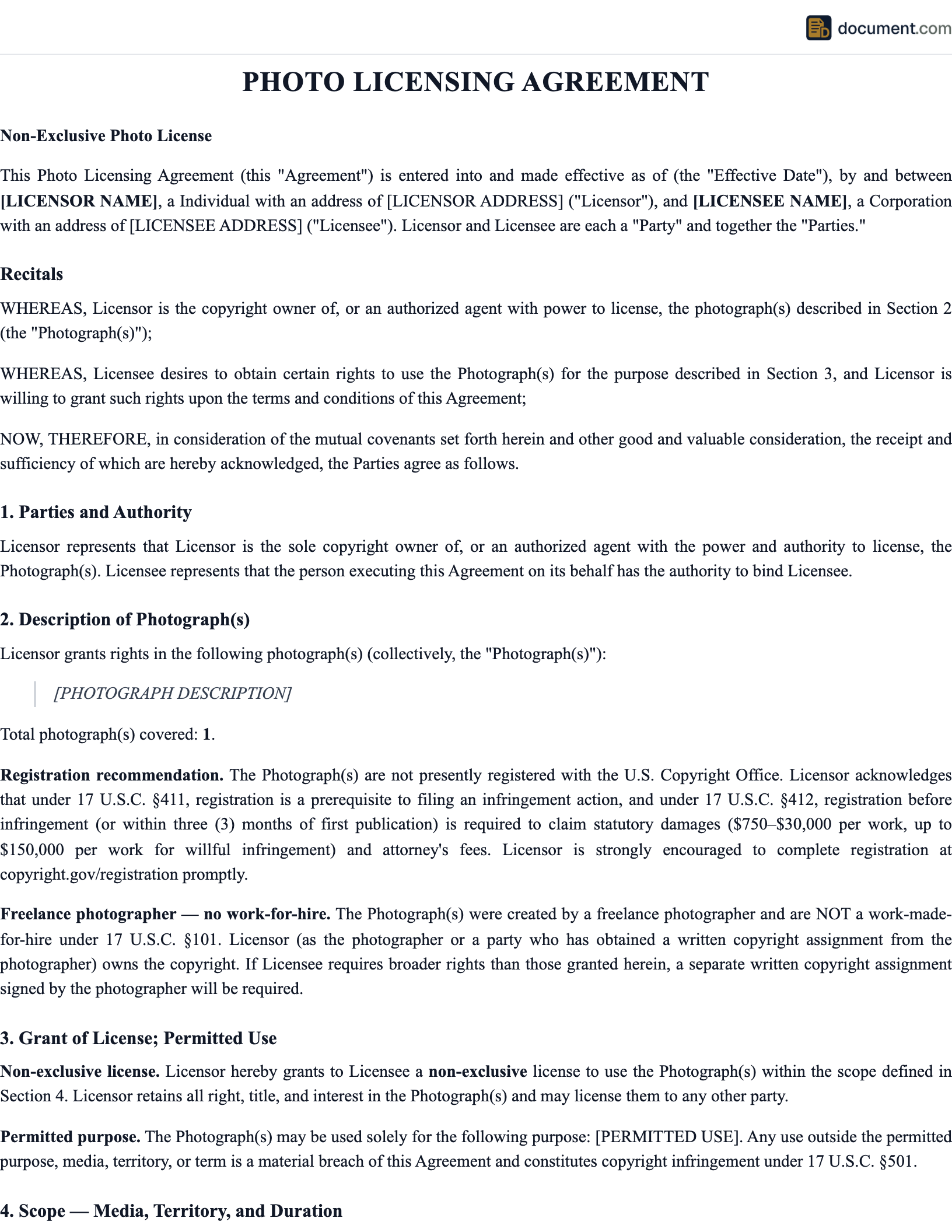



What Is a Photo Licensing Agreement?
A photo licensing agreement is a contract between the copyright owner of a photograph (typically the photographer) and a licensee who wants to use the image for a specific purpose. The agreement does not transfer ownership of the photograph — the photographer retains the copyright — but it grants the licensee defined rights to reproduce, distribute, display, and modify the image under terms that both parties agree to in advance. Without a license, any use of a copyrighted photograph is potentially infringement, exposing the user to statutory damages, injunctions, and attorneys' fees under the U.S. Copyright Act.
Photo licensing is the economic backbone of the professional photography industry. Stock agencies like Getty Images, Shutterstock, Adobe Stock, and Alamy operate as licensing intermediaries — collecting images from contributing photographers and licensing them to millions of buyers under standardized terms. Independent photographers also license images directly to clients, often for substantially more money than stock licensing yields, particularly for advertising, editorial, and corporate use. A well-drafted license protects both sides: the photographer retains future revenue from the image, and the licensee gains certainty about exactly what they can and cannot do with the photograph they paid for.
At its core, a photo license describes five things: who owns the copyright, who is being granted permission, what rights are granted, what restrictions apply, and what fee is paid in exchange. The grant of rights typically specifies the medium (print, digital, broadcast), the purpose (editorial, advertising, packaging), the term (one year, perpetual), the territory (national, worldwide), and the exclusivity (exclusive, non-exclusive). Each of these dimensions affects the value of the license and the risk borne by each party. A worldwide, perpetual, exclusive license costs many multiples of a single-use, regional, non-exclusive license for the same image.
Photo licensing also intersects with other legal documents that often accompany it. A model release addresses the rights of identifiable people in the image, separate from the photographer's copyright. A property release covers recognizable private property. A photography services contract governs the relationship between a photographer and a client who hired them to shoot. A copyright assignment transfers ownership entirely. Sophisticated image buyers often need a stack of these documents to ensure complete legal coverage for a campaign, particularly when the campaign involves recognizable people, branded products, or cross-border distribution.
Whether you are a working photographer licensing images to a magazine, a stock contributor uploading to global libraries, a brand purchasing images for a national campaign, or a small business buying images for your website, our attorney-reviewed photo licensing templates provide the legal framework you need. Each template clearly defines the rights granted, the price, the restrictions, and the remedies for breach — protecting both parties and creating a clean record of the deal that can be relied upon if disputes arise.
Copyright Protected
Photographer retains ownership while granting defined usage rights to the licensee
Clear Terms
Defines exactly what the licensee can and cannot do with the image
Flexible Scope
Customizable term, territory, exclusivity, and pricing model
License Agreement Preview
Below is a visual preview of the structure and fields in a typical photo licensing agreement. Your completed document will be tailored to your chosen license type and specific deal terms.
Photo Licensing Agreement
Non-Exclusive Commercial Use License
Section 1: Parties
Section 2: Licensed Image(s)
Section 3: Grant of Rights
Section 4: License Fee
Section 5: Signatures
Licensor Signature
Licensee Signature
Types of Photo Licenses
Photo licenses come in several variants, each suited to different commercial situations. Choose the type that matches the deal you are negotiating with the licensee or licensor.
Exclusive vs Non-Exclusive Licenses
Exclusivity is one of the most important and most negotiated terms in any photo license. It determines whether the photographer can license the same image to other buyers — and it dramatically affects price.
Exclusive License
- - Only the licensee may use the image
- - Photographer cannot license to others
- - Photographer often cannot use it themselves
- - Significantly higher price
- - Ideal for brand campaigns and signature visuals
Non-Exclusive License
- - Multiple licensees may use the same image
- - Photographer retains all licensing freedom
- - Standard model for stock and editorial
- - Substantially lower price
- - Suitable for blogs, presentations, and general use
Royalty-Free vs Rights-Managed
Royalty-free and rights-managed are two distinct pricing models for photo licensing. They describe how the fee is calculated and what restrictions apply, not whether the image is free of cost.
Royalty-Free (RF)
- - One-time, flat fee
- - Broad usage rights
- - No ongoing royalty payments
- - Simpler licensing process
- - Standard at major stock libraries
Rights-Managed (RM)
- - Pricing based on specific usage parameters
- - Tied to size, duration, territory, audience
- - Greater control over how images are used
- - Higher fees for premium uses
- - Common for advertising and editorial
License vs Copyright Transfer vs Work for Hire
These three legal mechanisms move different bundles of rights between photographer and client. Confusing them can result in losing rights you intended to keep — or paying for rights you never received.
License
Photographer retains copyright and grants the licensee defined usage rights for a fee. Most photography deals.
Copyright Assignment
Photographer transfers ownership of the copyright to the buyer in writing. Photographer no longer owns the image. Reserved for high-fee deals or buyouts.
Work Made for Hire
A statutory category under U.S. copyright law where the commissioning party is treated as the author from the moment of creation. Limited to specific categories and requires a written work-for-hire agreement signed before the work is created.
How to Create a Photo Licensing Agreement
A clear, well-structured license protects both photographer and licensee. Follow these steps to draft an enforceable agreement that covers all the variables that matter.
Identify the Parties
Include the full legal name of the licensor (the copyright owner) and the licensee. For business entities, use the registered legal name and state of formation. If a stock agency or third-party representative is involved, identify them and their authority to license on the photographer's behalf.
Identify the Licensed Images
List each image by file name, image ID, or attached thumbnail. For multi-image deals, attach a schedule. Be specific enough that there can be no later dispute about which images are covered. Include image metadata where possible.
Define the Grant of Rights
Specify the medium (print, digital, broadcast, packaging), the purpose (advertising, editorial, internal), the term (single use, one year, perpetual), the territory (regional, national, worldwide), and the exclusivity (exclusive, non-exclusive).
Set the Pricing Model and Fee
Choose royalty-free (flat fee) or rights-managed (usage-based). State the total fee, payment terms, late-payment interest, and any additional fees for expanded uses. Include kill-fee or three-times multiplier language for unauthorized use.
Address Sublicensing and Modifications
Specify whether the licensee can sublicense the image to vendors, agencies, or affiliates and whether modifications, derivative works, and AI training use are permitted. Default to no sublicensing and no AI training unless explicitly priced.
Include Attribution Requirements
State whether the photographer must be credited, the form of credit, and where it must appear. Tie pricing to credit if applicable.
Add Standard Boilerplate
Include warranties (the photographer owns the copyright and has any necessary releases), indemnification, governing law, dispute resolution, and termination provisions.
Sign and Deliver
Both parties should sign and date the agreement. Deliver the high-resolution files only after the license fee is paid. Maintain a copy of the signed license for the duration of the term plus any applicable statute of limitations.
Key Components
Every complete photo licensing agreement contains the following elements. Missing any of them can create ambiguity that leads to disputes about scope, payment, or ownership.
Term, Territory, and Scope
Term, territory, and scope are the three pricing levers in any rights-managed photo licensing deal. The term defines how long the licensee can use the image; the territory defines where it can be used; and the scope defines the media, audience, and purpose. Adjusting any one of these three variables changes the value of the license, and experienced photographers structure their pricing around these levers.
A typical term might run from 30 days (single campaign) to perpetual (forever). One-year and three-year terms are most common in advertising. Territory can be specified as a single city, a state, a country, a continent, or worldwide. Scope can be limited to a single placement or extended to all media now known or hereafter devised. The narrower each dimension, the lower the fee; the broader each dimension, the higher the fee. Both sides should review the term, territory, and scope language carefully to make sure it matches the actual planned use of the image.
Legal Requirements
Photo licensing is governed by U.S. copyright law (Title 17 of the U.S. Code) and by general state contract law. Under 17 U.S.C. § 204, an exclusive license — like a copyright transfer — must be in writing and signed by the copyright owner to be valid. Non-exclusive licenses can technically be granted orally or implied from conduct, but written agreements are strongly preferred for evidentiary clarity and enforceability.
Photo licensing agreements do not need to be filed with any government agency or notarized to be enforceable, though sophisticated photographers register their copyrights with the U.S. Copyright Office before licensing. Registration is a prerequisite to filing a copyright infringement lawsuit and unlocks statutory damages and attorneys' fees, which dramatically improve the photographer's leverage against infringers. The registration fee is modest, the process is online, and registration can be made for groups of unpublished or published photographs.
Sample Photo Licensing Agreement
Below is a condensed preview of a non-exclusive commercial photo licensing agreement. Your completed agreement will be customized for your specific deal terms.
PHOTO LICENSING AGREEMENT
Non-Exclusive Commercial License
This Agreement is entered into as of [Date] by and between[Licensor Name]("Licensor") and[Licensee Name]("Licensee").
1. GRANT OF LICENSE
Licensor grants Licensee a non-exclusive, non-transferable license to use the photograph(s) identified in Exhibit A (the "Image") for the term, territory, and purposes specified in this Agreement. Licensor retains all right, title, and interest in and to the Image, including all copyrights.
2. PERMITTED USE
Licensee may use the Image for [advertising, marketing, editorial, etc.]in [print, digital, broadcast, etc.] media, in the territory of [Worldwide / United States / etc.], for a term of [One Year / Two Years / Perpetual].
3. LICENSE FEE
In consideration of the rights granted, Licensee shall pay Licensor a one-time license fee of $[Amount] USD, payable within thirty (30) days of execution of this Agreement.
4. RESTRICTIONS
Licensee shall not (a) sublicense, sell, transfer, or assign any rights granted under this Agreement; (b) use the Image in any manner that is defamatory, obscene, or unlawful; (c) use the Image to train artificial intelligence or machine learning models; or (d) modify the Image except as necessary for the permitted use.
5. ATTRIBUTION
Where reasonably practicable, Licensee shall provide credit in substantially the following form: "Photograph by [Licensor Name]."
6. WARRANTIES
Licensor warrants that it owns the copyright in the Image and has the right to grant the license herein. Licensor has obtained any necessary model and property releases.
7. TERMINATION
This Agreement may be terminated by Licensor immediately upon written notice if Licensee breaches any term. Upon termination, all rights granted shall revert to Licensor and Licensee shall cease use of the Image.
Frequently Asked Questions
Common questions about photo licensing, exclusivity, royalty-free vs rights-managed pricing, sublicensing, attribution, and copyright protection.
Official Resources
Authoritative sources for photo licensing, copyright registration, and industry pricing.
U.S. Copyright Office
Federal copyright registration, search, and educational materials
Copyright Office Circular 42 - Photographs
Official guidance on copyright registration for photographs
ASMP - American Society of Media Photographers
Industry pricing guides, contract templates, and licensing best practices
PPA - Professional Photographers of America
Business and legal resources for working photographers
Creative Commons
Standardized free-use licenses for photographs and other creative works
Cornell LII - Title 17 (Copyright Law)
Full text of the U.S. Copyright Act with annotations
USPTO - U.S. Patent and Trademark Office
Federal trademark resources for photographers protecting their brand
APA - American Photographic Artists
Trade association resources, business education, and contract guidance
Create your Photo Licensing Agreement in under 10 minutes.
Answer a few questions and download a compliant, attorney-drafted document ready for your state.