
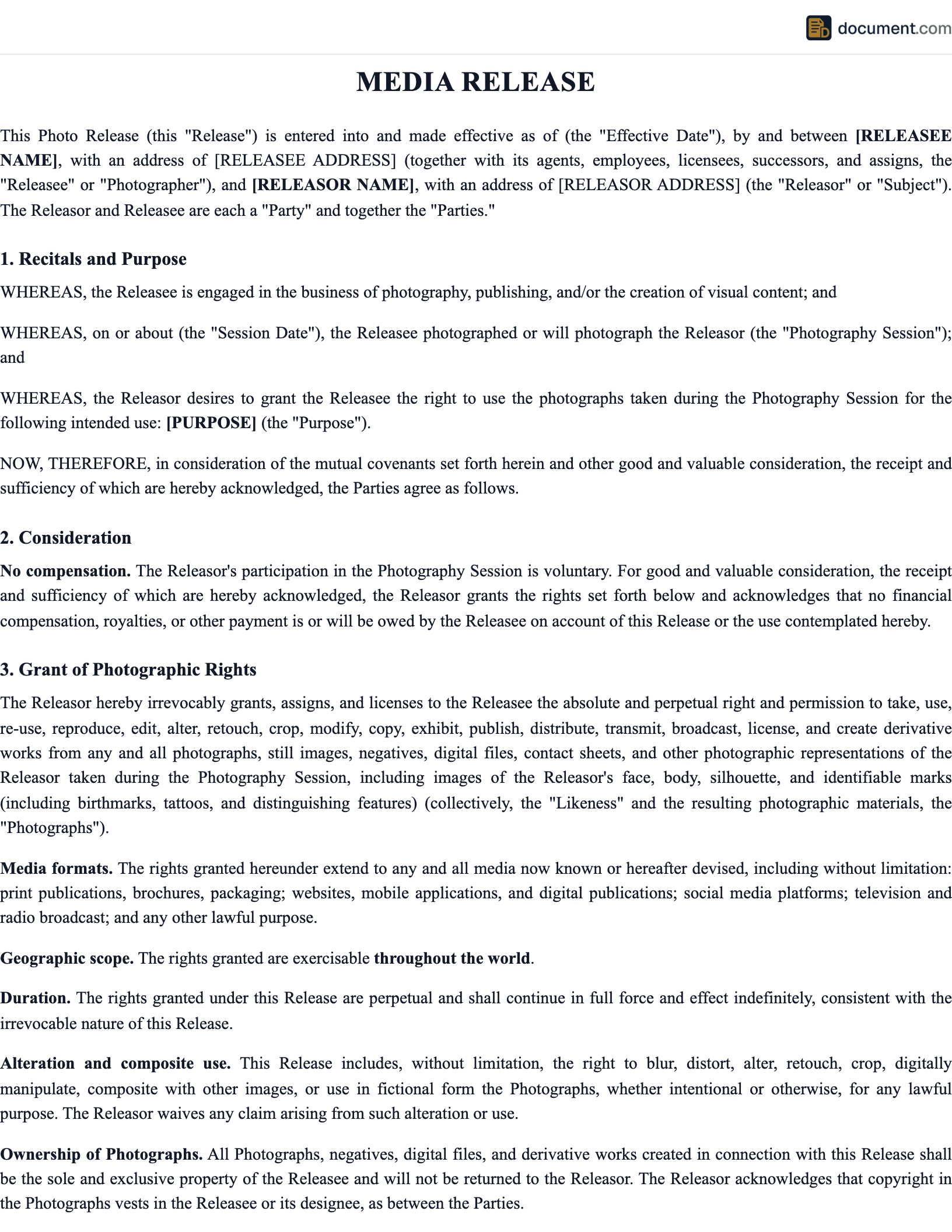



What Is a Photo Release Form?
A photo release form is a written legal agreement in which a person who appears in a photograph or video — known as the model or subject — grants permission to a photographer, filmmaker, business, or publisher to use their likeness for specified purposes. The release documents the subject's consent, defines the scope of permitted uses, recites the consideration exchanged, and waives certain claims the subject might otherwise bring under state right-of-publicity, privacy, and defamation laws. Without a properly executed release, any commercial use of an identifiable person's image creates significant legal risk for everyone involved in the chain of distribution.
The legal foundation for the photo release is the right of publicity — a state-law doctrine that gives individuals the exclusive right to control the commercial use of their name, image, voice, and other identifying characteristics. This right exists in every U.S. jurisdiction, either by statute (as in California, New York, and Tennessee) or under common law. When a photographer captures someone's image and a publisher uses that image in an ad, on a product label, on a billboard, or in a marketing campaign, they are using a property interest that belongs to the subject. The release transforms that potentially unlawful use into an authorized one, backed by a written record of consent.
A release is distinct from a copyright license. Copyright in a photograph belongs to the photographer (unless created as a work made for hire), while the right of publicity in the subject's likeness belongs to the subject. To use a photograph commercially, a publisher generally needs both: a copyright license from the photographer and a release from every identifiable person in the image. Stock photo agencies enforce this distinction rigorously, requiring contributors to upload signed releases for every recognizable model and every recognizable piece of private property before an image can be licensed for commercial use.
Releases come in many forms. A standard model release covers the commercial use of an adult's likeness in a single shoot. A minor release adds parental consent for subjects under 18. A property release covers recognizable private buildings, artwork, branded products, or animals. Event releases provide blanket consent for everyone attending a conference, wedding, or public gathering. Editorial releases allow limited journalistic use while reserving commercial rights. Each variation addresses a different legal risk, and serious photographers and publishers maintain a library of releases tailored to the specific contexts in which they shoot and license imagery.
Whether you are a wedding photographer building a portfolio, a marketing agency producing a national ad campaign, an event organizer documenting a conference, a content creator filming influencer collaborations, or a stock contributor uploading to global agencies, our attorney-reviewed photo release templates provide the legal framework you need. Each template is drafted to be enforceable in all 50 states, includes the proper consideration language, defines the scope of permitted uses clearly, and protects you from the costly right-of-publicity claims that follow the unauthorized commercial use of someone's image.
Legal Protection
Documented consent that defends against right-of-publicity, privacy, and defamation claims
Worldwide Use
Perpetual, worldwide rights across print, digital, broadcast, and social media platforms
Stock Agency Ready
Meets the contributor requirements of Getty, Shutterstock, Adobe Stock, and Alamy
Photo Release Form Preview
Below is a visual preview of the structure and fields included in a standard photo release. Your completed release will be fully formatted and customized for your release type, the identity of the model, and the intended scope of use.
Model Photo Release
Adult Commercial Use Authorization
Section 1: Model Information
Section 2: Photographer / Releasee
Section 3: Scope of Use
Section 4: Consideration
Section 5: Signatures
Model Signature
Photographer Signature
Types of Photo Releases
Different shooting situations call for different release types. Choose the variant that matches the subject of your photographs and the way you intend to use them. Each template contains the specific language required by stock agencies, advertisers, and publishers.
Model Releases vs Property Releases
One of the most common points of confusion in photography law is the distinction between model releases and property releases. They protect different rights, are required in different situations, and use different language. Most professional shoots will need both.
Model Release
- - Required for any identifiable person in a commercial image
- - Addresses the right of publicity and privacy claims
- - Must be signed by the model (or parent for a minor)
- - Covers face, body, voice, and identifying characteristics
- - Applies even when the person is partially obscured but recognizable
Property Release
- - Required for recognizable private property used commercially
- - Covers homes, interiors, artwork, branded products, pets
- - Signed by the legal owner of the property
- - Addresses trespass, trademark, and copyright concerns
- - Stock agencies require it for any private setting or branded item
Tip: A photo of a person inside their own home that will be used in a commercial campaign requires both a model release (signed by the person) and a property release (signed by the home owner). If the person and the owner are the same individual, they can sign both releases on the same day.
Release vs License vs Photography Contract
Photo releases are often confused with photo licensing agreements and photography service contracts. Each document plays a distinct role in the lifecycle of a photograph and addresses a different relationship.
Photo Release
Signed by the subjectof the photograph. Grants the photographer and assigns permission to use the subject's likeness. Addresses rights of publicity and privacy. Does not transfer copyright.
Photo Licensing Agreement
Signed by the photographer as copyright owner. Grants a publisher, brand, or end user the right to reproduce and distribute the photograph itself. Addresses copyright, scope, term, and territory.
Photography Contract
Signed between a photographer and a client who is hiring the photographer for a service (wedding, portrait session, commercial shoot). Addresses payment, deliverables, cancellation, and ownership of the resulting images.
How to Create a Photo Release: A Step-by-Step Guide
Creating an enforceable photo release does not require a lawyer for most situations, but it does require attention to several key details. Follow these steps to produce a release that will stand up in court and satisfy stock agency contributor requirements.
Identify the Right Type of Release
Choose between a model release, minor release, property release, event release, or a combined release. The right choice depends on who or what is in the image and how it will be used. Most professional shoots use a model release plus a property release when shooting on private property.
Identify the Parties
Include the full legal name of the model, the model's mailing address, and the photographer's name and business. For minor releases, also include the parent or guardian's name, the child's name and date of birth, and the relationship.
Recite the Consideration
Every contract requires consideration to be enforceable. State the cash payment, trade for prints, free copies, or simply "good and valuable consideration, the receipt and sufficiency of which is hereby acknowledged." Without consideration language, the release may be challenged as a gratuitous promise.
Define the Scope of Permitted Uses
Specify the media (print, digital, broadcast, social), the purposes (advertising, editorial, stock licensing), the territory (worldwide is standard), and the duration (perpetual is standard). Broad scope language protects future uses you cannot anticipate at the time of signing.
Include Standard Waivers
Include a waiver of the right to inspect or approve the finished work, a waiver of claims for libel or defamation arising from the use, and an acknowledgment that the model has read and understood the release. These provisions are standard and enforceable in every U.S. jurisdiction.
Sign, Date, and Store Securely
Both parties should sign and date the release on the day of the shoot. Store the original (or a high-resolution scan) in a secure file system organized by shoot date and model name. Stock agencies typically require you to upload a copy of the signed release with the corresponding image files.
Key Components of a Valid Release
A complete and enforceable photo release contains the following elements. Missing any of these can give the model grounds to challenge the release later or cause stock agencies to reject your contributor submission.
Photo Releases for Minors
Photographing children for commercial use requires extra legal care. Minors cannot enter into binding contracts in any U.S. state, which means a child's signature on a release has no legal effect. Instead, the release must be signed by a parent or court-appointed legal guardian who has the authority to consent on the child's behalf.
A proper minor release identifies the child by full legal name and date of birth, identifies the parent or guardian by name, states the relationship, and includes language affirming that the parent has the legal authority to grant the rights being conveyed. In divorced or separated families, the parent with primary legal custody is generally the appropriate signer; in shared custody arrangements, both parents may need to sign to avoid disputes.
Several states impose additional protections for minors who appear in commercial productions. California, New York, and other entertainment-industry states have child labor laws that may require work permits, limit shoot hours, mandate on-set educators, and require that a portion of the child's earnings be set aside in a Coogan trust account. Even for one-day commercial shoots, professional photographers should verify state-specific requirements before relying on a minor release alone.
Commercial vs Editorial Use
The distinction between commercial and editorial use determines whether a photo release is legally required. Commercial use means using an image to sell, promote, advertise, or endorse a product, service, brand, or cause. Editorial use means publishing an image to illustrate news, current events, education, art, or other matters of public interest. The First Amendment protects editorial use far more broadly than commercial use.
In practice, the line is not always crisp. A magazine cover photo of a celebrity is editorial; the same photo on a T-shirt sold by the magazine is commercial. A documentary film is editorial; a sponsored brand-funded documentary may cross into commercial. Stock agencies handle this distinction by labeling images as either "rights-managed editorial" (no release required, restricted to editorial use) or "royalty-free commercial" (release required, available for any use). Photographers should always obtain releases when commercial use is even remotely possible.
Legal Requirements
Photo releases are governed by state right-of-publicity and privacy laws, which vary by jurisdiction. New York, California, Tennessee, Indiana, and Florida have particularly strong statutory protections, while other states rely on common-law doctrines. To be enforceable, a release must be in writing (oral releases are permitted in some states but difficult to prove), recite consideration, identify the parties, define the scope, and be signed by a competent adult or by the legal guardian of a minor.
Releases do not need to be notarized to be legally valid, although notarization can strengthen the document by providing independent verification of the model's identity and the date of signing. For high-value campaigns, celebrity endorsements, or shoots that may be challenged later, notarization or witness signatures provide additional evidentiary protection. Releases also do not need to be registered with any government agency, but many photographers and agencies maintain digital release management systems to track which images have valid releases on file.
Sample Photo Release
Below is a condensed preview of our standard model release template. Your completed release will be fully customized for your specific release type, shoot details, and intended uses.
PHOTO RELEASE AND CONSENT
Model Release for Commercial Use
For good and valuable consideration, the receipt and sufficiency of which is hereby acknowledged, I, [Model Full Legal Name], residing at [Address], hereby grant to [Photographer / Releasee]and their legal representatives, assigns, licensees, and successors in interest (collectively, the "Releasees") the irrevocable, perpetual, worldwide, and royalty-free right and permission to use the photographs, video, and other recordings of me taken on [Date].
1. GRANT OF RIGHTS
The Releasees may use, reproduce, modify, adapt, publish, distribute, publicly display, transmit, broadcast, and create derivative works from the photographs in any and all media now known or hereafter devised, throughout the world, in perpetuity, for any and all lawful purposes including, without limitation, advertising, promotion, marketing, publicity, packaging, editorial, stock photography licensing, and trade.
2. NAME AND LIKENESS
The Releasees may use my name, image, voice, and biographical information in connection with the photographs. I waive any right to inspect or approve the finished photographs, advertising copy, printed matter, or other use that may be made in conjunction with them.
3. WAIVER
I release and discharge the Releasees from any and all claims, demands, or causes of action that I may have arising out of or related to any use of the photographs, including, without limitation, any claims for invasion of privacy, right of publicity, defamation, or copyright infringement.
4. NO COMPENSATION BEYOND CONSIDERATION
I acknowledge that I will not receive any further compensation, royalty, or other payment for the use of the photographs beyond the consideration described above.
5. REPRESENTATION
I represent that I am at least eighteen (18) years of age, that I have read this release, that I understand its contents, and that I am signing it freely and voluntarily.
Frequently Asked Questions
Find answers to common questions about photo releases, model and property releases, minors, commercial versus editorial use, and right-of-publicity law.
Official Resources
For additional information on photo releases, right of publicity, and photography law, consult these official and reputable sources.
U.S. Copyright Office
Federal copyright registration, fair use guidance, and photography copyright basics
ASMP - American Society of Media Photographers
Industry standards, sample releases, and business resources for professional photographers
PPA - Professional Photographers of America
Resources, education, and legal guidance for working photographers
Cornell LII - Right of Publicity
Legal encyclopedia entry on right-of-publicity doctrine and state variations
FTC Advertising Guidance
Federal Trade Commission rules on advertising, endorsements, and influencer disclosures
DOL YouthRules - Child Labor
Federal guidance on child labor in entertainment and commercial production
NPPA - National Press Photographers Association
Resources on editorial and press photography ethics and law
Copyright Office - Photographs
Copyright Office circular on registering photographs
Create your Photo Release Form in under 10 minutes.
Answer a few questions and download a compliant, attorney-drafted document ready for your state.