



What Is a Franchise Agreement?
A franchise agreement is a legally binding contract between a franchisor (the brand owner) and a franchisee (the operator) that grants the franchisee the right to operate a business using the franchisor's trademarks, business systems, proprietary methods, and ongoing support in exchange for fees and compliance with the franchisor's standards. It is the foundational document that governs every aspect of the franchise relationship, from site selection to termination.
Franchising is one of the most heavily regulated business structures in the United States. The Federal Trade Commission's Franchise Rule requires franchisors to provide prospective franchisees with a Franchise Disclosure Document containing 23 items of mandatory information at least 14 days before signing any agreement or paying any money. Roughly half the states impose additional registration, filing, or relationship laws that layer on top of the FTC requirements. The franchise agreement sits at the center of this regulatory framework: it is the contract that the FDD discloses and that state regulators review.
From the franchisor's perspective, the agreement protects brand consistency. It ensures that every location operates according to the same standards, uses the same recipes or processes, maintains the same look and feel, and delivers the same customer experience. From the franchisee's perspective, the agreement defines what the franchisor must provide in return: initial training, ongoing support, marketing, technology platforms, supply chain access, and the right to use a recognizable brand.
The financial terms of a franchise agreement typically include an initial franchise fee, ongoing royalty payments calculated as a percentage of gross sales, contributions to a national or regional advertising fund, and various ancillary fees for technology, transfers, and renewals. Understanding these costs and how they interact with your projected revenue is critical to evaluating any franchise opportunity.
Brand License
Operate under an established brand with proven systems and customer recognition
Territory Protection
Defined geographic area where the franchisor limits competition from other franchisees
Training & Support
Comprehensive initial and ongoing training to operate the franchise system successfully
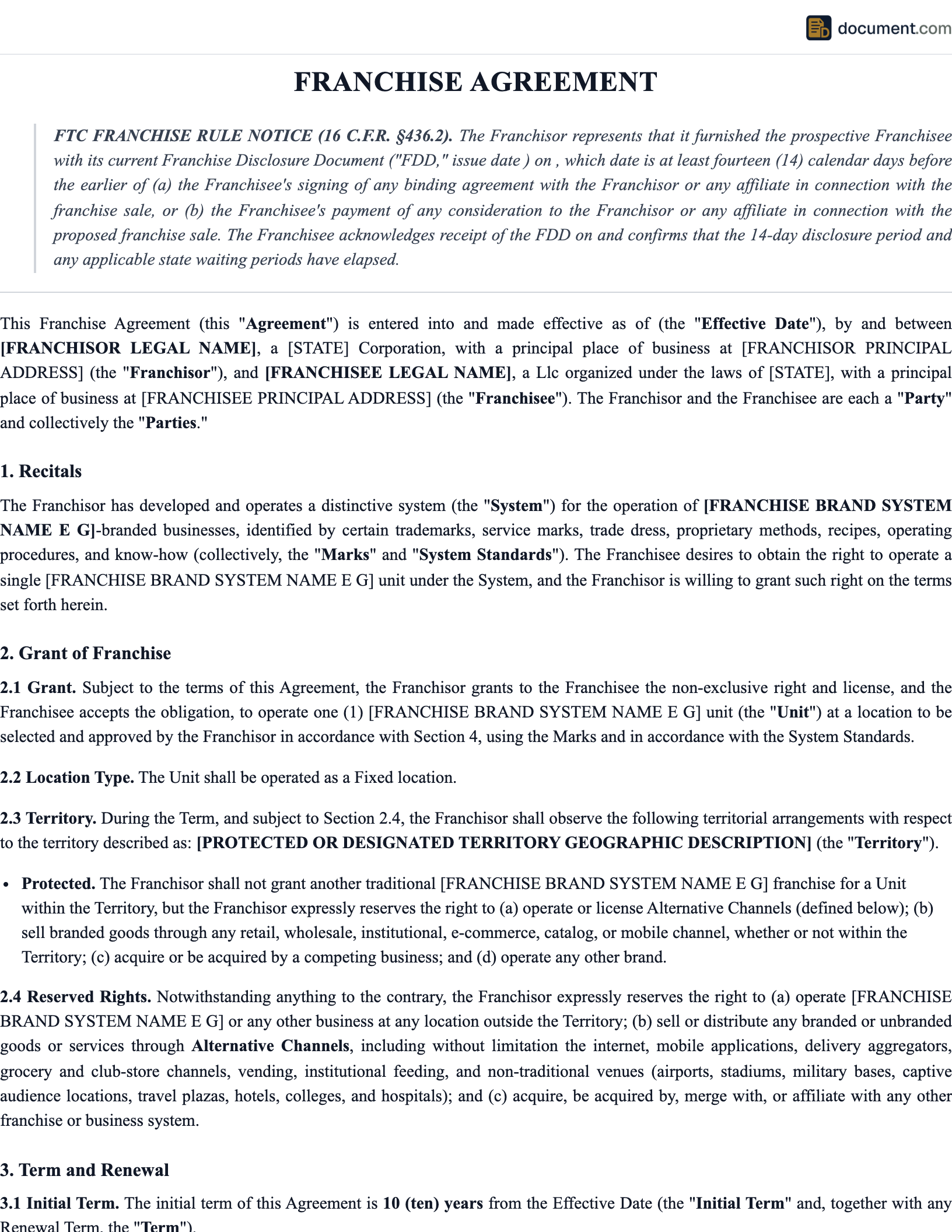
Franchise Agreement Form Preview
Preview of the core sections in our franchise agreement template.
Franchise Agreement
Single-Unit Franchise
Section 1: Parties
Section 2: Grant of Franchise
Section 3: Fees
Initial Franchise Fee: $35,000 due at execution
Royalty: 6% of Gross Sales, payable weekly
Advertising Fund: 2% of Gross Sales, payable monthly
Technology Fee: $500/month for POS and reporting systems
Section 4: Territory
The Franchise Disclosure Document (FDD)
Before any franchise agreement is signed, federal law requires the franchisor to deliver a Franchise Disclosure Document. The FDD is a lengthy document (often 200+ pages with exhibits) that provides standardized information about the franchisor's business, finances, litigation history, and the terms of the franchise relationship. It exists to give prospective franchisees enough information to make an informed investment decision.
The FDD contains 23 items mandated by the FTC Franchise Rule. Among the most important are Item 5 (initial fees), Item 6 (other fees), Item 7 (estimated initial investment), Item 12 (territory), Item 17 (renewal, termination, transfer, and dispute resolution), Item 19 (financial performance representations), and Item 21 (audited financial statements). The franchise agreement itself is attached as Item 22.
14-Day Cooling-Off Period
The FTC requires franchisors to provide the FDD at least 14 calendar days before the franchisee signs any binding agreement or pays any consideration. Some states impose longer waiting periods. Illinois requires 14 business days, and New York requires the FDD to be filed with the Department of Law before any offers are made. Signing before the cooling-off period expires can void the agreement and expose the franchisor to regulatory action.
Understanding Financial Performance Representations (Item 19)
Item 19 is the only place where a franchisor can legally make earnings claims. If the FDD includes an Item 19, it will show historical revenue, profit, or cost data from existing franchise locations. If it does not include an Item 19, the franchisor and its sales staff are prohibited from making any oral or written representations about what a franchisee can expect to earn. About 63% of franchise systems now include an Item 19, up from roughly 40% a decade ago. Always compare Item 19 data against the estimated initial investment in Item 7 to gauge likely returns.
Renewal, Termination, and Transfer (Item 17)
Item 17 summarizes the franchise agreement's provisions on renewal, termination, and transfer in a standardized table format. It covers the length of the franchise term, conditions for renewal, grounds for termination with and without an opportunity to cure, post-termination obligations including non-competes, and the requirements for transferring the franchise to a buyer. This is often the most negotiated section of the franchise relationship, so read Item 17 carefully alongside the corresponding agreement sections.
How to Create a Franchise Agreement: 8 Steps
Whether you are a franchisor building your system or a franchisee reviewing a proposed agreement, these steps walk through the critical decisions.
Define the Franchise Grant
Specify what exactly the franchisee receives: the right to use the franchisor's trademarks, trade dress, proprietary methods, recipes, software, and business system at a specific location or within a defined area. Clarify whether the grant is for a single unit, multiple units (area development), or a master franchise with sub-franchising rights.
Set the Fee Structure
Document the initial franchise fee, ongoing royalty rate and calculation method (percentage of gross sales is standard), advertising fund contribution rate, technology fees, and any other recurring charges. Specify payment frequency, late payment penalties, and interest rates on overdue amounts. Be explicit about what constitutes 'gross sales' and what exclusions apply.
Define the Territory
Draw the franchisee's territory using a clear methodology: a radius from the approved location, a list of ZIP codes, county boundaries, or a custom polygon. Specify whether the territory is exclusive, protected, or non-exclusive, and carve out any exceptions for online sales, delivery, catering, national accounts, or alternative distribution channels.
Outline Training and Support Obligations
Detail the franchisor's initial training program (location, duration, curriculum, who must attend), pre-opening assistance (site selection, build-out, equipment procurement), and ongoing support (field visits, refresher training, marketing assistance, technology updates). Specify who bears the cost of travel and lodging for training.
Establish Operating Standards
Set out the franchisee's obligations to comply with the franchisor's operations manual, quality standards, approved supplier lists, hours of operation, staffing requirements, customer service protocols, and brand standards. Address the franchisor's right to update the manual and the franchisee's obligation to implement changes within specified timeframes.
Address Renewal and Transfer
Specify the initial term (typically 10 to 20 years), the number and duration of renewal terms, conditions for renewal (no defaults, facility upgrades, signing the then-current agreement), the franchisor's right of first refusal on transfers, conditions for consent to transfer, transfer fees, and the buyer's obligations.
Draft Termination and Post-Termination Provisions
List the grounds for termination with a cure period (late payments, operational deficiencies) and without a cure period (abandonment, bankruptcy, criminal conduct, health and safety violations). Detail post-termination obligations: de-identification of the location, return of proprietary materials, covenant not to compete, and assignment of the lease and phone numbers.
Include Dispute Resolution and Governing Law
Choose the governing law (typically the franchisor's home state), specify the dispute resolution mechanism (mediation followed by arbitration or litigation), identify the venue, and address whether the franchisee waives the right to a jury trial. Be aware that several states restrict choice of law and venue provisions in franchise agreements.
Key Components
A comprehensive franchise agreement addresses all of these elements.
| Component | Description |
|---|---|
| Grant of Franchise | License to use marks, system, and methods at the approved location |
| Term and Renewal | Initial term length, renewal options, and conditions for renewal |
| Fees | Initial franchise fee, royalties, advertising fund, technology fees, transfer fees |
| Territory | Geographic scope, exclusivity level, and carve-outs for alternative channels |
| Training | Initial and ongoing training programs, curriculum, and cost allocation |
| Operating Standards | Operations manual compliance, quality standards, and brand requirements |
| Marketing | National advertising fund, local marketing requirements, and approval processes |
| Proprietary Products | Approved suppliers, proprietary recipes, and purchasing obligations |
| Insurance | Required coverage types, minimum limits, and naming the franchisor as additional insured |
| Transfer and Assignment | Right of first refusal, consent conditions, transfer fee, and buyer qualifications |
| Termination | Grounds for termination with and without cure, notice requirements |
| Post-Termination | De-identification, return of materials, non-compete, and lease assignment |
| Non-Compete | In-term and post-term restrictions on competing businesses |
| Confidentiality | Protection of trade secrets, operations manual, and proprietary information |
| Dispute Resolution | Mediation, arbitration, venue, governing law, and jury waiver |
Legal Requirements and Considerations
Franchise agreements operate within a dense regulatory environment at both the federal and state level. Understanding these requirements is essential for both franchisors and franchisees.
FTC Franchise Rule
The FTC Franchise Rule (16 C.F.R. Part 436) requires every franchisor offering or selling franchises in the United States to provide a Franchise Disclosure Document at least 14 calendar days before the franchisee signs any binding agreement or pays any consideration. The rule applies to all franchise offers and sales in or affecting commerce. Violations can result in civil penalties, injunctive relief, and rescission of the franchise agreement. The FTC does not require registration or filing of the FDD, but state laws may.
State Franchise Registration Laws
Approximately 15 states require franchisors to register or file their FDD with a state regulatory agency before making any franchise offers in the state. These "registration states" include California, Illinois, Maryland, Minnesota, New York, Virginia, Washington, and Wisconsin, among others. Some states review the FDD for completeness and may issue comments or require amendments before approving the registration. Filing states like Connecticut, Florida, Kentucky, Nebraska, North Carolina, South Dakota, Texas, and Utah require a notice filing but do not substantively review the FDD.
Franchise Relationship Laws
About 20 states have enacted franchise relationship laws that regulate the ongoing franchisor-franchisee relationship. These laws may restrict the franchisor's ability to terminate or refuse to renew a franchise without good cause, require the franchisor to repurchase inventory at termination, limit the franchisor's ability to impose unreasonable operating requirements, and provide the franchisee with a private right of action for violations. Franchise relationship laws generally cannot be waived by contract.
Earnings Claims Compliance
Franchisors and their sales representatives may only make financial performance representations about what a franchisee can expect to earn if those representations appear in Item 19 of the FDD. Any oral or written earnings claim that is not supported by Item 19 is a violation of the FTC Franchise Rule and state franchise laws. Franchisees should document any earnings claims made during the sales process and compare them to the FDD. If claims were made outside Item 19, this may be grounds for rescission.
Joint Employer Risk
- NLRB Standard: The franchisor may be deemed a joint employer of the franchisee's employees if it exercises direct or indirect control over essential terms and conditions of employment.
- Wage and Hour: Several courts have found franchisors liable under the FLSA and state wage laws when the franchisor controlled scheduling, hiring, or pay rates at franchise locations.
- Best Practice: The franchise agreement should clearly state that the franchisee is an independent business owner solely responsible for employment decisions, and the franchisor's operating standards should avoid dictating specific employment terms.
Sample Franchise Agreement
Condensed preview of our franchise agreement template.
FRANCHISE AGREEMENT
[Franchise System Name]
This Franchise Agreement is entered into between[Franchisor] and[Franchisee] for the operation of a[Brand Name]franchise at the Approved Location.
1. GRANT OF FRANCHISE
Franchisor grants Franchisee a non-exclusive license to operate one unit using the System, Marks, and Proprietary Methods at the Approved Location for the Initial Term.
2. FEES
(a) Initial Franchise Fee: [$] due at execution. (b) Continuing Royalty: [%] of Gross Sales, payable weekly. (c) Advertising Fund: [%] of Gross Sales, payable monthly.
3. TERRITORY
Franchisor grants Franchisee an exclusive territory defined as a[radius/area]from the Approved Location, subject to carve-outs for online sales and national accounts.
4. TERM AND RENEWAL
The Initial Term is [years]. Franchisee may renew for [number]successive terms of [years] each, subject to the conditions set forth herein.
5. TRAINING AND SUPPORT
Franchisor shall provide initial training of not less than[hours/weeks]at Franchisor's training facility, covering operations, customer service, marketing, and technology systems.
6. TERMINATION
Franchisor may terminate this Agreement upon thirty (30) days written notice for curable defaults and immediately for incurable defaults including abandonment, bankruptcy, and material health or safety violations.
Frequently Asked Questions
Common questions about franchise agreements, fees, territory rights, and FDD compliance.
Official Resources
Authoritative sources on franchise law, disclosure requirements, and regulatory compliance.
FTC Franchise Rule
Full text of the FTC Franchise Rule (16 C.F.R. Part 436) and compliance guides
International Franchise Association
IFA resources on franchise best practices, education, and advocacy
SBA Franchise Guide
Small Business Administration guidance on evaluating and financing franchise opportunities
NASAA Franchise Resources
North American Securities Administrators Association franchise filing and registration guidance
ABA Forum on Franchising
American Bar Association resources on franchise law and practice
Federal Franchise Legislation
Congressional franchise-related legislation and regulatory updates
Create your Franchise Agreement in under 10 minutes.
Answer a few questions and download a compliant, attorney-drafted document ready for your state.