



What Is a Business Plan?
A business plan is a written document that describes a company's concept, market, operations, management team, and financial forecast over a defined period — typically the next three to five years. It serves two purposes at the same time. Externally, it is the document lenders, investors, landlords, and strategic partners use to evaluate whether your business is worth supporting. Internally, it is the roadmap the founding team uses to stay aligned on priorities, capital allocation, hiring, and key milestones.
A good plan answers a handful of non-negotiable questions: What problem are you solving, and for whom? How big is the opportunity? What is your solution and why will customers choose it over alternatives? How will you actually deliver the product or service? What does the financial model look like, and how much capital do you need to reach a sustainable state? Who is running the business, and why are they the right team? Plans that answer these questions with clarity, specificity, and defensible data stand out immediately.
You do not have to start from a blank page. Our templates provide the standard lender-ready structure with prompts under every section, plus industry-specific variants for restaurants, daycares, food trucks, non-profits, real estate ventures, and lean one-page plans. Fill in your details, adjust the projections to match your assumptions, and export a clean PDF ready to send.
Strategic Clarity
Force yourself to define the customer, the offer, and the path to revenue
Funding Ready
Meet the standard format SBA lenders and investors expect to see
Growth Roadmap
A living document you can update as you hit milestones and learn
Business Plan Preview
The template walks you through each required section with prompts and example language. Here is how the cover and executive summary pages are structured.
Business Plan
Harvest & Oak, LLC
Farm-to-table restaurant concept | Denver, CO
Prepared by Alexandra Chen, Founder | April 2026
1. Executive Summary
Harvest & Oak is a 78-seat farm-to-table restaurant in the Highlands neighborhood of Denver, Colorado, focused on seasonal tasting menus sourced from a defined radius of 50 miles. We are raising $685,000 in a combination of SBA 7(a) financing and founder capital to complete the build-out, fund opening inventory, and cover the first six months of operations.
2. Market Opportunity
3. Financial Highlights
Types of Business Plans
Different industries and audiences call for different plan formats. Choose the template that matches your concept and the people you need to convince.
Daycare Business Plan
Plan for licensed childcare centers, in-home daycares, and early learning programs
Food Truck Business Plan
Mobile food service concept with commissary, route, and event strategy
Non-Profit Business Plan
Mission-driven plan with program design, fundraising, and board governance
Real Estate Business Plan
Plan for brokerages, investors, property managers, and rental portfolios
Restaurant Business Plan
Full-service restaurant concept with menu, operations, and unit economics
One Page Business Plan
Condensed single-page business plan summarizing strategy, market, financials, and milestones
How to Write a Business Plan
A good first draft takes 10 to 20 hours of focused work. Follow these steps and resist the urge to polish the prose until the thinking is solid.
- 1
Define the concept in one sentence
If you cannot describe your business in a single clear sentence, you are not ready to write the plan yet. Start here and refine until it is tight.
- 2
Research the market
Pull real data on market size, growth rate, customer behavior, and direct competitors. Cite the sources so the numbers are defensible.
- 3
Outline operations and team
Describe how the product or service will actually be delivered, what it costs to deliver, and who on the team is accountable for each function.
- 4
Build the financial model
Start with unit economics, then project monthly cash flow for year one and annually for years two and three. Every number should tie to a stated assumption.
- 5
Write the body sections
Company description, product, market analysis, marketing plan, operations, management, and financials. Keep each section focused and specific.
- 6
Write the executive summary last
Now that the details are locked in, write a clear one- to two-page summary that will make a busy reader want to read the rest.
- 7
Review and stress-test
Have a mentor, CPA, or SCORE advisor read it and challenge your assumptions. Tighten the parts they get stuck on.
Key Sections of a Business Plan
Every lender-ready plan includes the same core sections. Use this as your checklist.
Executive summary
One to two pages summarizing the whole plan and the ask
Company description
Legal structure, location, mission, and history
Product or service
What you sell, how it is priced, and why customers will buy
Market analysis
TAM, SAM, SOM, customer profile, and competitive landscape
Marketing and sales plan
How you will reach and convert customers
Operations plan
Supply chain, staffing, facilities, and day-to-day execution
Management team
Founder and key hire bios with relevant experience
Financial projections
P&L, cash flow, and balance sheet for 3 to 5 years
Funding request
How much capital you need, how it will be used, and terms
Appendix
Resumes, lease letters, permits, and supporting data
Sample Business Plan
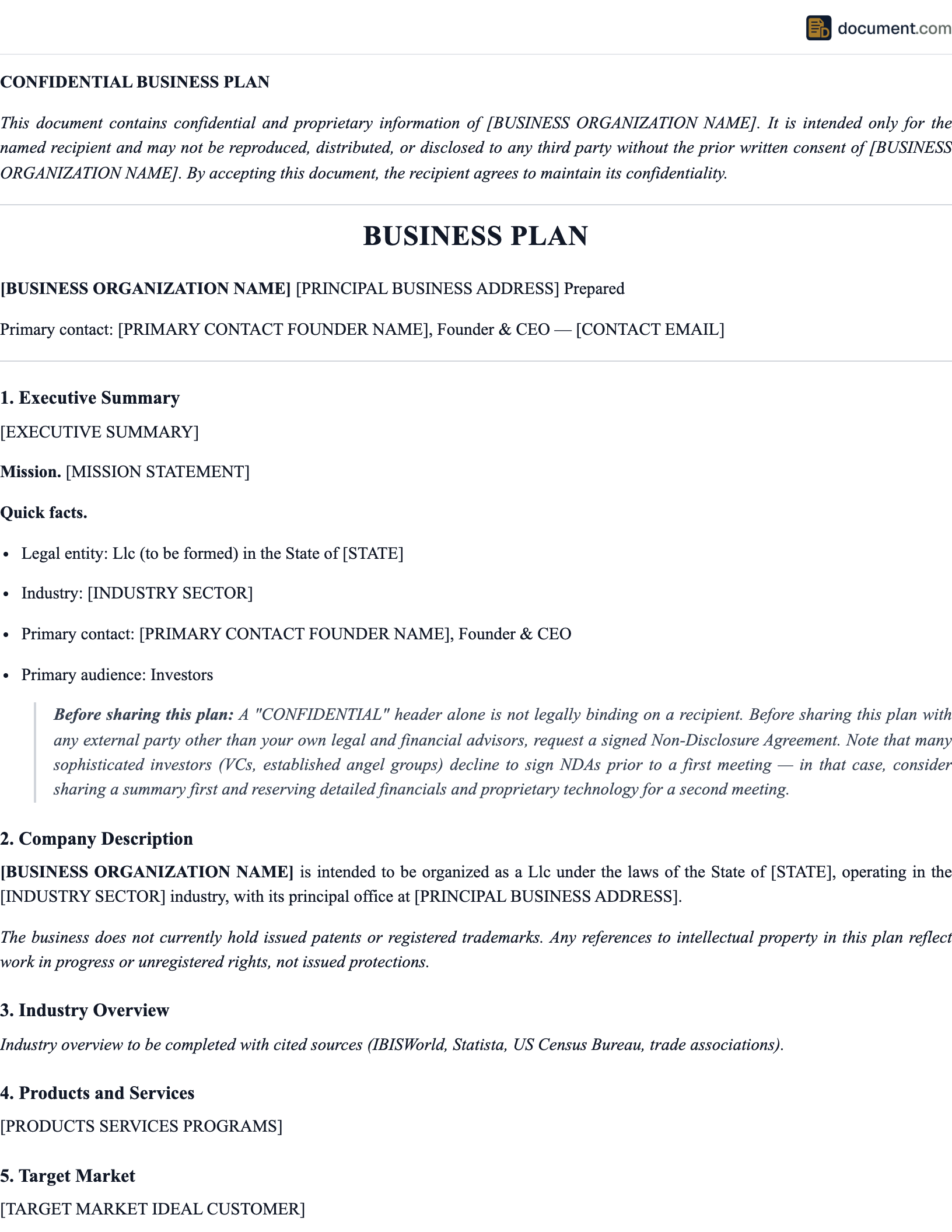
Below is a condensed preview of the standard business plan structure you will complete. Your final document will be fully formatted with your real data and industry-specific prompts.
BUSINESS PLAN
[Company Name]
[City, State] | [Month Year]
1. Executive Summary
[Company] is a [industry/concept] based in [location] serving [target customer]. We are seeking [$amount] to [use of funds]. Year 3 revenue is projected at [$amount] with an EBITDA margin of [%].
2. Company Description
Legal entity: [LLC/C-Corp/S-Corp]. Founded [date]. Mission: [one-sentence mission]. Location: [address]. Stage: [pre-revenue/revenue-generating].
3. Market Analysis
Total addressable market: [$TAM]. Serviceable market: [$SAM]. Our near-term share: [$SOM]. Primary customer: [profile]. Key competitors: [list]. Differentiation: [why customers choose us].
4. Products and Services
[Offering 1]: [price, margin]. [Offering 2]: [price, margin]. Unit economics: [CAC, LTV, payback period].
5. Marketing and Sales
Customer acquisition channels: [list]. Target CAC: [$amount]. Sales process: [describe]. Year 1 marketing budget: [$amount].
6. Operations
Location and facilities: [describe]. Staffing plan: [headcount by year]. Key suppliers and vendors: [list]. Technology stack: [list].
7. Management Team
[Founder Name], [Title]: [relevant experience]. [Co-founder Name], [Title]: [relevant experience]. Advisors: [list].
8. Financial Projections
Year 1: Revenue [$amount], Net income [$amount]. Year 2: Revenue [$amount], Net income [$amount]. Year 3: Revenue [$amount], Net income [$amount]. Break-even: [month]. Cash needed: [$amount].
Frequently Asked Questions
Common questions about plan length, the executive summary, financial projections, and lender expectations.
Official Resources
Use these official and reputable sources to research your market, refine your plan, and find mentors, funding programs, and technical assistance.
SBA - Write Your Business Plan
Small Business Administration guide to traditional and lean business plans
SCORE - Business Plan Template
Free mentorship and downloadable templates from SCORE
U.S. Census Bureau - Income and Demographics
Official demographic and household data for market sizing
BLS - Business Employment Dynamics
Bureau of Labor Statistics data on business starts, closures, and employment
SBA - Small Business Development Centers
Find a local SBDC for free business plan advising and lender introductions
IRS - Starting a Business
Federal tax obligations, entity selection, and EIN registration
Create your Business Plan in under 10 minutes.
Answer a few questions and download a compliant, attorney-drafted document ready for your state.