



What Is a Non-Profit Business Plan?
A non-profit business plan is a strategic document that translates a charitable mission into a structured operational and financial model. Unlike a for-profit plan where the bottom line is profit, a non-profit plan must demonstrate that the organization can deliver measurable social impact while maintaining fiscal sustainability through a diversified mix of grants, donations, program fees, and government contracts — none of which are guaranteed year over year.
The plan serves several audiences simultaneously. For the IRS, the plan's content feeds directly into the Form 1023 application for 501(c)(3) tax-exempt status. For foundation grantmakers, it demonstrates organizational capacity, sound governance, and a credible theory of change connecting your programs to the outcomes you claim. For major individual donors, it provides the transparency needed to justify significant charitable gifts. And for the board of directors, it is the governing document that aligns the organization's activities with its stated mission and establishes the financial guardrails for responsible stewardship.
Our non-profit business plan template is structured around the sections that grantmakers, the IRS, and accrediting bodies expect to see, with guided prompts for mission and vision statements, program design with logic models, board governance structure, fundraising strategy across multiple revenue streams, impact measurement frameworks, and a financial model that projects revenue and expenses over three to five years with explicit sustainability milestones.
Mission-Driven
Built for impact metrics, theories of change, and program logic models — not profit targets
Grant Ready
Structured to support foundation applications and 501(c)(3) filings
Sustainability Model
Diversified revenue projections with grant, donor, and earned income streams
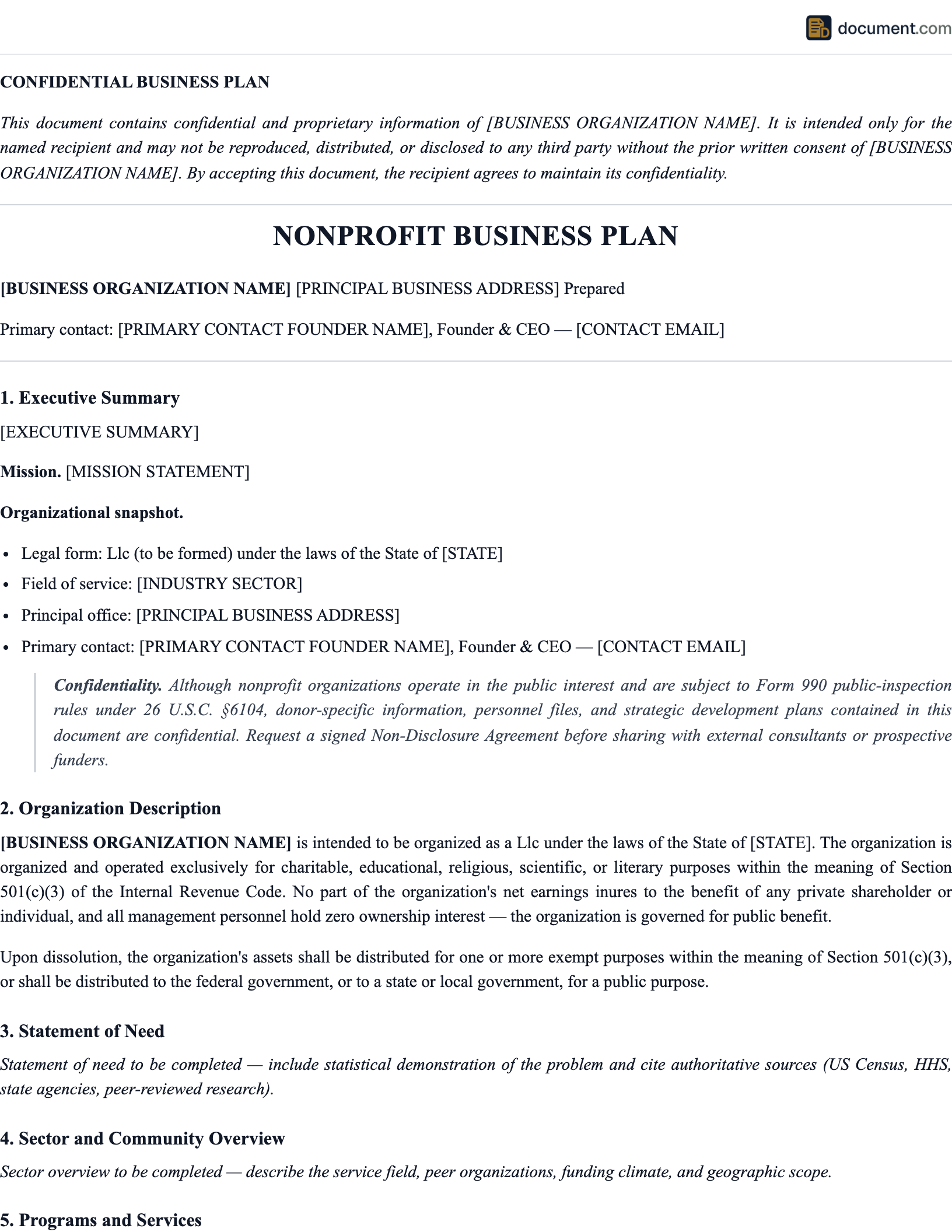
Non-Profit Business Plan Preview
The template walks you through every section a grantmaker and the IRS expect, with prompts and example language tailored to non-profit organizations. Here is how the mission overview and financial summary pages are structured.
Non-Profit Business Plan
Pathways to Literacy, Inc.
501(c)(3) adult literacy and workforce readiness | Denver, CO
Prepared by the Board of Directors
1. Mission & Vision
Pathways to Literacy provides free adult literacy instruction and workforce readiness training to 600 adults annuallyin the Denver metro area who read below a sixth-grade level. The organization's vision is a community where every adult has the reading and digital literacy skills needed to secure stable employment, support their children's education, and participate fully in civic life.
2. Financial Summary
3. Impact Targets
Serve 600 adult learners in year one. Achieve a minimum two-grade-level reading improvement for 70% of participants completing the 16-week program. Place 45% of workforce-track graduates into employment within 90 days of program completion.
Why Non-Profits Need a Dedicated Business Plan
Non-profit organizations face a funding model that is fundamentally different from any for-profit business. Revenue comes from sources that require applications, cultivation, and reporting — grants have deadlines and compliance requirements, individual donors need engagement and stewardship, government contracts require competitive bidding and performance reporting, and program fees rarely cover full costs. A generic business plan template cannot model these dynamics.
Grantmakers are the most demanding audience for a non-profit plan. Foundation program officers review hundreds of proposals and can immediately identify organizations that have not done the strategic planning work. They look for a clear theory of change, measurable outcomes, a realistic budget, a diversified revenue model, strong board governance, and evidence that the organization has the capacity to deliver what it promises. A well-written business plan addresses every one of these evaluation criteria before the first grant application is submitted.
The IRS also scrutinizes non-profit organizational structure during the 501(c)(3) application process. The narrative description of activities, the governance policies, and the financial projections required on Form 1023 map directly to sections of the business plan. Organizations that write the plan first consistently produce stronger IRS applications and receive determination letters faster because the information is organized and internally consistent.
Sector Scale
The U.S. non-profit sector includes over 1.8 million registered organizations and contributes more than $1 trillion annually to the economy. Despite this scale, roughly 30 percent of new non-profits fail within the first ten years, and the most commonly cited reasons are inadequate funding diversification, weak governance, and the absence of a strategic plan. Organizations that launch with a formal business plan are significantly more likely to secure initial funding, attract qualified board members, and survive the critical first three years of operation.
Key Sections of a Non-Profit Business Plan
A non-profit plan must cover the standard organizational sections plus the mission-specific components that grantmakers, the IRS, and donors require. Our template provides guided prompts under each one.
Executive Summary
A one-to-two-page overview covering the mission, the problem you address, the programs you deliver, the population you serve, the funding model, the board composition, and the key impact metrics. Write this last so it accurately reflects the detail in the full plan.
Mission, Vision & Theory of Change
The mission statement (what you do and for whom), the vision statement (the long-term change you seek), and the theory of change that connects your programs to the outcomes you claim. Include a logic model showing inputs, activities, outputs, outcomes, and long-term impact.
Programs & Services
A detailed description of each program — the target population, the service model, the delivery schedule, the staffing required, the participant capacity, the measurable outcomes, and the cost per participant. Grantmakers evaluate whether your programs are evidence-based or evidence-informed.
Governance & Management
Board of directors composition with member bios and expertise, committee structure, conflict of interest policies, officer roles and term limits, the board-staff relationship, and the executive director's qualifications. Include the organizational chart and key hire timeline.
Market & Needs Assessment
Data documenting the need your organization addresses — demographics of the target population, gap analysis showing unmet demand, comparable organizations and how you differ, and supporting data from government agencies, academic research, or community needs assessments.
Fundraising & Revenue Strategy
Projected revenue from each source (grants, individual donors, corporate sponsors, government contracts, program fees, events) with specific targets, timelines, and the strategy for cultivating each stream. Include the grant pipeline with identified foundations and application deadlines.
Impact Measurement
The outcomes framework for each program, data collection methods, evaluation timeline, reporting cadence, and how impact data will be used to improve programs and satisfy funder reporting requirements. Reference relevant evidence standards for your field.
Financial Projections
Three-to-five-year projected budget showing revenue by source and expenses by program and administrative function. Include the program expense ratio, fundraising efficiency ratio, months of operating reserves, and a sustainability trajectory showing how the revenue mix evolves over time.
Non-Profit Financial Projections
The financial section of a non-profit plan must demonstrate fiscal responsibility and sustainability. Grantmakers and donors evaluate your numbers against sector benchmarks to assess organizational health and capacity.
Unlike a for-profit plan, the goal is not to maximize profit but to show that revenue is sufficient to deliver programs, maintain operations, and build a reasonable reserve.
| Metric | Sector Benchmark | What Grantmakers Check |
|---|---|---|
| Program Expense Ratio | 75-85% of total expenses | Whether most spending goes to mission delivery, not overhead |
| Fundraising Efficiency | $0.10-0.25 per $1 raised | Cost-effectiveness of fundraising activities |
| Revenue Diversification | No source > 50% | Whether the organization survives if one funder leaves |
| Operating Reserve | 3-6 months expenses | Cash cushion to weather funding gaps and timing mismatches |
| Cost per Outcome | Varies by sector | Whether the cost to achieve each outcome is reasonable |
| Admin Overhead | 10-20% of expenses | Management and general costs relative to total budget |
How to Write a Non-Profit Business Plan
Writing a non-profit business plan requires input from your founding team, board members, and ideally a few people from your target community. Budget 60 to 120 hours for a thorough first draft. Here is the process.
Define the mission and theory of change
Articulate the specific problem you address, the population you serve, and the mechanism by which your programs create change. Build a logic model connecting your inputs and activities to measurable outcomes. Every other section of the plan flows from this foundational work — if the theory of change is unclear, the rest of the plan will be too.
Conduct a needs assessment
Gather data documenting the scope of the problem in your target community. Use government data (Census, BLS, HHS), academic research, community surveys, and interviews with potential participants and partner organizations. Grantmakers want evidence that the need is real, quantifiable, and not already adequately addressed by existing organizations.
Design the programs
For each program, define the target population, the service model, the delivery schedule, the staff required, the participant capacity, and two to four measurable outcomes with targets. Use evidence-based or evidence-informed approaches wherever possible — grantmakers increasingly require this. Calculate the cost per participant for each program.
Build the governance structure
Recruit board members who bring the skills the organization needs — financial oversight, legal expertise, fundraising connections, and lived experience related to the mission. Draft the bylaws, conflict of interest policy, and board job descriptions. Document the committee structure and the board-staff relationship. This section is heavily weighted in both grant applications and the IRS 1023 review.
Develop the fundraising strategy
Identify specific funding sources for each revenue stream. For grants, build a pipeline of five to fifteen foundations with aligned funding priorities, typical grant sizes, and application deadlines. For individual donations, map your founding team's network and estimate realistic first-year giving. For program fees and government contracts, research what comparable organizations charge and what contracts are available in your area.
Build the financial model
Project revenue by source and expenses by program and administrative function for three to five years. Show the revenue diversification trajectory — heavy grant dependence in year one is expected, but by year three the mix should be more balanced. Include a reserve fund buildup plan and a sustainability milestone showing when the organization reaches financial independence from any single funder.
Write the executive summary last
The executive summary should be a compelling two-page overview that a foundation program officer can read in five minutes and immediately understand the mission, the approach, the team, the funding model, and the expected impact. Write it after everything else so it is accurate and internally consistent.
Frequently Asked Questions
Common questions about writing and using a non-profit business plan for 501(c)(3) applications, grant proposals, and organizational planning.
Official Resources
Authoritative resources for non-profit formation, tax-exempt status, governance best practices, grant research, and impact measurement.
IRS Tax-Exempt Organization Resources
The IRS's official portal for non-profit tax-exempt organizations, including Form 1023 instructions, annual filing requirements, and compliance guidance.
Foundation Center / Candid
The leading resource for foundation and grant research, including Foundation Directory Online for identifying funders whose priorities match your mission.
National Council of Nonprofits
Governance best practices, board development resources, financial management guides, and state-by-state registration requirements for charitable solicitation.
Guidestar (Candid)
Non-profit transparency platform where organizations post their financials and impact data. Grantmakers and donors routinely check Guidestar profiles before funding decisions.
BoardSource
The authoritative resource for non-profit board governance, including board self-assessment tools, governance policies, and executive director evaluation frameworks.
Grants.gov
The federal government's portal for finding and applying to all discretionary grant programs across federal agencies — essential for non-profits seeking government funding.
Create your Non Profit Business Plan in under 10 minutes.
Answer a few questions and download a compliant, attorney-drafted document ready for your state.