
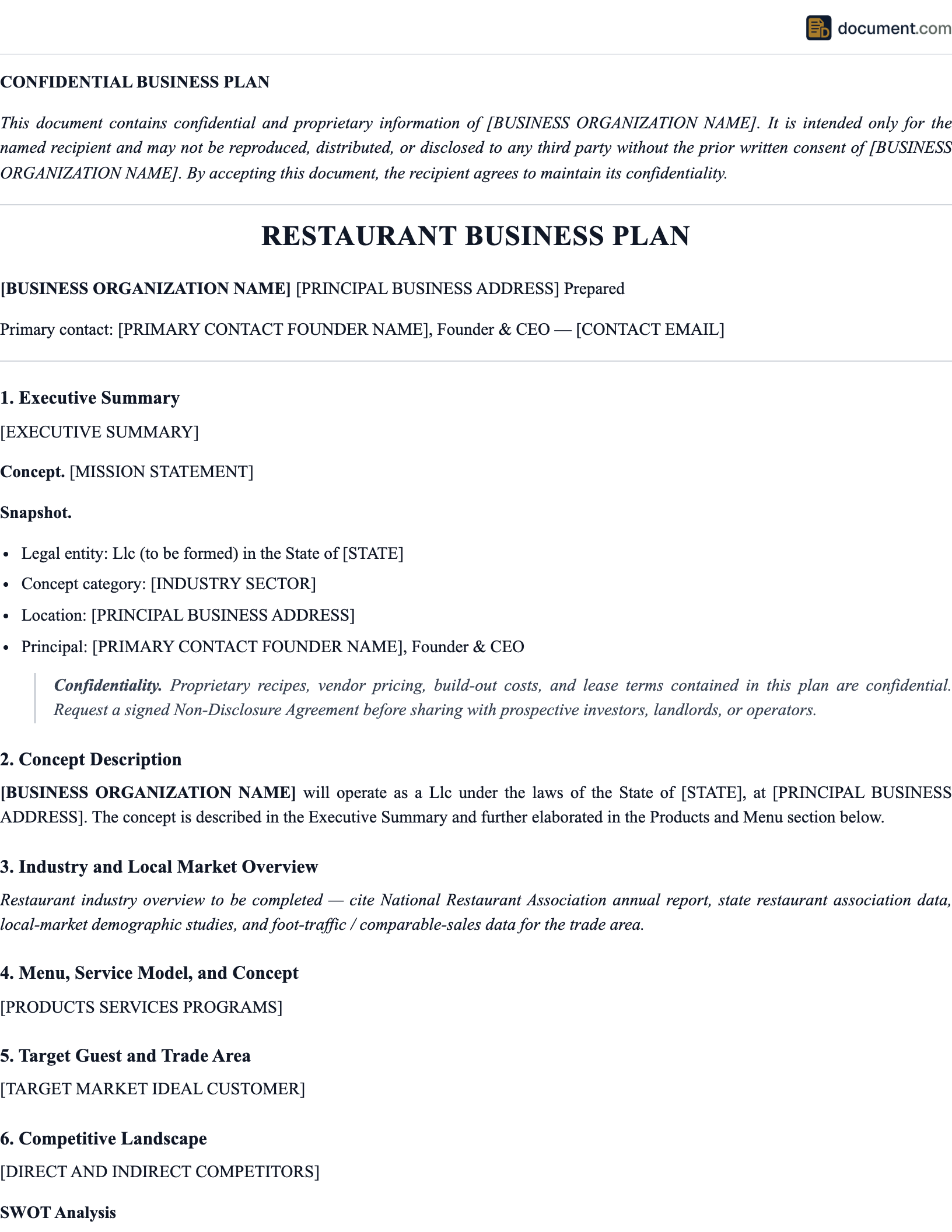



What Is a Restaurant Business Plan?
A restaurant business plan is a written document that translates a dining concept into a structured operating and financial model. Unlike a generic business plan, a restaurant plan must address industry-specific variables that do not appear in other sectors: food cost percentages, table turn rates, kitchen workflow design, liquor licensing timelines, health department permitting, menu engineering, and the labor model that ties front-of-house and back-of-house staffing to projected covers per meal period.
The plan serves two audiences simultaneously. Externally, it is what SBA lenders, commercial landlords, and private investors use to evaluate whether your concept is financially viable and whether the team can execute it. Internally, it is the operational blueprint the ownership and management team reference during buildout, hiring, menu development, and the critical first twelve months of operation when cash flow is tightest.
Our restaurant business plan template is structured around the sections lenders and landlords expect to see, with guided prompts for concept description, trade-area analysis, competitive positioning, menu and pricing strategy, kitchen and front-of-house operations, staffing and management, and a full financial model including startup costs, monthly cash flow, and a three-year income statement.
Restaurant-Specific
Built for food cost, covers, turns, and kitchen ops — not generic business templates
Lender Ready
Structured for SBA 7(a), 504, and commercial bank loan applications
Full Financials
Startup costs, monthly cash flow, P&L, and break-even analysis included
Restaurant Business Plan Preview
The template walks you through every section a lender expects, with prompts and example language tailored to the restaurant industry. Here is how the concept overview and financial summary pages are structured.
Restaurant Business Plan
Ember & Vine, LLC
Wood-fired Mediterranean grill | Austin, TX
Prepared by Marco DeLuca, Managing Partner
1. Concept Overview
Ember & Vine is a 72-seat wood-fired Mediterranean grill in the East Austin corridor, targeting the 25-to-45 professional demographic with a $52 average dinner checkand a curated natural wine program. The concept fills a gap between the neighborhood's taco-and-barbecue density and the demand for ingredient-driven, fire-focused cooking with a walk-in-friendly format.
2. Financial Summary
3. Menu Strategy
A focused 24-item dinner menu and a 12-item weekend brunch menu, rotated seasonally, with 60% of proteins cooked over the wood-fire hearth. Menu pricing is engineered to maintain a blended food cost of 30% while keeping the average entree under $28.
Why Restaurants Need a Dedicated Business Plan
Restaurants operate under financial dynamics that are fundamentally different from most businesses. Margins are thin — a well-run full-service restaurant typically nets 3 to 9 percent pre-tax profit — and the gap between success and failure often comes down to whether the operator accurately modeled food cost, labor, and rent before signing a lease. A generic business plan template does not account for these variables.
Lenders who specialize in restaurant financing evaluate plans differently than they evaluate a tech startup or a consulting firm. They look at the rent-to-revenue ratio (ideally under 8 to 10 percent of gross revenue), prime cost (food plus labor, which should stay under 60 to 65 percent), the experience of the management team in the specific restaurant segment, and whether the buildout budget accounts for the real cost of hood ventilation, grease traps, ADA compliance, and fire suppression — items that routinely run 30 to 50 percent over first-time operators' estimates.
Commercial landlords also use the business plan to screen tenants. A restaurant lease is a long-term commitment with significant tenant improvement costs, and landlords want evidence that the operator has the capital, the concept, and the operational plan to survive the first two years. Submitting a thorough, restaurant-specific plan signals that you understand the business you are entering.
Industry Failure Rate
According to research published by the National Restaurant Association and hospitality academics, roughly 60% of restaurants fail within the first year and 80% within five years. Undercapitalization and poor planning — not bad food — are the most cited reasons. A detailed business plan is the single best tool for stress-testing your concept before you sign a lease and start spending capital.
Key Sections of a Restaurant Business Plan
While the exact structure varies by concept and audience, most lender-ready restaurant business plans include the following sections. Our template provides guided prompts under each one.
Executive Summary
A one-to-two-page overview covering the concept, target market, capital required, use of funds, projected revenue, and the management team. Write this section last so it accurately reflects the detail underneath it.
Concept & Menu
The cuisine type, service style, price positioning, menu size and structure, sourcing philosophy, and any differentiating elements like a scratch kitchen, specific cooking method, or beverage program. Include a sample menu with pricing.
Market & Competition
Trade-area demographics, foot traffic, daytime population, competitor mapping by cuisine and price point, and the specific gap your concept fills. Use Census data, BLS reports, and local economic development sources.
Location & Design
Site selection criteria, lease terms, square footage breakdown between front-of-house and back-of-house, seating capacity, kitchen layout, and buildout scope including hood ventilation, grease trap, ADA compliance, and signage.
Operations Plan
Hours of operation, meal periods, kitchen workflow, vendor relationships, inventory management, point-of-sale system, reservation strategy, and delivery or takeout integration if applicable.
Management & Staffing
Ownership structure, key management bios with relevant restaurant experience, organizational chart, staffing levels by meal period, training program, and labor cost model as a percentage of revenue.
Marketing & Launch
Pre-opening marketing timeline, grand opening strategy, ongoing marketing channels, social media plan, local press outreach, loyalty program, and customer acquisition cost estimates.
Financial Projections
Startup cost budget, monthly cash flow for year one, annual P&L for years two and three, break-even analysis, sensitivity analysis at different revenue levels, and a clear use-of-funds table for lenders.
Restaurant Financial Projections
The financial section is where most restaurant business plans either earn credibility or lose it. Lenders evaluate your numbers against known industry benchmarks, so projections that are wildly optimistic or missing standard line items will get flagged immediately.
Your plan should include the following financial components, each supported by clearly stated assumptions that a lender can trace back to your concept and market data.
| Metric | Industry Benchmark | What Lenders Check |
|---|---|---|
| Food Cost % | 25-35% of revenue | Menu-level cost analysis, not just an industry average |
| Labor Cost % | 25-35% of revenue | Staffing model by position and meal period |
| Prime Cost | Under 60-65% | Food + labor combined — the single most watched number |
| Rent-to-Revenue | 6-10% of revenue | Whether the lease is sustainable at projected volume |
| Break-Even | Month 6-18 | Expressed in daily covers and revenue dollars |
| Net Profit Margin | 3-9% pre-tax | Whether debt service is covered after all operating costs |
How to Write a Restaurant Business Plan
Writing a restaurant business plan is a research and modeling exercise, not a creative writing project. Budget 40 to 80 hours for a first draft if you are doing it yourself. Here is the process that produces the strongest plans.
Lock the concept first
Define the cuisine, service style, target customer, price point, and hours of operation before writing anything else. Every other section — menu, staffing, financials, marketing — flows from the concept. If the concept is fuzzy, the plan will be too.
Research the trade area
Pull Census data for your target location's demographics, income, and population density. Visit the area at different times of day and week. Identify every direct and indirect competitor within a one-to-three-mile radius. Talk to commercial brokers about vacancy rates and lease economics.
Build the menu and price it
Draft a working menu, source ingredient costs from actual suppliers, and calculate the food cost per dish. The blended food cost across your full menu mix is the foundation of your entire financial model. Do not guess — get real quotes.
Model the labor
Create a staffing schedule by position (line cooks, prep, servers, bartenders, host, dishwashers, manager) for each meal period. Multiply by local wage rates plus benefits, taxes, and workers' comp. Labor should land between 25 and 35 percent of projected revenue.
Build the startup cost budget
Itemize every pre-opening cost: lease deposit, buildout, equipment, furniture, smallwares, POS system, initial inventory, permits and licenses, pre-opening marketing, and at least three to six months of working capital for the cash-burn period before you reach break-even.
Project revenue conservatively
Use your seat count, turn rate, and average check to model revenue by meal period. Ramp the first year — start at 50-60% of capacity and reach stabilized volume by month ten to twelve. Include seasonal adjustments. Lenders will flag projections that assume full volume from day one.
Write the narrative sections last
The executive summary, concept description, and market analysis are easier and more credible to write after you have built the financial model. The numbers inform the story, not the other way around.
Sample Restaurant Business Plan Outline
Below is a condensed outline showing how a lender-ready restaurant plan is organized. The full template includes prompts, example language, and financial worksheets under each section.
Frequently Asked Questions
Common questions about writing and using a restaurant business plan for financing, lease applications, and operational planning.
Official Resources
Authoritative resources for restaurant business planning, financing, food safety compliance, and industry data.
SBA Business Plan Guide
The U.S. Small Business Administration's official guide to writing a business plan, including format requirements for SBA loan applications.
National Restaurant Association
Industry research, benchmarks, workforce data, and advocacy resources for restaurant operators across all segments.
FDA Food Code
The federal model food safety code adopted by most state and local health departments as the basis for food service regulations.
SCORE Restaurant Mentorship
Free mentorship from experienced restaurant operators and business advisors through the SBA's SCORE network.
ServSafe (National Restaurant Association)
Food safety certification programs required by most states for restaurant managers and food handlers.
Bureau of Labor Statistics — Food Services
Employment, wages, and industry outlook data for restaurants and food services used in market analysis sections.
Create your Restaurant Business Plan in under 10 minutes.
Answer a few questions and download a compliant, attorney-drafted document ready for your state.