



What Is a Food Truck Business Plan?
A food truck business plan is a structured document that translates a mobile food concept into an operational and financial model. Unlike a brick-and-mortar restaurant plan, a food truck plan must account for variables unique to mobile food service: the cost and configuration of the truck itself, commissary kitchen requirements mandated by health departments, route planning and location strategy, seasonal revenue swings that can cut income by 30 to 60 percent in winter months, and the permit landscape that varies dramatically from one city to the next.
The plan serves both as a financing tool and an operating manual. For lenders and investors, it demonstrates that you understand the real economics of mobile food — that revenue depends on location quality and weather, that a commissary kitchen is a non-negotiable fixed cost, and that the truck itself depreciates and requires a maintenance reserve. For you as the operator, it is the document that forces you to model daily revenue per stop, food cost per item, and the monthly cash burn during the slow season before you commit $50,000 to $200,000 in capital.
Our food truck business plan template is structured around the sections that lenders, commissary partners, and event organizers expect to see, with guided prompts for concept and menu development, truck specification and equipment planning, commissary arrangements, permit timelines, route and event strategy, and a financial model that accounts for seasonality, weather days, and equipment maintenance reserves.
Mobile-Specific
Built for trucks, routes, commissaries, and seasonal ops — not fixed-location templates
Route Planning
Location strategy, event calendar, and revenue-per-stop modeling included
Seasonal Financials
Monthly projections with weather adjustments and off-season planning
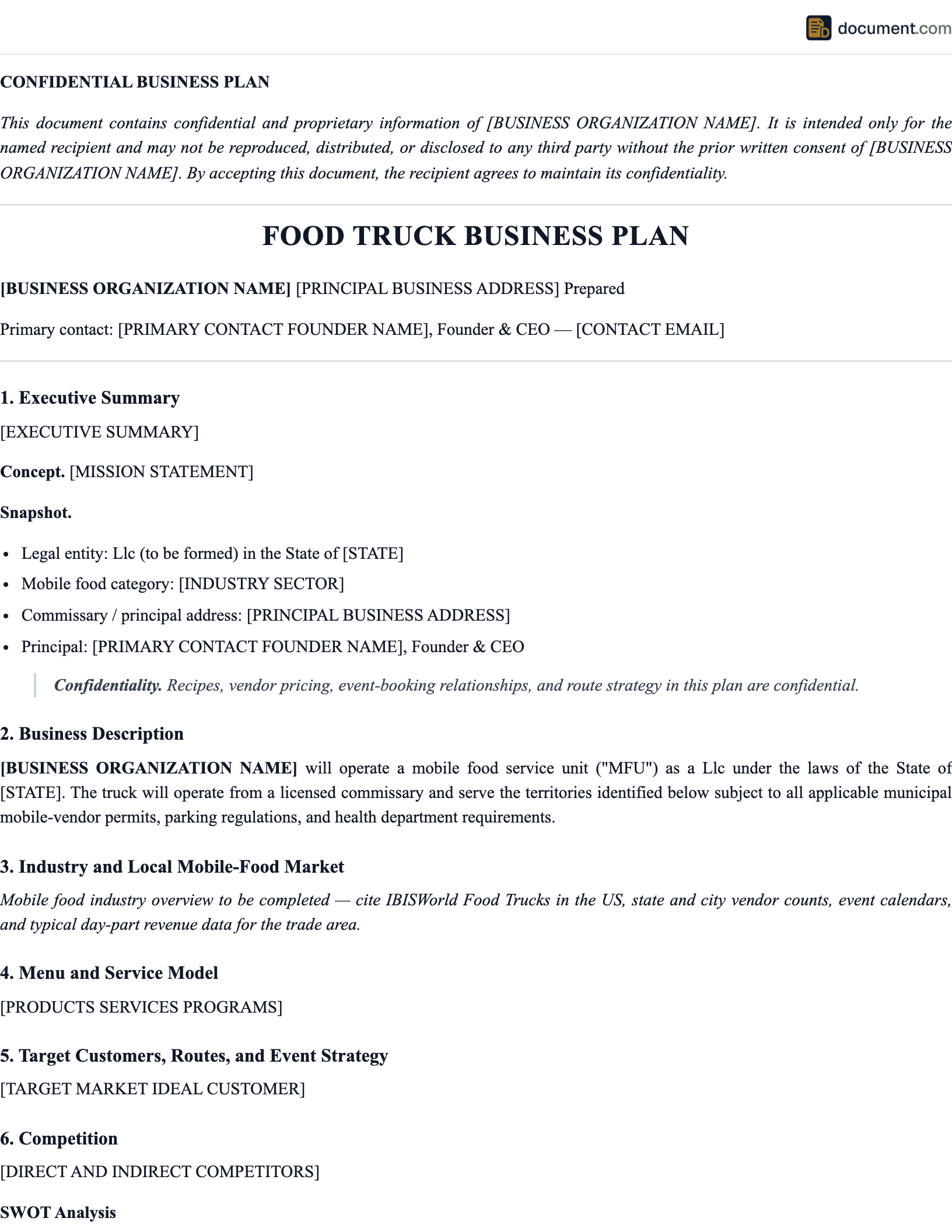
Food Truck Business Plan Preview
The template walks you through every section a lender or investor expects, with prompts and example language tailored to the mobile food industry. Here is how the concept overview and financial summary pages are structured.
Food Truck Business Plan
Seoul on Wheels, LLC
Korean-Mexican fusion street food | Portland, OR
Prepared by David Kim, Owner / Operator
1. Concept Overview
Seoul on Wheels is a Korean-Mexican fusion food truck serving a focused 7-item menu built around Korean BBQ tacos, kimchi quesadillas, and bibimbap bowls with a $13 average ticket. The truck operates a five-day weekly rotation covering Portland's downtown lunch pods, the Pearl District evening scene, and weekend farmers markets.
2. Financial Summary
3. Route Strategy
Monday through Friday lunch rotation across five downtown pod locations averaging 110 transactions per stop. Thursday and Friday evening service at the Pearl District (65 transactions). Saturday and Sunday at Portland Saturday Market and Beaverton Farmers Market during peak season (April through October).
Why Food Trucks Need a Dedicated Business Plan
Food trucks operate under a financial model that is fundamentally different from a brick-and-mortar restaurant. There is no lease for a dining room, but there is a depreciating vehicle that requires insurance, maintenance, fuel, and eventual replacement. There is no fixed address, but there is a commissary kitchen that most health departments require as a condition of your mobile food vendor permit. Revenue depends not just on the quality of the food but on weather, location permits, event schedules, and seasonal patterns that can swing monthly income by 50 percent or more.
Lenders who review food truck applications look for evidence that the operator understands these dynamics. They want to see a truck specification that accounts for the full equipment list and build-out cost, a commissary arrangement that satisfies the local health code, a route plan with realistic customer counts per stop, a permit timeline showing every license needed and when to apply, and a financial model that projects revenue by month — not by quarter — because the difference between a July and a January can be the difference between profit and cash crisis.
Event organizers and commissary kitchens also evaluate your business plan. Large food truck festivals, corporate catering events, and brewery partnerships increasingly ask for proof of insurance, a food safety plan, and a business plan before booking. A professional plan opens doors that a verbal pitch cannot.
Industry Growth
The food truck industry in the United States generates over $1.4 billion in annual revenue and has grown at roughly 7 to 9 percent annually over the past decade, outpacing traditional restaurant growth. However, competition has intensified in most major metros, making location strategy and financial planning more critical than ever. Operators who launch without a plan and rely on finding good spots by trial and error burn through their working capital faster than those who research locations, model seasonal revenue, and secure event bookings before opening day.
Key Sections of a Food Truck Business Plan
A food truck plan must cover both the standard business sections and the mobile-specific components that distinguish food truck operations from fixed-location restaurants. Our template provides guided prompts under each one.
Executive Summary
A one-to-two-page overview covering the concept, menu positioning, truck specification, target markets, capital required, projected revenue, and the operator's food industry experience. Write this last so it accurately reflects the detail in the plan.
Concept & Menu
The cuisine style, menu size and pricing, signature items, sourcing philosophy, prep workflow, and how the menu is designed for efficient truck service — limited items, fast ticket times, and ingredients that travel well. Include a full menu with per-item food cost analysis.
Truck & Equipment
Truck specifications including make, model, year, dimensions, generator type, cooking equipment layout, refrigeration, ventilation, fire suppression system, and the total cost of purchase and build-out. If buying used, include the inspection and retrofit budget.
Commissary & Operations
The commissary kitchen arrangement including the facility name, services, monthly cost, storage capacity, and how it satisfies your health department's requirements. Daily operational workflow from commissary prep through service and end-of-day cleaning.
Permits & Licensing
A complete list of every permit required in your operating jurisdiction, the issuing agency, the application timeline, the cost, and the renewal schedule. Include health department requirements, fire inspection, vehicle registration, vending permits, and event-specific permits.
Route & Event Strategy
Your weekly location rotation with the rationale for each stop, expected customer count, and projected revenue. Include event strategy — festivals, farmers markets, corporate catering, and private events — with booking timelines and fee structures.
Marketing & Brand
Truck wrap design, social media strategy (especially location-based platforms and real-time updates), event listing management, loyalty programs, catering outreach, and the pre-launch marketing plan to build a following before your first day of service.
Financial Projections
Startup cost budget, monthly revenue projections with seasonal adjustments, food cost per item, commissary and fuel costs, insurance, maintenance reserve, monthly cash flow for year one, annual P&L for years two and three, and break-even analysis expressed in daily transactions and revenue.
Food Truck Financial Projections
The financial section must reflect the unique cost structure of a mobile food business — no rent for a dining room, but significant costs for the truck, commissary, fuel, permits, and the maintenance reserve that keeps the truck running.
Lenders and investors evaluate your projections against known industry benchmarks. Projections that ignore seasonality or assume full capacity from day one will be flagged.
| Metric | Industry Benchmark | What Lenders Check |
|---|---|---|
| Food Cost % | 28-35% of revenue | Per-item cost analysis, not just a blended percentage |
| Labor Cost % | 20-30% of revenue | Crew size per shift and hourly wage rates |
| Commissary Cost | $500-2,000/month | Written agreement and health department compliance |
| Fuel & Maintenance | 5-10% of revenue | Monthly fuel budget plus annual maintenance reserve |
| Seasonal Variance | 30-60% winter dip | Monthly projections, not flat annual averages |
| Net Profit Margin | 10-20% annualized | After all costs including truck depreciation and reserves |
How to Write a Food Truck Business Plan
Writing a food truck business plan is a research and budgeting exercise that requires real-world data — supplier quotes, commissary pricing, permit costs, and location traffic counts. Budget 30 to 60 hours for a solid first draft.
Define the concept and menu
Lock the cuisine, the menu size (most successful trucks run 5 to 10 items), the price point, and the service style. A focused menu is critical for a food truck because space is limited, ticket times must be fast, and inventory control is harder in a mobile kitchen. Test recipes, source ingredient costs from actual suppliers, and calculate the food cost per item.
Research the truck and equipment
Decide whether to buy new, buy used, or lease. Get quotes from food truck fabricators for a custom build or from dealers for used trucks. Spec the equipment list — griddle, fryer, steam table, refrigeration, generator, ventilation, fire suppression — and confirm that the layout supports your menu's prep workflow. Include an inspection budget if buying used.
Secure a commissary arrangement
Contact commissary kitchens in your area, tour the facilities, and get pricing for the services you need — overnight parking, cold storage, prep space, waste disposal. Confirm that the commissary holds the health department certifications your city requires. A signed commissary agreement is typically required before you can apply for your mobile food vendor permit.
Map the permit landscape
Call your city's health department, business licensing office, and fire department. List every permit required, the application process, the timeline, and the cost. Research city-specific rules — some cities limit the number of food truck permits, restrict where trucks can park, or require GPS tracking. Build a permit timeline that accounts for the longest lead-time items.
Plan your route and event strategy
Research permitted vending locations, food truck pods, business parks, breweries, and event venues in your market. Visit each potential stop at the time of day you would operate and count foot traffic. Contact event organizers for festivals and farmers markets to understand booking requirements, fees, and schedules. Build a preliminary weekly rotation with projected customer counts per stop.
Build the financial model with seasonal adjustments
Project revenue by month, not by annual average. Model each location's expected transactions and average ticket separately. Layer in seasonal adjustments — a 30 to 60 percent drop in winter for most markets. Include all costs: truck payment or depreciation, commissary, fuel, insurance, permits, food, labor, maintenance reserve, and marketing. Calculate break-even in daily transactions.
Write the narrative after the numbers
The executive summary, concept description, and market analysis are more convincing after the financial model is built. Lead with the numbers — the narrative explains them. A lender should be able to read the executive summary and immediately understand the concept, the capital need, and the expected return.
Frequently Asked Questions
Common questions about writing and using a food truck business plan for financing, permit applications, and operational planning.
Official Resources
Authoritative resources for food truck business planning, mobile food permits, food safety compliance, and industry benchmarks.
SBA Business Plan Guide
The U.S. Small Business Administration's official guide to writing a business plan, including format requirements for SBA microloan and 7(a) loan applications.
FDA Food Code — Mobile Operations
The federal model food safety code that most state and local health departments adopt as the basis for mobile food vendor regulations and inspections.
National Food Truck Association
Industry association providing advocacy, regulatory guidance, event listings, and operational resources for mobile food vendors across the United States.
SCORE Food Truck Mentorship
Free mentorship from experienced business advisors through the SBA's SCORE network, including mentors with food service and mobile vending experience.
ServSafe Food Handler Certification
Food safety certification programs required by most jurisdictions for food truck operators and all staff who handle food during preparation and service.
Bureau of Labor Statistics — Food Services
Employment, wages, and industry outlook data for food service businesses used in market analysis and staffing cost projections.
Create your Food Truck Business Plan in under 10 minutes.
Answer a few questions and download a compliant, attorney-drafted document ready for your state.