



What Is a Daycare Business Plan?
A daycare business plan is a formal document that maps out every operational, regulatory, and financial component of launching and running a childcare center. Unlike a generic business plan template, a daycare plan must address the highly regulated nature of child care — state licensing requirements, mandatory staff-to-child ratios, facility safety standards, curriculum frameworks, and insurance obligations that are unique to the industry and have no equivalent in most other small businesses.
The plan serves multiple audiences. For lenders and SBA loan officers, it demonstrates that you understand the economics of child care — that labor is 50 to 70 percent of revenue, that enrollment ramp-up takes six to twelve months, and that your tuition pricing is supported by local market data. For state licensing agencies, the plan shows your facility meets square footage minimums, your staffing model complies with ratio requirements, and your background check and training procedures are in place. For yourself as the operator, the plan is the roadmap that connects your enrollment targets to the cash flow needed to cover payroll every two weeks.
Our daycare business plan template walks you through each section that lenders and licensing agencies expect, with guided prompts for facility layout, age-group capacity planning, staffing models tied to your state's ratio requirements, curriculum selection, parent communication systems, and a financial model that accounts for the unique cash flow dynamics of a childcare operation — including the critical enrollment ramp period where expenses outpace tuition revenue.
Childcare-Specific
Built for ratios, licensing, enrollment, and curriculum — not generic business templates
Licensing Ready
Structured to satisfy state licensing requirements and facility inspections
Enrollment Economics
Revenue ramp, ratio-driven labor costs, and tuition modeling included
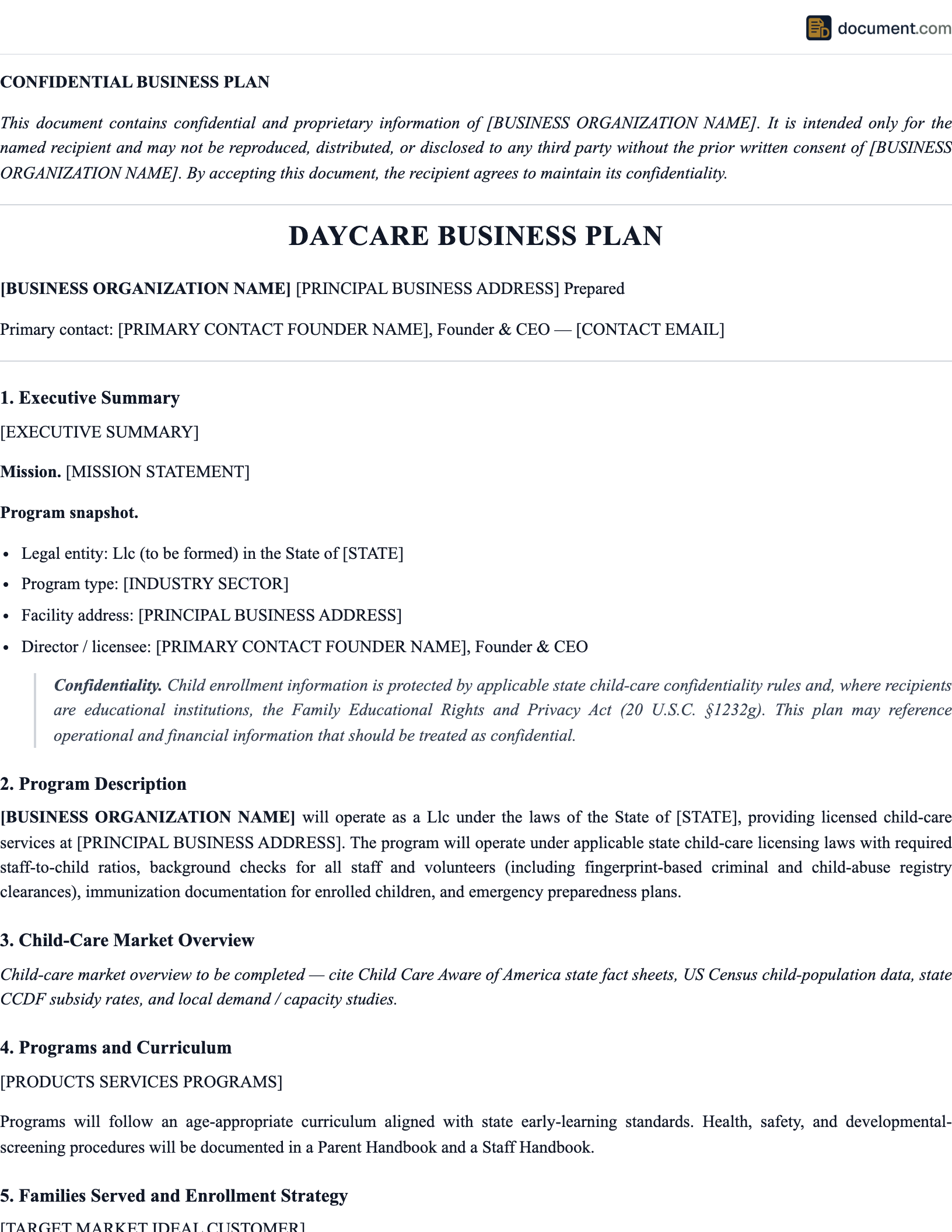
Daycare Business Plan Preview
The template guides you through every section a lender and licensing agency expects, with prompts and example language tailored to the childcare industry. Here is how the program overview and financial summary pages are structured.
Daycare Business Plan
Bright Horizons Learning Center, LLC
Licensed childcare center | Ages 6 weeks to 5 years | Charlotte, NC
Prepared by Angela Torres, Director / Owner
1. Program Overview
Bright Horizons Learning Center is a 78-child licensed center serving infants through pre-kindergarten in a renovated 5,400-square-foot commercial space. The center follows the Creative Curriculum framework with a focus on school-readiness skills, targeting dual-income families in the South Charlotte corridor with a median household income above $95,000.
2. Financial Summary
3. Age Group Capacity
Infants (6 weeks to 12 months): 12 children, 3 caregivers. Toddlers (12 to 24 months): 16 children, 4 caregivers. Twos (24 to 36 months): 18 children, 3 caregivers. Preschool (3 to 5 years): 32 children, 3 caregivers. Total staff: 13 classroom caregivers plus 1 director and 1 assistant director.
Why Daycare Centers Need a Dedicated Business Plan
Daycare centers face a financial structure unlike almost any other small business. Your largest cost — labor — is not discretionary. State licensing agencies dictate exactly how many caregivers you must employ based on the number and ages of children enrolled, and those ratios create a step-function cost structure where adding one child past a ratio threshold forces you to hire an entirely new staff member. A generic business plan template cannot model this dynamic, and lenders who review childcare applications know it.
The regulatory burden is also substantial. Before you enroll a single child, you need state licensing approval, fire marshal inspection, health department clearance, zoning confirmation, background checks on every employee, and compliance with your state's early learning standards. Each of these has its own timeline, cost, and documentation requirements. A daycare business plan that does not lay out the licensing pathway in detail signals to lenders that the operator has not done the groundwork.
Cash flow management during the enrollment ramp is the other critical challenge. Most new daycare centers take six to twelve months to reach the 80 to 90 percent enrollment needed for healthy margins, but the fixed costs — rent, utilities, insurance, and the minimum staffing required by ratio mandates — start on day one. A well-built business plan models this gap explicitly and shows the lender how much working capital is needed to bridge the period between opening and stabilized enrollment.
Growing Demand
The U.S. childcare industry generates over $60 billion annually, and demand continues to exceed supply in most markets. The Bureau of Labor Statistics projects employment in childcare services to grow through the decade, driven by dual-income households and expanding state-funded pre-K programs. However, high startup costs and razor-thin margins during the ramp-up phase mean that operators who skip the financial planning step are disproportionately likely to close within the first three years.
Key Sections of a Daycare Business Plan
A daycare business plan must cover both the standard business sections that lenders expect and the childcare-specific sections that licensing agencies and parents require. Our template provides guided prompts under each one.
Executive Summary
A one-to-two-page overview covering the center concept, licensed capacity by age group, target market demographics, capital required, use of funds, projected enrollment ramp, and the director's qualifications. Write this section last so it reflects the detail in the rest of the plan.
Program & Curriculum
The educational philosophy and curriculum framework (Montessori, Reggio Emilia, HighScope, Creative Curriculum, or custom), daily schedule by age group, developmental milestones tracked, parent communication methods, and how the program aligns with your state's Early Learning Standards.
Licensing & Compliance
A detailed timeline for obtaining your state childcare license, fire inspection, health department approval, zoning clearance, background checks, staff certifications, and any accreditation you plan to pursue (NAEYC, NECPA). Include the specific regulatory citations for your state.
Facility & Safety
Square footage breakdown by classroom, indoor and outdoor space per child, renovation scope, playground design, security systems, fire safety equipment, ADA compliance, and the floor plan showing age-group room assignments and emergency exit routes.
Staffing & Ratios
Staff-to-child ratios by age group per your state's requirements, organizational chart, director qualifications, hiring plan, training and professional development schedule, background check procedures, and the labor cost model showing wages, benefits, payroll taxes, and workers' compensation.
Market & Enrollment
Trade-area demographics, competing centers and their tuition rates, waitlist data from nearby programs, employer-sponsored childcare demand, and your enrollment strategy including pre-registration campaigns, open house events, employer partnerships, and referral incentives.
Marketing & Parent Relations
Pre-opening marketing plan, website and social media strategy, community outreach, local employer partnerships, referral program design, parent communication platform, and ongoing engagement through events, conferences, and progress reports.
Financial Projections
Startup cost budget, monthly enrollment ramp for year one, tuition revenue by age group, labor cost model tied to ratio thresholds, operating expenses, monthly cash flow projection, annual P&L for years one through three, break-even analysis expressed as enrollment count, and use-of-funds table for lenders.
Daycare Financial Projections
The financial section of a daycare plan must account for the unique economics of childcare — primarily the step-function labor costs driven by mandatory ratios and the enrollment ramp that determines when the center becomes cash-flow positive.
Lenders compare your projections to industry benchmarks and will flag any numbers that do not reflect the reality of operating a licensed childcare facility.
| Metric | Industry Benchmark | What Lenders Check |
|---|---|---|
| Labor Cost % | 50-70% of revenue | Staffing model tied to state ratio requirements by age group |
| Occupancy Cost % | 10-18% of revenue | Rent, utilities, maintenance relative to tuition revenue |
| Break-Even Enrollment | 60-75% of capacity | Whether fixed costs are covered before full enrollment |
| Revenue per Sq Ft | $30-60 annually | Whether the facility size supports the revenue target |
| Enrollment Ramp | 6-12 months to 85% | Realistic timeline with adequate working capital reserves |
| Net Profit Margin | 10-15% at stabilization | Whether debt service is covered after all operating costs |
How to Write a Daycare Business Plan
Writing a daycare business plan requires research into both the childcare market in your area and the specific licensing requirements in your state. Budget 50 to 100 hours for a thorough first draft. Here is the process that produces the strongest plans.
Research your state's licensing requirements
Contact your state's childcare licensing agency and request the complete regulations for center-based care. Document every requirement — staff-to-child ratios by age group, director qualifications, facility square footage minimums, outdoor space requirements, background check procedures, and training hour mandates. These regulations drive every other section of the plan.
Analyze the local childcare market
Survey every licensed center within a five-mile radius. Record their capacity, enrollment status, waitlist length, tuition rates by age group, hours of operation, and curriculum approach. Contact local employers to gauge demand for childcare benefits. Pull Census data for household income, dual-income household percentages, and the number of children under five in your target area.
Design the facility and capacity plan
Work with your state's square footage requirements to determine how many children each classroom can hold. Map age groups to rooms, plan the outdoor play area, and identify every renovation needed for licensing compliance — child-height fixtures, safety glass, fire suppression, fencing, and security systems. Get contractor quotes for the build-out.
Build the staffing model
Create a staffing schedule based on your state's ratios for each age group at your planned capacity. Calculate wages using local market rates for childcare workers, add benefits, payroll taxes, and workers' compensation. Model the step-function: show exactly where adding one child triggers a new hire. Labor should be 50 to 70 percent of projected revenue.
Select and plan the curriculum
Choose a curriculum framework that aligns with your state's Early Learning Standards and your target market's expectations. Budget for curriculum materials, training costs, and ongoing professional development. Parents and licensing agencies both evaluate this section closely.
Model the enrollment ramp and financials
Project enrollment month by month for the first year, starting at 30 to 40 percent of capacity and reaching 80 to 85 percent by month nine to twelve. Multiply enrolled children by tuition rates to calculate revenue. Layer in all costs — labor, rent, food, supplies, insurance, and loan payments — to produce a monthly cash flow projection. Calculate the break-even enrollment count.
Write the narrative sections last
The executive summary, program description, and market analysis are more credible after you have built the financial model and confirmed the licensing pathway. The numbers inform the narrative, ensuring every claim in the plan is backed by data.
Frequently Asked Questions
Common questions about writing and using a daycare business plan for financing, licensing applications, and enrollment planning.
Official Resources
Authoritative resources for daycare business planning, childcare licensing, early childhood education standards, and industry data.
Child Care Aware of America
National resource for childcare licensing information by state, quality standards, and provider support tools including market rate surveys.
SBA Business Plan Guide
The U.S. Small Business Administration's official guide to writing a business plan, including format requirements for SBA loan applications.
NAEYC Accreditation
The National Association for the Education of Young Children's accreditation program — the gold standard for early childhood program quality.
Office of Child Care (ACF)
The federal Office of Child Care administers the Child Care and Development Fund and provides policy guidance on licensing, subsidy, and quality improvement.
CDC Developmental Milestones
Evidence-based developmental milestone checklists used by childcare providers to track child development and identify early intervention needs.
SCORE Childcare Mentorship
Free mentorship from experienced business advisors through the SBA's SCORE network, including mentors with childcare industry experience.
Create your Daycare Business Plan in under 10 minutes.
Answer a few questions and download a compliant, attorney-drafted document ready for your state.