



What Is a Real Estate Business Plan?
A real estate business plan is a strategic document that defines how an investor or investment company will acquire, finance, manage, and dispose of real property to generate returns. Unlike a generic business plan, a real estate plan is built around deal-level underwriting — every acquisition target must be analyzed individually using metrics specific to real estate: capitalization rates, net operating income, cash-on-cash return, debt service coverage ratio, internal rate of return, and gross rent multiplier. Generic templates do not include these calculations, and lenders who finance real estate will not take a plan seriously without them.
The plan also serves as the governing document for the investment strategy. It specifies the property types the business will target (single-family, multifamily, commercial, industrial, mixed-use), the markets and submarkets it will operate in, the acquisition criteria (minimum cap rate, maximum price per unit, target cash-on-cash return), the financing structures it will use, the property management approach, and the hold period and disposition strategy. For investors who raise capital from partners or passive investors, the business plan is the document that defines the investment thesis and the terms of the partnership.
Our real estate business plan template is structured around the sections that commercial lenders, private money lenders, and equity partners expect to see, with guided prompts for market analysis at the submarket level, deal-level underwriting worksheets, financing term comparison tables, property management operational plans, and a portfolio-level financial model that projects cash flow, equity growth, and total returns over a three-to-five-year hold period.
Real Estate Specific
Built for cap rates, NOI, DSCR, and IRR — not generic business templates
Deal Underwriting
Property-level analysis with acquisition, hold, and disposition modeling
Portfolio Projections
Multi-year cash flow, equity growth, and total return analysis
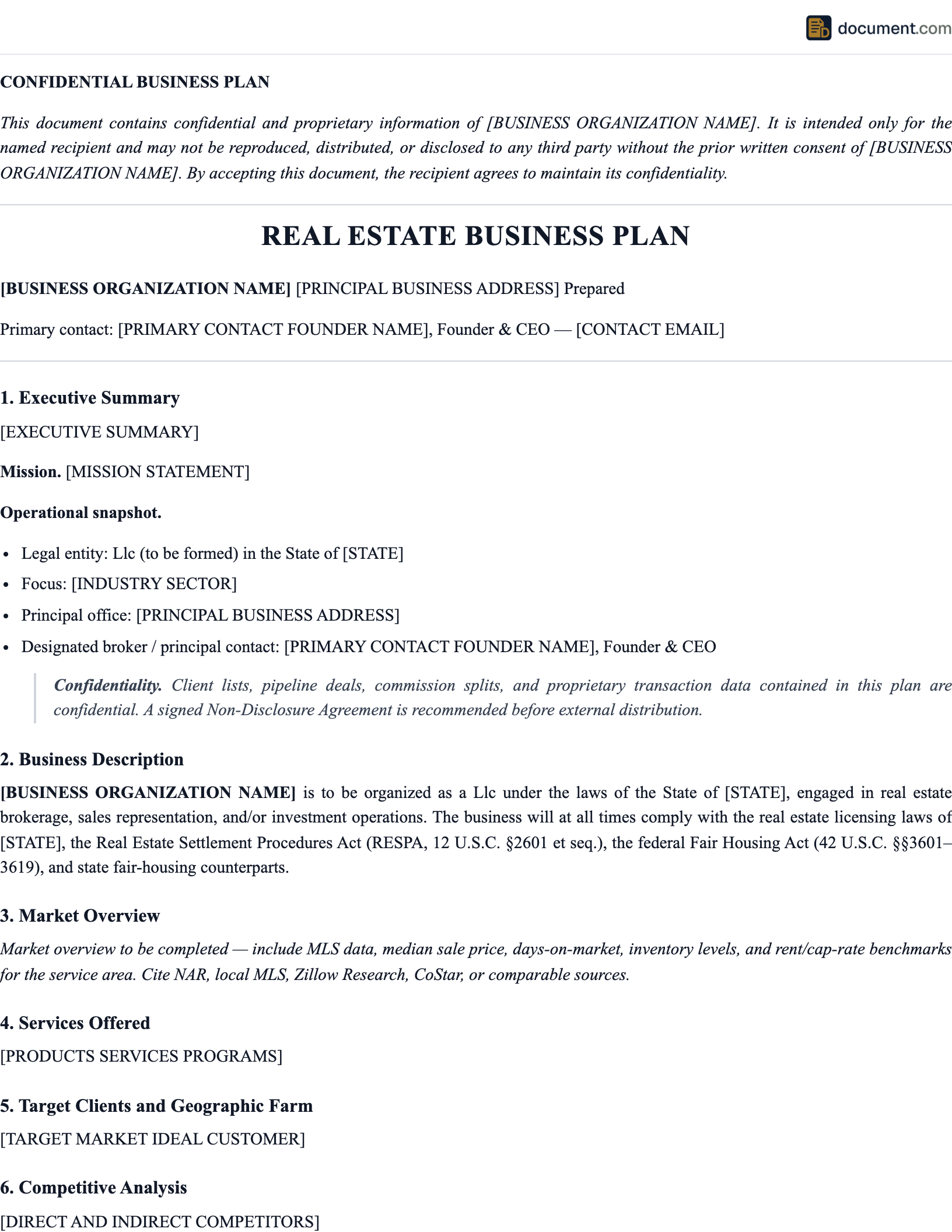
Real Estate Business Plan Preview
The template walks you through every section a lender or equity partner expects, with prompts and worksheets tailored to real estate investment. Here is how the investment thesis and portfolio summary pages are structured.
Real Estate Business Plan
Cornerstone Capital Properties, LLC
Value-add multifamily acquisition | Southeast U.S. markets
Prepared by James Harwell, Managing Partner
1. Investment Thesis
Cornerstone acquires 20-to-60-unit Class B multifamily properties in secondary Southeast markets (Chattanooga, Greenville, Huntsville, Savannah) at a minimum 7% going-in cap rate with value-add potential through unit renovations, operational improvements, and rent-to-market adjustments targeting a 5-year IRR of 18-22%.
2. Portfolio Summary
3. Acquisition Criteria
20 to 60 units, built after 1980, minimum 7% cap rate on trailing NOI, located in markets with 3%+ annual population growth and sub-5% multifamily vacancy. Value-add opportunity through unit interior renovations averaging $8,000 to $12,000 per unit supporting $150 to $200 per unit monthly rent increases.
Why Real Estate Investors Need a Dedicated Business Plan
Real estate investment operates under a financial framework that is entirely different from operating businesses. Returns are generated through a combination of current cash flow (rental income minus expenses and debt service), principal paydown (tenants effectively paying down your mortgage), tax benefits (depreciation sheltering cash flow from income tax), and appreciation (the increase in property value over the hold period). A generic business plan template captures none of these return components.
Commercial lenders who finance real estate underwrite the property, not just the borrower. They analyze the debt service coverage ratio (whether the property's NOI is sufficient to cover the mortgage payment with a safety margin), the loan-to-value ratio (the loan amount relative to the appraised value), the borrower's liquidity and net worth, and the borrower's real estate experience. Your business plan must present all of this information in the format lenders expect — with property-level pro formas, rent rolls, comparable market data, and a clear explanation of your management capability.
For investors who raise capital from partners, the business plan is also a legal and compliance necessity. Securities regulations require that investors in a real estate syndication or fund receive adequate disclosure about the investment strategy, the risks, the fee structure, and the projected returns. The business plan forms the foundation of the private placement memorandum and operating agreement that govern the partnership.
Leverage Amplifies Planning
Real estate is one of the most leveraged asset classes available to individual investors. A typical acquisition uses 70 to 80 percent debt, meaning a $1 million property requires only $200,000 to $300,000 in equity. Leverage amplifies returns when things go well but also amplifies losses when they do not. A business plan that stress-tests the portfolio at different vacancy rates, interest rates, and appreciation scenarios is the primary tool for understanding the downside before committing capital. Investors who skip this analysis often discover the risks only after they are locked into a mortgage.
Key Sections of a Real Estate Business Plan
A real estate business plan must cover the investment strategy and the property-level underwriting that lenders and equity partners require. Our template provides guided prompts and worksheets under each section.
Executive Summary
A one-to-two-page overview covering the investment thesis, target property types and markets, acquisition criteria, financing strategy, management approach, projected returns, and the principal's real estate experience and track record. Write this last so it accurately reflects the detail in the full plan.
Investment Strategy
The core approach — buy-and-hold for cash flow, value-add for forced appreciation, development, or a combination. Define the property type (residential, multifamily, commercial, industrial), the target markets, the acquisition criteria (cap rate, price range, unit count), the hold period, and the disposition strategy.
Market Analysis
Metro-level economic fundamentals, submarket vacancy and rent data, absorption trends, new construction pipeline, comparable sales and cap rate data, and demographic drivers (population growth, employment, income). Use data from CoStar, the Census Bureau, BLS, and local MLS or commercial brokers.
Deal Underwriting
Property-level pro formas for target acquisitions or representative deals: gross potential rent, vacancy and credit loss, effective gross income, operating expenses by category, NOI, debt service, and pre-tax cash flow. Show cap rate, cash-on-cash return, debt service coverage ratio, and internal rate of return.
Financing Strategy
The loan products you plan to use, the terms (LTV, interest rate, amortization, term), the lender relationships you have or plan to develop, and how the debt structure supports your return targets while maintaining adequate DSCR. Include a comparison table if evaluating multiple financing options.
Property Management
Whether you will self-manage or use third-party management, the fee structure, the tenant screening criteria, the lease administration process, the maintenance workflow, the accounting system, and the reporting cadence. Lenders want to see that a competent management structure is in place.
Risk Analysis
The specific risks to the portfolio — vacancy, interest rate increases, unexpected capital expenditures, market downturns, tenant defaults — and the mitigation strategies for each. Include sensitivity analysis showing returns at different vacancy rates, interest rates, and exit cap rates.
Financial Projections
Portfolio-level cash flow projections for three to five years showing acquisition timeline, cumulative NOI, debt service, pre-tax cash flow, equity growth through appreciation and principal paydown, and total return expressed as IRR and equity multiple. Include scenario analysis for conservative, base, and aggressive assumptions.
Real Estate Financial Projections
The financial section must speak the language of real estate — NOI, cap rate, cash-on-cash, DSCR, and IRR. Lenders and investors evaluate your numbers against market data and will question any assumptions that deviate from reality.
Your projections should work at two levels: the individual deal level (each property pro forma) and the portfolio level (aggregate performance across all holdings).
| Metric | Industry Benchmark | What Lenders Check |
|---|---|---|
| Cap Rate | 4-10% (varies by market/type) | Whether acquisition pricing aligns with comparable sales data |
| Cash-on-Cash Return | 6-12% for stabilized properties | Current yield on invested equity after debt service |
| DSCR | 1.20x-1.35x minimum | Whether NOI covers the mortgage with an adequate margin |
| Vacancy Rate | 5-10% residential, 10-15% commercial | Whether vacancy assumptions match submarket data |
| Operating Expense Ratio | 35-50% of gross income | Whether expenses account for all categories including reserves |
| 5-Year IRR | 12-22% for value-add | Total return including cash flow, appreciation, and principal paydown |
How to Write a Real Estate Business Plan
Writing a real estate business plan requires market research, deal-level underwriting, and a clear financing strategy. Budget 40 to 80 hours for a thorough first draft. Here is the process that produces the most credible plans.
Define the investment strategy
Choose your primary approach — buy-and-hold for cash flow, value-add for forced appreciation, fix-and-flip for short-term profits, or development. Define the property type, the target market, the price range, the minimum cap rate or return threshold, and the hold period. Every other section of the plan flows from these strategic decisions.
Research the target market at the submarket level
Pull vacancy rates, rent trends, absorption data, new construction pipeline, and comparable sales for the specific submarkets you are targeting. Use CoStar, Zillow, Redfin, local MLS data, and commercial brokerage reports. Present metro-level economic data (population growth, employment, income) and then drill into the submarket fundamentals that drive property values and rental demand.
Underwrite representative deals
Build a property-level pro forma for at least one to three representative deals that match your acquisition criteria. Start with gross potential rent, subtract vacancy and credit loss, add other income, subtract all operating expenses by category, and arrive at NOI. Then layer in debt service to calculate pre-tax cash flow. Show cap rate, cash-on-cash return, and DSCR. If you have a specific deal in contract, underwrite that deal in detail.
Structure the financing
Research the loan products available for your strategy and property type. Get pre-qualification from one or two lenders so you can include real terms — interest rate, LTV, amortization, loan term, and fees. Model the debt service for each deal and confirm that the DSCR meets lender minimums. If you plan to raise equity from partners, define the equity split, preferred return, and waterfall structure.
Plan the property management
Describe whether you will self-manage or hire a property management company. Define tenant screening criteria, lease terms, rent collection procedures, maintenance protocols, and the accounting system. If using third-party management, identify the firm and the fee structure. Lenders evaluate management capacity separately from investment acumen.
Build the portfolio-level financial model
Project the acquisition timeline, aggregate NOI, total debt service, portfolio cash flow, equity growth through appreciation and principal paydown, and total returns over the hold period. Include scenario analysis at different vacancy rates, interest rates, and exit cap rates. Express returns as cash-on-cash, equity multiple, and internal rate of return.
Write the narrative and executive summary last
The investment thesis and market narrative are more compelling after the numbers are built. Lead with the strategy and the track record, then let the financial analysis support the claims. A lender should be able to read the executive summary and immediately understand the investment approach, the capital need, and the projected returns.
Frequently Asked Questions
Common questions about writing and using a real estate business plan for financing, investor presentations, and portfolio planning.
Official Resources
Authoritative resources for real estate business planning, investment analysis, market data, and financing guidance.
SBA 504 Loan Program
The SBA 504 loan program provides long-term, fixed-rate financing for owner-occupied commercial real estate, with loan amounts up to $5.5 million and down payments as low as 10%.
National Association of Realtors
Market research, housing statistics, commercial real estate data, and economic forecasts from the largest real estate trade association in the United States.
U.S. Census Bureau — Housing Data
Comprehensive housing data including vacancy rates, homeownership rates, rent levels, housing starts, and demographic data essential for real estate market analysis.
Federal Reserve Economic Data (FRED)
Interest rates, mortgage rates, housing price indices, employment data, and economic indicators used in real estate financial modeling and market analysis.
SCORE Real Estate Mentorship
Free mentorship from experienced business advisors through the SBA's SCORE network, including mentors with real estate investment and commercial lending experience.
Fannie Mae Multifamily Research
Multifamily market research, rent trends, vacancy data, and financing guidance from Fannie Mae's multifamily division — a primary source for apartment market fundamentals.
Create your Real Estate Business Plan in under 10 minutes.
Answer a few questions and download a compliant, attorney-drafted document ready for your state.