
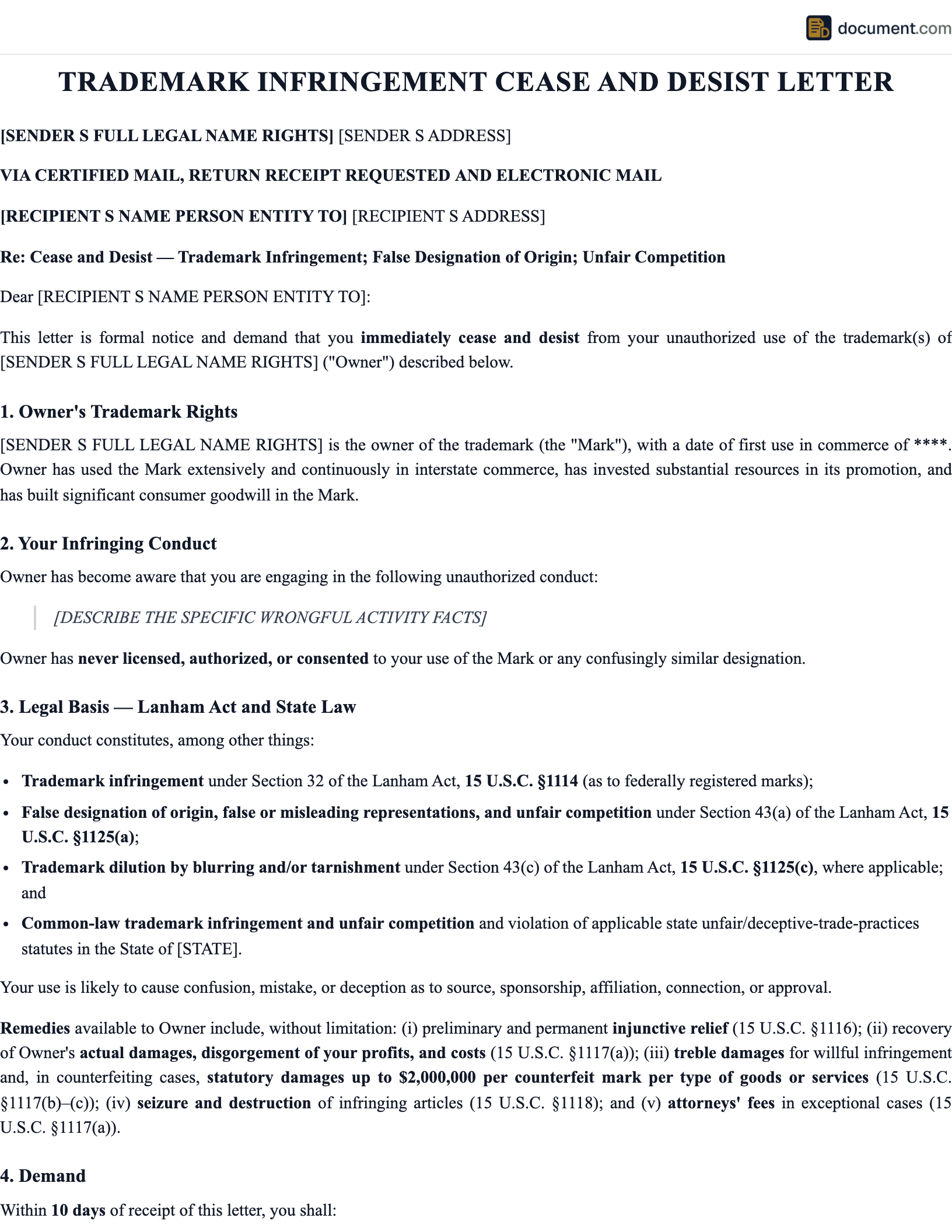



What Is a Trademark Infringement Cease and Desist Letter?
A trademark infringement cease and desist letter is a formal pre-litigation demand sent by a trademark owner (or their attorney) to a party that is using a mark identical or confusingly similar to the owner's registered or common-law trademark. The letter identifies the protected mark, describes the infringing use, cites the relevant provisions of the Lanham Act, demands that the infringing use stop, and sets a deadline for compliance before a federal lawsuit is filed.
Trademark rights are governed primarily by the federal Lanham Act, enacted in 1946 and codified at 15 U.S.C. §§ 1051 et seq. Section 32 (15 U.S.C. § 1114) protects registered marks against infringement, and Section 43(a) (15 U.S.C. § 1125(a)) creates a broader federal cause of action for unregistered marks, false designation of origin, and false advertising. Section 43(c) (15 U.S.C. § 1125(c)) protects famous marks from dilution, and Section 43(d) (the Anticybersquatting Consumer Protection Act, 15 U.S.C. § 1125(d)) provides a cause of action against cybersquatters.
The core test for trademark infringement is likelihood of confusion: whether an ordinary consumer in the relevant market is likely to be confused about the source, sponsorship, or affiliation of goods or services bearing the allegedly infringing mark. Courts apply a multi-factor test (the specific factors vary by federal circuit, with the Sleekcraft, Polaroid, and DuPont factor tests being the most common) that examines the strength of the senior mark, the similarity of the marks, the similarity of the goods, the trade channels, buyer sophistication, actual confusion, intent, and the likelihood of expansion.
A cease and desist letter is the first step in almost every trademark enforcement campaign. The Lanham Act offers powerful remedies — injunctive relief, the infringer's profits, actual damages, enhanced damages up to three times actual damages for willful infringement, statutory damages of up to $200,000 per counterfeit mark ($2 million for willful counterfeiting), ACPA statutory damages of up to $100,000 per cybersquatted domain, and attorney fees in exceptional cases — and the threat of federal litigation often produces compliance without the need to file suit.
Asserts Your Mark
Puts the infringer on formal notice of your Lanham Act rights
Unlocks Enhanced Damages
Documents knowledge to prove willfulness and treble damages
Preserves Injunctions
Strengthens any later motion for a preliminary or permanent injunction
Form Preview
Cease and Desist — Trademark Infringement
Pursuant to the Lanham Act, 15 U.S.C. §§ 1114 & 1125
Section 1: Trademark Owner
Section 2: The Mark
Word mark: NORTHSTAR OUTFITTERS
Class: 025 (apparel) and 035 (retail services)
First use in commerce: June 2014
Registered: February 8, 2022
Section 3: Infringing Use
You have used the confusingly similar mark "Northstarr Outfitter" on Shopify at northstarroutfitter.example.com and on Amazon seller account A1B2C3...
Section 4: Demand
(1) Cease all use of the infringing mark; (2) destroy all inventory, packaging, and marketing materials; (3) transfer the domain; (4) account for profits...
Types of Trademark Letters
Brand Name Infringement
Unauthorized use of a word mark, company name, or brand identifier
Logo Infringement
Unauthorized reproduction of a registered logo or design mark
Counterfeit Goods
Sale of products bearing fake versions of a genuine trademark
Domain Name Squatting
Registration of confusingly similar domain names under the ACPA
Keyword Advertising
Competitor bidding on trademarked keywords in ways that cause confusion
Trade Dress
Copying of distinctive packaging, storefront design, or product appearance
Amazon Listing Hijacking
Unauthorized sellers attaching to or copying your branded listings
Business Name Conflict
A newer business adopting a confusingly similar corporate or DBA name
The Lanham Act at a Glance
§ 32 (15 U.S.C. § 1114)
Infringement of a federally registered mark; the primary cause of action for registered mark owners.
§ 43(a) (15 U.S.C. § 1125(a))
Federal unfair competition — covers unregistered marks, false designation of origin, and false advertising.
§ 43(c) (15 U.S.C. § 1125(c))
Federal Trademark Dilution Act — protects famous marks from blurring and tarnishment.
§ 43(d) (15 U.S.C. § 1125(d))
Anticybersquatting Consumer Protection Act — statutory damages up to $100,000 per bad-faith domain.
§ 34 (15 U.S.C. § 1116)
Injunctive relief including temporary restraining orders and preliminary injunctions.
§ 35 (15 U.S.C. § 1117)
Remedies: infringer's profits, damages, treble damages, attorney fees, statutory damages for counterfeiting.
§ 36 (15 U.S.C. § 1118)
Destruction of infringing articles in the possession of the defendant.
Likelihood of Confusion Factors
Federal courts apply multi-factor tests derived from cases like AMF Inc. v. Sleekcraft Boats (9th Cir. 1979) and Polaroid Corp. v. Polarad Elecs. Corp. (2d Cir. 1961). The factors below are weighed together; no single factor is dispositive.
| Factor | Inquiry |
|---|---|
| Strength of mark | Distinctive or generic? Registered? Famous? |
| Similarity of marks | Sight, sound, meaning, commercial impression |
| Similarity of goods | Same, related, or entirely different product categories? |
| Trade channels | Same retail outlets, same customer base? |
| Buyer sophistication | Casual consumer vs. sophisticated professional buyer |
| Actual confusion | Documented instances of customer confusion |
| Defendant intent | Evidence of bad faith or copying |
| Line expansion | Likelihood that the parties' product lines will overlap |
How to Draft the Letter
Step 1: Confirm your rights
Verify your federal registration status at uspto.gov and document your first date of use in commerce.
Step 2: Document the infringement
Capture screenshots of the infringing mark, the URL, product listings, and any evidence of confusion.
Step 3: Analyze likelihood of confusion
Walk through the Sleekcraft/Polaroid factors honestly. Overreach invites a declaratory judgment action.
Step 4: Identify the infringer
Use WHOIS, state business records, and platform transparency tools to find the responsible party.
Step 5: Draft the letter
Cite your registration, describe the infringement, and demand specific remedial action.
Step 6: Set a deadline
Typically 10-30 days depending on the complexity of the required action.
Step 7: Preserve your position
Send by certified mail and email, keep all proofs of service, and reserve all rights.
Key Components
Trademark owner identification
Full legal entity name of the mark owner
Description of the mark
Word mark, stylized mark, or logo with image attached
Registration details
USPTO registration number, class, and date
Priority of use
Date of first use in commerce
Description of infringing use
URLs, product listings, dates, and sample images
Likelihood of confusion analysis
Brief explanation of why the uses are confusingly similar
Statutory citations
15 U.S.C. § 1114, § 1125(a), and others as applicable
Specific demands
Stop use, destroy inventory, transfer domain, account for profits
Compliance deadline
Typically 10-30 days
Reservation of rights
Explicit reservation of all legal remedies
Dilution and Famous Marks
Under § 43(c), the owner of a famousmark can sue to prevent uses that blur the distinctiveness of the mark or tarnish its reputation, even without proof of likelihood of confusion. Only truly famous marks qualify — the test is whether the mark is "widely recognized by the general consuming public of the United States as a designation of source." Famous marks include names like Coca-Cola, Nike, Google, and McDonald's. Niche or regionally famous marks generally do not qualify. Dilution is a powerful supplemental claim for famous mark owners but is not available to most trademark holders.
Damages Under 15 U.S.C. § 1117
Infringer's profits
Disgorgement of the profits the infringer earned from the unauthorized use.
Actual damages
Lost sales, corrective advertising costs, and reputational harm.
Enhanced damages
Courts may increase damages up to three times actual damages for willful infringement.
Counterfeit statutory damages
$1,000 to $200,000 per counterfeit mark per type of goods; up to $2,000,000 for willful counterfeiting.
ACPA statutory damages
$1,000 to $100,000 per cybersquatted domain.
Attorney fees
Reasonable fees in exceptional cases under Octane Fitness standard.
Common Defenses to Trademark Claims
Fair use
Descriptive fair use and nominative fair use allow limited use of another's mark to describe goods, compare products, or refer to the mark holder.
First sale doctrine
Resale of genuine branded goods is generally not infringement.
Parody and commentary
First Amendment protection for criticism, parody, and artistic expression.
No likelihood of confusion
Different markets, different consumers, or different goods may negate the core element of the claim.
Laches and abandonment
Delay in enforcement or failure to police the mark can bar relief or lead to abandonment.
Sample Letter
VIA CERTIFIED MAIL AND EMAIL
April 7, 2026
Northstarr Outfitter
c/o Tomas Velasquez, Registered Agent
4412 Buckhead Avenue
Atlanta, GA 30305
Re: Trademark Infringement of U.S. Reg. No. 6,214,887 (NORTHSTAR OUTFITTERS)
Dear Mr. Velasquez,
This firm represents Northstar Outfitters Co., LLC ("Northstar"), owner of U.S. Trademark Registration No. 6,214,887 for the mark NORTHSTAR OUTFITTERS, registered in International Classes 025 and 035 for outdoor apparel and retail store services. Northstar has used this mark continuously in interstate commerce since June 2014.
It has come to our attention that your business is currently marketing and selling outdoor apparel under the mark "Northstarr Outfitter," including through the domain northstarroutfitter.example.com and Amazon seller account A1B2C3. Your use of the confusingly similar mark in direct competition with our client's goods constitutes trademark infringement under Section 32 of the Lanham Act (15 U.S.C. § 1114) and unfair competition under Section 43(a) (15 U.S.C. § 1125(a)).
The marks are virtually identical in sight, sound, and commercial impression. The goods are the same. The trade channels overlap. Consumer confusion is not merely likely, it is inevitable, and our client has already received three customer inquiries intended for your business.
Within twenty (20) days of receipt of this letter, you are demanded to: (1) immediately cease all use of the mark NORTHSTARR OUTFITTER or any confusingly similar variation; (2) transfer the domain northstarroutfitter.example.com to our client; (3) remove the infringing Amazon listings; (4) destroy all infringing inventory, packaging, and marketing materials; (5) provide a full accounting of revenues earned from the infringing use; and (6) confirm compliance in writing.
Should you fail to comply, our client is prepared to pursue all remedies available under federal law, including injunctive relief under 15 U.S.C. § 1116, disgorgement of profits and treble damages under § 1117, destruction of infringing articles under § 1118, cybersquatting statutory damages of up to $100,000 per domain under § 1125(d), and reasonable attorney fees in this exceptional case.
This letter is sent without prejudice and without waiver of any rights, all of which are expressly reserved.
Sincerely,
Counsel for Northstar Outfitters Co., LLC
Frequently Asked Questions
Official Resources
USPTO - Trademarks Home
U.S. Patent and Trademark Office trademark registration and information
USPTO - TSDR (Status & Documents)
Check trademark registration status and documents
USPTO - Trademark Search
Search federal trademark database for conflicts and clearances
Cornell LII - Lanham Act
Full text of 15 U.S.C. Chapter 22 (the Trademark Act of 1946)
ICANN - UDRP
Uniform Domain-Name Dispute-Resolution Policy for cybersquatting disputes
WIPO - Trademarks
World Intellectual Property Organization trademark resources and Madrid System
INTA - International Trademark Association
Global association of trademark owners, brand professionals, and practitioners
Amazon Brand Registry
Amazon's brand protection program for trademark owners
Create your Trademark Infringement Cease and Desist Letter in under 10 minutes.
Answer a few questions and download a compliant, attorney-drafted document ready for your state.