
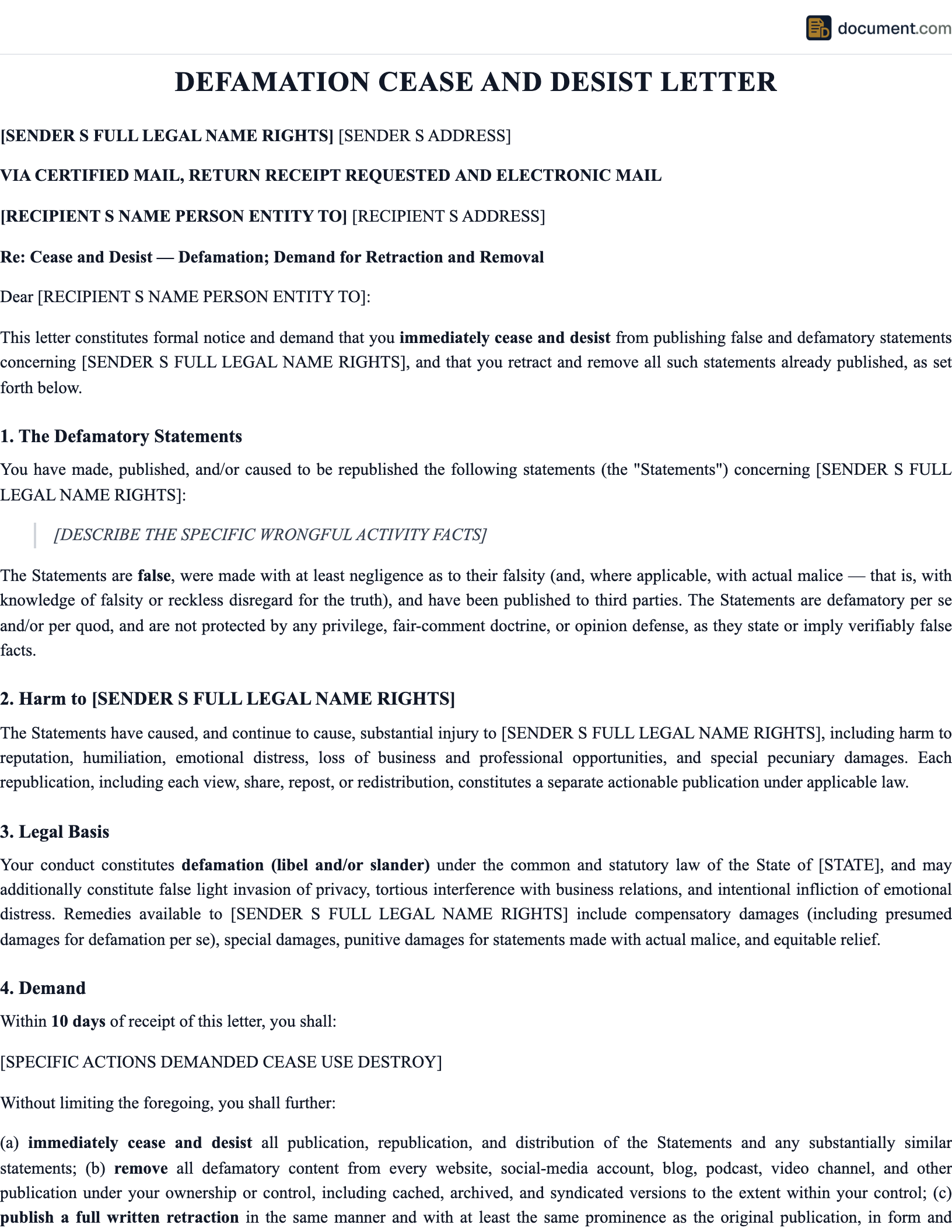



What Is a Defamation Cease and Desist Letter?
A defamation cease and desist letter is a formal pre-litigation demand sent to a person or entity that has published false and damaging statements of fact about the sender. The letter identifies each defamatory statement with precision, explains why the statement is false, demands immediate retraction and removal, warns of the civil remedies available under state defamation law, and sets a deadline for compliance before a lawsuit is filed.
Defamation is a common-law tort (and in some states a statutory cause of action) that protects reputation from false factual statements. The two branches are libel(written or otherwise fixed defamation, including online posts, emails, videos, and articles) and slander (spoken defamation). Although the historical distinction still matters for damages in some jurisdictions, both branches require the same core proof: a false statement of fact, publication to a third party, fault (usually negligence for private figures and actual malice for public figures), and harm to reputation.
A cease and desist letter is often the most cost-effective first step in a defamation dispute. Defamation lawsuits are expensive, time-consuming, and face significant legal hurdles — including First Amendment protections, the actual malice standard for public figures, and anti-SLAPP statutes in over thirty states. A well-drafted letter signals seriousness without the cost of litigation, creates a record that the defamer knew the statements were contested (strengthening a later claim for damages or punitive damages), and in many states is a statutory prerequisite to recovering certain categories of damages under a retraction-demand statute.
Before sending a defamation cease and desist letter, carefully evaluate whether the target statements are actually actionable. Truth is an absolute defense. Pure opinions are constitutionally protected. Statements on matters of public concern receive heightened protection, and anti-SLAPP statutes can impose substantial fee awards against plaintiffs who file meritless defamation suits. Our template is drafted to focus on identifiable false statements of fact, to avoid overreach, and to stay within pre-litigation privilege.
Protects Reputation
Demands removal of the false statements and correction of the public record
Preserves Claims
Satisfies retraction-demand statutes that are a prerequisite to certain damages
Avoids Litigation
Most defamers back down rather than defend an expensive lawsuit
Form Preview
Cease and Desist — Defamation
Demand for Retraction and Removal
Section 1: Sender Information
Section 2: Defamatory Statements
Statement 1 (Google Review, March 28, 2026): "Dr. Kovalenko practices without a license..."
Statement 2 (same review): "She stole my insurance refund..."
Section 3: Falsity and Harm
Dr. Kovalenko holds California dental license No. 47112, active and in good standing since 2009. No insurance refund was withheld; the claim in question was denied by the carrier...
Section 4: Demand for Retraction
You are demanded to (1) immediately remove the review, (2) publish a retraction, and (3) confirm removal in writing within seven (7) days...
Types of Defamation Letters
Libel (Written)
Written defamatory statements in articles, posts, emails, or printed materials
Slander (Spoken)
Spoken defamatory statements made to third parties
Online Defamation
False statements published on websites, blogs, forums, or review sites
Social Media Defamation
Defamatory posts, comments, or messages on social media platforms
False Review
Fabricated or deliberately false business reviews on Yelp, Google, and similar platforms
Business Defamation
False statements damaging a company's reputation or commercial relationships
Personal Defamation
False statements damaging an individual's personal reputation
Defamation Per Se
Statements so clearly damaging that harm is presumed without specific proof
Elements of a Defamation Claim
1. False statement of fact
Opinions and subjective judgments are protected; only verifiable factual claims can be defamatory.
2. Publication to a third party
The statement must be communicated to someone other than the plaintiff.
3. Identification of the plaintiff
The statement must be about the plaintiff, either explicitly or by reasonable implication.
4. Fault
Negligence for private figures; actual malice for public officials, public figures, and limited-purpose public figures.
5. Damages
Harm to reputation, which may be presumed in cases of defamation per se or proven with specific economic or reputational injury.
Libel vs. Slander
| Feature | Libel | Slander |
|---|---|---|
| Medium | Written, printed, fixed | Spoken, transient |
| Examples | Posts, emails, articles, videos | Speeches, conversations |
| Damages presumed? | Often yes | Usually no (per se excepted) |
| Evidence | The document itself | Witness testimony |
| Statute of limitations | 1-3 years | 1-3 years |
How to Draft the Letter
Step 1: Preserve the evidence
Screenshot, archive, and save copies of every defamatory statement with URLs, dates, and author information.
Step 2: Verify falsity
Gather documentary proof that each statement is false — licenses, contracts, receipts, witness declarations.
Step 3: Assess defenses
Is the statement opinion? Is it on a matter of public concern? Does the speaker have anti-SLAPP protection? Evaluate before sending.
Step 4: Identify the speaker
For anonymous posts, consider whether you can identify the author through the platform or a John Doe subpoena.
Step 5: Draft with precision
Quote each statement verbatim, identify its source, and explain why it is false.
Step 6: Demand retraction
Specify the retraction language, the placement, and the deadline. Include it as a statutory retraction demand where applicable.
Step 7: Deliver with proof
Certified mail and email. Keep the return receipt and all delivery confirmations.
Key Components
Sender identification
Full legal name and title of the injured party
Recipient identification
The defamer and, if applicable, the publishing platform
Verbatim statements
Each defamatory statement quoted exactly with source, date, and URL
Falsity explanation
A specific statement of why each assertion is false
Harm to reputation
A factual description of the damage caused
Retraction demand
Specific language and placement for the retraction
Removal demand
Instruction to remove the defamatory content immediately
Compliance deadline
Typically 7-14 days for online content
Defenses to Defamation
Before sending a letter, consider the defenses the recipient is likely to raise.
Truth
An absolute defense. If the gist of the statement is true, the claim fails.
Opinion
Pure opinion cannot be defamatory. Context matters.
Absolute privilege
Statements made in judicial proceedings, legislative debate, and certain government contexts are absolutely immune.
Qualified privilege
Employment references, credit reports, and some reports on matters of public concern receive qualified immunity, which can be defeated only by actual malice.
Fair report privilege
Accurate reports of official government proceedings are generally protected.
Anti-SLAPP statutes
Thirty-plus states have laws allowing defendants to dismiss meritless defamation claims early, with mandatory fee awards. Check your state before sending.
Damages Available
Actual damages
Out-of-pocket losses, lost business, medical costs for emotional distress, and documented reputational harm.
Presumed damages
Available in defamation per se cases without specific proof of harm.
Punitive damages
Awarded for especially egregious defamation involving malice or willfulness; capped in many states.
Injunctive relief
A court order requiring removal of the defamatory content. First Amendment concerns limit prior restraint, but narrow post-judgment injunctions are generally permitted.
Public Figures and Actual Malice
Under New York Times Co. v. Sullivan (1964), public officials must prove that a defamatory statement was made with actual malice — knowledge of falsity or reckless disregard for the truth. This heightened standard was later extended to public figures in Curtis Publishing Co. v. Butts (1967) and to limited-purpose public figures in Gertz v. Robert Welch, Inc. (1974). Private individuals only need to prove negligence.
If you are a public figure, a defamation claim requires clear and convincing evidence of the defendant's state of mind — an extremely high bar. Before sending a cease and desist letter as a public figure, consult a defamation attorney to evaluate whether the claim is viable.
Sample Letter
VIA CERTIFIED MAIL AND EMAIL
April 7, 2026
Mr. Brandon L. Kessler
8890 Crestview Drive
San Jose, CA 95125
Re: Formal Demand for Retraction and Removal of Defamatory Statements
Dear Mr. Kessler,
This letter serves as a formal demand that you immediately retract and remove the false and defamatory statements you published regarding my client, Dr. Elena V. Kovalenko, on or about March 28, 2026, in a Google Review of her pediatric dental practice.
The review contains the following false statements of fact: (1) "Dr. Kovalenko practices without a license"; and (2) "She stole my insurance refund." Both statements are false. Dr. Kovalenko holds California dental license No. 47112, active and in good standing since October 2009, as verifiable through the California Dental Board. No insurance refund was withheld by Dr. Kovalenko or her practice; the claim to which you refer was denied by your insurance carrier directly, as confirmed by the attached explanation of benefits.
These statements constitute defamation per se under California law because they accuse Dr. Kovalenko of professional incompetence and theft. Dr. Kovalenko has suffered demonstrable harm, including lost new-patient appointments and reputational injury within her community.
You are hereby demanded to, within seven (7) days of receipt of this letter: (1) permanently remove the defamatory review from Google and any other platform where it appears; (2) post a clear and conspicuous retraction with language we will provide on request; and (3) provide written confirmation of removal and retraction to this office.
Should you fail to comply, my client is prepared to pursue all available remedies, including a civil action for defamation, defamation per se, intentional interference with prospective economic advantage, and punitive damages. This demand is also a statutory retraction demand under California Civil Code § 48a.
All rights and remedies are expressly reserved.
Sincerely,
Counsel for Dr. Elena V. Kovalenko
Frequently Asked Questions
Official Resources
Cornell LII - Defamation
Overview of defamation law from the Legal Information Institute
Reporters Committee for Freedom of the Press
Comprehensive guide to libel and defamation from a First Amendment perspective
Public Participation Project - Anti-SLAPP Resources
State-by-state anti-SLAPP law tracker and advocacy resources
U.S. Supreme Court Opinions
Full text of key defamation cases including New York Times v. Sullivan and Gertz v. Welch
EFF - Online Defamation Law
Electronic Frontier Foundation guide to defamation for bloggers and online publishers
ABA - Communications Law Forum
American Bar Association forum on media, communications, and defamation law
FCC - Freedom of Speech
Federal Communications Commission guide to First Amendment protections
Nolo - Defamation Encyclopedia
Plain-English overview of libel and slander law
Create your Defamation Cease and Desist Letter in under 10 minutes.
Answer a few questions and download a compliant, attorney-drafted document ready for your state.