



What Is a Cover Letter?
A cover letter is a one-page introductory document submitted alongside a resume when applying for a position. It performs two functions: a human-facing function (introducing the candidate, contextualizing the application, demonstrating writing ability) and a machine-facing function (supplying keyword density for ATS systems including Workday, Greenhouse, Lever, iCIMS, and Taleo that score candidate documents against job-description keywords). Modern hiring workflows score cover letters on both dimensions; effective drafting addresses both audiences in the same 250 to 400 words.
The 2023 Society for Human Resource Management hiring survey found 56% of hiring managers consider cover letters when evaluating candidates even when listed as optional, rising to 73% for executive, legal, marketing, and communications roles. ATS keyword scanning operates independently: cover letters with strong job-description keyword match score higher in candidate ranking algorithms regardless of human review. The document functions as the candidate's controlled narrative covering career changes, employment gaps, relocations, and motivation that an ATS-parsed resume cannot convey.
Drafting operates against federal anti-discrimination law. Title VII (42 U.S.C. § 2000e), the ADEA (29 U.S.C. § 621), the ADA (42 U.S.C. § 12112), the Pregnancy Discrimination Act (42 U.S.C. § 2000e(k)), and the EEOC pre-employment-question guidance (29 C.F.R. § 1604.7 and successor publications) restrict what employers may ask about protected categories. Candidate volunteer disclosures of age, race, national origin, disability, religious practice, marital status, pregnancy, or gender identity create risk that should be avoided in cover-letter drafting. State and local salary-history bans further constrain what may appear; California Labor Code § 432.3 prohibits salary-history inquiry by employers and 17 states plus dozens of cities have parallel statutes.
ATS keyword optimization and recruiter scoring
Applicant Tracking Systems used by 75% of large employers (Workday, Greenhouse, Lever, iCIMS, Taleo, BambooHR) parse cover-letter text and score documents on keyword density against the job description. Tailoring requires substantive integration of two to three job-description keywords into the opening paragraph plus a company-research line referencing a recent product launch, funding announcement, or strategic initiative. Generic cover letters score uniformly low on this metric. Practical workflow: maintain a base template with substitutable variables for company, role, hiring manager, and three keywords. Per-application tailoring time runs 8 to 15 minutes for substantive customization.
EEOC pre-employment-question guidance and salary-history bans
The EEOC's pre-employment-question guidance (codified at 29 C.F.R. § 1604.7 for sex-based questions and amplified across categorical guidance documents) restricts employer inquiries about age, race, national origin, religion, disability, marital status, family status, pregnancy, and gender identity. Reciprocally, candidates should not volunteer this information in cover letters; doing so creates documentary evidence that complicates later discrimination claims. Salary-history bans are the most active state-by-state employment regulation: California (Cal. Lab. Code § 432.3), Colorado, Connecticut, Delaware, Hawaii, Illinois, Maine, Maryland, Massachusetts, New Jersey, New York, Oregon, Vermont, Washington, and many cities (NYC, San Francisco, Chicago, Atlanta) prohibit employer inquiries about prior compensation and some prohibit voluntary disclosure. Provide salary expectations only when the job posting expressly requests them and only with market-rate research support.
Personal Touch
Shows personality and motivation that a resume cannot convey
Targeted Pitch
Connects your background directly to the job requirements
Context & Story
Explains career changes, gaps, or relocations in your own words
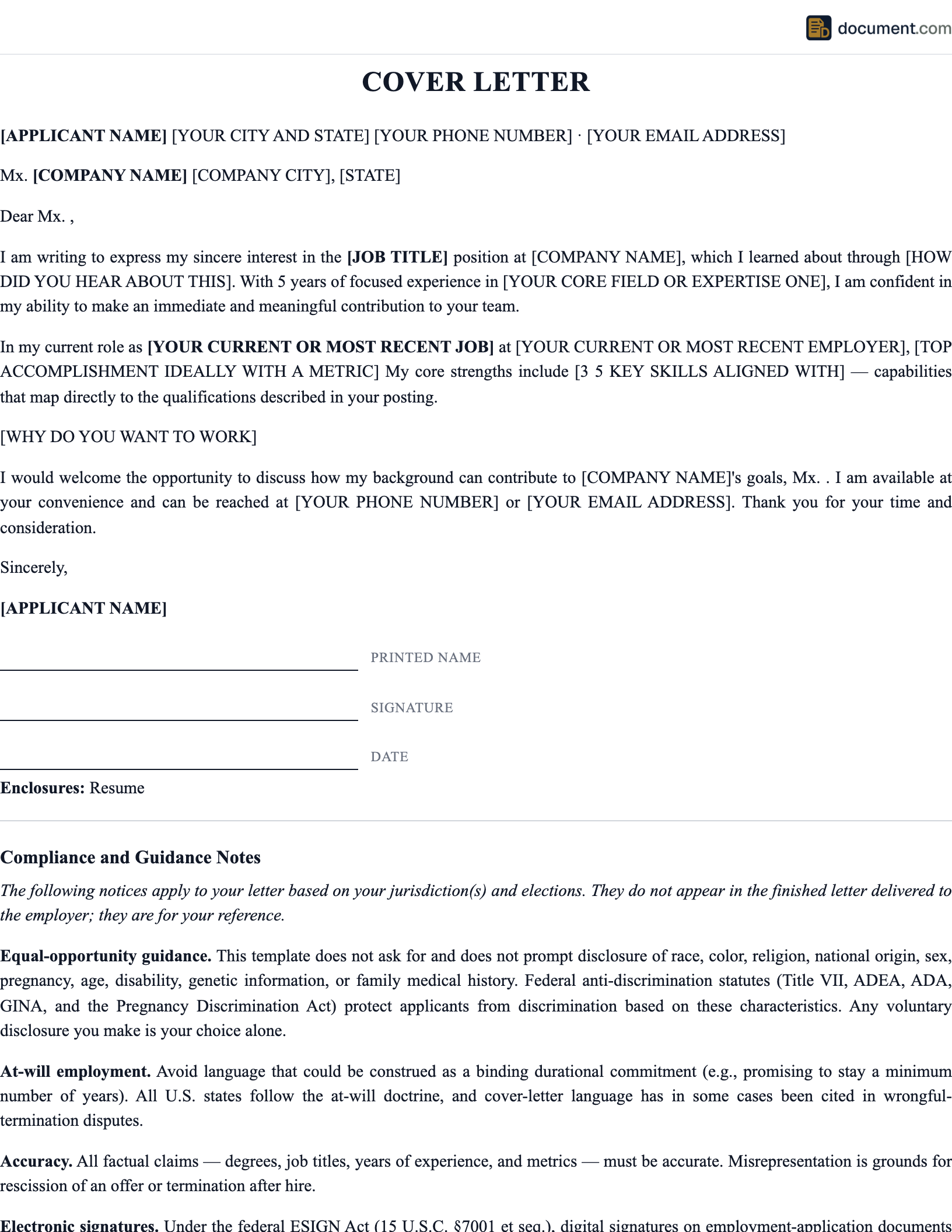
Cover Letter Preview
The preview below shows the structure of a standard cover letter. Your final document will be fully customized with your information, target role, and qualifications.
Dear [Hiring Manager Name],
I am writing to express my interest in the [Job Title] position at [Company Name]. With [X years] of experience in [relevant field], I am confident that my background in [key skill] and [key skill] makes me a strong fit for your team.
In my current role at [Current Company], I [specific accomplishment with measurable result]. This experience has sharpened my ability to [relevant skill], which I understand is central to the work your team does in [specific area].
I am drawn to [Company Name] because [specific reason tied to the company's mission, product, or culture]. I would welcome the chance to bring my skills in [area] to your organization and contribute to [specific goal or project].
Thank you for considering my application. I look forward to discussing how I can contribute to your team.
Sincerely,
[Your Name]
How to Write a Cover Letter
- 1
Research the company and role
Read the job description carefully. Visit the company's website and recent news. Identify what they value and what problems they are trying to solve. Your letter should show that you understand their world.
- 2
Open with a strong hook
Skip generic openers like 'I am writing to apply.' Lead with something specific: a result you achieved, a connection to the company, or a genuine reason you are excited about the role.
- 3
Connect your experience to the job
Pick two or three achievements from your career that directly relate to the position. Use concrete numbers and outcomes when possible. The hiring manager wants proof, not promises.
- 4
Show why this company
Explain what draws you to this specific organization. Reference their mission, a product you admire, or a recent initiative. This tells the reader you are not mass-applying to every opening.
- 5
Close with confidence
End by thanking the reader and expressing your interest in an interview. Do not beg or apologize. A simple 'I look forward to discussing how I can contribute' is enough.
- 6
Proofread ruthlessly
Read the letter aloud. Check for the correct company name, job title, and hiring manager name. Then have someone else read it. A single typo can undermine everything above it.
Key Sections of a Cover Letter
Header
Your name, contact information, date, and the recipient's details.
Opening Paragraph
The role you are applying for and a compelling reason you are a fit.
Body Paragraphs
Two or three specific achievements that connect to the job requirements.
Company Connection
Why you want to work at this company specifically, not just any company.
Closing Paragraph
A thank you, a call to action, and your interest in an interview.
Sign-off
A professional closing such as 'Sincerely' followed by your full name.
Formatting Tips
The content of your cover letter matters most, but formatting affects readability and first impressions. A clean layout signals professionalism before the hiring manager reads a single word.
Keep it to one page
Anything longer signals that you cannot communicate concisely. Most hiring managers will not read past page one.
Use a professional font
Stick with clean, readable fonts like Calibri, Garamond, or Helvetica at 10.5 to 12 points. Avoid decorative or overly creative typefaces.
Match your resume style
Use the same font, header format, and color scheme as your resume so the two documents look like a cohesive package.
Leave white space
Use standard one-inch margins and space between paragraphs. Cramming text into every corner makes the letter harder to read.
Common Cover Letter Mistakes
Even strong candidates undermine their applications with avoidable errors. Watch out for these:
Using a generic letter
Hiring managers can tell when you have sent the same letter to 50 companies. Customize at least the opening, the company name, and the skills you highlight.
Repeating your resume
The cover letter is not a narrative version of your resume. Use it to add context, tell a brief story, or explain something your resume cannot.
Focusing on what you want
The letter should center on what you can do for the employer, not what the job will do for your career. Frame your experience in terms of their needs.
Writing too much
Long cover letters get skimmed or skipped. Aim for 250 to 400 words. Every sentence should serve a purpose.
Neglecting the company name
Addressing the letter to the wrong company is an instant disqualification. Triple check every detail before you hit send.
Frequently Asked Questions
Official Resources
Bureau of Labor Statistics
Occupational Outlook Handbook with salary data and job outlook by industry
CareerOneStop
U.S. Department of Labor career exploration and job search tools
SHRM
Society for Human Resource Management hiring and recruitment insights
DOL Training Resources
Federal workforce training and career development programs
Create your Cover Letter in under 10 minutes.
Answer a few questions and download a compliant, attorney-drafted document ready for your state.