



What Is a Reference List?
A reference list is a one-page document containing the names, current titles, employers, contact information, and relationship descriptors of three to five people who have consented to speak with prospective employers, recruiters, or admissions committees about the candidate's professional experience, work product, and character. The reference list is delivered separately from the resume, typically after the second or third interview round when the candidate has reached the shortlist. Federal applications follow the OPM Form OF-306 reference-collection process; private-sector employers vary in process but generally request three references with at least one direct supervisor. When the employer engages a third-party consumer reporting agency to verify references (HireRight, Sterling, Checkr, Accurate, GoodHire), the resulting report is a consumer report under the Fair Credit Reporting Act, 15 U.S.C. § 1681a(d), triggering disclosure and authorization requirements.
Reference checking sits at the intersection of employment law, defamation law, and privacy law. Most large employers operate neutral-reference policies that limit HR responses to objective facts (dates of employment, job title, sometimes salary) because providing performance information exposes the employer to potential defamation claims, retaliation claims under Title VII (42 U.S.C. § 2000e-3, extended to former employees by Robinson v. Shell Oil Co., 519 U.S. 337 (1997)), and tortious interference claims. Thirty-nine states have enacted reference-immunity statutes (California Cal. Civ. Code § 47(c), Florida Fla. Stat. § 768.095, Texas Tex. Lab. Code § 103.003) protecting truthful, good-faith references against defamation liability. Despite statutory immunity, most large employers continue neutral-reference policies because litigation cost outweighs candor.
FCRA disclosures and applicant authorization
When the employer uses a consumer reporting agency to check references, the FCRA process governs. Under 15 U.S.C. § 1681b(b)(2), the employer must provide the applicant a clear and conspicuous written disclosure that a consumer report will be obtained for employment purposes, in a document separate from the application, containing only the disclosure and the applicant's authorization. Many courts strictly enforce the "solely contains" requirement; embedded liability waivers, additional state-law disclosures crammed into the same document, or embedded boilerplate language can void the disclosure (Syed v. M-I, LLC, 853 F.3d 492 (9th Cir. 2017)). Following an adverse hiring decision based on the report, the employer must follow the two-step adverse action process under 15 U.S.C. § 1681b(b)(3): pre-adverse action notice with a copy of the report and the FTC Summary of Rights, then a final adverse action notice after a reasonable period (typically 5 business days). State law adds layered requirements in California (ICRAA, Cal. Civ. Code § 1786 et seq.) and New York (General Business Law § 380).
Defamation safe harbors and neutral references
A former employer providing a negative reference faces three potential claims: defamation (libel for written, slander for oral), tortious interference with prospective economic advantage, and intentional infliction of emotional distress. Most states recognize a qualified privilege for honest, good-faith employer references made without malice (Lewis v. Equitable Life Assurance Society, 389 N.W.2d 876 (Minn. 1986); Williams v. School District, 998 F. Supp. 2d 1108 (E.D. Cal. 2014)), but the privilege defeats only the defamation claim and only if the employer can show good faith. Reference-immunity statutes in 39 states extend the protection further: California Cal. Civ. Code § 47(c) absolutely privileges reference statements made without malice; Florida Fla. Stat. § 768.095 immunizes references unless the disclosure was knowingly false, violates a civil right, or is motivated by retaliation. The combination of common-law privilege, statutory immunity, and neutral-reference policy explains why most employers refuse performance discussions and why candidates should recruit personal-capacity references who can speak freely.
Outside Perspective
Lets former managers vouch for your work in their own voice
HR-Ready Format
Matches the structure recruiters and HR systems expect
One-Page Standard
Fits everything on a single, scannable page
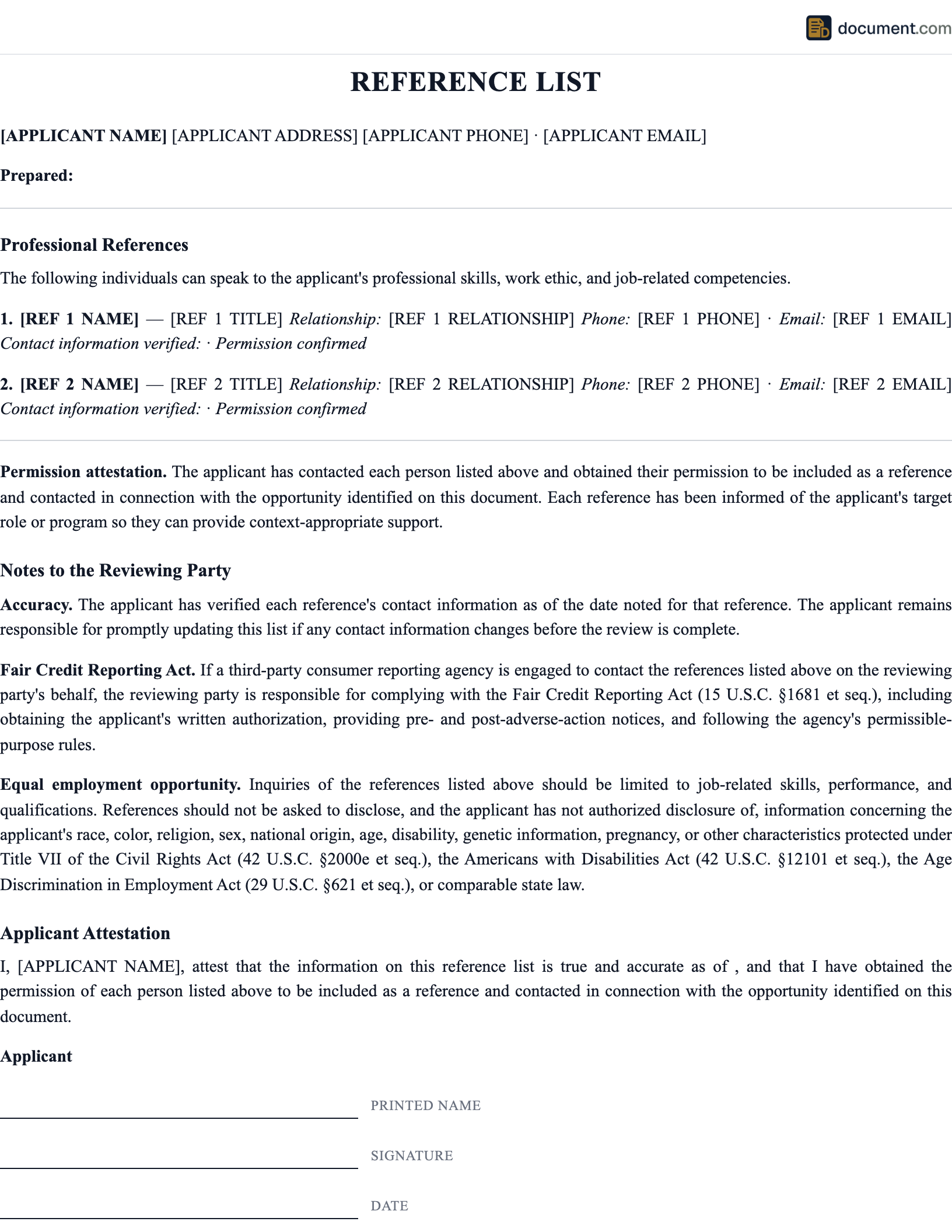
Reference List Preview
The preview below illustrates how a typical professional reference list is structured.
Professional References
How to Build a Reference List
- 1
Identify three to five strong references
Choose former direct managers, senior colleagues, or clients who can speak with enthusiasm about your work.
- 2
Ask each person for permission
Reach out individually and confirm they are willing to be a reference. Never list someone without asking.
- 3
Verify all contact information
Confirm each reference's current title, company, phone, and professional email before adding them to the list.
- 4
Match the header to your résumé
Use the same name, font, and formatting as your résumé so the documents look like a set.
- 5
Add relationship context
Include a one-line description of how you know each reference and the time period.
- 6
Send only when requested
Provide the list when an employer specifically asks for it, and brief your references in advance.
Key Components
Matching Header
Same name, formatting, and contact info as your résumé.
Section Title
A clear heading such as 'Professional References.'
Full Name & Title
Each reference's full name and current professional title.
Company
The reference's current employer.
Phone & Email
Direct, professional contact methods. No personal numbers.
Relationship Context
A one-line description of how the reference knows you.
Sample Reference List
[Your Full Name]
[Address] | [Phone] | [Email] | [LinkedIn]
Professional References
[Reference Name], [Title]
[Company]
[Phone] [Email]
Direct supervisor at [Company], [Year]-[Year]
[Reference Name], [Title]
[Company]
[Phone] [Email]
Senior colleague on [Project], [Year]-[Year]
[Reference Name], [Title]
[Company]
[Phone] [Email]
Client at [Company], engagement [Year]
Frequently Asked Questions
Official Resources
U.S. DOL Hiring
Federal Department of Labor guidance on the hiring process
SHRM
Society for Human Resource Management. Reference checking best practices.
EEOC
Equal Employment Opportunity Commission. Fair hiring guidance.
BLS Occupational Outlook
Career and hiring data from the Bureau of Labor Statistics
USA.gov Find a Job
Federal job search resources and application guidance
CareerOneStop
DOL-sponsored career resources and reference checking guides
Create your Reference List in under 10 minutes.
Answer a few questions and download a compliant, attorney-drafted document ready for your state.