



What Is a Harassment Cease and Desist Letter?
A harassment cease and desist letter is a formal written demand sent to an individual whose conduct toward you — or toward someone close to you — has crossed the line from annoying into a repeated pattern of unwelcome contact, intimidation, threats, or interference with your daily life. The letter identifies the specific conduct, demands that it stop immediately, warns the recipient of the legal remedies available if the harassment continues, and creates a written record that the harasser was put on clear notice.
Unlike a restraining order, a cease and desist letter is not a court order and carries no automatic penalty for violation. Its power comes from three places: first, it communicates unambiguously that the behavior is unwanted and will not be tolerated; second, it creates a time-stamped, signed record that the recipient cannot credibly claim they did not know their conduct was unwelcome; and third, it becomes critical evidence in any subsequent restraining-order petition, civil harassment lawsuit, or criminal complaint because it establishes that you asked the harasser to stop before escalating.
Harassment is defined by state statute as a course of conduct — meaning two or more acts over time — directed at a specific person that serves no legitimate purpose and that would cause a reasonable person to suffer emotional distress, alarm, or fear. A single rude interaction rarely qualifies. What matters is the pattern, the persistence, and the impact. Harassment can occur in person, by phone, by text, by email, through social media, through third parties, or through any combination of channels. The law treats online harassment the same as in-person harassment when the conduct is repeated, targeted, and causes real harm.
Our harassment cease and desist template is drafted to stay within legal safe guardrails. It focuses on a factual description of the conduct, an unambiguous demand to stop, a short compliance deadline, and a measured warning of the civil and criminal remedies available under state and federal law. It avoids inflammatory language, threats, and factual assertions that cannot be proven, so the letter itself cannot be turned into the basis of a defamation or harassment claim against you.
Creates a Record
Documents formal notice and the pattern of conduct for any future court filing
Deters Further Contact
Most harassers back down when they realize you have documented their conduct
Supports a Future Order
Strengthens any later restraining-order petition or civil harassment suit
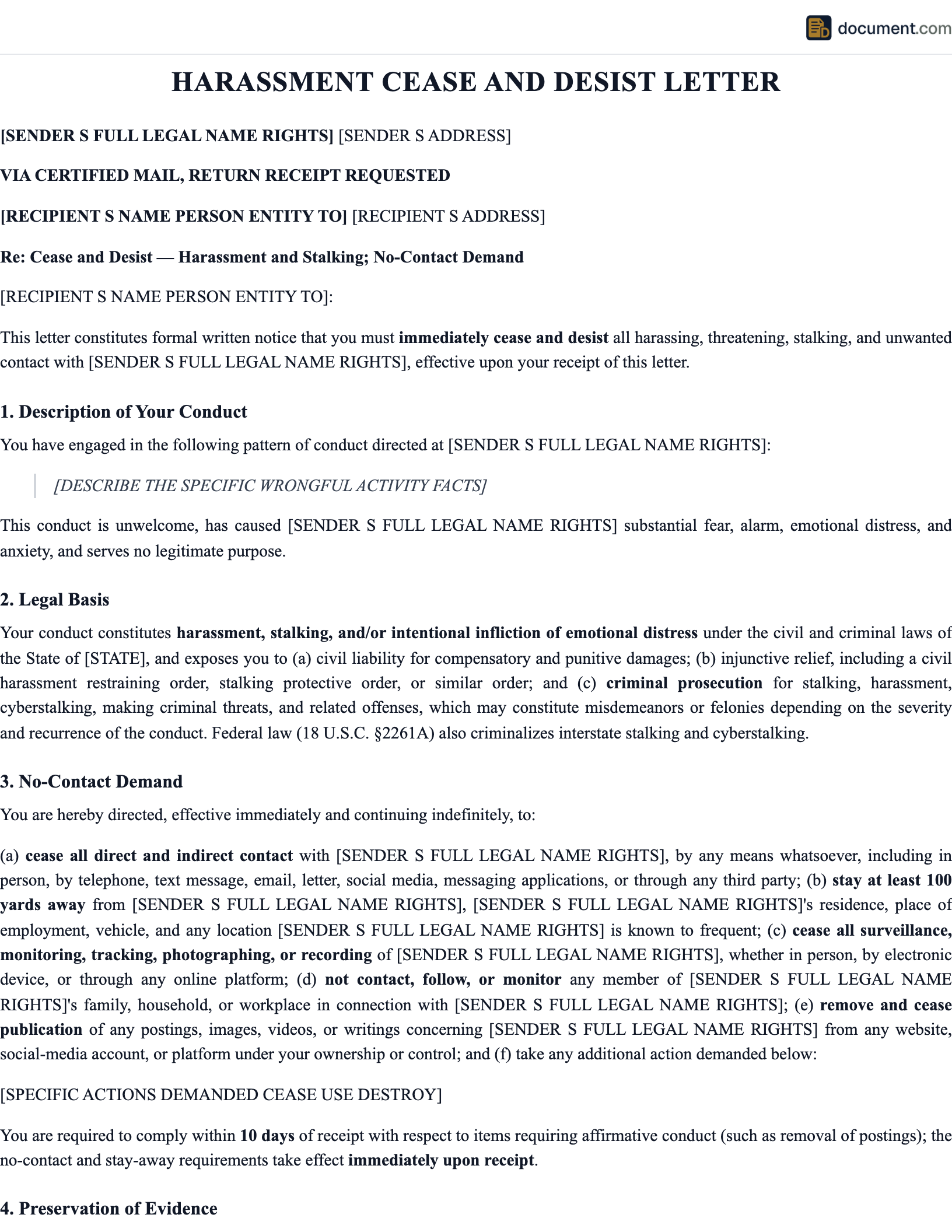
Harassment Letter Form Preview
Below is a visual preview of the sections and fields included in a harassment cease and desist letter. Your completed document will be professionally formatted, attorney-reviewed, and customized for your specific situation and state.
Cease and Desist Harassment
Formal Demand to Stop Unwanted Contact
Section 1: Sender Information
Section 2: Recipient Information
Section 3: Description of Harassing Conduct
Since March 3, 2026, you have contacted me at least 47 times by phone and text despite repeated requests to stop. On March 15, you appeared at my workplace uninvited. On March 22, you posted my home address publicly on social media...
Section 4: Demand and Deadline
You are hereby demanded to CEASE AND DESIST all further contact with me, my family, my employer, and any mutual acquaintances, within ten (10) days of receipt of this letter...
Types of Harassment Cease and Desist Letters
Harassment takes many forms and our templates are tailored to each major context. Select the scenario that most closely matches your situation.
Workplace Harassment
Unwelcome conduct by a coworker, supervisor, or client in a workplace environment
Neighbor Harassment
Repeated disturbances, trespass, threats, or intimidation by a neighbor
Stalking and Following
Pattern of unwanted following, surveillance, or physical pursuit causing fear
Phone and Text Harassment
Repeated unwanted calls, voicemails, or text messages at all hours
Email Harassment
Persistent unwelcome emails, including threats, insults, or unwanted contact
Social Media Harassment
Online abuse, doxxing, targeted posts, or repeated unwanted contact on social platforms
Ex-Partner Harassment
Unwanted contact, intimidation, or monitoring by a former spouse or partner
Third-Party Harassment
Harassment directed at friends, family, or employer to reach the recipient
When to Send a Harassment Cease and Desist Letter
A cease and desist letter is appropriate when the conduct has become persistent, the harasser has ignored informal requests to stop, and you want to create a formal record before escalating. It is not the right tool for every situation — for imminent threats of violence, call the police immediately.
The harasser has contacted you repeatedly after you clearly asked them to stop
You are being followed, watched, or surveilled in a way that causes fear
An ex-partner will not accept that the relationship is over and continues to reach out
A neighbor's conduct — noise, trespass, threats — has become a pattern, not a single incident
A coworker or former coworker continues unwanted contact outside of work channels
You are receiving a barrage of unwanted emails, texts, or social media messages
The harasser is contacting your family, friends, or employer to reach you indirectly
You intend to seek a restraining order and want to document a prior warning
Cease and Desist Letter vs. Restraining Order
These two tools are often confused but serve different purposes. A cease and desist letter is a private demand; a restraining order is a court order with criminal teeth.
| Feature | Cease & Desist Letter | Restraining Order |
|---|---|---|
| Issued by | You or your attorney | A judge |
| Cost | Free to a few hundred dollars | Filing fees, often waived for DV victims |
| Time to obtain | Same day | Days to weeks |
| Penalty for violation | None directly | Criminal contempt, arrest |
| Requires proof in court | No | Yes |
| Public record | No | Yes |
How to Draft a Harassment Cease and Desist Letter
Follow these steps to produce a letter that is firm, factual, and legally sound.
Step 1: Document the conduct
Gather dates, times, locations, screenshots, voicemails, and witness names. Build a chronological log before you write a single line of the letter.
Step 2: Identify the harasser
Confirm the recipient's legal name and a deliverable address. If you only have a username, do what you can to identify the real person.
Step 3: State the facts without embellishment
Describe what happened in clear, neutral language. Avoid insults and adjectives. Let the pattern speak for itself.
Step 4: Make the demand explicit
State unambiguously that the recipient must cease all contact with you and specified third parties, and stay away from specified locations.
Step 5: Set a compliance deadline
Ten to fourteen days is standard. State that failure to comply will result in legal action without further notice.
Step 6: Sign and date
Sign the original letter personally. Keep at least two copies — one for your files and one for any process server or attorney.
Step 7: Deliver with proof
Certified mail with return receipt, a process server, or a neutral third party. Keep all delivery receipts and tracking records.
Key Components of the Letter
Sender identification
Your full legal name and a return address (a P.O. box is acceptable)
Recipient identification
The harasser's full legal name and deliverable address
Date of the letter
Establishes when notice was given
Description of conduct
Specific, dated incidents with supporting evidence referenced
Explicit demand
Clear instruction to cease all contact and specified behaviors
Compliance deadline
Usually 10-14 days from receipt
Legal consequences
Brief, factual statement of remedies you may pursue
Signature block
Your signature, printed name, and date
How to Deliver the Letter
Delivery matters as much as content. Use a method that creates proof the harasser received the letter.
USPS Certified Mail, Return Receipt Requested
The most common and cost-effective option. Generates a USPS tracking number and a signed green card returned to you as proof of delivery.
Process Server
A professional process server hand-delivers the letter and provides a sworn affidavit of service. Higher cost but ironclad proof of receipt.
Neutral Third-Party Hand Delivery
A friend or family member — never you personally — hands the letter to the recipient and signs an affidavit of service.
What Happens After You Send the Letter
Most harassers fall into one of three response patterns after receiving a cease and desist letter. Knowing what to expect helps you plan your next move.
The conduct stops
By far the most common outcome. The harasser realizes they have been formally warned and does not want to risk legal action. Keep the letter and all delivery proof in a safe place in case they resume.
The harasser responds in writing
They may deny the conduct, try to justify it, or respond through a lawyer. Do not engage directly. Keep any response and forward it to your attorney if you have one.
The harassment continues
If the conduct continues after the deadline, you now have powerful evidence that the harasser knew the behavior was unwelcome and persisted anyway. Proceed to a restraining-order petition, civil suit, or criminal complaint.
Legal Considerations
A harassment cease and desist letter has no statutory requirements and does not need to be notarized, witnessed, or filed with any court. However, there are legal pitfalls to avoid.
Do not make threats
Threatening to publish private information, contact the harasser's employer, or take any action unrelated to lawful legal remedies can expose you to extortion or harassment claims.
Stick to verifiable facts
Do not include factual assertions you cannot prove. False statements of fact could become the basis of a defamation counterclaim.
Do not demand money
Unless you have an independently valid legal claim, a demand for payment alongside a stop-harassment demand can look like extortion.
If you are in danger, call 911
A cease and desist letter is not a substitute for emergency services. For imminent threats of violence, contact law enforcement immediately.
Sample Harassment Cease and Desist Letter
The excerpt below shows the tone and structure of a well-drafted harassment letter.
VIA CERTIFIED MAIL — RETURN RECEIPT REQUESTED
April 7, 2026
Mr. Marcus T. Webb
1204 Pine Crest Lane
Roseville, CA 95661
Re: Formal Demand to Cease and Desist All Harassing Contact
Dear Mr. Webb,
This letter serves as formal notice that you must immediately cease and desist all contact, communication, and interference with me, Jennifer L. Hayes, effective upon receipt of this letter.
Beginning on or about March 3, 2026, and continuing through the present, you have engaged in a repeated course of unwelcome conduct directed at me, including but not limited to: (a) more than forty-seven (47) unwanted phone calls and text messages; (b) appearing at my place of employment on March 15, 2026 after being asked not to; (c) publishing my home address on a public social media platform on March 22, 2026; and (d) contacting three of my family members in an attempt to pressure them to relay messages to me.
You are hereby directed to CEASE AND DESIST all such conduct immediately. Specifically, you shall: (1) make no further contact with me by any means, direct or indirect; (2) refrain from approaching me, my residence, or my place of employment; (3) make no contact with my family, friends, or employer; and (4) remove any and all references to me from your social media accounts.
You have ten (10) days from the date of receipt of this letter to comply. Should you fail to do so, I will pursue all available legal remedies, including but not limited to a civil harassment restraining order under California Code of Civil Procedure § 527.6, a civil lawsuit for intentional infliction of emotional distress, and referral to law enforcement for criminal prosecution under applicable harassment and stalking statutes.
This letter is sent without waiver of any rights or remedies, all of which are expressly reserved.
Sincerely,
Jennifer L. Hayes
Frequently Asked Questions
Answers to the most common questions about harassment cease and desist letters, their legal effect, and what to do if the conduct continues.
Official Resources
The following government and nonprofit resources provide authoritative information on harassment, stalking, and victim support.
DOJ - Office on Violence Against Women: Stalking
Federal stalking resources and victim assistance programs
SPARC - Stalking Prevention Resource Center
Training, statistics, and victim resources from a DOJ-funded center
National Domestic Violence Hotline
24/7 confidential support for victims of intimate partner harassment (1-800-799-7233)
National Center for Victims of Crime
Victim rights, resources, and referrals for harassment and stalking victims
EEOC - Workplace Harassment
Equal Employment Opportunity Commission guidance on workplace harassment
FBI - Stalking Investigations
Federal Bureau of Investigation information on stalking and cyberstalking
Cyber Civil Rights Initiative
Resources for victims of online harassment, doxxing, and image-based abuse
WomensLaw.org
State-by-state legal information on restraining orders and harassment remedies
Create your Harassment Cease and Desist Letter in under 10 minutes.
Answer a few questions and download a compliant, attorney-drafted document ready for your state.