



What Is an Incident Report?
An incident report is a contemporaneous written record of an unexpected event — such as a workplace injury, vehicle accident, patient fall, security breach, or near miss — that documents the facts of what happened, who was involved, and what was done in response. Organizations across virtually every industry use incident reports as the foundational record for safety management, regulatory compliance, insurance claims handling, and litigation defense. A well-written incident report protects everyone involved by creating an objective account of the event before memories fade, witnesses scatter, and the physical scene changes.
Incident reports are required or recommended in many regulated environments. Employers covered by OSHA must record qualifying work-related injuries and illnesses on the OSHA 300 Log and prepare a more detailed Form 301 incident report for each case. Healthcare facilities document patient incidents to satisfy state licensing requirements and Joint Commission standards. Schools and daycare centers report student injuries to parents, licensing agencies, and insurers. Construction contractors track jobsite incidents for OSHA compliance and to inform jobsite safety improvements. Even when no regulator requires a written report, businesses routinely create one to preserve facts in case a claim or lawsuit later emerges.
Our attorney-reviewed templates cover the most common incident types — workplace, accident, construction, cybersecurity, daycare, employee, near miss, patient, police, school, and security — with the fields and prompts each scenario requires. Each template captures the basic facts (who, what, when, where, how), space for witness information, immediate actions taken, photographs or evidence, and the signatures needed to authenticate the report.
Factual Record
Capture what happened while details are fresh and witnesses are still available
Compliance & Defense
Satisfy OSHA recordkeeping, insurer requirements, and create a defensible audit trail
Prevent Recurrence
Inform root cause analysis and corrective actions so the same incident does not happen again
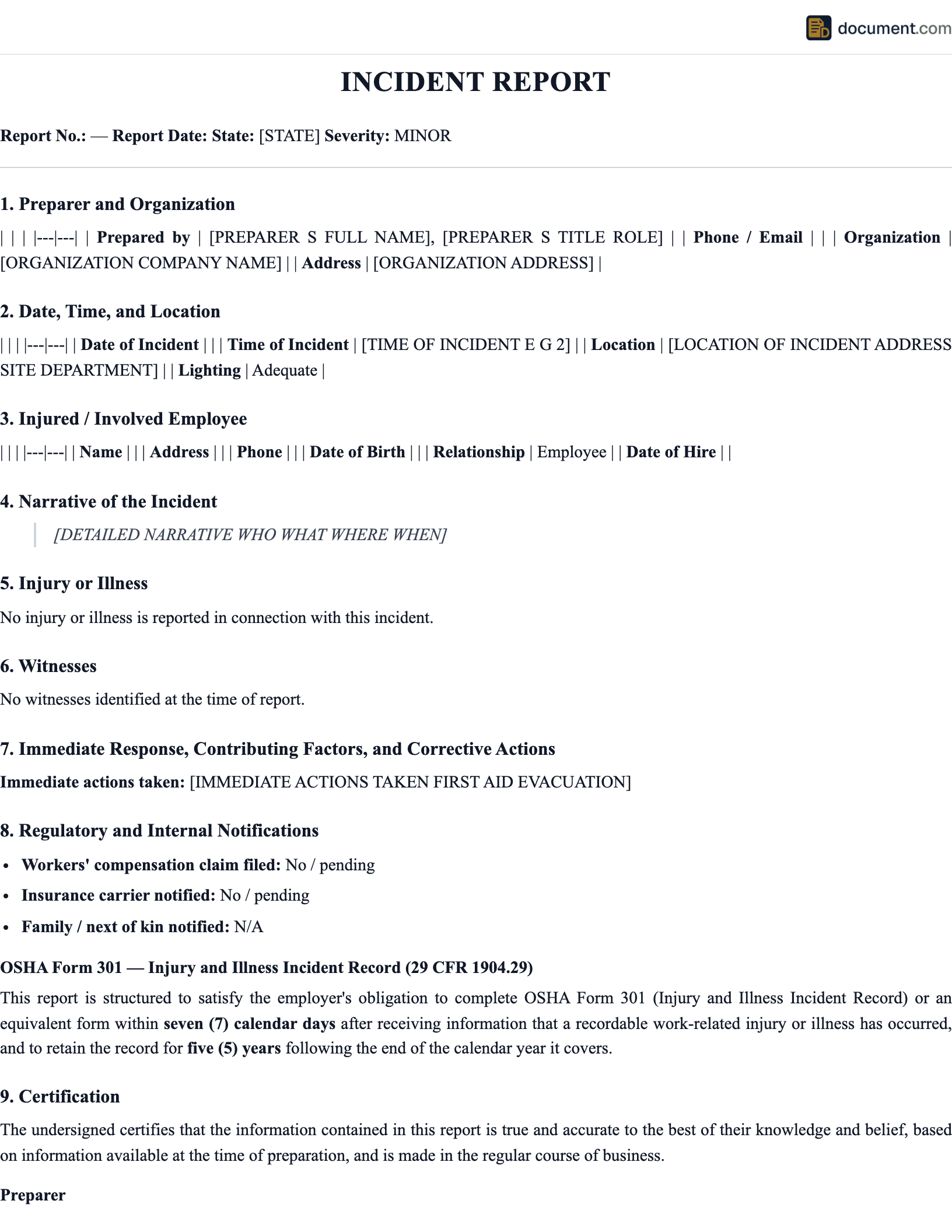
Incident Report Form Preview
Below is a visual preview of the sections included in a standard incident report form. Your completed document will be customized for your specific incident type and jurisdiction.
Incident Report
Workplace Injury / Illness
Section 1: Incident Details
Section 2: Person Involved
Section 3: Description of Incident
Section 4: Injury / Damage
Section 5: Witnesses
Section 6: Signatures
Reporter Signature
Supervisor Signature
Types of Incident Reports
Different incidents require different fields, witnesses, and follow-up actions. Choose the template that matches the type of event you need to document.
Workplace Incident Report
Documents injuries, illnesses, or unsafe events occurring during the course of employment
Accident Report
General-purpose accident documentation for vehicles, premises, and personal injury events
Construction Incident Report
Records jobsite injuries, falls, equipment failures, and OSHA-recordable construction events
Cybersecurity Incident Report
Captures data breaches, ransomware events, unauthorized access, and IT security incidents
Daycare Incident Report
Documents injuries, illnesses, or behavioral incidents involving children in licensed care
Employee Incident Report
Internal HR form for documenting employee-involved events, complaints, or policy violations
Near Miss Report
Records hazardous conditions or close calls that did not result in injury but could have
Patient Incident Report
Healthcare facility documentation for falls, medication errors, and adverse patient events
Police Incident Report
Citizen report supplied to law enforcement to document a crime, theft, or public safety event
School Incident Report
Records student injuries, fights, bullying, or safety events on school grounds
Security Incident Report
Documents trespassing, vandalism, theft, or other security-related events at a facility
How to Write an Incident Report
A useful incident report is factual, complete, and written promptly. Follow these steps to produce a report that holds up to insurer review, OSHA inspection, and potential litigation.
Secure the Scene and Provide Aid
Before writing anything, ensure injured parties receive medical attention, contain any ongoing hazards, and preserve the physical evidence. Take photographs of the scene from multiple angles, save any defective equipment, and identify witnesses while they are still present. The first priorities are people and safety — documentation comes next.
Gather the Basic Facts
Capture the date, exact time, and specific location of the incident. Identify everyone involved by full legal name, job title (if applicable), department, and contact information. Note the weather, lighting, equipment in use, and any other environmental factors that could be relevant. Collect witness names and contact information before anyone leaves the scene.
Describe the Sequence of Events
Write a chronological narrative of what happened in plain, factual language. Describe what people were doing immediately before the incident, what triggered it, what happened next, and how it ended. Use specific details (distances, weights, names of equipment) rather than vague generalities. Avoid speculating about cause or fault.
Document Injuries and Damage
Record any injuries reported by involved parties, the body parts affected, and the immediate first aid or medical treatment provided. Note any property or equipment damage, including the estimated extent. Avoid making medical diagnoses — leave that to the treating provider — and stick to observable facts.
Sign, Submit, and Follow Up
Have the reporter and supervisor sign and date the report, then submit it to the designated recipient (HR, safety manager, insurer, or regulator) within your organization's required timeframe. File copies in the employee, patient, or facility record as appropriate, and trigger any required follow-up — such as an OSHA filing, workers' compensation claim, or root cause investigation.
Key Components of an Incident Report
Every well-drafted incident report contains the same core elements, regardless of incident type. These components form the factual foundation that insurers, regulators, and courts will rely on if the event leads to a claim.
Time, Date, Location
- - Exact date and time of the event
- - Specific physical location and area
- - Weather and environmental conditions
- - Lighting and visibility
People Involved
- - Injured or affected person(s)
- - Job title and department
- - Witnesses with contact information
- - First responders and supervisors
Narrative Description
- - Sequence of events leading up to the incident
- - What happened during the event
- - Equipment, materials, or tools involved
- - Immediate actions taken in response
Outcomes & Follow-Up
- - Injuries, illnesses, or property damage
- - Medical treatment provided or refused
- - Corrective and preventive actions
- - Reporter and supervisor signatures
Sample Incident Report
Below is a condensed example of how a workplace incident report might be drafted. Your completed document will be customized for the specific incident type and your jurisdiction.
EMPLOYEE INCIDENT REPORT
Report #[Number]
1. INCIDENT INFORMATION
On [Date] at approximately [Time], an incident occurred at [Location].
2. DESCRIPTION
[Employee Name], employed as a [Job Title], was performing routine duties when [Description of what happened]. The employee reported the incident to [Supervisor]within [Time] minutes.
3. INJURY OR DAMAGE
Reported injury: [Body part and nature]. First aid provided: [Treatment]. Medical referral: [Yes / No].
4. CONTRIBUTING FACTORS
Observed conditions at the time of the incident included[Factors]. No employee rule violations or unsafe acts were observed by the reporter.
5. CORRECTIVE ACTIONS
Immediate corrective actions: [Actions]. Recommended follow-up: [Recommendations].
Frequently Asked Questions
Common questions about when to file an incident report, OSHA requirements, witness statements, and the legal use of incident report records.
Official Resources
Authoritative federal and industry resources for incident reporting and recordkeeping.
OSHA - Injury & Illness Recordkeeping
Federal rules for the OSHA 300 Log and Form 301 incident reports
OSHA - Report a Severe Injury
8-hour and 24-hour reporting for fatalities, hospitalizations, amputations
CDC NIOSH - Workplace Safety
Research and guidance on occupational injury prevention
CISA - Report a Cyber Incident
Federal portal for reporting cybersecurity incidents and breaches
BLS - Injuries, Illnesses, Fatalities
National statistics on workplace injuries and illnesses by industry
Joint Commission - Sentinel Events
Healthcare standards for patient safety incident reporting
Create your Incident Report in under 10 minutes.
Answer a few questions and download a compliant, attorney-drafted document ready for your state.