
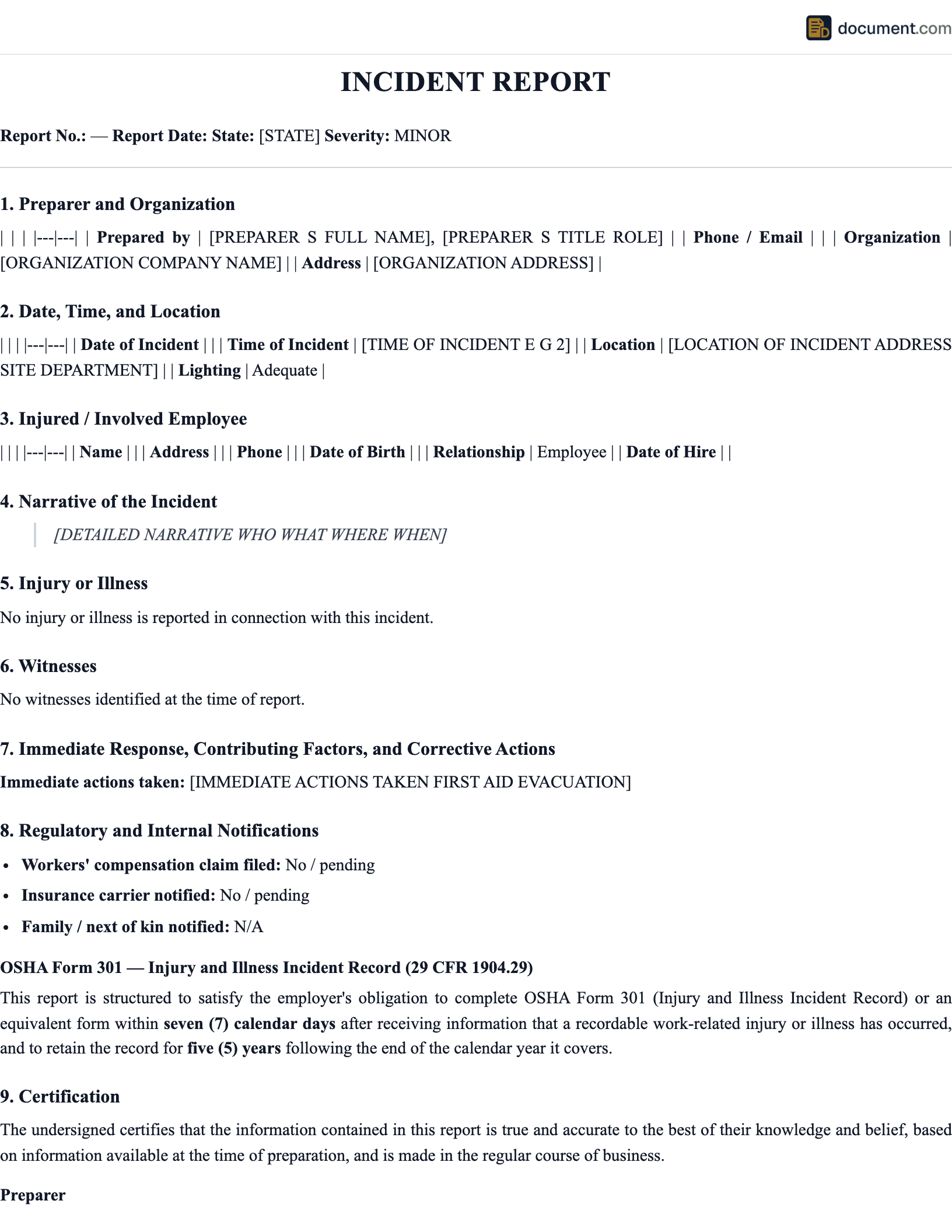



What Is an Accident Incident Report?
An accident incident report is a formal written record that documents the circumstances, causes, and consequences of an unplanned event resulting in bodily injury, property damage, or both. Unlike a general incident report that may cover near misses and safety observations, an accident report specifically addresses events where harm has already occurred — a warehouse worker who fractures a wrist in a fall from a ladder, a delivery driver involved in a rear-end collision, or a customer who slips on a wet floor in a retail store. The report captures the who, what, when, where, and how of the event, creating a contemporaneous factual record that becomes the foundation for every downstream process.
The accident incident report serves multiple audiences simultaneously. For the employer, it initiates the internal safety investigation and corrective action process. For the workers' compensation insurer, it provides the factual basis for the first report of injury and the subsequent claims adjudication. For OSHA, it supplies the information needed to determine whether the injury is recordable and, if so, to complete the OSHA 300 Log entry and Form 301 or equivalent. For attorneys on either side of a potential lawsuit, it establishes the facts as understood at the time of the event — before memories fade, witnesses scatter, and the scene is altered.
Accident reports vary in scope depending on the type of event. Workplace slip-and-fall reports focus on floor conditions, footwear, lighting, and housekeeping practices. Vehicle accident reports document road conditions, traffic controls, vehicle positions, speed estimates, and driver actions. Equipment-related accident reports detail the make, model, maintenance history, and operating condition of the machinery involved. Regardless of the accident type, the core requirement is the same: capture objective facts promptly, thoroughly, and without speculation about fault.
Workers' Comp Foundation
Provides the factual basis for first report of injury and claims processing
OSHA Recordkeeping
Supports 300 Log entries and Form 301 completion for recordable injuries
Root Cause Analysis
Captures scene data and contributing factors to drive corrective action
Accident Incident Report Form Preview
Below is a condensed preview showing the key sections of an accident incident report. Your completed document will be customized based on the type of accident, your state's workers' compensation requirements, and your organization's reporting policies.
ACCIDENT INCIDENT REPORT
Report #[Number]
1. ACCIDENT DETAILS
Date: [Date] Time: [Time] Location: [Exact Location]
Type: [Slip/Fall / Vehicle / Equipment / Other]
2. INJURED PERSON(S)
Name: [Full Name] Title: [Job Title] Dept: [Department]
3. DESCRIPTION OF ACCIDENT
[Chronological factual narrative of what happened]
4. INJURY / PROPERTY DAMAGE
Body part: [e.g., left ankle] Nature: [e.g., fracture] Property: [Damage description]
5. WITNESSES & CORRECTIVE ACTIONS
Witness: [Name / Contact] Immediate action: [Actions taken]
Key Components of an Accident Incident Report
A well-structured accident report addresses every element that investigators, insurance adjusters, and regulators will look for. The specific fields vary by accident type and jurisdiction, but these sections appear in virtually every thorough accident report.
Accident Classification
Categorize the accident type — slip/trip/fall, struck-by, caught-in/between, vehicle collision, burn, electrical, chemical exposure, or other. Classification drives the investigation methodology and determines which regulatory reporting rules apply.
Scene Documentation
Exact location (building, floor, room, outdoor area), environmental conditions (lighting, weather, temperature, floor surface condition), photographs from multiple angles, and any physical evidence preserved. Specificity matters — "east stairwell, between floors 2 and 3, step 7 from top" is actionable; "stairwell" is not.
Injury and Damage Assessment
Body part affected, nature of injury (fracture, laceration, contusion, sprain), treatment provided (first aid, ER, hospitalization), and prognosis if available. For property damage, describe the item, estimated repair or replacement cost, and whether the equipment was taken out of service.
Contributing Factors
Observable conditions that may have contributed to the accident — wet floors, missing guardrails, inadequate lighting, defective equipment, lack of PPE, fatigue, or deviation from standard operating procedures. Document what was observed, not conclusions about causation.
Vehicle-Specific Details
For vehicle accidents: make, model, year, license plate, VIN, insurance information for all vehicles involved; road and weather conditions; traffic control devices; estimated speeds; point of impact; police report number; and whether the driver was tested for impairment per company policy.
Witness Statements and Signatures
Each witness provides a separate written statement in their own words. The report is signed and dated by the injured person, each witness, the supervisor, and the safety officer. Signatures confirm the facts as each party understands them and establish the chain of documentation.
How to Write an Accident Incident Report
A thorough accident report requires prompt action, attention to detail, and disciplined adherence to factual reporting. Follow these steps to produce a report that will withstand scrutiny from investigators, insurers, attorneys, and regulators.
Ensure safety and provide medical attention
Before documenting anything, make sure the injured person receives appropriate medical care and the area is secured to prevent additional injuries. Call 911 if the situation warrants emergency response. Do not move the injured person unless they are in immediate danger.
Preserve and photograph the scene
Before anything is moved, cleaned, or repaired, photograph the accident location from multiple angles. Capture environmental conditions, equipment positions, floor surfaces, lighting, and any physical evidence. If a vehicle is involved, photograph all vehicles, damage, road conditions, and traffic controls.
Collect witness statements immediately
Interview all witnesses separately while their memories are fresh. Have each witness write their own statement describing what they saw and heard. Record the date, time, and location of each interview. Do not coach, lead, or suggest answers — let witnesses describe events in their own words.
Complete the accident report form
Fill in every section: accident classification, date, time, exact location, persons involved, narrative description, injury and damage assessment, contributing factors, and immediate response actions. Leave no field blank — write N/A if a section does not apply.
Write a factual chronological narrative
Describe the sequence of events leading up to the accident, the accident itself, and the immediate aftermath. Use past tense, specific times, and measurable descriptions. Avoid opinions, blame, and legal conclusions. The narrative should answer who, what, when, where, and how.
Document corrective actions and route the report
Record immediate actions taken (first aid, scene secured, equipment locked out) and recommended follow-up actions (engineering controls, training, policy revision). Assign responsibility and deadlines. Obtain all required signatures and distribute copies to HR, safety, the insurance carrier, and management.
Frequently Asked Questions
Common questions about accident incident reporting, OSHA obligations, workers' compensation documentation, and vehicle accident procedures.
Official Resources
Federal and industry resources for accident reporting, OSHA compliance, workers' compensation, and vehicle accident documentation.
OSHA - Injury & Illness Recordkeeping
Federal rules for the OSHA 300 Log, Form 301, and annual summary
OSHA - Report a Fatality or Severe Injury
8-hour and 24-hour reporting portal for serious workplace events
DOL - Office of Workers' Compensation
Federal workers' compensation programs and filing resources
NHTSA - Vehicle Safety Reporting
Report vehicle defects and access crash data from the National Highway Traffic Safety Administration
BLS - Injuries, Illnesses, and Fatalities
National statistics on workplace injuries by industry, occupation, and event type
CDC NIOSH - Workplace Safety Research
Research and guidance on occupational injury prevention and workplace hazards
Create your Accident Incident Report in under 10 minutes.
Answer a few questions and download a compliant, attorney-drafted document ready for your state.