



What Is an Employee Incident Report?
An employee incident report is an HR document that records a specific behavioral event, policy violation, or workplace conduct issue involving an employee. It is fundamentally different from a workplace safety incident report: rather than documenting physical injuries or environmental hazards, the employee incident report focuses on actions and behaviors — insubordination, harassment, attendance violations, policy non-compliance, workplace conflicts, dishonesty, substance abuse concerns, and other conduct that affects the work environment, violates company policy, or triggers legal obligations. The report creates a contemporaneous written record that becomes part of the employee's personnel file and serves as the factual foundation for progressive discipline.
The employee incident report occupies a critical position in employment law. When an employee is terminated and challenges the decision — through a wrongful termination lawsuit, an EEOC discrimination charge, an unemployment insurance appeal, or a union grievance arbitration — the employer must demonstrate that the termination was based on legitimate, documented reasons. Courts, arbitrators, and agency investigators consistently give the most weight to documentation that was created at the time of the events, not after the termination decision was made. A well-maintained series of employee incident reports shows that the employer identified specific performance or conduct issues, communicated them clearly to the employee, gave the employee an opportunity to improve, applied escalating consequences consistently, and ultimately made the termination decision based on an objective record.
Employee incident reports also serve a protective function beyond discipline. When an employee files a harassment or discrimination complaint, the incident report is the first step in demonstrating that the employer took the complaint seriously, initiated a prompt investigation, and took appropriate remedial action. Under the Faragher-Ellerth defense framework, an employer can avoid vicarious liability for supervisor harassment if it can show that it exercised reasonable care to prevent and correct harassment and that the employee unreasonably failed to take advantage of corrective opportunities. The incident report — and the investigation it triggers — is the employer's primary evidence of reasonable care.
Progressive Discipline
Build the documented record that supports fair, consistent corrective action
Investigation Trigger
Initiate formal HR investigations for harassment, discrimination, and misconduct
Legal Defense
Create the evidentiary record for unemployment hearings, EEOC charges, and litigation
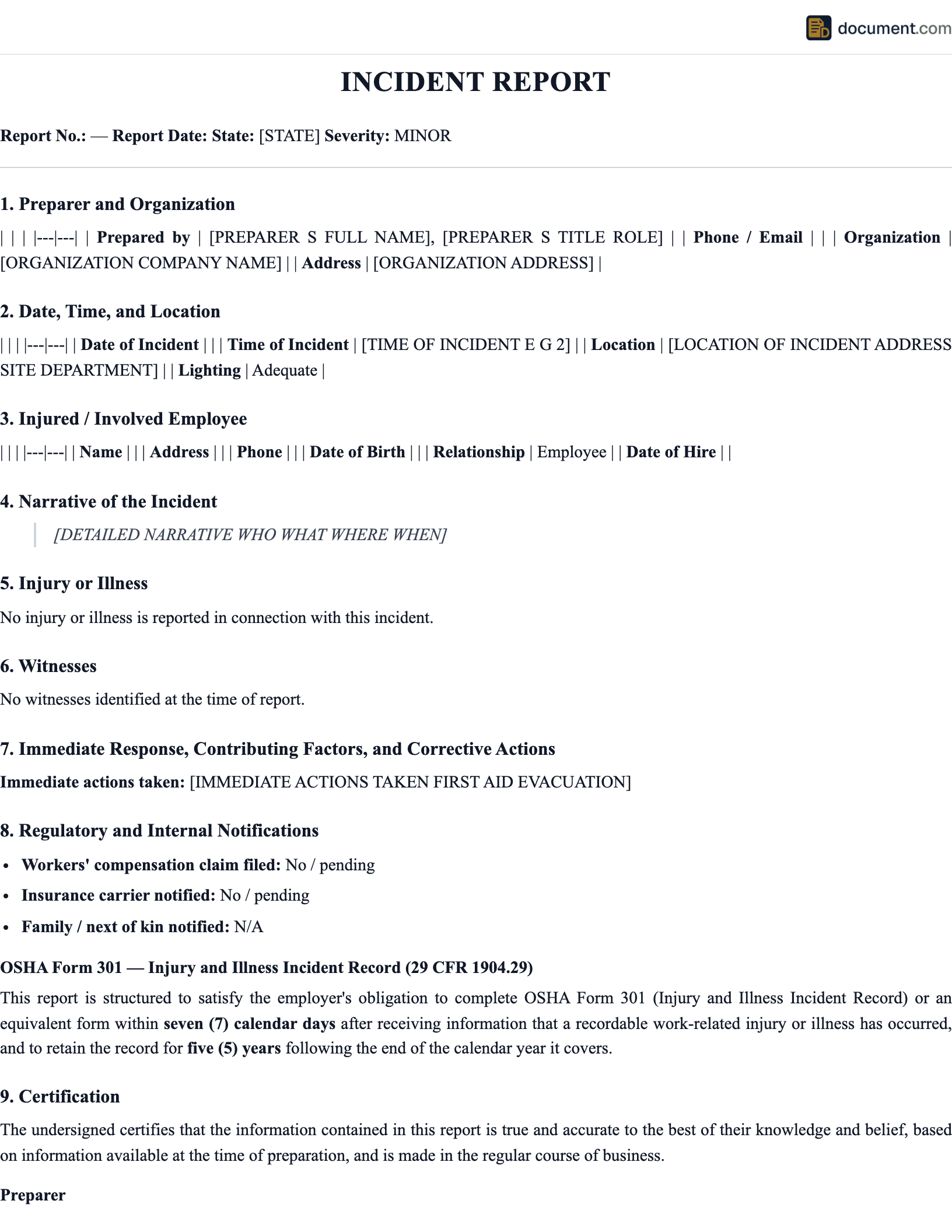
Employee Incident Report Form Preview
Below is a condensed preview of the key sections in an employee incident report. Your completed document will be customized based on the incident type and your organization's HR policies.
EMPLOYEE INCIDENT REPORT
Report #[Number] Confidential
1. EMPLOYEE INFORMATION
Name: [Full Name] Title: [Job Title] Dept: [Department]
Supervisor: [Name] Hire date: [Date]
2. INCIDENT DETAILS
Date: [Date] Time: [Time] Location: [Office / Department / Remote]
Type: [Policy Violation / Harassment / Attendance / Conduct / Other]
3. DESCRIPTION OF BEHAVIOR / INCIDENT
[Factual description of observable behavior]
4. POLICY VIOLATED & PRIOR HISTORY
Policy: [Section / Name] Prior incidents: [Dates / Count]
5. CORRECTIVE ACTION
Action: [Verbal Warning / Written Warning / Suspension / PIP / Termination]
Key Components of an Employee Incident Report
A legally sound employee incident report contains specific elements that demonstrate fair process, factual documentation, and consistent policy application. These components are essential for defending disciplinary decisions.
Employee Identification and Employment Context
Full name, job title, department, supervisor, hire date, and employment status (full-time, part-time, probationary). This establishes the employment relationship and identifies the chain of management. Include the employee's tenure and prior performance history to provide context for the corrective action.
Observable Behavior Description
A factual, objective description of what the employee did or said — not an interpretation of their attitude, character, or intent. Describe the specific behavior in concrete terms: "Employee arrived at 9:47 AM, 47 minutes after the scheduled 9:00 AM start time, without prior notification" rather than "Employee has a bad attitude about punctuality." Include direct quotes where possible.
Policy Reference and Prior Violations
Cite the specific company policy, handbook section, or work rule that was violated. Reference any prior incidents involving the same or similar behavior, including dates and the corrective actions taken at each stage. This establishes the progressive discipline pattern and demonstrates that the employee was on notice.
Employee's Response and Explanation
Document the employee's explanation, denial, or admission — in their own words where possible. If the employee declined to respond, note that. Demonstrating that the employee was given an opportunity to be heard is a fundamental element of due process and strengthens the employer's position in any subsequent challenge to the disciplinary action.
Corrective Action and Expectations
The specific corrective action taken — verbal warning, written warning, suspension (with dates and duration), performance improvement plan, or termination. State the expected behavior going forward and the consequences of further violations. Be specific: "Any additional unexcused absence within the next 90 days will result in termination" is clearer than "further action may be taken."
Witness Information and Signatures
Names and statements of any witnesses to the incident. The report should be signed by the supervisor, the employee (acknowledging receipt, not necessarily agreement), and an HR representative or second management witness. If the employee refuses to sign, document the refusal with the date and the witness who observed it.
How to Write an Employee Incident Report
Writing an effective employee incident report requires objectivity, precision, and awareness of the legal implications. Follow these steps to produce a report that is defensible, fair, and consistent with your organization's policies.
Document the facts promptly
Write the report on the same day as the incident or, for ongoing patterns (attendance), on the day you decide to address it formally. Record the specific date, time, location, and exactly what you observed or what was reported to you. Do not wait until multiple incidents accumulate — each event should be documented individually.
Describe observable behavior, not character
Stick to what the employee did or said. Avoid characterizing their attitude, personality, or motivation. Write 'Employee used profanity directed at a coworker in the break room in front of three other employees' rather than 'Employee has an anger management problem.' Concrete descriptions are defensible; character judgments invite legal challenges.
Identify the policy violation and prior history
Reference the specific handbook section, company policy, or work rule that the behavior violated. Review the employee's file for prior incidents and note the dates, nature, and corrective actions from each previous report. This establishes the progressive discipline trajectory.
Meet with the employee and document their response
Present the report to the employee in a private setting, ideally with an HR representative or second supervisor present as a witness. Give the employee an opportunity to explain their perspective and document their response. If they refuse to participate, note the refusal.
State the corrective action and future expectations
Clearly document the disciplinary step being taken (verbal warning, written warning, suspension, PIP), the specific behavior expected going forward, the timeframe for improvement, and the consequences of further violations. Be precise and consistent with how similar situations have been handled for other employees.
Obtain signatures and file the report
Have the employee sign acknowledging receipt (not agreement). If they refuse, document the refusal with a witness. Provide the employee with a copy. File the original in the employee's personnel file and send a copy to HR. If the incident involves harassment, discrimination, or threats, notify HR immediately to initiate a formal investigation.
Frequently Asked Questions
Common questions about employee incident reporting, progressive discipline, HR documentation, harassment investigations, and record retention.
Official Resources
Federal agencies and resources for employment law compliance, anti-discrimination enforcement, and HR best practices.
EEOC - Equal Employment Opportunity Commission
Federal anti-discrimination enforcement, charge filing, and employer guidance
DOL - Wage and Hour Division
FLSA compliance, wage and hour laws, and record retention requirements
NLRB - National Labor Relations Board
Protected concerted activity, unfair labor practices, and employee rights
SHRM - Society for Human Resource Management
HR best practices, policy templates, and compliance guidance
DOL - Workplace Policy Research
Federal research on employment practices, workplace safety, and labor standards
ADA.gov - Americans with Disabilities Act
Disability accommodation requirements and documentation guidance for employers
Create your Employee Incident Report in under 10 minutes.
Answer a few questions and download a compliant, attorney-drafted document ready for your state.