



What Is a Workplace Incident Report?
A workplace incident report is a written document that records the facts of an unexpected event occurring during the course of employment — including injuries, occupational illnesses, near misses, equipment failures, exposure events, and property damage. The report captures what happened, when and where it occurred, who was involved or witnessed it, what immediate actions were taken, and what follow-up steps are recommended. It is the foundational record that drives every downstream process: workers' compensation claims, OSHA recordkeeping, internal root cause investigations, and corrective action tracking.
Workplace incident reports differ from general accident reports in their employment-specific focus. They account for the work environment, the task being performed, supervisory oversight, applicable safety protocols, personal protective equipment in use, and the employer's response obligations under federal and state occupational safety laws. A properly completed workplace incident report protects both the employee (by creating a contemporaneous record that supports their workers' compensation claim) and the employer (by demonstrating a good-faith response and establishing facts before litigation begins).
Contemporaneous Record
Document facts while the scene is intact and witness memories are fresh
OSHA Compliance
Satisfy federal recordkeeping rules and severe-injury reporting deadlines
Corrective Action
Initiate root cause analysis and track hazard elimination to prevent recurrence
When to File a Workplace Incident Report
A workplace incident report should be filed whenever an event occurs that results in — or could have resulted in — injury, illness, or property damage during the course of employment. The threshold for reporting should be low: even minor first-aid-only injuries and near misses deserve documentation because they reveal hazards that could cause more serious harm in the future.
Common triggering events include slips, trips, and falls; struck-by or caught-in incidents; ergonomic injuries from lifting or repetitive motion; chemical splashes or inhalation exposure; burns and electrical shocks; workplace violence or threats; motor vehicle incidents involving company vehicles; and equipment malfunctions that create unsafe conditions. The report should be initiated immediately — ideally before the end of the shift on which the incident occurred — because delay erodes the accuracy of the record and may violate employer reporting obligations.
Critical OSHA Deadlines
Fatalities must be reported to OSHA within 8 hours. In-patient hospitalizations, amputations, and losses of an eye must be reported within 24 hours. All other recordable injuries must be entered on the OSHA 300 Log within 7 calendar days.
Key Components of a Workplace Incident Report
A thorough workplace incident report addresses every element that investigators, insurers, and regulators will look for. The specific fields vary by industry and company, but the following sections appear in virtually every well-designed workplace incident form.
Incident Identification
Date, time, exact location (building, floor, room, or area), report number, and the name and job title of the person completing the report. Precision matters — "warehouse loading dock, bay 3" is far more useful than "warehouse."
Involved Persons
Full name, job title, department, employment status (full-time, temporary, contractor), and contact information for every person involved in or affected by the incident. For injuries, include the body part affected and the nature of the injury.
Narrative Description
A factual, chronological account of what happened — the task being performed, the sequence of events leading up to the incident, the incident itself, and the immediate aftermath. Written in past tense, free of opinions and fault-assignment.
Witness Information
Names, job titles, and contact details for all witnesses. Each witness should provide a separate written statement describing what they saw or heard in their own words. Witness statements should be collected as soon as possible after the incident.
Contributing Factors & Conditions
Environmental conditions (lighting, weather, floor condition, noise level), equipment involved, personal protective equipment in use or required, and any observable conditions that may have contributed to the incident. Describe what was observed — do not speculate about root causes.
Immediate Actions & Corrective Steps
First aid or medical treatment provided, scene secured, equipment taken out of service, area cordoned off, and any other immediate response actions. Include recommended corrective actions to prevent recurrence and the person or department responsible for follow-up.
Signatures & Review
Signature and date of the report writer, the injured employee (if different), the immediate supervisor, and the safety officer or HR representative who reviews the report. Signatures confirm that each party has read the report and agrees it reflects the facts as they understand them.
How to Write a Workplace Incident Report
Writing an effective workplace incident report requires discipline and attention to detail. Follow these steps to produce a report that will hold up under scrutiny from investigators, insurers, attorneys, and regulators.
Secure the scene and provide aid
Before writing anything, ensure the injured person receives medical attention and the area is safe. Preserve the scene if possible — do not move equipment or clean up until the relevant facts have been documented or photographed.
Collect facts while they are fresh
Interview the involved employee, witnesses, and the supervisor separately. Record each person's account in their own words. Note the time each interview takes place. Photograph the scene, equipment, conditions, and any visible injuries.
Complete the report form
Fill in every field on the form — date, time, location, involved persons, narrative, contributing factors, immediate actions, and witness details. Leave nothing blank; if a field does not apply, write N/A so reviewers know it was not overlooked.
Write a factual narrative
Describe the sequence of events in chronological order using past tense. Stick to observable facts. Avoid opinions, fault language, and legal conclusions. Use specific measurements, times, and descriptions rather than vague terms.
Document corrective actions
Record what was done immediately (first aid, equipment shutdown, area barricade) and what follow-up is recommended (engineering controls, training, policy update). Assign responsibility and a target completion date for each action item.
Obtain signatures and distribute
Have the report writer, injured employee, supervisor, and safety officer sign and date the completed report. Distribute copies to HR, safety, the insurance carrier (if a claim is anticipated), and retain the original in the incident file.
OSHA Recordkeeping Requirements
Under 29 CFR Part 1904, employers with more than 10 employees in non-exempt industries must maintain records of work-related injuries and illnesses. Understanding which incidents are OSHA-recordable — and which trigger direct reporting to OSHA — is essential for every employer completing a workplace incident report.
Recordable vs. First-Aid-Only
An injury or illness is OSHA-recordable if it results in any of the following: death, days away from work, restricted duty or job transfer, medical treatment beyond first aid, loss of consciousness, or a significant injury or illness diagnosed by a physician or other licensed healthcare professional.
First aid includes wound cleaning, bandages, non-prescription medications, hot or cold therapy, and similar minor treatments. If the only treatment is first aid, the case is generally not OSHA-recordable — but it should still be documented internally for safety tracking and workers' compensation purposes.
Required OSHA Forms
- OSHA 300 Log — Log of work-related injuries and illnesses, updated within 7 calendar days
- OSHA 301 Form — Detailed incident report for each recordable case (or an approved equivalent)
- OSHA 300A Summary — Annual summary posted in the workplace from February 1 through April 30
- Electronic submission — Employers with 250+ employees must submit 300A data electronically via the ITA portal
Sample Workplace Incident Report
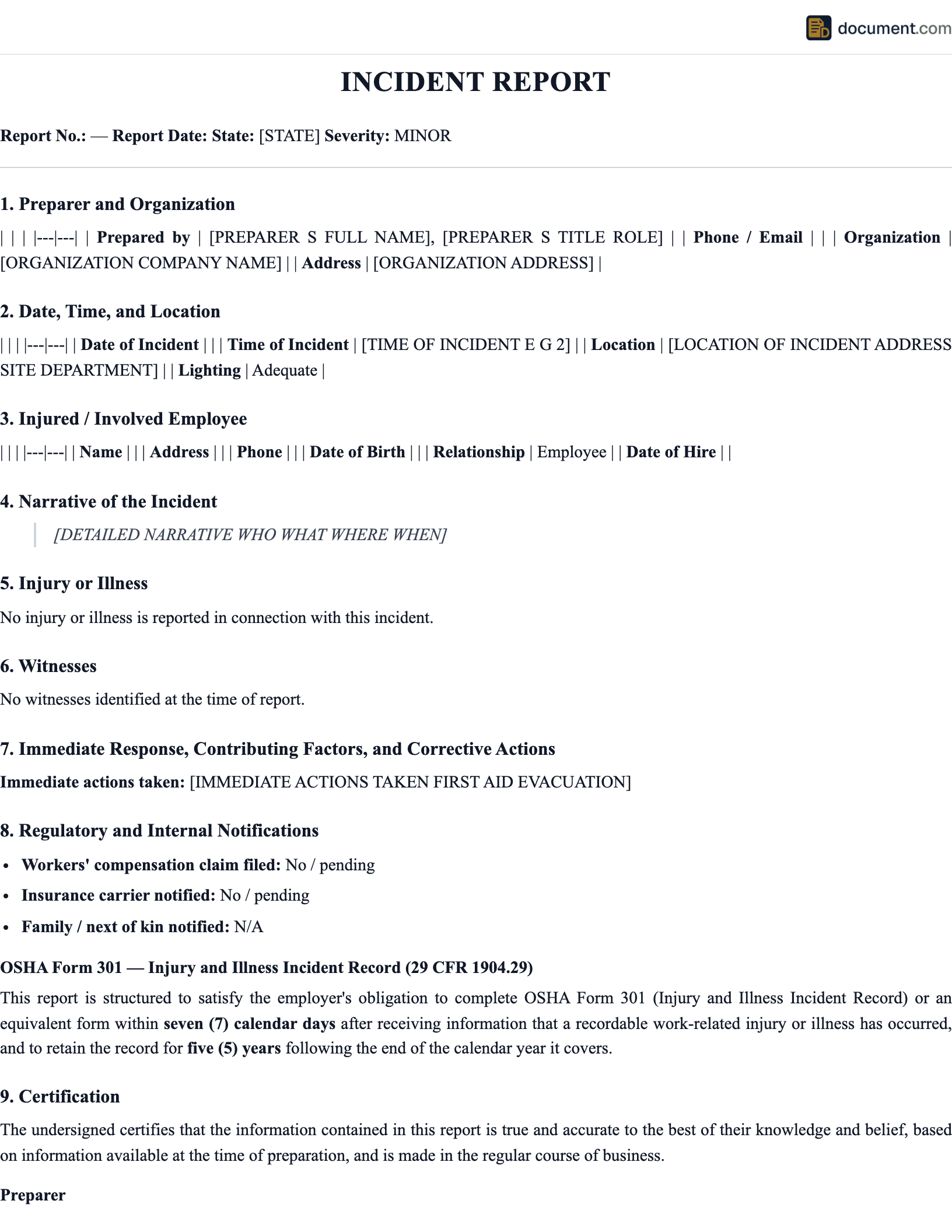
Below is a condensed example showing how the key sections of a workplace incident report might be completed. Your final document will be tailored to the specific incident and your organization's reporting requirements.
WORKPLACE INCIDENT REPORT
Report #[Number]
1. INCIDENT DETAILS
Date: [Date] Time: [Time] Location: [Building / Area / Room]
2. INJURED EMPLOYEE
Name: [Full Name] Title: [Job Title] Dept: [Department]
3. DESCRIPTION OF INCIDENT
Employee was performing [task] when[what happened]. The employee reported the incident to [Supervisor] at[Time].
4. INJURY / DAMAGE
Body part: [e.g., right wrist] Nature: [e.g., sprain] Treatment: [First aid / ER referral]
5. CORRECTIVE ACTIONS
Immediate: [Actions taken]. Follow-up: [Recommendations]. Responsible: [Name / Dept].
Frequently Asked Questions
Common questions about workplace incident reporting, OSHA obligations, employee responsibilities, and record retention.
Official Resources
Federal and industry resources for workplace incident reporting and occupational safety compliance.
OSHA - Injury & Illness Recordkeeping
Federal rules for the OSHA 300 Log, Form 301, and 300A summary
OSHA - Report a Fatality or Severe Injury
8-hour and 24-hour reporting portal for serious workplace events
OSHA - ITA Electronic Submission Portal
Submit OSHA 300A annual summary data electronically
CDC NIOSH - Workplace Safety & Health
Research and guidance on occupational injury and illness prevention
BLS - Injuries, Illnesses, and Fatalities
National statistics on workplace injuries by industry and occupation
DOL - Workers' Compensation Programs
Federal workers' compensation information and filing resources
Create your Workplace Incident Report in under 10 minutes.
Answer a few questions and download a compliant, attorney-drafted document ready for your state.