



What Is a Near Miss Incident Report?
A near miss incident report is a written document that captures the details of an unplanned event where no injury, illness, or property damage occurred, but where the potential for harm was clearly present. The report records what happened, what conditions or behaviors contributed to the event, what the realistic worst-case outcome could have been, and what corrective actions are recommended to eliminate the hazard before it produces an actual injury. Near miss reports are the cornerstone of proactive safety management because they provide hazard intelligence without requiring someone to get hurt first.
The conceptual foundation for near miss reporting comes from Herbert William Heinrich's 1931 research into industrial accident causation, which produced what is now known as Heinrich's Triangle (or the accident pyramid). Heinrich observed a consistent ratio in workplace incidents: for every major injury, there were roughly 29 minor injuries and 300 no-injury close calls sharing the same underlying causes. Modern research by Frank Bird (1969) and the British Safety Council has refined these ratios, but the core insight remains: near misses are leading indicators that predict future injuries, and organizations that capture and act on them have measurably lower injury rates than those that only react after harm occurs.
What distinguishes a near miss report from a standard incident report is its emphasis on potential rather than outcome. Where an injury report documents what damage was done, a near miss report documents what damage was avoided and why. This forward-looking orientation makes near miss reporting particularly valuable for root cause analysis, because investigators can examine the hazard conditions without the complicating factors of injury severity, medical treatment, and workers' compensation claims. The goal is to build a no-blame reporting culture where workers feel safe disclosing close calls, enabling the organization to fix systemic problems before they produce casualties.
Early Hazard Detection
Identify dangerous conditions and behaviors before they produce injuries
Root Cause Analysis
Investigate systemic causes without the pressure of an active injury claim
Safety Culture Metric
High reporting rates signal a healthy safety culture; low rates signal underreporting
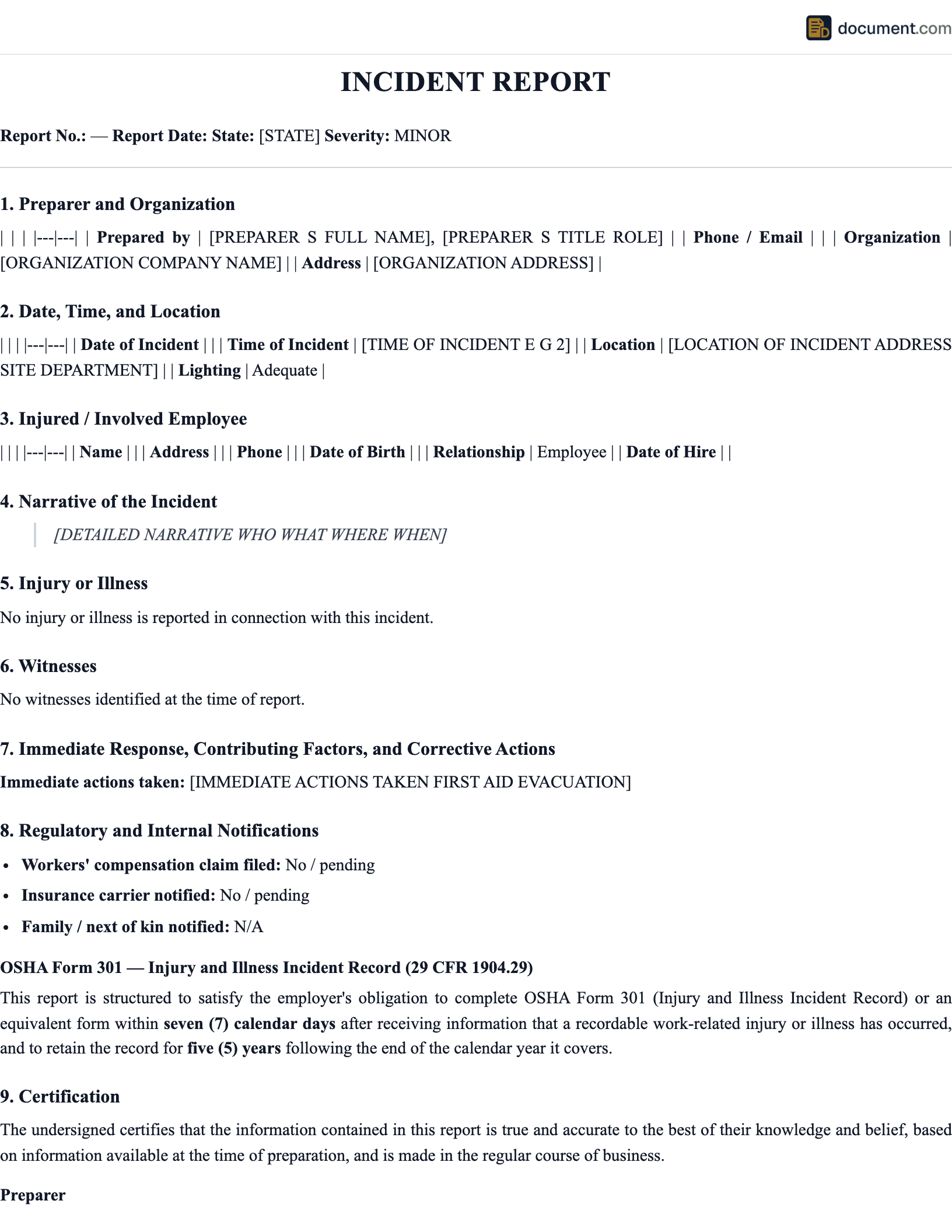
Near Miss Report Form Preview
Below is a condensed preview showing how the key sections of a near miss incident report are structured. Your final document will be customized based on the specific event and your organization's safety management system.
NEAR MISS INCIDENT REPORT
Report #[Number]
1. EVENT DETAILS
Date: [Date] Time: [Time] Location: [Area / Zone / Station]
2. REPORTER INFORMATION
Name: [Optional / Anonymous] Dept: [Department] Shift: [Shift]
3. DESCRIPTION OF NEAR MISS
What happened: [Factual narrative]
Potential outcome: [What could have happened]
4. SEVERITY POTENTIAL
Potential severity: [Low / Medium / High / Critical] Likelihood of recurrence: [Rare / Possible / Likely / Frequent]
5. CONTRIBUTING FACTORS & ROOT CAUSE
Conditions: [Environmental / equipment factors]
Root cause: [5 Whys / Fishbone findings]
6. RECOMMENDED CORRECTIVE ACTIONS
Action: [Specific corrective measure] Owner: [Name / Dept] Due: [Date]
Key Components of a Near Miss Incident Report
An effective near miss report captures enough detail to support root cause analysis and corrective action planning while remaining simple enough that frontline workers will actually complete it. These are the essential elements every near miss form should include.
Event Description
A factual, chronological narrative of what happened — the task being performed, the sequence of events, what went wrong, and how harm was avoided. The description should focus on observable facts rather than opinions or blame. Include the specific location, time, and any equipment, materials, or substances involved.
Potential Consequence Assessment
An honest evaluation of what the worst realistic outcome could have been if circumstances had been slightly different. This is what separates a near miss report from a routine observation — it quantifies the risk that was narrowly avoided. Rate both potential severity (minor, moderate, serious, catastrophic) and likelihood of recurrence.
Contributing Factors
Environmental conditions (lighting, weather, floor surfaces, noise), equipment status (maintenance history, known defects, modifications), procedural factors (whether standard operating procedures exist and were followed), and human factors (fatigue, distraction, training adequacy, communication breakdowns) that contributed to the event.
Root Cause Analysis
The systematic investigation findings identifying why the near miss occurred at a fundamental level. This goes beyond the immediate cause (the wrench fell) to the systemic cause (no tool tethering policy for elevated work). Common RCA methods include 5 Whys, fishbone diagrams, fault tree analysis, and bow-tie analysis.
Corrective Action Plan
Specific, measurable actions to eliminate or control the hazard, prioritized using the hierarchy of controls (elimination, substitution, engineering controls, administrative controls, PPE). Each action should have an assigned owner, a target completion date, and a verification method to confirm the action was effective.
Reporter Confidentiality Option
A mechanism for anonymous or confidential reporting. Many near miss programs allow workers to submit reports without identifying themselves, because removing the fear of personal consequences dramatically increases reporting rates. The report should capture enough detail about the event itself that investigation can proceed without the reporter's identity.
How to Write a Near Miss Incident Report
A well-written near miss report transforms an anecdotal close call into actionable safety intelligence. Follow these steps to create a report that drives meaningful hazard correction rather than gathering dust in a filing cabinet.
Report immediately while details are fresh
File the initial report as soon as the near miss occurs — ideally before leaving the area. Use whatever reporting channel is fastest: mobile app, paper form, QR code submission, or verbal report to a supervisor. The goal at this stage is to capture the raw facts before memory decay sets in.
Describe the event factually and completely
Write a chronological narrative of what happened, including the task being performed, the sequence of events leading up to the near miss, what went wrong, and how harm was avoided. Be specific about location, time, equipment, and conditions. Avoid blame language or speculation about fault.
Assess the potential severity and recurrence likelihood
Evaluate what the realistic worst-case outcome could have been — a minor first-aid injury, a lost-time injury, a permanent disability, or a fatality. Then assess how likely the same scenario is to recur given current conditions. This severity-likelihood matrix determines the priority level for investigation and corrective action.
Identify contributing factors across all categories
Examine equipment, environment, procedures, training, communication, and human factors. Most near misses have multiple contributing factors — rarely does a single cause explain the event. Use a structured framework like the fishbone diagram to ensure you examine all categories systematically.
Conduct root cause analysis
Apply a formal RCA method — 5 Whys is the simplest and most accessible for frontline teams. Ask 'why' iteratively until you reach a systemic cause that, if corrected, would prevent recurrence. Document each step of the analysis so reviewers can follow the logic chain from immediate cause to root cause.
Assign corrective actions with owners and deadlines
Write specific, measurable corrective actions that address the root cause — not just the immediate symptom. Prioritize using the hierarchy of controls. Assign a responsible person and a target date for each action. Schedule a follow-up verification to confirm the corrective action was implemented and is effective.
Frequently Asked Questions
Common questions about near miss incident reporting, no-blame culture, root cause analysis methods, and regulatory obligations for proactive safety programs.
Official Resources
Federal, industry, and professional resources for near miss reporting programs, root cause analysis methodologies, and proactive safety management systems.
OSHA - Safe + Sound Campaign
Federal initiative promoting proactive safety programs including near miss reporting
OSHA - Safety Management Systems
Recommended practices for safety and health programs in the workplace
CDC NIOSH - Workplace Safety Research
National research on occupational hazard identification and prevention strategies
NSC - Near Miss Reporting Systems
National Safety Council guidance on building effective near miss programs
CSB - Chemical Safety Board Investigations
Root cause investigation reports for major industrial near misses and incidents
ISO 45001 - OH&S Management Systems
International standard requiring near miss investigation as part of safety management
Create your Near Miss Incident Report in under 10 minutes.
Answer a few questions and download a compliant, attorney-drafted document ready for your state.