



What Is a Construction Incident Report?
A construction incident report is a specialized document designed to capture the facts of an injury, near miss, property damage, or safety violation on a construction jobsite. Construction environments present hazards that are fundamentally different from office or retail settings — working at heights on incomplete structures, excavating near underground utilities, operating heavy equipment in close proximity to foot traffic, and coordinating multiple trade contractors who share the same workspace simultaneously. A construction incident report must account for this complexity, documenting not only what happened but also which OSHA construction standard (29 CFR Part 1926) applies, which employer's scope of work was involved, and what safety controls were — or should have been — in place.
The construction industry consistently records the highest number of workplace fatalities of any sector, with OSHA's "Fatal Four" — falls, struck-by, caught-in/between, and electrocution — accounting for the majority of construction deaths. This high-hazard environment means that construction incident reports serve as both a legal compliance mechanism and a critical safety management tool. A well-documented incident report enables the project team to identify root causes, implement engineering and administrative controls, and prevent recurrence. It also creates the evidentiary foundation for workers' compensation claims, OSHA defense, and third-party liability cases that are common on multi-employer construction sites.
Unlike general workplace incident forms, construction-specific reports include fields for project identification (owner, GC, subcontractors), trade and activity at the time of the incident, competent person identification, specific OSHA construction standards that apply, fall protection systems and their inspection status, excavation soil classification, scaffold configuration, crane operation details, and the multi-employer chain of supervisory authority. These details are essential because OSHA inspectors on construction sites routinely cite multiple employers under the multi-employer citation policy.
OSHA Construction Standards
Document compliance with 29 CFR 1926 fall protection, excavation, and scaffolding rules
Multi-Employer Coordination
Track GC, subcontractor, and trade responsibilities under multi-employer citation policy
Hazard-Specific Documentation
Capture fall protection, excavation, scaffolding, and crane-specific details
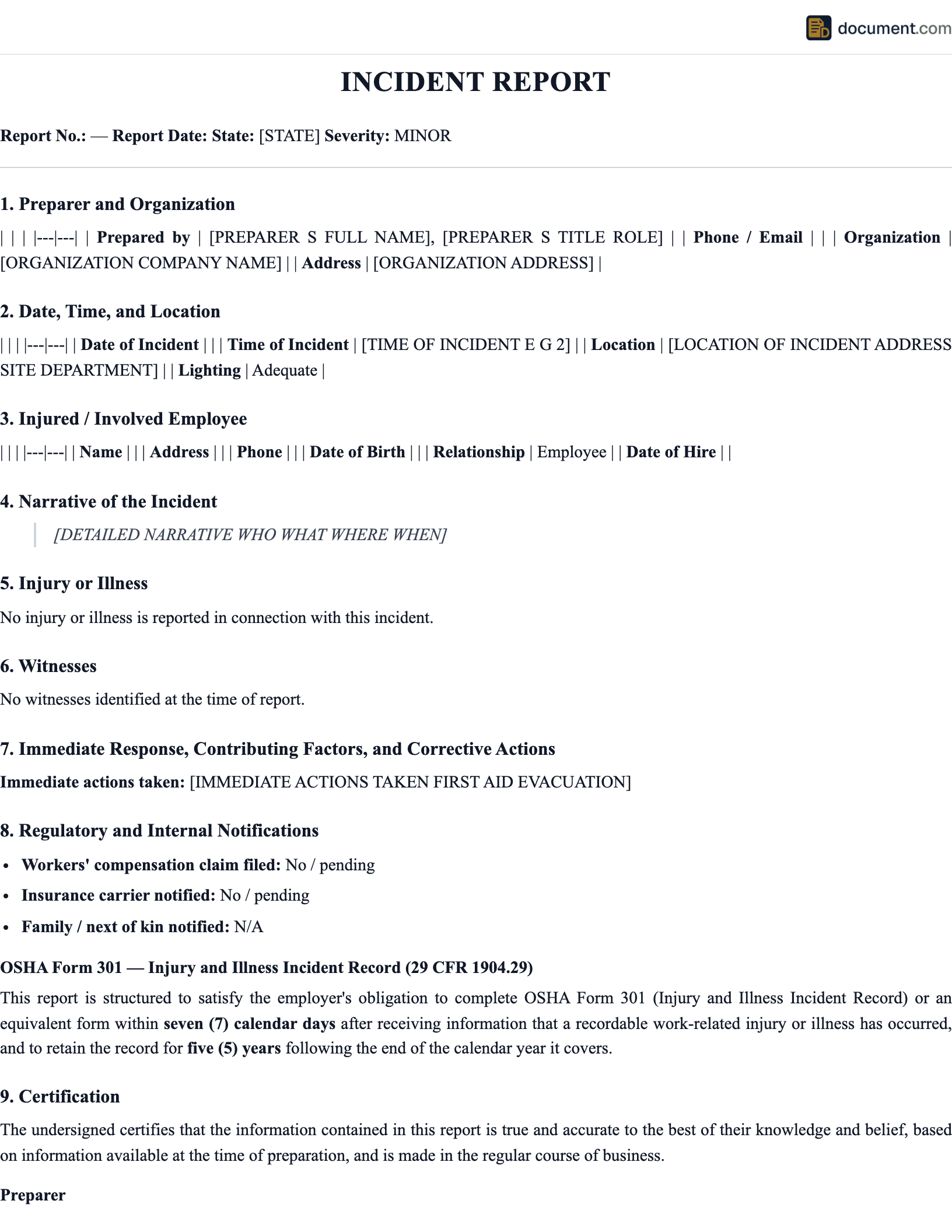
Construction Incident Report Form Preview
Below is a condensed preview showing the construction-specific sections of an incident report form. Your completed document will include additional fields based on the type of incident and your state's regulatory requirements.
CONSTRUCTION INCIDENT REPORT
Report #[Number]
1. PROJECT INFORMATION
Project: [Name] GC: [General Contractor] Sub: [Subcontractor]
2. INCIDENT DETAILS
Date: [Date] Time: [Time] Location: [Building / Floor / Area]
Trade: [Iron / Electrical / Concrete / etc.] Activity: [Task being performed]
3. SAFETY CONTROLS IN PLACE
Fall protection: [PFAS / Guardrails / Nets / None] Competent person: [Name]
4. OSHA STANDARD REFERENCE
Applicable standard: [29 CFR 1926.___]
5. CORRECTIVE ACTIONS
Immediate: [Actions taken] Follow-up: [Recommendations]
Key Components of a Construction Incident Report
Construction incident reports require industry-specific fields that go well beyond a standard workplace incident form. These components ensure the report captures the regulatory, contractual, and safety management information unique to construction jobsites.
Project and Employer Identification
Project name, address, and number; owner, general contractor, and all subcontractors involved in the area where the incident occurred; contract numbers and scopes of work; site superintendent and project manager names; and the competent person designated for the relevant safety discipline (fall protection, excavation, scaffolding, cranes).
Trade and Activity Details
The specific construction trade (ironwork, electrical, concrete, roofing, demolition) and the exact task being performed at the time of the incident. Include the phase of construction (excavation, foundation, structural steel, enclosure, MEP rough-in, finish) because hazard profiles vary dramatically across phases.
Safety Controls and PPE
Document every safety control that was in place — and every control that should have been in place — at the time of the incident. This includes personal fall arrest systems (harness, lanyard, anchor), guardrails, safety nets, trench protective systems (sloping, shoring, shielding), scaffold guardrails and toeboards, hard hats, safety glasses, high-visibility vests, and hearing protection. Note inspection dates and the last competent-person review for each system.
OSHA Standard Cross-Reference
Identify the specific OSHA construction standard(s) that apply to the incident — for example, 1926.501 (fall protection requirements), 1926.652 (excavation protective systems), 1926.451 (scaffold general requirements), or 1926.1153 (respirable crystalline silica). This cross-reference helps the employer assess citation exposure and prioritize corrective actions.
Environmental and Site Conditions
Weather conditions (temperature, wind speed, precipitation, visibility), ground conditions (wet, muddy, frozen, uneven), proximity to excavations, overhead power lines, or traffic, and any temporary conditions such as recent concrete pours, crane operations, or material deliveries that affected the work area.
Multi-Employer Responsibility Chain
Identify the creating employer, exposing employer, correcting employer, and controlling employer for the hazard involved. Document the contractual safety obligations of each employer and whether the GC conducted jobsite safety inspections covering the area and activity where the incident occurred.
How to Write a Construction Incident Report
Construction incident reports require specialized knowledge and prompt action. The following steps ensure a thorough report that satisfies OSHA requirements, supports workers' compensation claims, and enables effective corrective action across the multi-employer jobsite.
Secure the area and provide emergency care
Stop work in the affected area, call 911 if needed, and render first aid. Barricade the incident zone to prevent additional exposures. If a fatality or serious injury occurred, do not disturb the scene — OSHA may conduct an inspection and will want to see the conditions as they were at the time of the incident.
Notify the general contractor and site safety officer
Most GC contracts require verbal notification within one hour and a written report within 24 hours. The GC must determine whether the incident triggers OSHA's 8-hour (fatality) or 24-hour (hospitalization, amputation, eye loss) reporting obligations and make the report if so.
Document the scene before anything changes
Photograph the incident location, equipment, fall protection systems, excavation conditions, scaffolding configuration, and any physical evidence. Note weather, lighting, ground conditions, and the positions of workers and equipment. Preserve failed components (broken lanyards, snapped scaffold couplers) as evidence.
Collect trade-specific and witness information
Interview the injured worker, witnesses, the competent person for the relevant discipline, and the subcontractor foreman. Document the trade, task, training records, safety meeting attendance, and toolbox talk topics for the day. Obtain separate written witness statements.
Complete the construction incident report form
Fill in all sections including project identification, employer chain, incident narrative, safety controls, OSHA standard cross-reference, injury assessment, and corrective actions. Reference specific OSHA standards (e.g., 1926.501(b)(1) for unprotected edges) and document the gap between the required safeguard and what was in place.
Initiate corrective actions and distribute the report
Implement immediate corrective measures (install missing guardrails, shore the trench, repair the scaffold). Assign long-term corrective actions with responsible parties and deadlines. Distribute the report to the GC, subcontractor safety director, workers' compensation carrier, and project owner as required by contract.
Frequently Asked Questions
Common questions about construction incident reporting, OSHA construction standards, multi-employer responsibilities, and trade-specific documentation requirements.
Official Resources
Federal and industry resources for construction safety, OSHA construction standards, and jobsite incident reporting.
OSHA - Construction Industry
Federal construction safety standards, guidance, and compliance assistance
OSHA - Fall Protection in Construction
Standards, fact sheets, and training resources for fall prevention
OSHA - Trenching and Excavation Safety
Protective system requirements, soil classification, and competent person guidance
OSHA - Scaffolding Safety
Standards for supported, suspended, and mobile scaffolds in construction
CPWR - Center for Construction Research and Training
Construction safety research, hazard alerts, and training materials
OSHA - Severe Injury Reporting
Report fatalities, hospitalizations, amputations, and eye losses online
Create your Construction Incident Report in under 10 minutes.
Answer a few questions and download a compliant, attorney-drafted document ready for your state.