
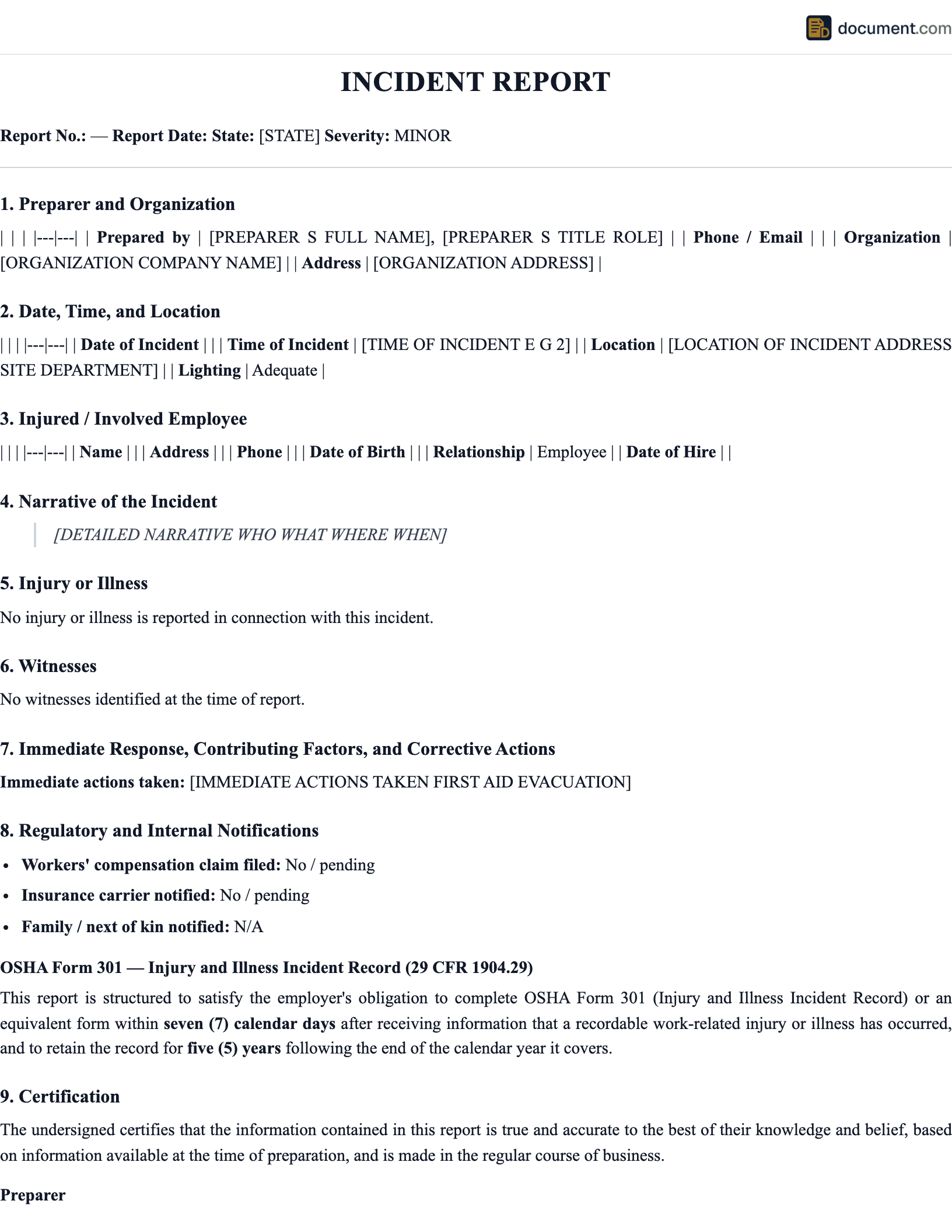



What Is a Police Incident Report?
A police incident report is an official law enforcement document that creates a contemporaneous record of an event reported to or observed by police. It captures the essential facts of the incident — the nature of the event, when and where it occurred, who was involved, what was observed, what evidence was collected, and what actions officers took in response. The report is the foundational document in the criminal justice system: it initiates investigations, supports arrest warrants and search warrants, provides the factual basis for prosecutorial charging decisions, and serves as a key exhibit in court proceedings.
Police incident reports serve dual functions that can be in tension. As an internal law enforcement document, the report guides investigation and case management — detectives rely on the initial report to identify leads, witnesses, and evidence. As a public record, the report is subject to Freedom of Information Act (FOIA) requests and state public records laws, making it accessible to crime victims, insurance companies, attorneys, journalists, and the general public (subject to exemptions for active investigations, juvenile records, and victim privacy). This dual nature means that officers must write reports that are both operationally useful for investigators and legally defensible when scrutinized in court or through public records requests.
The structure and content of police incident reports are governed by a combination of department policy, state reporting mandates, and national standards. The FBI's Uniform Crime Reporting (UCR) program and its successor, the National Incident-Based Reporting System (NIBRS), establish standardized offense classifications that departments must use when coding incidents for federal crime statistics. State criminal codes dictate the elements of offenses that must be documented to support charges. And department general orders specify the format, approval chain, and retention schedule for incident reports. The quality of the initial incident report directly affects every downstream process — from investigation to prosecution to public accountability.
Evidentiary Foundation
Creates the factual record that supports warrants, charges, and court proceedings
Chain of Custody
Documents evidence collection, handling, and storage from scene to courtroom
Public Accountability
Subject to FOIA and state public records laws for transparency and oversight
Police Incident Report Form Preview
Below is a condensed preview showing how the key sections of a police incident report are structured. Actual police report formats vary by department, but the core elements are consistent across jurisdictions.
POLICE INCIDENT REPORT
Case #[Number]
1. INCIDENT INFORMATION
Date: [Date] Time: [Time] Location: [Address / Cross Streets]
Offense: [UCR/NIBRS Code] Classification: [Felony / Misdemeanor / Infraction]
2. INVOLVED PARTIES
Victim: [Name / DOB / Contact] Suspect: [Name or Description]
3. OFFICER NARRATIVE
[Chronological account of officer observations and actions]
4. WITNESS STATEMENTS
Witness 1: [Name / Contact] Statement: [Summary or attached written statement]
5. EVIDENCE COLLECTED
Item: [Description] Location found: [Where] Disposition: [Evidence room / Lab]
Key Components of a Police Incident Report
A complete police incident report must contain sufficient detail to support criminal prosecution, civil litigation, insurance claims, and public records requests. These are the essential elements that every police report should document.
Incident Classification & Coding
The offense type classified according to the applicable criminal statute, UCR/NIBRS coding for federal crime statistics, and the department's internal classification system. Accurate coding determines how the incident is tracked statistically, which investigative unit is assigned, and what reporting obligations are triggered (e.g., hate crimes, domestic violence, sex offenses).
Officer Narrative
A detailed, chronological, first-person account of the officer's observations, actions, and findings from arrival at the scene through completion of the investigation. The narrative should document what the officer saw, heard, smelled, and did — using specific sensory observations rather than conclusions. This is the core of the report and the section most heavily scrutinized in court.
Victim & Suspect Information
Complete identifying information for victims, suspects, and other involved parties: name, date of birth, physical description, address, phone number, relationship to other parties, and any identifying marks or characteristics. For unknown suspects, a detailed physical description and any available identifiers (vehicle description, direction of flight, clothing) are documented.
Witness Documentation
Names, contact information, and statements from all witnesses. Each witness should be interviewed separately. The report should document the witness's vantage point, proximity to the event, environmental conditions affecting observation, and any relationship to involved parties. Written or recorded witness statements should be referenced and preserved as attachments.
Evidence Documentation & Chain of Custody
A complete inventory of all physical evidence collected, photographed, or processed at the scene. Each item must be described, its location noted, the collecting officer identified, and the chain of custody initiated — recording every transfer of possession from scene to evidence room to lab to court. Digital evidence (surveillance footage, phone records, electronic data) follows the same chain of custody requirements.
Case Disposition & Follow-Up
The current status of the case (open, closed, inactive, referred for prosecution, unfounded), any arrests made, charges filed, court dates scheduled, and recommended follow-up actions. The disposition section is updated as the case progresses through supplemental reports, and the final disposition is reported to NIBRS for national crime statistics.
How to File a Police Incident Report
Whether you are a citizen reporting a crime or an officer documenting an event, the process of creating an accurate and complete police incident report follows a structured sequence designed to preserve facts and protect the integrity of any subsequent investigation.
Contact law enforcement and secure the scene
Call 911 for emergencies or the non-emergency line for incidents that do not require immediate response. For in-progress crimes, officer safety and scene security take priority. Once the scene is secure, the reporting process begins with the responding officer establishing the basic facts — who called, what happened, and whether there are injuries requiring medical attention.
Provide a detailed account of the incident
Give the officer a thorough, factual account of what happened in chronological order. Include specific details: times, descriptions of people and vehicles, direction of travel, words spoken, and any identifying information. If you have physical evidence, photographs, or surveillance footage, inform the officer immediately. Do not speculate about motives or events you did not personally observe.
Identify and document all witnesses
Provide the officer with names and contact information for anyone who witnessed the event. If witnesses are present at the scene, the officer will interview them separately. If witnesses have left, provide as much identifying information as possible so they can be contacted for follow-up statements.
Preserve and surrender evidence
Do not disturb the scene or handle evidence. If you have already moved items, tell the officer their original position. Surrender any physical evidence to the officer for proper collection and chain of custody documentation. Provide access to surveillance systems, electronic records, or other documentary evidence. The officer will issue property receipts for seized items.
Review the report for accuracy
Before the officer leaves, ask for the case number and the officer's name and badge number. When the written report is available (typically within a few days), request a copy and review it for factual accuracy. If you identify errors — wrong dates, misspelled names, incorrect descriptions — contact the records division to request a correction through the department's amendment process.
Follow up as the investigation progresses
Stay in contact with the assigned investigator or detective. Provide any additional information you discover after filing the initial report. If you are a crime victim, ask about victim services, restitution, and your rights under your state's crime victims' rights statutes. Request supplemental reports as they are added to your case file.
Frequently Asked Questions
Common questions about police incident reports, public records access, chain of custody, witness statements, insurance claims, and the FOIA request process.
Official Resources
Federal and professional resources for police incident reporting, crime statistics, public records access, and law enforcement documentation standards.
FBI - NIBRS Crime Reporting
National Incident-Based Reporting System standards and offense classifications
DOJ - Freedom of Information Act
Federal FOIA statute, exemptions, and guidance for requesting government records
BJA - Law Enforcement Policy
Bureau of Justice Assistance resources for law enforcement agencies
IACP - International Association of Chiefs of Police
Professional standards, model policies, and best practices for law enforcement
NIJ - Forensic Evidence Resources
National Institute of Justice guidance on evidence collection and chain of custody
NCJRS - Criminal Justice Reference Service
Research library for criminal justice policy, law enforcement, and victim services
Create your Police Incident Report in under 10 minutes.
Answer a few questions and download a compliant, attorney-drafted document ready for your state.