



What Is a School Incident Report?
A school incident report is a formal document created by school administrators, teachers, counselors, or other staff to record an event that affects the safety, security, or welfare of students, staff, or visitors on school property or during school-sponsored activities. These reports cover a broad spectrum of events — from playground injuries and classroom disruptions to bullying, fights, weapons violations, sexual harassment, suspected child abuse, and campus security threats. The report serves as both an operational tool (triggering investigation, disciplinary action, and parent notification) and a legal record (documenting what the school knew, when it knew it, and how it responded).
School incident reporting operates at the intersection of several overlapping legal frameworks that make it uniquely complex. The Family Educational Rights and Privacy Act (FERPA) governs the privacy of student education records, including incident reports. Title IX of the Education Amendments of 1972 imposes specific response obligations when an incident involves sexual harassment or sexual violence. The Individuals with Disabilities Education Act (IDEA) requires particular documentation when behavioral incidents involve students with disabilities and Individualized Education Programs (IEPs). State mandatory reporting statutes require school employees to report suspected child abuse and neglect to child protective services. And state anti-bullying laws — now enacted in all 50 states — impose specific investigation, documentation, and notification requirements.
The quality of school incident documentation directly affects the school's legal exposure, its ability to maintain a safe learning environment, and its relationships with families and the community. Schools that document incidents thoroughly and consistently can demonstrate that they took reasonable steps to protect students — a critical defense in negligence litigation. Schools that fail to document — or that document inconsistently — face the inference that they were indifferent to known hazards, which is the standard for liability under Title IX and Section 1983 civil rights claims.
Student Safety
Document events that affect student welfare and trigger protective interventions
FERPA Compliance
Protect student privacy while meeting documentation and disclosure obligations
Title IX & Civil Rights
Meet investigation and response obligations for harassment and discrimination
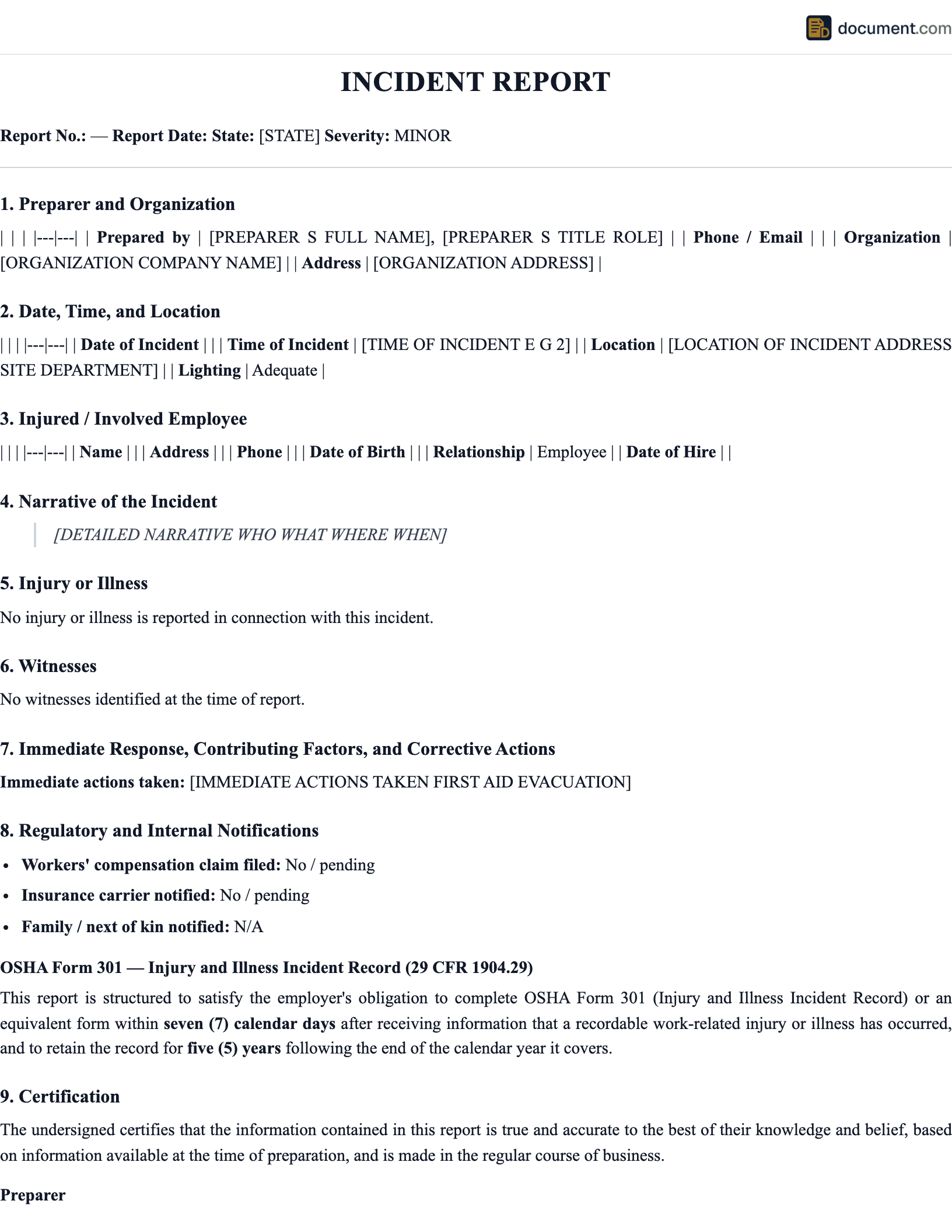
School Incident Report Form Preview
Below is a condensed preview showing how the key sections of a school incident report are structured. Your final document will be customized for your state's education code, district policies, and the specific type of incident.
SCHOOL INCIDENT REPORT
Report #[Number]
1. INCIDENT INFORMATION
Date: [Date] Time: [Time] Location: [Classroom / Hallway / Playground / Bus]
2. STUDENTS INVOLVED
Student: [Name / Grade / ID] Role: [Target / Perpetrator / Witness / Bystander]
3. INCIDENT TYPE
Category: [Bullying / Fight / Injury / Harassment / Vandalism / Other]
4. DESCRIPTION OF INCIDENT
[Factual chronological narrative of what occurred]
5. ACTION TAKEN & NOTIFICATIONS
Action: [Disciplinary / Medical / Counseling] Parent notified: [Date / Time / By Whom]
Key Components of a School Incident Report
A complete school incident report must satisfy educational accountability requirements, student privacy laws, mandatory reporting obligations, and the school's duty of care. These are the essential elements that every school incident form should capture.
Student Identification & Enrollment Data
Names, student ID numbers, grade levels, and classroom assignments for all students involved. Note each student's role: target, perpetrator, witness, or bystander. For students with IEPs or 504 Plans, flag the special education status because behavioral incidents may trigger manifestation determination requirements under IDEA. All student information is protected under FERPA.
Incident Classification
Categorize the event using your state's education code categories and federal reporting classifications: bullying (physical, verbal, social, cyber), harassment (racial, sexual, disability-based), fighting, assault, weapons violation, substance violation, vandalism, trespassing, elopement, medical emergency, or other. Accurate classification determines which legal frameworks apply and what response obligations are triggered.
Factual Narrative
A chronological description of the incident written in objective, factual language. Include the supervising adult's observations, student statements (attributed and in their own words where possible), the sequence of events, and the physical environment. Avoid conclusions, opinions about intent, or diagnostic language (do not characterize a student's behavior as symptomatic of a condition unless quoting a qualified professional).
Witness Documentation
Names and statements from adult witnesses (teachers, aides, bus drivers, coaches) and student witnesses. For student witnesses, consider age-appropriate interview techniques and document the interview setting and who was present. Student witness statements are education records of the witness student and are subject to FERPA protections — they cannot be shared with the parents of other involved students without consent.
Response Actions & Disciplinary Measures
Document the immediate response (separating students, first aid, calling 911), the investigation conducted, the disciplinary action imposed (verbal warning, detention, suspension, expulsion referral, restorative justice conference), safety measures implemented (schedule changes, supervision plans, no-contact agreements), and support services offered (counseling, conflict resolution, behavior intervention plan).
Notification Log
A detailed record of who was notified and when: parents/guardians of all involved students, the school principal, district administration, school resource officer, child protective services (if mandatory reporting is triggered), law enforcement (if criminal activity is suspected), Title IX Coordinator (if sexual harassment is alleged), and the student's IEP team (if the student has an IEP). Document the method of notification (phone, email, in person) and the substance of what was communicated.
How to File a School Incident Report
School incident reports must balance thoroughness with urgency — student safety and regulatory deadlines demand prompt action, while the legal significance of the report demands careful, accurate documentation. Follow these steps to create a defensible record.
Ensure immediate student safety
Separate involved students, provide first aid or call emergency services as needed, and secure the area. If the incident involves a weapon, active threat, or serious injury, follow the school's emergency operations plan and contact law enforcement immediately. Student safety is the absolute first priority — documentation follows.
Assess mandatory reporting and notification triggers
Determine whether the incident triggers mandatory reporting to child protective services (suspected abuse or neglect), law enforcement (criminal activity), the Title IX Coordinator (sexual harassment), or district administration (weapons, drugs, serious injury). These notifications have statutory deadlines that begin running immediately — do not wait for the written report to be completed before making required notifications.
Gather facts from witnesses and involved parties
Interview witnesses and involved students separately, using age-appropriate techniques for younger children. Record each person's account in their own words. Document the setting of each interview and who was present. Collect any physical or digital evidence (screenshots of cyberbullying, damaged property, surveillance footage). Preserve evidence in its original form.
Complete the incident report form
Document all required fields: student identification, incident classification, factual narrative, witness information, response actions, and notifications. Write in objective, factual language — avoid opinions, intent attributions, and diagnostic labels. If a field does not apply, write N/A. File the report within the timeframe specified by district policy (typically within 24 hours).
Notify parents and guardians
Contact the parents or guardians of all involved students in accordance with state law and district policy. Document the date, time, method, and substance of each notification. Be specific about what information was shared and what the parent's response was. Remember that FERPA prevents you from sharing the disciplinary records or identity of other students — you can inform a parent that their child was involved in an incident, but you cannot identify the other students.
Implement follow-up measures and monitor
Based on the investigation findings, implement appropriate follow-up: safety plans for targets, behavior intervention plans for perpetrators, schedule adjustments, increased supervision, counseling referrals, and restorative justice conferences. Document each follow-up action in the incident file. Schedule check-ins with involved students to verify that the situation has been resolved and that no retaliation has occurred.
Frequently Asked Questions
Common questions about school incident reporting, FERPA privacy rules, Title IX obligations, mandatory reporting, bullying documentation, and parent notification requirements.
Official Resources
Federal agencies and educational organizations providing guidance on school safety, student privacy, bullying prevention, and incident reporting compliance.
ED - Student Privacy Policy Office
FERPA guidance, FAQs, and technical assistance for schools and districts
ED OCR - Title IX Resources
Title IX regulations, guidance documents, and complaint procedures
StopBullying.gov
Federal anti-bullying resources, state law database, and prevention strategies
Child Welfare - Mandatory Reporters
State-by-state mandatory reporting laws and guidance for school personnel
REMS TA Center - School Emergency Management
Emergency operations planning, threat assessment, and crisis response resources
ED - IDEA (Special Education)
Disciplinary procedures, manifestation determination, and behavioral intervention guidance
Create your School Incident Report in under 10 minutes.
Answer a few questions and download a compliant, attorney-drafted document ready for your state.