
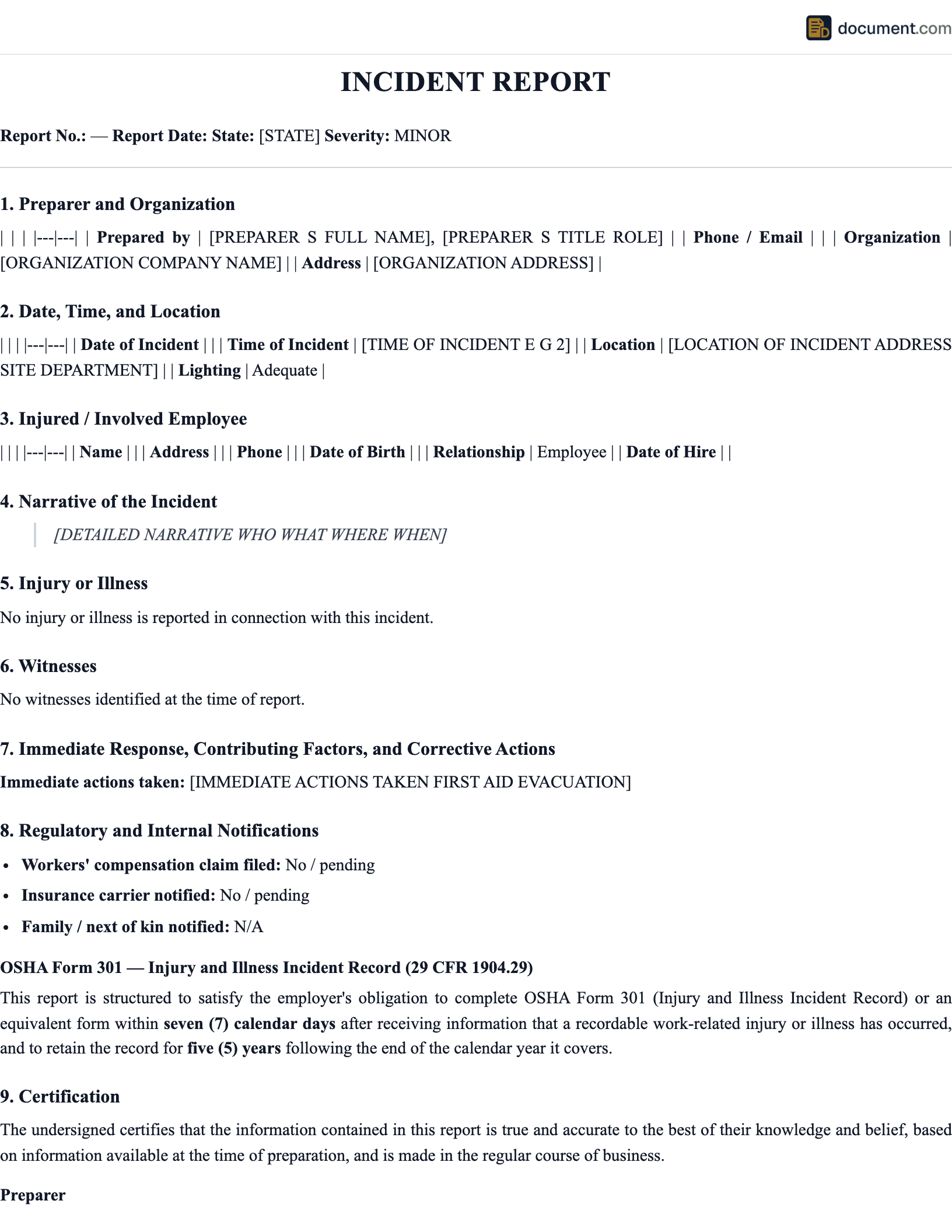



What Is a Patient Incident Report?
A patient incident report is a structured document used in healthcare settings to record any event that resulted in, or could have resulted in, harm to a patient during the delivery of medical care. These reports capture medication errors, surgical complications, patient falls, healthcare-associated infections, diagnostic errors, equipment malfunctions, and any other deviation from the expected standard of care. The report serves as both a contemporaneous factual record and the starting point for quality improvement analysis aimed at preventing recurrence.
Patient incident reporting operates within a complex regulatory ecosystem. The Joint Commission requires accredited hospitals to define sentinel events, conduct root cause analyses, and submit corrective action plans. CMS Conditions of Participation mandate Quality Assessment and Performance Improvement (QAPI) programs that depend on incident data. Every state operates its own mandatory adverse event reporting system with defined reportable event categories — often modeled on the National Quality Forum's list of Serious Reportable Events (commonly called "never events"). The federal Patient Safety and Quality Improvement Act (PSQIA) created Patient Safety Organizations (PSOs) that provide legal protections for voluntarily reported patient safety data.
What distinguishes a patient incident report from a workplace incident report is its clinical orientation. The report must account for the patient's medical condition, the treatment being administered, the clinical decision-making process, the care team involved, and the patient outcome — while also navigating HIPAA privacy requirements, medical malpractice liability considerations, and the legal privilege that may attach to quality improvement documents. Effective patient incident reporting balances the need for thorough documentation with the practical reality that overburdened clinical staff will only file reports if the process is fast, accessible, and non-punitive.
Patient Safety
Identify system failures that put patients at risk and drive corrective action
Regulatory Compliance
Meet Joint Commission, CMS, and state mandatory reporting requirements
Legal Protection
Create privileged quality improvement records with PSQIA and peer review protections
Patient Incident Report Form Preview
Below is a condensed preview of how the key sections of a patient incident report are structured. Your final document will be customized for your facility type, state reporting requirements, and accreditation standards.
PATIENT INCIDENT REPORT
Report #[Number]
1. INCIDENT DETAILS
Date: [Date] Time: [Time] Unit/Floor: [Location]
2. PATIENT INFORMATION
MRN: [Medical Record #] DOB: [Date] Diagnosis: [Primary Dx]
3. EVENT CLASSIFICATION
Type: [Medication / Fall / Procedure / Infection / Other] Severity: [No Harm / Mild / Moderate / Severe / Death]
4. DESCRIPTION OF EVENT
[Factual chronological narrative of what occurred]
5. PATIENT OUTCOME & RESPONSE
Outcome: [Patient condition after event] Physician notified: [Name / Time]
6. FOLLOW-UP ACTIONS
Immediate: [Actions taken] Family notified: [Yes/No / Time]
Key Components of a Patient Incident Report
A thorough patient incident report must satisfy clinical documentation standards, regulatory reporting requirements, and quality improvement analysis needs. These are the essential elements that every healthcare incident form should capture.
Patient Identification & Clinical Context
Medical record number, date of birth, admitting diagnosis, relevant comorbidities, current medications, code status, and the care team responsible for the patient at the time of the event. This clinical context is essential for understanding whether the incident was related to the patient's condition or represented a system failure.
Event Classification & Severity
Categorization of the event type (medication error, fall, procedure complication, healthcare-associated infection, diagnostic error, equipment failure, patient identification error) and harm severity using a standardized scale such as the NCC MERP Index for medication errors or the AHRQ Common Formats harm scale. Accurate classification drives appropriate investigation depth and regulatory reporting.
Factual Event Narrative
A chronological account of what happened, including the care activity underway, the sequence of events, when the error or adverse event was discovered, what the patient's condition was before and after, and what immediate clinical interventions were performed. The narrative should be objective and factual — free of blame, speculation, or legal conclusions.
Notification & Disclosure Documentation
Record of who was notified and when: the attending physician, nursing supervisor, risk management, patient's family or healthcare proxy, and any external entities (state health department, Joint Commission, law enforcement if applicable). Many states have mandatory disclosure laws requiring healthcare providers to inform patients of adverse events, and the incident report should document compliance with these obligations.
Contributing Factors & System Analysis
Identification of the conditions and system factors that contributed to the event: staffing levels, communication breakdowns (handoff failures, unclear orders), equipment issues, environmental factors (lighting, noise, distractions), training gaps, and process design flaws. This section feeds directly into root cause analysis and is the most important part of the report for preventing recurrence.
Corrective Action & Follow-Up Plan
Specific actions taken or recommended to prevent recurrence: system redesign, protocol changes, technology implementation (barcode medication verification, CPOE alerts), staffing adjustments, or education. Each action should have an assigned owner, a completion date, and a measure for evaluating effectiveness. The Joint Commission expects corrective actions to be "strong" (system-level changes) rather than "weak" (individual retraining alone).
How to File a Patient Incident Report
Filing a patient incident report promptly and thoroughly is both a professional obligation and a patient safety imperative. Follow these steps to create a report that supports quality improvement, satisfies regulatory requirements, and withstands legal scrutiny.
Stabilize the patient and provide immediate clinical care
Patient safety comes first. Ensure the patient receives any necessary medical intervention before beginning documentation. Notify the attending physician immediately if they are not already aware of the event. Document the clinical response in the patient's medical record separately from the incident report.
Notify risk management and chain of command
Alert the charge nurse, nursing supervisor, and risk management department according to your facility's escalation protocol. For sentinel events, notify administration immediately. Time-sensitive regulatory reporting obligations may begin running from the moment the facility becomes aware of the event.
Complete the incident report form promptly
File the report as soon as practicable — ideally before the end of your shift. Record the event classification, a factual narrative of what happened, the patient's condition before and after, who was involved, who was notified, and what immediate actions were taken. Use objective language and avoid opinions about fault or causation.
Document the patient and family notification
Record whether and when the patient (or their healthcare proxy) and family were informed of the event. Many states have mandatory disclosure laws requiring providers to inform patients of adverse events. Document the disclosure conversation, including who was present, what information was shared, and the patient's or family's response.
Identify contributing factors for quality review
Note the system-level factors that may have contributed to the event: staffing ratios, handoff communication, equipment status, environmental conditions, and process design. This section drives the subsequent root cause analysis and corrective action planning — without it, the report has limited quality improvement value.
Submit to the incident reporting system and external agencies as required
Enter the report into your facility's electronic event reporting system (RL Solutions, Quantros, Midas, or similar). Determine whether the event triggers mandatory reporting to the state health department, Joint Commission, or other regulatory bodies. Coordinate with risk management on timing and content of external reports.
Frequently Asked Questions
Common questions about patient incident reporting, Joint Commission requirements, CMS compliance, HIPAA considerations, and legal protections for quality improvement records.
Official Resources
Federal agencies, accreditation organizations, and patient safety resources for healthcare incident reporting and quality improvement.
Joint Commission - Sentinel Event Policy
Sentinel event definitions, reporting requirements, and root cause analysis expectations
CMS - Quality Improvement Organizations
Medicare quality oversight, QAPI requirements, and hospital Conditions of Participation
AHRQ - Patient Safety Organizations
PSQIA protections, listed PSOs, and Common Formats for event reporting
FDA MedWatch - Adverse Event Reporting
Report serious adverse events, product problems, and medication errors to the FDA
ISMP - Medication Error Reporting
Voluntary medication error reporting program and safety recommendations
NQF - Serious Reportable Events
National Quality Forum's list of "never events" in healthcare
Create your Patient Incident Report in under 10 minutes.
Answer a few questions and download a compliant, attorney-drafted document ready for your state.