



What Is a Security Deposit Demand Letter?
A security deposit demand letter is a formal written notice from a former tenant to a landlord demanding the return of all or part of a security deposit that the landlord has wrongfully withheld. It invokes the specific provisions of the state's landlord-tenant statute that govern security deposits, itemizes the amount owed, and warns the landlord of the statutory penalties — often two or three times the wrongfully withheld amount, plus attorney's fees — that will apply if the dispute proceeds to small claims court.
Security deposit disputes are the most common landlord-tenant dispute in America, and they are the area where state law most strongly favors tenants. Every state has a detailed statute governing how deposits must be held, when they must be returned, what deductions are permitted, and what documentation the landlord must provide. These statutes are strictly construed against landlords — missing a deadline by a day or failing to itemize a single deduction can forfeit the landlord's entire right to withhold money. A well-drafted demand letter weaponizes this statutory strictness.
The combination of short statutory deadlines, mandatory itemization, treble damages, and fee-shifting makes the security deposit demand letter unusually effective. Most landlords, faced with a letter that correctly cites the state statute and the penalty exposure, will return the disputed amount rather than litigate in small claims.
Recover Your Deposit
Demand the full deposit plus interest required by some state statutes
Cite State Statute
Quote the exact section of your state's landlord-tenant law
Invoke Penalties
Warn of 2x or 3x statutory damages and attorney's fees exposure
State Landlord-Tenant Law Framework
Unlike many legal areas, security deposits are governed entirely by state law. There is no federal landlord-tenant statute. Each state has its own deposit statute, and these statutes vary dramatically in their specific requirements — return deadlines, maximum deposit amounts, interest requirements, itemization rules, and penalty provisions. A strong demand letter cites your state's exact statutory section and quotes the relevant language.
Uniform Residential Landlord and Tenant Act (URLTA)
The URLTA, drafted by the Uniform Law Commission, provides a model framework for residential landlord-tenant statutes. It has been adopted in whole or in part by roughly 21 states including Alaska, Arizona, Florida, Hawaii, Iowa, Kansas, Kentucky, Mississippi, Montana, Nebraska, New Mexico, Oregon, Rhode Island, South Carolina, Tennessee, Virginia, and Washington. The URLTA establishes default deposit return deadlines, itemization requirements, and penalty provisions. Even in states that have not adopted URLTA, it influences judicial interpretation.
Common Statutory Requirements
- Maximum Deposit: Many states cap deposits at 1 to 2 months' rent. California caps unfurnished at 2 months, furnished at 3 (reduced to 1 month in 2024 under AB 12). New York caps at 1 month for regulated units.
- Separate Account: Several states (Massachusetts, New Jersey, New York, Connecticut) require landlords to hold deposits in a separate interest-bearing account and provide the account information to the tenant.
- Interest: Some states require landlords to pay interest to tenants on deposits held more than a year. Rates and methodologies vary.
- Move-In Checklist: Many states require the landlord to provide a written statement of the unit's condition at move-in, which becomes the baseline for any damage deductions.
- Return Deadline: 14 to 60 days after the tenant vacates, depending on state. Strict compliance is required.
- Itemized Statement: Written itemization of every deduction with specific amounts and justifications.
- Receipts: Some states require receipts or invoices for repair deductions above a threshold (California: $125).
Types of Security Deposit Disputes
Full Deposit Not Returned
Landlord failed to return any of the security deposit within the statutory deadline
Partial Deposit Withheld
Landlord returned only a portion and withheld the rest without proper itemization
Improper Deductions
Deductions for normal wear and tear, pre-existing damage, or unauthorized charges
No Itemized Statement
Landlord failed to provide a written itemized statement of deductions
Missed Statutory Deadline
Landlord did not return the deposit or statement within the state-required timeframe
Pre-Move-Out Deposit Dispute
Dispute over deposit handling before the lease ends or during a walkthrough
Statutory Return Deadlines (Sample States)
The most important date in any deposit dispute is the statutory return deadline. If the landlord missed this deadline — even by a single day — the landlord has typically forfeited the right to withhold any portion of the deposit, regardless of legitimate damages. Here are representative deadlines from major jurisdictions. Check your state's specific statute for the exact rule.
| State | Deadline | Statute |
|---|---|---|
| California | 21 days | Civ. Code § 1950.5 |
| New York | 14 days | Gen. Oblig. Law § 7-108 |
| Texas | 30 days | Prop. Code § 92.103 |
| Florida | 15/30 days | § 83.49 |
| Illinois | 30 days | 765 ILCS 710/1 |
| Massachusetts | 30 days | M.G.L. c. 186 § 15B |
| New Jersey | 30 days | N.J.S.A. 46:8-21.1 |
| Washington | 21 days | RCW 59.18.280 |
| Pennsylvania | 30 days | 68 Pa. Stat. § 250.512 |
| Ohio | 30 days | ORC § 5321.16 |
How to Write and Send a Security Deposit Demand Letter
Confirm the Statutory Deadline Has Passed
Count the days from when you vacated and returned the keys. If the landlord's deadline has passed — even by one day — the landlord is in violation regardless of any legitimate damages. This is the strongest possible position.
Gather Your Documentation
Collect the lease, the move-in checklist, dated move-in and move-out photos, communications with the landlord, proof of your forwarding address notice, and any itemized statement the landlord did send. These become exhibits to the demand letter and to any small claims action.
Identify the Landlord's Legal Entity
Determine whether the landlord is an individual or a corporate entity (LLC, corporation, property management company). For corporate landlords, look up the registered agent on the Secretary of State website. Send the letter to the legal entity, not just the property manager.
Quote Your State's Statute
Find the exact section of your state's landlord-tenant act governing security deposits. Quote the relevant provisions on return deadlines, itemization, and penalties. Specific statutory citations signal that you know your rights and are serious about enforcement.
Itemize What You Are Owed
List the deposit amount, any statutorily required interest, and the statutory penalty you believe applies (2x or 3x the wrongfully withheld amount under your state's bad-faith provision). Explain your math.
Dispute Any Improper Deductions
If the landlord sent an itemized statement, go line by line: which deductions are for normal wear and tear (not permitted), which are pre-existing damage (documented in your move-in photos), which are excessive or undocumented, and which are for items the lease did not permit the landlord to charge.
Set a Deadline
Give the landlord 10 to 14 days to refund the full disputed amount. Warn that you will file in small claims court on the 15th day seeking the deposit plus statutory penalties and attorney's fees.
Send by Certified Mail and File if Ignored
USPS Certified Mail with Return Receipt Requested. If the deadline passes without resolution, file in small claims court. Bring your photos, the move-in checklist, the lease, the demand letter, and the certified mail receipt as exhibits. Judges reliably rule for tenants with clean documentation.
Key Components
Tenant and Landlord Information
Names, forwarding address, property address, and landlord legal entity
Tenancy Details
Lease dates, deposit amount, move-in date, and move-out date
Statutory Deadline Calculation
Exact date the landlord was required to return the deposit under state law
State Statute Citation
Exact section of the landlord-tenant act, quoted in relevant part
Dispute of Deductions
Line-by-line rebuttal of any improper or undocumented deductions
Amount Demanded
Deposit owed, statutory interest, and penalty exposure under bad-faith provision
Cure Deadline
Specific date, typically 10 to 14 days from the letter
Small Claims Threat
Notice of intent to file in small claims seeking full statutory remedies
Penalties and Treble Damages
The treble-damages feature of most state deposit statutes is what makes these cases economically attractive and creates real settlement leverage. A $1,500 deposit becomes a $4,500 claim once trebled, and attorney's fees easily add another $2,000 to $5,000. Faced with that exposure, landlords commonly settle for the disputed amount rather than litigate.
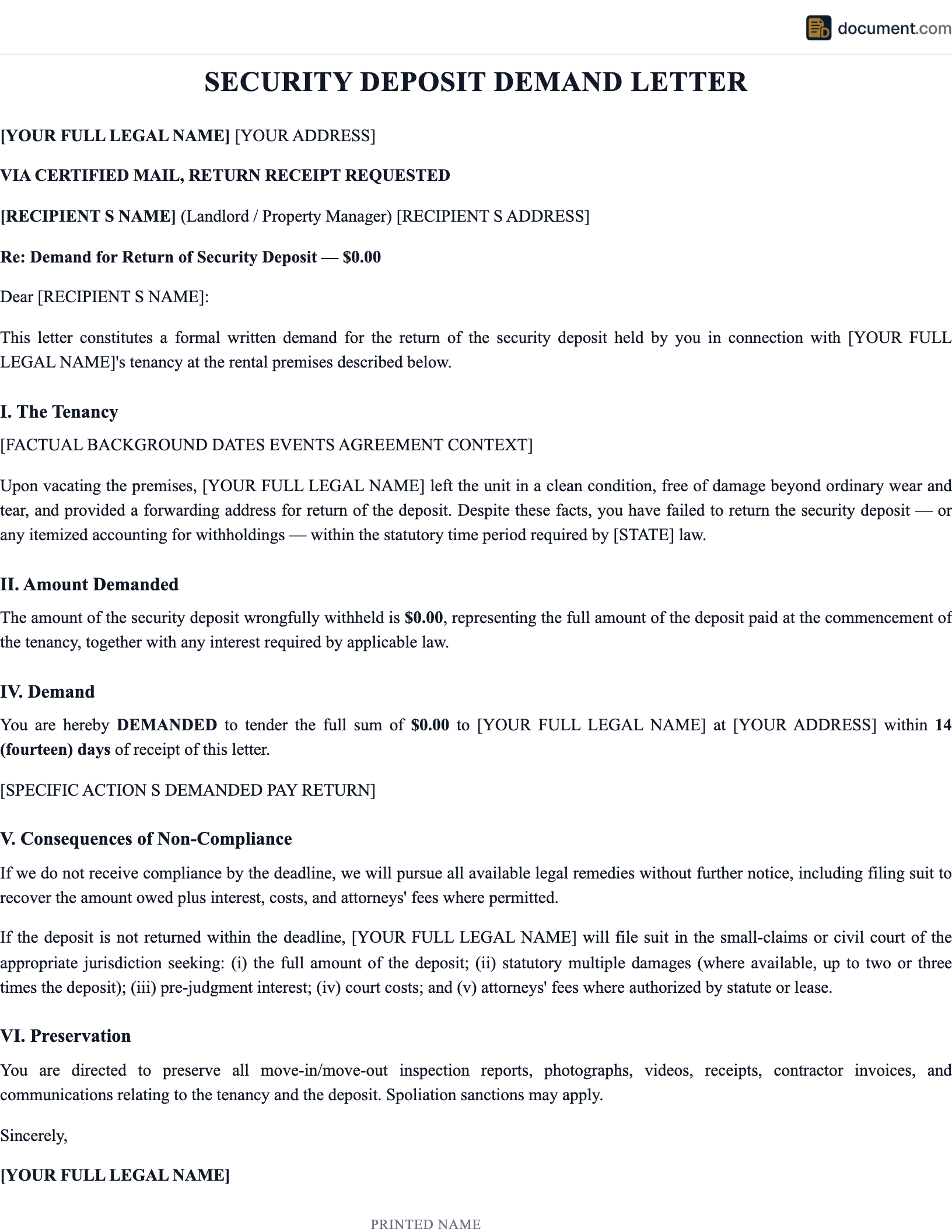
Sample Security Deposit Demand Letter
[Tenant Name]
[Forwarding Address]
[Date]
VIA CERTIFIED MAIL — RETURN RECEIPT REQUESTED
[Landlord / Property Management LLC]
[Registered Agent Address]
Re: Demand for Return of Security Deposit — [Rental Address] — Lease ended [Date]
Dear [Landlord]:
I am the former tenant of [Rental Address]. My lease ended and I vacated the premises on [Date], returning all keys and providing you with my forwarding address. I paid a security deposit of $[____] at the start of the tenancy on [Date].
Under [State] [Landlord-Tenant Act §___], you were required to return my security deposit, along with a written itemized statement of any deductions, within [__] days after I vacated — that is, by no later than [Statutory Deadline Date]. As of the date of this letter, you have [failed to return any portion of the deposit / returned only $[____] with no itemization / taken improper deductions as detailed below].
AMOUNT DEMANDED:
Deposit owed: $[____]
Statutory interest (if applicable): $[____]
TOTAL: $[____]
Plus statutory penalty of [2x / 3x] under [State Statute §___] and attorney's fees if this matter proceeds to court.
Please remit the full amount of $[____] to me at the above address within [14] daysof the date of this letter — no later than [Cure Deadline]. If you fail to do so, I will file a small claims action in [County] seeking the full deposit, statutory penalties of [2x / 3x] the wrongfully withheld amount, prejudgment interest, attorney's fees, and costs of court.
All rights and remedies are expressly reserved.
Sincerely,
[Signature]
[Printed Name]
Frequently Asked Questions
Official Resources
HUD - Tenant Rights
U.S. Department of Housing and Urban Development tenant rights resources
CFPB - Housing Resources
Consumer Financial Protection Bureau housing and tenant guidance
ULC - URLTA
Uniform Law Commission Residential Landlord and Tenant Act
Nolo - Security Deposit by State
Free encyclopedia of state-by-state deposit rules
LawHelp - Legal Aid
Find free legal help for landlord-tenant issues in your state
National Housing Law Project
Tenant advocacy and legal resources
Create your Security Deposit Demand Letter in under 10 minutes.
Answer a few questions and download a compliant, attorney-drafted document ready for your state.