



What Is an Unpaid Wages Demand Letter?
An unpaid wages demand letter is a formal written notice from a worker (or former worker) to an employer demanding payment of wages that were earned but never paid. The letter identifies the legal basis for the claim — usually the federal Fair Labor Standards Act and one or more state wage statutes — calculates the amount owed, including overtime, liquidated damages, and applicable penalties, and gives the employer a specific deadline to pay before the worker escalates to a state labor agency, the U.S. Department of Labor, or court.
Wage theft is one of the largest categories of property crime in the United States. The Economic Policy Institute and academic researchers have estimated that workers lose more than $50 billion per year to unpaid wages — more than the total value of all robberies, burglaries, and motor vehicle thefts combined. Most of these losses are not recovered because workers do not know how to assert their rights, fear retaliation, or assume the cost of legal action will exceed the amount owed. A well-drafted demand letter changes that calculus by putting the employer on notice of the legal exposure and the likelihood of escalation.
A demand letter is most effective when it is specific. Vague complaints about being underpaid are easy to dismiss; detailed letters that cite the FLSA section, calculate the unpaid hours and rate of pay, add liquidated damages, identify the applicable state penalties, and warn of attorney's fees exposure routinely produce settlements within days. Many employers — especially smaller employers without in-house counsel — will pay the disputed amount rather than risk a Department of Labor investigation that could uncover broader violations across the workforce.
Our attorney-reviewed templates cover the most common wage claims: unpaid regular wages, unpaid overtime, minimum wage violations, off-the-clock work, employee misclassification as independent contractor, missed meal and rest breaks, and final paycheck violations. Each template is keyed to the controlling federal statute and the specific state's wage rules so the letter carries maximum legal weight.
Itemized Calculation
Hours, rate, overtime, and liquidated damages broken out line by line
FLSA Citation
Cites 29 U.S.C. sections 206, 207, and 216(b) plus state wage laws
Escalation Notice
Warns of state DOL and federal Wage and Hour Division complaint
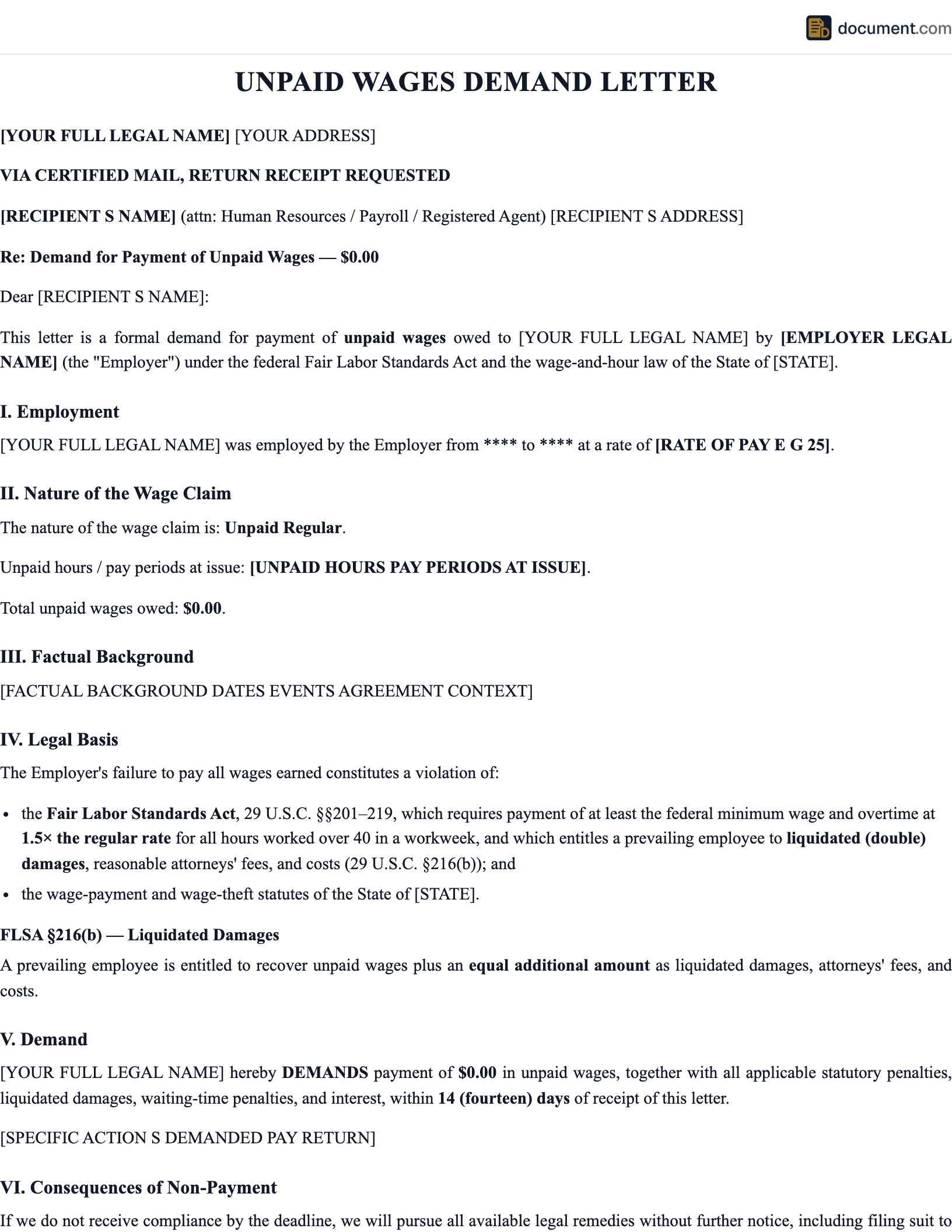
Letter Preview
The demand letter is delivered as a fillable PDF and an editable Microsoft Word document. It is formatted as a professional business letter with all of the legal citations and calculations a wage-and-hour attorney would include.
Included Sections
- Worker and employer identification
- Employment history summary
- Specific wage claim and time period
- Hour and pay rate calculation
- FLSA and state law citations
Also Included
- Liquidated damages calculation
- State penalty assessment
- Demand and payment deadline
- Anti-retaliation warning
- Escalation notice and signature
Common Wage Claims
The most common wage claims fall into a handful of categories. Each one is governed by both the federal FLSA and the wage law of the state where the work was performed.
Unpaid Regular Wages
Hours worked but never paid, including final paychecks withheld after termination
Unpaid Overtime
Hours over 40 in a workweek not paid at the FLSA-required 1.5x rate
Minimum Wage Violation
Pay below the federal, state, or local minimum wage for hours worked
Off-the-Clock Work
Pre-shift, post-shift, donning/doffing, or unpaid breaks treated as hours worked
Misclassification (1099)
Independent contractor classification used to avoid overtime and minimum wage
Final Paycheck Withheld
State final-pay deadlines violated after voluntary or involuntary termination
FLSA Federal Protections
The Fair Labor Standards Act of 1938, codified at 29 U.S.C. sections 201-219, is the federal statute that establishes minimum wage, overtime, recordkeeping, and youth employment standards. It covers most private and public sector workers in the United States and is enforced by the Wage and Hour Division of the U.S. Department of Labor.
Key provisions to cite in any unpaid wages demand letter include: section 6 (29 U.S.C. 206) setting the federal minimum wage at $7.25 per hour; section 7 (29 U.S.C. 207) requiring overtime at one and one-half times the regular rate for hours over 40 in a workweek; section 11(c) (29 U.S.C. 211(c)) requiring employers to maintain accurate records of hours worked; and section 16(b) (29 U.S.C. 216(b)) authorizing back wages, liquidated damages, attorney's fees, and costs in a private lawsuit. Section 15(a)(3) (29 U.S.C. 215(a)(3)) prohibits retaliation against workers who file or threaten to file a wage complaint.
The FLSA applies to enterprises engaged in interstate commerce with annual gross sales of at least $500,000, and to many employees individually engaged in interstate commerce regardless of the employer's size. In practice, the FLSA's coverage is so broad that most U.S. workers are covered. Where state law provides greater protection — for example, a higher minimum wage or daily overtime — the worker is entitled to the more generous standard.
Calculating What You Are Owed
An effective demand letter must include a clear, itemized calculation of the wages owed. Vague claims invite delay; specific numbers force a response.
Step 1 — Identify the regular rate
For hourly workers, the regular rate is your hourly wage plus any non-discretionary bonuses, shift differentials, and commissions earned in the workweek. For salaried non-exempt workers, divide the weekly salary by the number of hours the salary was intended to compensate.
Step 2 — Calculate unpaid straight-time hours
Multiply the unpaid hours by the regular rate. Include off-the-clock time and unpaid breaks if applicable.
Step 3 — Calculate unpaid overtime
Multiply hours over 40 in each workweek by 1.5 times the regular rate for that workweek. In California, Alaska, Nevada, and Colorado, also calculate daily overtime.
Step 4 — Add liquidated damages
Under FLSA section 16(b), add an amount equal to the unpaid wages as liquidated damages. In Massachusetts, Maryland, and DC, the multiplier is higher.
Step 5 — Add state penalties and interest
Add California waiting-time penalties, New York liquidated damages, missed-break premiums, pre-judgment interest, and any other state-specific remedies.
Liquidated Damages
Liquidated damages are an additional amount the employer must pay on top of the unpaid wages, designed to compensate the worker for the delay in receiving wages and to deter future violations. Under FLSA section 16(b), liquidated damages are awarded automatically in an amount equal to the back wages, unless the employer can prove it acted in good faith and had reasonable grounds to believe its conduct was lawful — a defense that courts apply narrowly.
Several states impose liquidated damages on top of the federal amount. New York's Labor Law section 198 awards 100% liquidated damages on most wage claims. Massachusetts G.L. c. 149 section 150 requires triple (3x) damages on prevailing wage claims. The District of Columbia awards quadruple (4x) damages for willful violations. These multipliers can transform a modest wage claim into a significant six-figure exposure for the employer, which is exactly why explicitly calculating them in the demand letter dramatically improves the chance of settlement.
Tip: Always show the doubled (or tripled) total in the demand. Employers who see only the back-wages number often try to negotiate down to a fraction of the underlying claim — but the realistic litigation exposure includes liquidated damages, attorney's fees, and state penalties on top.
How to Write the Letter
- 1
Gather your records
Collect pay stubs, time records, schedules, text messages, emails, and any documentation of hours worked and rates of pay.
- 2
Identify the legal basis
Decide whether your claim is for unpaid regular wages, overtime, minimum wage, off-the-clock, misclassification, or final paycheck violation.
- 3
Calculate the amount owed
Itemize back wages, overtime, liquidated damages, and any state penalties using the worksheet in our template.
- 4
Address the right party
Send to the employer's registered agent, HR director, owner, or general counsel. Include the legal entity name.
- 5
State the demand and deadline
Specify the total amount demanded and a payment deadline of 14 to 30 days from the date of the letter.
- 6
Warn of escalation
Identify the U.S. DOL or state labor agency you will file with and reference attorney's fees exposure.
- 7
Send by trackable mail
Send by certified mail, return receipt requested, and keep a copy for your records.
Key Components
Sender and recipient
Worker's name and address; employer's legal name, registered agent, and address.
Employment dates
Start date, end date, position, and rate of pay.
Description of claim
Specific wage violation, with dates and circumstances.
Itemized calculation
Hours, rates, regular and overtime wages, and totals.
Liquidated damages
FLSA double-damages and any state-law multipliers.
Legal citations
29 U.S.C. 206, 207, 216(b), and applicable state statutes.
Demand and deadline
Total amount demanded with a clear payment deadline.
Anti-retaliation notice
Reference to FLSA section 15(a)(3) and state anti-retaliation laws.
Escalation warning
Statement of intent to file with DOL or court if unpaid.
Signature and date
Worker's signature, date, and contact information.
Filing With State DOL or U.S. DOL
If the employer does not pay by the demand letter deadline, the next step is filing a formal wage claim with a labor agency. Workers can usually choose between the U.S. Department of Labor's Wage and Hour Division and the state labor agency in the state where the work was performed.
The U.S. DOL's Wage and Hour Division enforces federal wage law and accepts complaints at dol.gov/agencies/whd/contact/complaints. WHD investigations are confidential, free, and can cover multiple workers and multiple violations across the employer's workforce. State agencies — the California Labor Commissioner, the New York Department of Labor, the Texas Workforce Commission, and similar bodies in every state — enforce state wage laws and often offer faster individual claim processing for smaller amounts. Some states (notably California) hold a 'Berman hearing' that functions like a small administrative trial.
Workers can also file a private lawsuit in state or federal court without first going through an agency. For large claims or potential collective actions on behalf of similarly situated workers, hiring a wage-and-hour attorney is usually the best option, because the FLSA and most state laws shift the worker's attorney's fees to the employer if the worker prevails.
Sample Demand Letter
[YOUR NAME]
[YOUR ADDRESS]
[CITY, STATE, ZIP]
[DATE]
VIA CERTIFIED MAIL — RETURN RECEIPT REQUESTED
[EMPLOYER LEGAL NAME]
Attn: [HR Director / Owner / Registered Agent]
[EMPLOYER ADDRESS]
Re: Demand for Payment of Unpaid Wages
Dear [Recipient]:
I am writing to demand payment of wages owed to me by [EMPLOYER NAME] for work performed during the period from [START DATE] to [END DATE]. During this period, I was employed as a [POSITION] at an hourly rate of $[RATE] per hour.
Based on my records, I worked a total of [HOURS] hours that were not paid, including [OVERTIME HOURS] hours of overtime. Under the Fair Labor Standards Act (29 U.S.C. sections 206 and 207) and the [STATE] wage law, I am entitled to the following:
- Unpaid straight-time wages: $[AMOUNT]
- Unpaid overtime (1.5x regular rate): $[AMOUNT]
- Liquidated damages (FLSA section 16(b), equal to unpaid wages): $[AMOUNT]
- State law penalties: $[AMOUNT]
- Total demanded: $[TOTAL]
I demand payment of the total amount of $[TOTAL] within fourteen (14) days of the date of this letter. Payment should be sent to the address above by certified check or wire transfer.
If full payment is not received by [DEADLINE DATE], I will file a wage claim with the U.S. Department of Labor's Wage and Hour Division and the [STATE] [labor agency], and I reserve the right to file a private lawsuit seeking back wages, liquidated damages, attorney's fees, and costs as authorized by 29 U.S.C. section 216(b) and applicable state law.
Please be advised that any retaliation against me for asserting these rights is prohibited by section 15(a)(3) of the FLSA and applicable state law and will result in additional claims.
Sincerely,
_______________________________
[Your name] / date
Frequently Asked Questions
Official Resources
Ready to demand the wages you are owed?
Generate a customized, attorney-reviewed unpaid wages demand letter in minutes.
Create Document